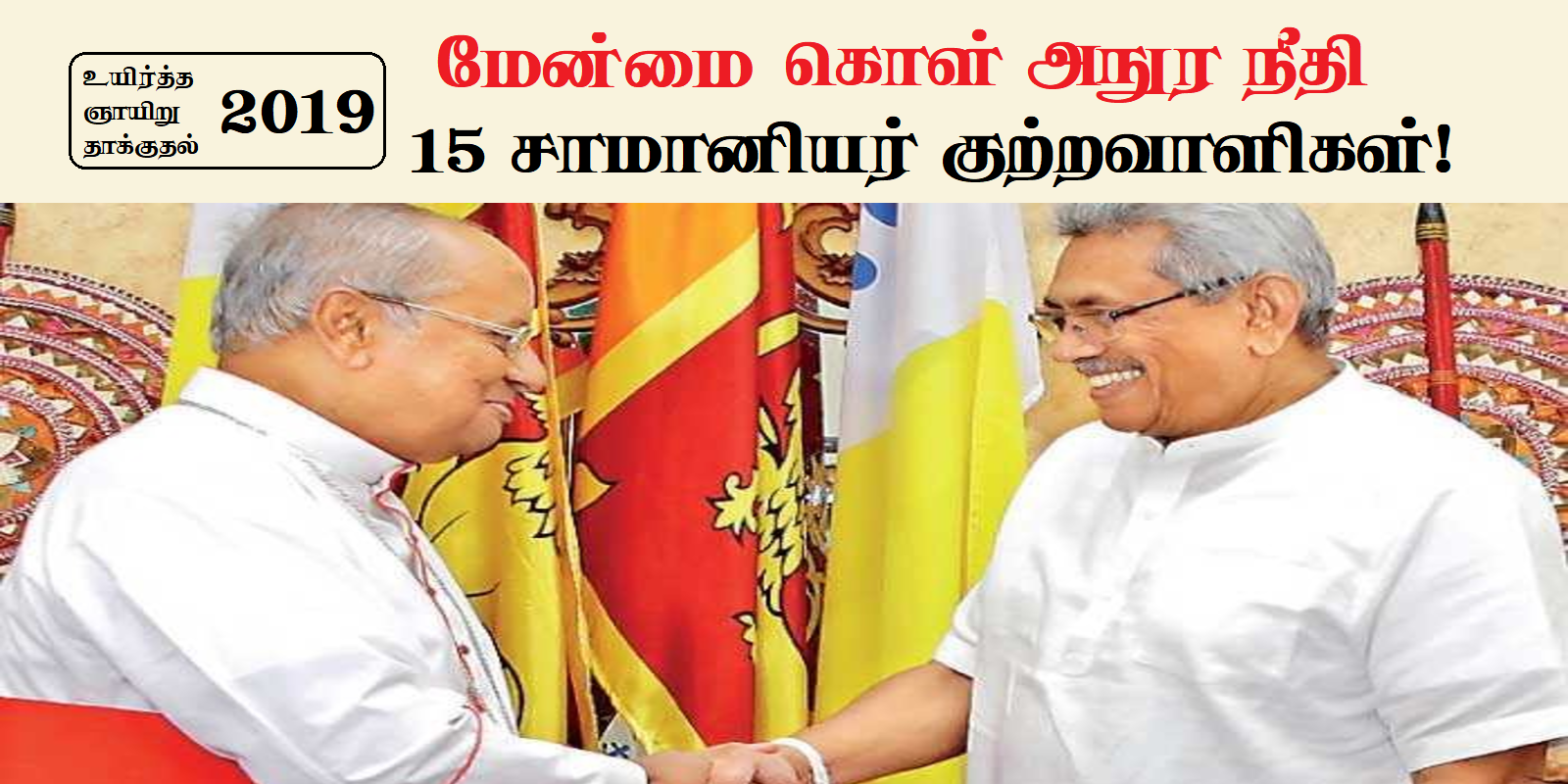
Chemmani report sparks protest by northern MPs
- Resistance to organised Crimes Bill gathers pace
- HRCSL, BASL, civic rights groups say proposed law affront to human rights, call for withdrawal or revision
- UNP accuses govt of failing to accord due courtesy to Thailand’s deputy premier during private visit; Vijitha contests claim
- Protesting monks stay put, defy court order to vacate Viharamahadevi Park; Govt mulls further action
By our ST Political Desk 25-10-26
At a time when the Inspector General of Police (IGP) Priyantha Weerasooriya is facing possible contempt of court action for failing to comply with a court order to issue a circular prohibiting the filing of cases based on trumped-up charges against members of the public, the government is planning to enact two new laws which could impinge on the fundamental rights of the people and infringe on individual rights.
If the case involving the IGP’s contempt matter is anything to go by, it’s a reflection of how often Sri Lanka’s law enforcement authorities have been found wanting in carrying out their duties diligently. This case involves a resident of Makandana against whom the Gampaha Anti-Corruption Unit of the Police had filed drug possession charges which were later found to be baseless. The court dismissing the case ordered three police officers and the Police Department to pay the man Rs 200,000 in compensation and for the IGP to issue a nationwide circular instructing officers not to institute frivolous cases against innocent people. However, it was the Deputy Inspector General of Police in charge of the Western Province North who issued the guidelines applicable only to the Gampaha, Kelaniya and Negombo police divisions. This led to the magistrate directing that contempt of court charges be initiated against the IGP.
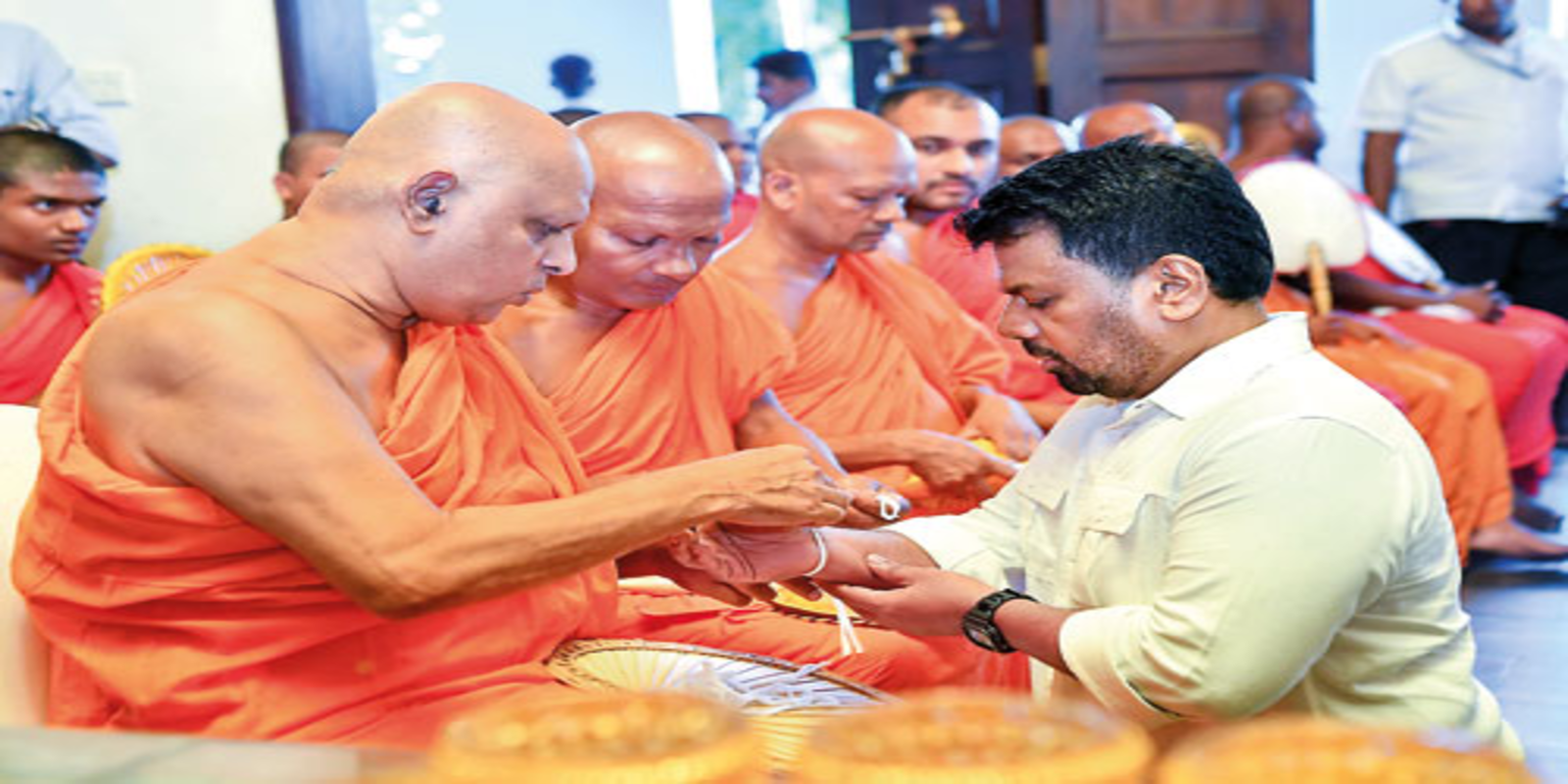
The Most Venerable Eethalawetunuwewe Gnanathilaka Thera, Acting Chief Prelate of the Atamasthana and Chief Incumbent of the Ruwanwelisaya, ties a pirith thread on the wrist of President Anura Kumara Dissanayake when he visited the Sacred City.
A senior government source, however, hinted that the contempt matter involving the IGP is likely to be resolved without it proceeding any further while asking the question if a directive can be given to issue a circular effective island-wide.
It is while the IGP himself is facing such a charge that the government is on the way to enact two bills, namely the Protection of the State from Terrorism Act (PSTA) and the Prevention of Organised Crime (POC) Bill, both of which have drawn criticism, with calls to substantially amend them. While the PSTA will replace the Prevention of Terrorism Act (PTA), the newly mooted POC Bill should raise an alarm bells, – that, if enacted, it will become a tool in the hands of law enforcement authorities in a way that the individual freedoms of people will be seriously compromised.
The Human Rights Commission of Sri Lanka (HRCSL), the Bar Association of Sri Lanka (BASL) and many other civic rights activists have raised concerns, particularly against the POC Bill. Calling for its withdrawal, they argue that the bill is incompatible with the country’s constitution and international human rights treaties.
The HRCSL wrote to Justice and National Integration Minister Harshana Nanayakkara this week expressing serious concerns regarding the POC Bill, published in the Gazette on October 6, 2026, recommending that the Bill be withdrawn and substantially revised to ensure full compliance with constitutional safeguards and international human rights standards. Copies of the letter were also forwarded to President Anura Kumara Dissanayake in his capacity as Minister of Defence.
The Commission acknowledged that the activities of organised crime groups can have a serious impact on human rights, including the rights of women and children as well as the rights of victims and witnesses of crimes and in this context welcomes legislation that seeks to combat organised crime, provided that such legislation fully complies with the fundamental rights chapter of the Sri Lankan Constitution and international human rights treaties to which Sri Lanka is a party.
“The bill introduces a radical new legal regime for issuing detention orders against suspects of ‘serious crimes’ and makes confessions to police officers admissible as evidence. Based on its initial review of the bill, the Commission is of the opinion that the bill is potentially more draconian than the Prevention of Terrorism Act, No. 48 of 1979 (PTA),” the HRCSL said.
Former presidents Ranil Wickremesinghe and Maithripala Sirisena and Sarvana Jana Balaya leader Dilith Jayaweera join visiting Thai Deputy Prime Minister Suphajee Suthumpun at a religious ceremony in Mihintale
In a statement, the BASL noted that there was no public consultation in the preparation of the bill, and the BASL in particular was neither consulted nor informed of the drafting of such a law and warned that the new bill envisages a parallel regularity regime.
The bill defines a ‘organised criminal group’ to mean a structured group of three or more persons acting in concert to obtain a financial or other material benefit, and the group need not have formal roles, continuity of membership or a developed structure. BASL said that these provisions would appear to be far broader than anything required to combat organised crime.
One area that the BASL has highlighted illustrating the breadth of the POC bill is its treatment of intellectual-property offences. Copyright infringement is already fully addressed under the Intellectual Property Act, No. 36 of 2003, yet under the POC bill, even a minor copyright infringement is classified as a “serious crime” and may be prosecuted as organised crime.
“For example, consider an amateur band of five performing popular songs in a restaurant without permission from the songwriter or label owner. On a literal reading of the bill, the band is a structured group of three or more persons acting in concert for a financial benefit, and the unlicensed performance is a copyright offence listed in the First Schedule. Its members may be arrested and detained under a Detention Order issued by the Secretary for up to one year, and their instruments and equipment may be seized and subjected to forfeiture. Few would regard such a band as an organised criminal group, yet nothing in the bill prevents that result, BASL said.
The bill seems to be drafted on the lines of the Organised Crime Act 2015 of Singapore, particularly sections on how one is identified as a member of a criminal gang. According to the bill, in determining whether any person is or acts as a member of an organised criminal group, the matters which would be considered include whether that person adopts the style of dress, hand signs, language or tattoos used by known members of the organised criminal group. This section in particular has drawn widespread criticism. While Minister Nanayakkara assured Parliament this week that no one would be arrested for their hairstyles, tattoos or clothing, the concerns remain given that many laws are abused by the police, and this would add one more to their arsenal of laws which may open more doors to frame or harass the public.
Row over Thai Deputy PM’s visit
While things are warming up on the domestic front for the government, there was a diplomatic hiccup of sorts this week over the visit of the Thai Deputy Prime Minister and Commerce Minister Suphajee Suthumpun. She was in Sri Lanka in a private capacity to participate in the enshrinement ceremony at the Mihintale temple along with the Buddhist devotees.
Her presence snowballed into a diplomatic faux pas after the United National Party (UNP) criticised the government over its failure to provide diplomatic courtesies and security to Ms Suthumpun, stating it was customary for foreign leaders visiting Sri Lanka, whether on official or private visits, to receive appropriate diplomatic courtesies and security arrangements.
UNP leader and former president Ranil Wickremesinghe and former president Maithripala Sirisena were among those attending the religious ceremonies at Mihintale, but there was no state representation at the ceremony, even at an official level. The government boycott of the event probably had to do with its frequent run-ins with the chief incumbent of the Mihintale Ancient Temple, Ven. Walawahengunawewe Dhammaratana Thera, who is a vocal critic of the government. He had approached a senior officer in the Ministry of Public Security through an intermediary to obtain additional security for the visiting Thai dignitary only to be denied the request. This in turn led to the absence of any government politicians or any officials at the ceremony with the Deputy Prime Minister of Thailand. The office of former President Wickremesinghe said that his security detail had been directed to ensure that the Thai leader received the necessary security.
The UNP, in its statement, said it was customary for foreign leaders visiting Sri Lanka, whether on official or private visits, to receive appropriate diplomatic courtesies and security arrangements. Citing a previous example, the party said special security had been provided by the government of the time when former British Prime Minister David Cameron visited Sri Lanka on a private trip, despite no longer holding office.
Sarvajana Balaya MP Dilith Jayaweera, who attended the Mihintale ceremony, also raised the issue in Parliament, noting that the Foreign Ministry hides behind cold, bureaucratic excuses, claiming she arrived in her ‘private capacity’ and was provided only ‘what was requested’. He called it an evasion of duty, adding that a sitting Deputy Prime Minister of a vital regional ally is never just a private citizen. “She brought a sacred crest-gem to our soil as a cultural ambassador. To deny her standard state protocol and secure dignity is a direct insult to the Thai state. It carelessly damages centuries of sacred Theravada Buddhist ties,” he said.
The Ministry of Foreign Affairs (MFA) refuted the allegations and said that there were no other officials in her delegation, as the visit is exclusively to attend an event on a private basis. “The Thai Embassy has requested the VIP lounge and courtesies which had been granted by the Sri Lankan side as per their request,” the statement said, adding that Ms Suthumpun had undertaken similar visits to Sri Lanka previously to attend religious activities in a private capacity.
Foreign Affairs Minister Vijitha Herath also hit back at the criticism of the government by accusing the opposition of unscrupulously attempting to damage the goodwill between the countries through false propaganda.
“Efforts to undermine the historical, religious and diplomatic friendship that has existed between Sri Lanka and Thailand for many years for political gain are unacceptable. The controversy surrounding the visit of Thailand’s Deputy Prime Minister and Minister of Commerce, Ms Suphajee Suthampun, to attend a religious ceremony in Mihintale should not be viewed from a narrow political angle but based on accurate facts and the long-standing relationship between the two countries,” his media section said.
Monks continue Satyagraha
Meanwhile, the ‘Satyagraha’ that a group of Buddhist monks have launched demanding the release of imprisoned Bodu Bala Sena (BBS) General Secretary Venerable Galagoda Aththe Gnanasara Thera continued for a ninth day yesterday (24) near the vicinity of the Buddha statue at Colombo’s Viharamahadevi Park. The monks continued their Satyagraha despite a court order obtained by the Cinnamon Gardens Police from the Colombo Chief Magistrate’s Court prohibiting them from occupying the area.
The original court order was issued on Thursday and there were angry scenes at the site of the Satyagraha on Thursday evening as police attempted to serve the court order on the monks. Amid the pouring rain, police used a loudspeaker to read out the court’s order to those at the site and then moved in to serve the order on them, resulting in a heated exchange of words between the two sides. The protesters chanted pirith and refused to accept the court order that the police tried to hand over to them. On Friday, a group of monks who were part of the protest filed a motion through their lawyers at the Colombo Chief Magistrate’s Court requesting the court to either withdraw or amend its earlier order. Colombo Chief Magistrate Asanga S. Bodagarama, however, rejected the request. The Magistrate also rejected a request by police to issue arrest warrants against several individuals accused of violating the court order by remaining at the location despite the court order. The Magistrate observed that the police could take appropriate action instead, under provisions of the Code of Criminal Procedure.
There was a sense of defiance in the air at the park on Friday. Most of the monks who acted as the organisers of the Satyagraha, including Ven. Balangoda Kassapa Thera and Ven. Ulapane Sumagala Thera, were present at the Colombo Magistrate’s Court as their lawyers made submissions requesting the court to allow them to remain at the site. The monks who remained continued with their sit-in while a few other monks and several dozen lay-supporters were busy laying out to dry in the sun, items that had been drenched following the deluge experienced in Colombo the day before. Schoolchildren and teachers from outstation schools, who usually stop at the Viharamahadevi Park on their school trips to the city, were watching curiously, as were a group of clearly bored police officers who have been assigned to keep a constant watch at the site. The monks are holding their Satyagraha near the base of the park’s iconic Buddha statue, directly in front of the National People’s Power (NPP) controlled Colombo Municipal Council (CMC). The protesters have accused the CMC of trying their best to make life difficult for them, including by locking the public toilets situated inside the park.
“The police obtained a court order against us when we were protesting in front of the Presidential Secretariat. We chose to honour that court order and move our Satyagraha to Viharamahadevi Park. This is a public space and we have the right to peacefully protest at this location as this is still a democratic country,” said Ven. Thamalagamuwe Khemasumana Thera, who was acting as the spokesman for the protesting monks in the absence of their senior leaders. He insisted that contrary to what the police is saying, the monks are not acting in any manner that would disturb the peace. “We haven’t even encroached on the park’s jogging track. We have limited our protest to the area in front of the Buddha statue. The police wouldn’t even let us set up a hut initially and we have been much battered by the rain. They even confiscated the sound system whereby we were broadcasting pirith,” the Thera charged. Despite the various obstacles that the authorities were laying in their path, the monk insisted that the protest would continue. The protesters were even planning to hold a programme to observe sil at the protest site today (25) to mark Vap Full Moon Poya Day.
“What happens if we go somewhere else and the police ask for a court order to evict us from there too?” Ven. Khemasumana Thera asked. He said the authorities currently had only two options – “They have to either leave us in peace or arrest us. We are not going anywhere.”
As Saturday dawned however, the Satyagraha continued as usual. The protesting monks and their lawyers argue that the court order has not specifically prevented them from protesting since they were not acting in a manner that disturbed the peace.
A senior government source said yesterday that there might be “some movement” regarding the monk’s protest tomorrow (26) once police report further facts to court. The indication from the government side is that they see the continuing protest at Viharamahadevi Park as being an opposition sponsored project aimed at stirring up anti-government sentiment. They have pointed to various pronouncements made by some of the monks who are acting as organisers of the protest as evidence of this. These include demands calling on President Anura Kumara Dissanayake to resign and threats to organise another ‘Aragalaya’ to force him to leave office. They also point to the open support given by some opposition political parties to the Satyagraha and the presence of opposition politicians at the earlier march the monks undertook to Colombo, as well as their visits to the Satyagraha site.
Opposition political parties have indeed continued to support the struggle of the monks and their supporters have launched to secure the release of Ven. Gnanasara Thera, who is currently serving a sentence for contempt of court after the earlier presidential pardon granted to him by then President Maithripala Sirisena was recently nullified by the Supreme Court.
The on-going protest is clearly causing a headache to the NPP Government. While the number of protesters at the Viharamahadevi Satyagraha site are far fewer than those who marched to Colombo on October 16 after a week-long march dubbed ‘Nidahase Paada Yaathrawa’ (March for Freedom), the Satyagraha is being held in a very prominent location in the city. It is directly visible from the road opposite the CMC building and can be seen clearly by those who walk through the park. Government sources are also irked by the media coverage given to the continuing protest, with some accusing two leading private television channels of giving constant coverage to the protest and stationing news crews there on a 24-hour basis.
The Sri Lanka Podujana Peramuna (SLPP) has made no secret of its open support for the struggle to secure Ven. Gnanasara Thera’s release. “People have a right to protest democratically and we as a party, have decided to fully support their efforts,” SLPP General Secretary Sagara Kariyawasam said. He added that party representatives would also be working with monks in Buddhist temples at the village level to make people aware of the continuing ‘Anti-Buddhist’ actions of the NPP government.
The UNP, meanwhile, released a statement on Friday, accusing the NPP government of attempting to destroy Buddhism in the country. “That the Compass government has an intense desire to destroy Buddhism in this country is proven not merely by one or two instances. The government constantly attempts to attack Buddhism and the respected Maha Sangha at every available opportunity,” said the statement. It added that the UNP strongly condemns the government’s attempts and reiterated that the party will not allow the government to destroy the Buddha Sasana and the venerable monks.
Herein lies the predicament of the NPP government. Even before it came to power, its political opponents had accused the NPP of having an anti-Buddhist agenda. Two years into its rule, the more fanciful claims such as an NPP government stopping the conduct of Buddhist Peraheras have failed to materialise. Nevertheless, accusations that the government was deliberately acting in a manner that disregards the constitutional provision giving Buddhism the ‘Foremost Place’ has continued. The government has also not helped matters in the case involving Ven. Gnanasara Thera, where prison authorities removed the monk’s robes and produced him in court twice in lay attire, leading to a firestorm of criticism, which snowballed into the protests that it is now having to deal with. It must also contend with the fact that some very prominent Buddhist monks have also called for Ven. Gnanasara Thera’s release. They include the Asgiriya Chapter Mahanayake, the Most Venerable Warakagoda Sri Gnanarathana Thera. The response from the government so far has been that the law must apply equally to all and that it cannot make exceptions for individuals. President Anura Kumara Dissanayake himself stressed this point during an NPP rally in Badulla last Sunday, without specifically mentioning the situation involving Ven. Gnanasara Thera by name. Whether the government can continue to withstand the pressure being brought on it on this matter is to be seen.
The government would be hoping that the new regulations under the Prisons Ordinance allowing monks to be produced in court in monk’s robes would eventually calm the situation somewhat. The regulations, which were drafted according to the recommendations of a five-member committee, have now been gazetted.
The newly amended regulations insert a new Standing Order 356A to the Standing Orders of Prisons. It notes, “Where a Buddhist monk is imprisoned, the Commissioner of Prisons shall consult the Department of Buddhist Affairs regarding the removal of the robes worn by such monk at the time of imprisonment and the Department of Buddhist Affairs shall inform the relevant Nikaya or Chapter of the same, and shall notify of the actions of the Nikaya or Chapter regarding the removal of such robes to the Commissioner of Prisons within ten days. Where no response regarding the actions to be taken is so informed, the Commissioner of Prisons may take necessary action in accordance with the relevant provisions.”
According to the newly gazetted regulations, where a Buddhist monk is taken out of prison in the capacity of a prisoner, such prisoner will be allowed to wear the robes worn by him at the time of imprisonment. Provided further, where the relevant Nikaya or Chapter to which such prisoner belongs has not permitted such prisoner to wear robes, the Commissioner of Prisons shall take necessary action in accordance with the relevant provisions.
The regulation will also apply to the imprisonment of any priest of any other religion.
Ven. Gnanasara Thera was to be produced in court on Thursday, where he was set to be once again attired in his monk’s robes, but the Ministry of Buddha Sasana, Religious and Cultural Affairs informed the Kotte Sri Kalyani Samagri Dharma Maha Sangha Sabha, to which the Thera belongs, that he would not be produced on that date.
Chemmani dispute
As the government grapples with protests by the Buddhist clergy in the South, in the North, there have been some strong reactions regarding recent developments into investigation concerning the Chemmani mass grave site. The fourth interim report submitted by Prof Raj Somadeva on the Chemmani mass grave site was raised in Parliament on Friday, where Tamil-speaking MPs challenged the authenticity of the report and called for an international probe.
Democratic Tamil National Alliance MP Selvam Adaikalanathan, representing Vanni district, suggested that those who were detained in the one-time military camp in Chemmani might be among those who were buried.
“It is a widespread fear among the locals that those who were displaced to Vanni from Jaffna at the height of war and tried to return from the Colombothurai coastal area were detained in the camp for questioning. Most of them were reported missing thereafter,” the MP said.
The MP pointed out that people in groups who tried to re-enter Jaffna peninsula via the lagoon were taken into military custody and in some instances detained over ten days. Locals suspect those who were detained for a longer period among those buried there as well.
Meanwhile, fellow MP Gajendrakumar Ponnambalam of All Ceylon Tamil Congress (ACTC) called for a press briefing at his residence ‘Gitanjali’ in Kollupitiya on Friday, where he alleged that the latest report is “an attempt to cover up the mass grave site”,
Questioning the validity of the report, the Jaffna district MP noted that compared to the previous three reports submitted by him to courts, the latest (fourth) one is totally opposite to the conclusions reached in previous reports.
“Earlier it was indicated that most of the bodies were buried without clothes. But the latest report says clothes are damaged due to natural and microbial activities in the soil. This is unacceptable,” the MP said.
The report also became a controversial topic in the North this week, where political parties and war-affected communities are on the move to stage protests in the coming weeks, challenging the report and calling for an international mechanism for the mass grave investigations.

ஒத்தவை:

சென்ற வாரம் இலங்கை-சண்டே ரைம்ஸ்