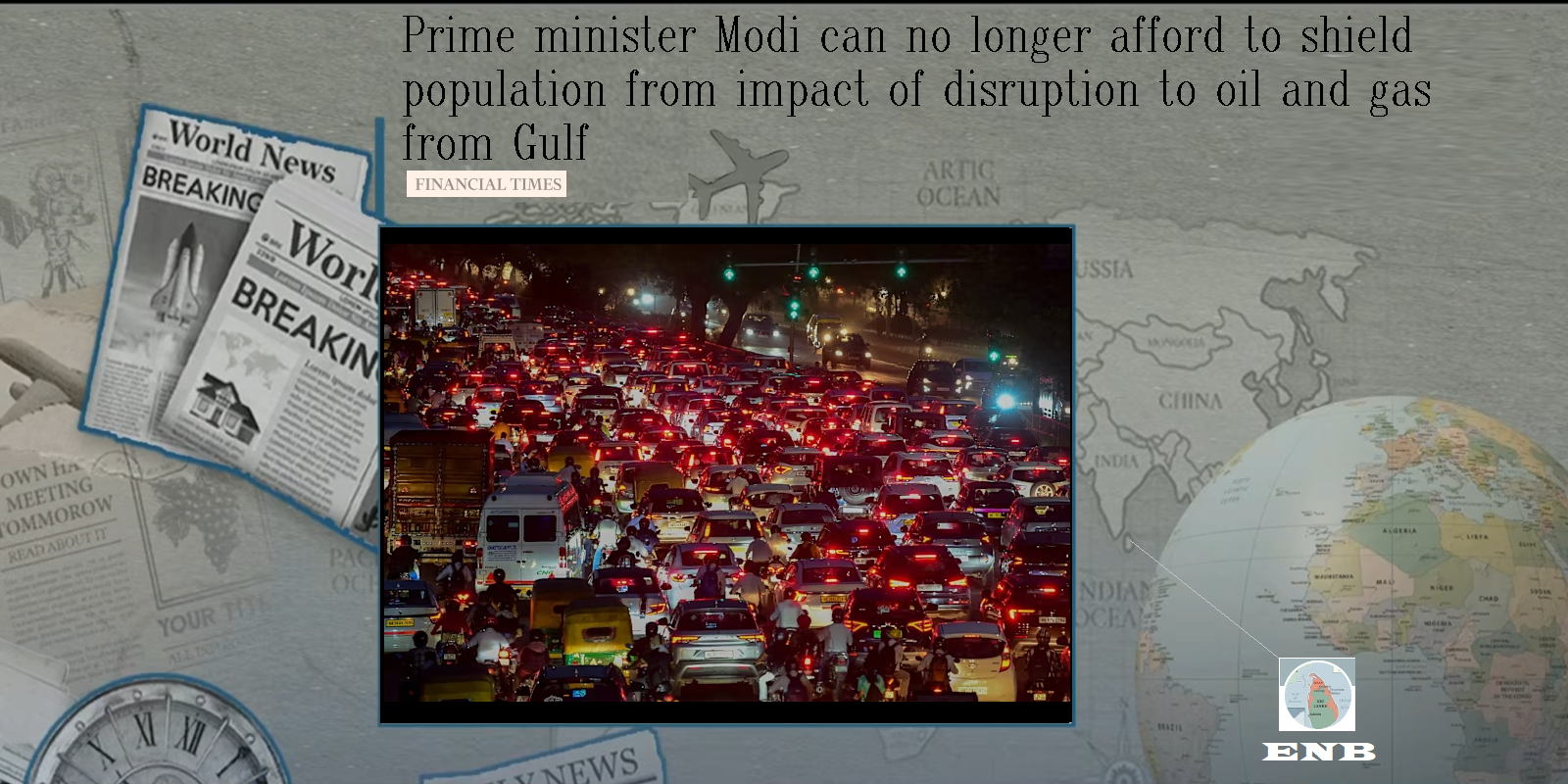
India is the world’s third-largest oil importer, with up to half of its prewar supplies of crude coming through the Strait of Hormuz. © Ritesh Shukla/Getty Images
Narendra Modi starts to let Indians feel the economic pain of Iran war
Prime minister can no longer afford to shield population from impact of disruption to oil and gas from Gulf © Anushree Fadnavis/Reuters
Michael Stott in New Delhi and Chris Kay in Mumbai
India’s state-owned fuel retailers have raised petrol and diesel prices twice in less than a week as Prime Minister Narendra Modi makes clear to the country’s 1.5bn people that he can no longer shield them fully from the economic fallout of the war in the Gulf.
The latest price rise on Tuesday came after the prime minister warned that the coronavirus pandemic, conflicts and the current energy crisis were creating a global “decade of disasters”.
Modi’s government has spent heavily to insulate citizens from the impact of the US-Israeli war on Iran by holding down fuel and fertiliser prices, finding alternative oil and gas suppliers and ordering domestic plants to produce cooking gas, an important staple.
But senior officials now recognise that with the conflict in the Gulf set to drag on, subsidies on this scale are no longer sustainable. The combined rise of less than 4 per cent to the retail prices of petrol and diesel was modest — but also symbolic. Until the first increase last week, fuel prices had been frozen for four years.
Now, citizens must prepare for an economic shock that could be comparable to the Covid-19 pandemic, said one top government figure who declined to be identified.
Modi sounded almost apocalyptic in a speech to Indian expatriates in the Netherlands at the weekend, warning that without prompt action to respond to a disastrous 10 years, “achievements of the past many decades would be washed away, and a huge section of the world’s population would be pushed back into poverty”.
Earlier this month the prime minister called on Indians to save fuel by working from home and using public transport, to suspend non-essential purchases of gold and to avoid travelling abroad for holidays and weddings.
It has been a marked change of tone from Modi’s speeches ahead of regional elections last month in which his Bharatiya Janata Party won a historic landslide in West Bengal. Before the votes, the prime minister was still reassuring Indians their nation was resilient and well prepared to face the challenges ahead.
Aastha Gudwani, India chief economist at Barclays, said Modi was “basically setting the stage for less happy times to come”.
“There is no doubt that as a net oil-importing country, we are in a troubled situation,” Gudwani said.

Rahul Gandhi, India’s main opposition leader, said on Tuesday that “a ferocious economic storm is looming over our heads” and accused the government of pursuing policies that benefited only the country’s wealthiest tycoons, Gautam Adani and Mukesh Ambani.
“In 12 years, what Modi-ji built as a structure — it was only for Adani and Ambani,” Gandhi said. “And now, that very structure is about to come crashing down. The blow won’t land on them — they have escape routes. The blow will land on you.”
India is the world’s third-largest oil importer, with up to half of its prewar supplies of crude coming through the Strait of Hormuz. New Delhi moved quickly to secure alternative supplies from Russia and other countries after Iran all but closed the waterway, but import volumes are still down.
As well as the fuel price rises, Modi’s government has increased tariffs on imported gold and silver, popular commodities in India. “These consumption curbs were probably the first round where consumers feel the pain,” Gudwani said. “If this prolongs, it will not be the only round of pain that consumers will bear.”
With Modi determined not to lose his reputation for careful budget management, economists believe more fuel price rises are inevitable now that the elections in five states and territories are out of the way and the BJP will not face voters again until next year.
Fertiliser subsidies for India’s vast agricultural sector are still seen as too politically sensitive to touch, even though a senior official admitted this week that their cost could rise by nearly a third to Rs2.41tn ($25bn) this year.
“In the initial period of the conflict, the government protected growth and inflation at the cost of fiscal balance,” said one economist, who asked not to be identified because of his bank’s policy of avoiding public comment.
“We are now reaching a point where you can’t do this anymore. The new measures will hurt growth and inflation, but they will aim to protect the current account and the fiscal side.”
Indian inflation has been relatively stable in recent months at below 4 per cent but any increase could prompt a rise in interest rates. Capital Economics analysts believe India is among the emerging markets most likely to tighten monetary policy in the coming weeks.
One of the government’s main concerns is the weakness of the rupee. One of Asia’s worst-performing currencies this year, it had already weakened before the US war on Iran as investors turned bearish on Indian shares.

The benchmark Nifty 50 stock index has fallen more than 9 per cent this year as foreign investors have pulled more than $23bn from Indian equities. India’s foreign currency reserves have declined by almost $20bn to $552bn since the start of the Gulf conflict.
Economists at Citi now believe India’s current account deficit will hit 2 per cent of GDP in the 2026-27 fiscal year, up from an earlier estimate of 1.4 per cent. They have also revised up their estimate of the balance of payments deficit to $50bn from $18bn, mainly because of the much higher cost of oil imports.
Banks have been trimming their estimates for Indian economic growth this year, although most still expect it to be above 6 per cent. That would be the highest of any major economy, but India needs 8 per cent or more growth to reach Modi’s aim of becoming a developed nation by 2047.
Senior officials have expressed frustration over the slow pace of private sector investment, saying the government’s ambitious infrastructure programme has fuelled most of the growth over the past six years.
Modi may now struggle to continue at the same pace his cherished but costly construction of motorways, airports and high-speed railways. Devendra Pant, chief economist at Fitch subsidiary India Ratings & Research, said the government might sacrifice spending on infrastructure in order to meet its fiscal deficit target.
“There could be a chance there is a hit to the capex,” Pant said.
Data visualisation by Haohsiang Ko in Hong Kong