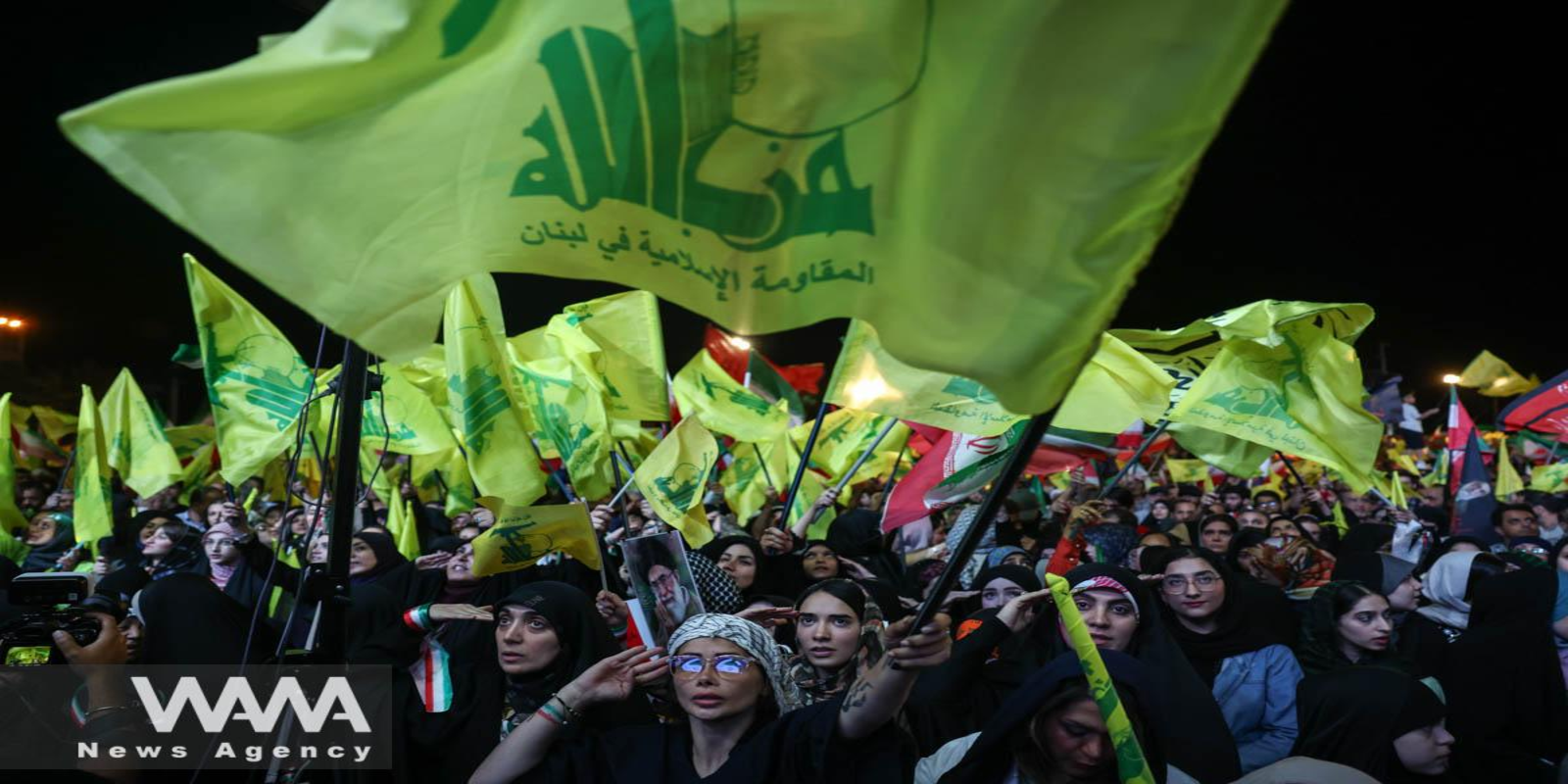
People hold Hezbollah flags during a rally in Tehran, Iran, June 1, 2026. Majid Asgaripour/WANA (West Asia News Agency)
A New Phase of the War: Armed Ceasefire
WANA News 03 June 2026
WANA (Jun 03) – Those who view the recent developments as merely a series of missile and drone exchanges between Iran and the United States are probably missing the bigger picture.
The reality is that the war that began against Iran on February 28, 2026, has never truly stopped. What was announced on April 8 as a ceasefire was not the end of the conflict; it marked the beginning of a new phase. In this phase, rather than conducting large-scale operations, the parties seek to gain greater leverage both on the battlefield and at the negotiating table through limited pressure, controlled strikes, and the testing of each other’s red lines.
This pattern has been evident repeatedly in recent weeks. On one hand, the United States and its allies have spoken about negotiations and extending the ceasefire; on the other, military pressure and attacks have not ceased.
From strikes on targets in southern Iran to actions against vessels and infrastructure linked to Iran in the Persian Gulf, the military dimension of the conflict has remained active. Tehran, for its part, has made it clear that it does not interpret the ceasefire as a suspension of its right to respond militarily.
It was within this context that Iran’s Foreign Ministry, responding to what it described as last night’s ceasefire violation, declared:
“The Islamic Republic of Iran, in exercising its inherent right to defend Iran’s territorial integrity and national sovereignty, will utilize all available capabilities to counter acts of aggression, including by targeting the origin and source of aggressive attacks.”
Perhaps this statement, more than any other explanation, captures the logic behind recent developments. From Tehran’s perspective, retaliation is no longer directed solely at the immediate perpetrator of an attack; any location involved in the planning, support, or execution of operations against Iran may be considered part of the response equation.
For this reason, the recent strike on Kuwait should not be viewed as an isolated event or merely a military operation. Kuwait was not targeted simply because it was an accessible objective. The issue is larger than that.
Iran is sending a strategic message to the entire region—a message that says responsibility does not rest solely with the actor carrying out an attack. Any location that contributes to operations against Iran can also be regarded as part of the battlefield.
For years, the Arab states of the Persian Gulf sought to maintain a balance between Iran and the United States. The war of 2026 has altered that equation. Tehran now appears determined to establish that the use of regional territory, bases, airspace, or infrastructure for operations against Iran will carry consequences. From this perspective, Kuwait is not the primary target; Kuwait is the message.
But the second message is directed at Washington.
During the opening weeks of the war, the United States appeared to believe it could maintain military pressure without significantly expanding the costs of the conflict.
Iran’s responses suggest that Tehran is attempting to disrupt that calculation. If every American strike is met with retaliatory attacks against bases, command centers, or related infrastructure across the region, the costs of continuing such a strategy will rise substantially for both Washington and its regional partners.
People ride motorcycles near a billboard featuring an image of the late Supreme Leader of Iran, Ayatollah Ali Khamenei, in Tehran, Iran, May 5, 2026. Majid Asgaripour/WANA (West Asia News Agency)
That is why the central issue today is not how many missiles were launched or how much damage was inflicted on a particular airport or military installation. The real question is how prepared the United States is to continue down this path.
The broader Iran’s responses become, the more Arab states hosting American forces and facilities will face a difficult choice: maintaining their security cooperation with Washington or avoiding becoming part of the conflict zone themselves.
Esmail Kowsari, a member of the Iranian Parliament’s National Security and Foreign Policy Commission, commented on the recent developments:
“The Americans speak of negotiations and a ceasefire on the surface, but in practice they undertake actions that are completely inconsistent with those claims. We must demonstrate that these individuals should be confronted far more forcefully, because they understand nothing except the language of power and strength.”
What is unfolding in the Persian Gulf today is no longer an ordinary ceasefire. It is an armed ceasefire—a situation in which negotiations continue, yet missiles are still being fired. The parties remain at the negotiating table while simultaneously testing each other’s capabilities, resolve, and tolerance for escalation.
Recent events suggest that Iran has concluded that if it continues to be targeted during the ceasefire period, its responses will no longer be limited, symbolic, or delayed. Tehran appears determined to impose a new rule on its adversaries: every military action will be met with a faster, broader, and more costly response.
That shift may ultimately prove more significant than any of the explosions witnessed in recent days in Kuwait, Bahrain, Iraq, or along the shores of the Persian Gulf. The war is not over—it has simply entered a new chapter.