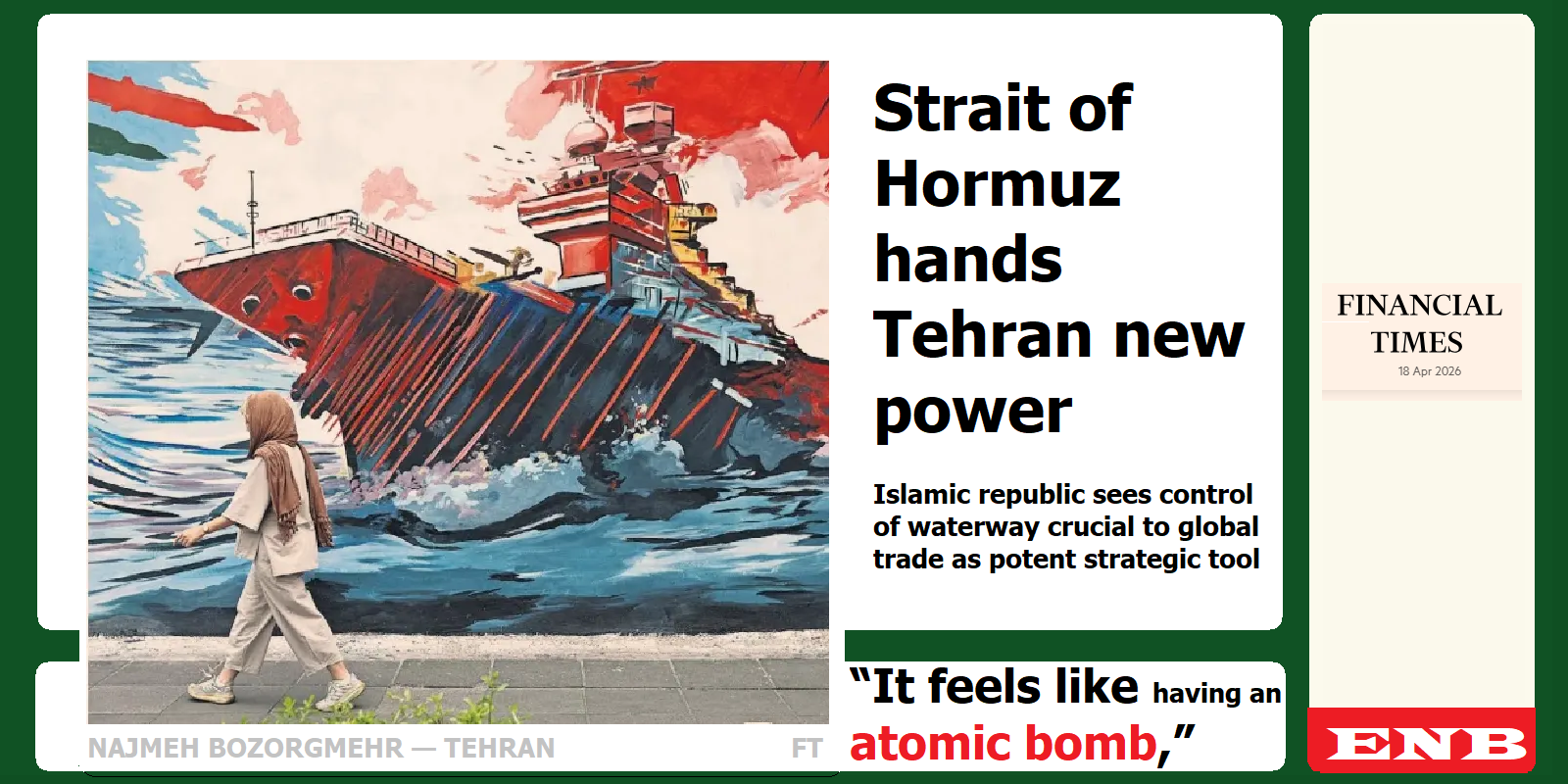
A woman walks past a mural in Tehran depicting what the regime believes is its ability to target US naval vessels in the Strait of Hormuz
Strait of Hormuz hands Tehran new power
Islamic republic sees control of waterway crucial to global trade as potent strategic tool
NAJMEH BOZORGMEHR — TEHRAN 18-04-2026 FT
For decades, Iran hinted that it could close the Strait of Hormuz if hostilities between the US, Israel or its regional rivals boiled over. Yet the ease with which it has finally done so surprised not only its rivals but members of the regime itself.
While regional tensions have long centred on Iran’s nuclear or missile programmes, this previously untested weapon has become its most important point of leverage, triggering the biggest energy crisis in decades and dealing an immediate hit to the global economy.
One person close to the regime described the closure as a strategic breakthrough for the Islamic republic, which had before the US-Israeli war been seen to be at its weakest point militarily in years.
“It feels like having an atomic bomb,” the person said, adding that enforcing the closure has been “easier than expected” and claiming it would not be reversed “under any circumstances”.
For US President Donald Trump, the development presents an unexpected challenge. Having gone to war with hopes of everything from toppling the regime to preventing Iran acquiring nuclear weapons — something Tehran has long denied it is planning — Washington is now grappling with a problem that did not exist before.
In a sign of Trump’s frustration, he ordered the US Navy to blockade the strait, through which roughly a fifth of the world’s energy supplies transit. This is designed to prevent ships travelling to and from Iranian ports and cut off Iran’s oil exports, intensifying pressure on Tehran to negotiate a deal to end the war and reopen the waterway.
But Iran’s top military command centre threatened on Wednesday to use the country’s “full force” to stop trade not only in the Gulf but also the Red Sea and Gulf of Oman if the blockade continued.
Yesterday Iran’s foreign minister announced that the Strait of Hormuz was “completely open” to commercial shipping for the duration of the 10-day ceasefire in Lebanon, following the agreement between Israel and Hizbollah on Thursday.
But Iran would still insist merchant vessels require permission from the Islamic Revolutionary Guard Corps before transiting the strait, an unnamed Iranian official told state television.
Iranian politicians have articulated a more expansive vision of the economic and political role they hope the strait will play in the country’s future.
Iran has previously said that it expects oil tankers transiting the strait to pay up to $2mn in cryptocurrency, and its parliament is drafting legislation to regulate maritime passage, introducing tolls and restricting access for vessels linked to “hostile states”.
Some Iranian members of parliament have suggested Tehran needs the revenues to compensate for the costs of war.
Hamid-Reza Hajibabaei, Iran’s deputy parliament Speaker, told state television that the waterway had turned into the country’s top point of leverage.
“When we have control over the Strait of Hormuz, no other country can impose sanctions on us,” he claimed, in a reference to decades of US-led economic penalties.
Before the US blockade, Tehran’s oil revenues nearly doubled as the country continued to export oil, much of it destined for China, according to Iranian analysts. But the war and Iran’s decision to close the strait have come at a considerable cost to the regime.
US and Israeli air strikes on industrial facilities have caused tens of billions of dollars in damage. The prospect that Iran could continue levying tolls has caused alarm around the world. It could hurt not only neighbouring states but also important economic partners such as China.
“When it comes to applying pressure, the Iranians have shown they can asymmetrically do so very effectively, very quickly, with relatively little military cost,” said HA Hellyer, a senior associate fellow at the Royal United Services Institute think-tank. “But in so doing, they’ve wrecked their connections with pretty much the whole Gulf Arab region.”
Alongside the fraught and longstanding efforts to make a deal curbing Iran’s nuclear programme, convincing Tehran to allow the free flow of shipping through the strait has become a central sticking point in talks between the US and Iran.
Gulf states fear the US could agree a deal that allows Iran to retain some degree of control over the strait.
The Islamic republic has continued to project defiance over Trump’s blockade, but analysts say it may have to start significantly reducing oil production within a fortnight if the blockade succeeds in stopping its exports.
Tehran has signalled it could seek to escalate. Regime figures have suggested the Red Sea chokepoint Bab al-Mandab could be targeted by Iran-backed Houthis, who caused havoc to maritime trade by firing missiles at ships in the conflict that followed Hamas’s October 7 2023 attack on Israel.
Even if the blockade could do significant damage to Iran’s economy, supporters of the regime suggested the Islamic republic would have a higher tolerance for pain than Trump, who is under pressure to contain the domestic economic fallout ahead of US midterm elections in November.
According to individuals close to the leadership, the decision to close the strait gained momentum after Israel’s 12-day war on Iran in June.
The strait is a critical artery not only for energy but also global supply chains. Ali Shirinzad, a member of parliament, said on Monday that Iranian duties would apply not only to oil tankers but to “any vessels”.
Hardliners in Tehran have framed the closure of the strait as a turning point. Even moderate figures are resigned to Iran seeking to retain leverage over the strait. Majid Hosseini, a reformist political economist at Tehran university, said there was little prospect of Iran backing down. “This is the main and perhaps the only deterrent leverage the Islamic republic now has that is working.”