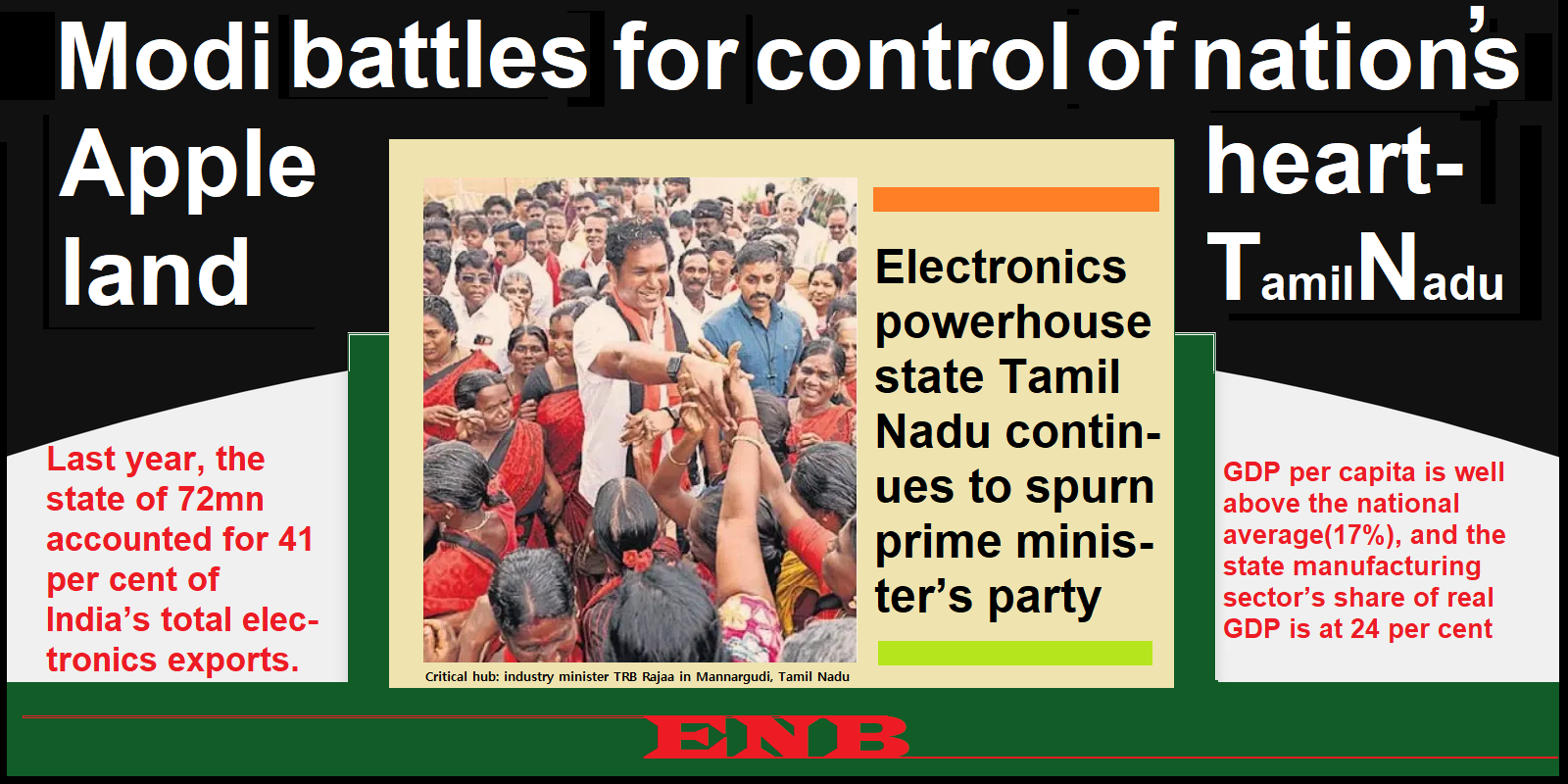
Modi battles for control of nation’s Apple heartland
Electronics powerhouse state Tamil Nadu continues to spurn prime minister’s party
ANDRES SCHIPANI AND JYOTSNA SINGH THANJAVUR
Days after Apple decided to change its leadership, voters in the Indian state that is now one of the company’s biggest production bases were asked whether they should do the same.
Tamil Nadu has become a critical hub for Apple suppliers such as Taiwan’s Foxconn and domestic group Tata Electronics, which assemble iPhones in the state, part of Prime Minister Narendra Modi’s “Make in India” drive to turn the country into a manufacturing powerhouse and supply chain rival to China.
Last year, the state of 72mn accounted for 41 per cent of India’s total electronics exports.
Companies “are here because they felt this is the right place”, industry minister TRB Rajaa told the FT as he was showered with flower petals in his constituency of Mannargudi. “You can blindly close your eyes, put your finger on the state map, and place an industry there.”
Polls yesterday offered a referendum on that industrial strategy, as a coalition including Modi’s Bharatiya Janata Party attempted to unseat Rajaa’s secular progressive Dravida Munnetra Kazhagam party, led by fiery chief minister MK Stalin. Results are expected on May 4.
Despite dominating Indian politics for more than a decade, Modi has struggled to make inroads in India’s prosperous south. Tamil Nadu in particular is a bastion of anti-Modi sentiment, with secular leadership that has long resisted the BJP’s hardline Hindu nationalism and efforts to promote Hindi, which is unrelated to Tamil, the state’s language.
The BJP “never tried to understand Tamil Nadu”, said Rajaa. “They try to bring in their ideology and steamroll it into every state. That will never work in Tamil Nadu.”
India’s southernmost state is among the country’s most economically successful. GDP per capita is well above the national average, and the state manufacturing sector’s share of real GDP is at 24 per cent, closing in on Modi’s national target of 25 per cent and well above the national average of about 17 per cent.
Economist M Vijayabaskar at the Madras Institute of Development Studies credits this success to a “Dravidian Model” of southern Indian governance that marries industrialisation and social welfare and has kept local parties in power in Tamil Nadu since 1967.
The education system churns out tens of thousands of engineering graduates annually, who have contributed to turning Tamil Nadu into India’s manufacturing powerhouse, with more than 40,000 factories.
India is now the second-biggest mobile phone maker globally, with Tamil Nadu hosting almost 47 electronics manufacturing units. The state’s motor industry is also one of India’s largest, with Tata’s Jaguar Land Rover now producing Range Rovers, helping push GDP growth to 11.2 per cent in the 2024-25 fiscal year — the fastest among India’s states, according to official data.
“Today, the most valuable supply chain in the world is in Tamil Nadu,” said Josh Foulger, president of IT hardware at Dixon Technologies in the state capital Chennai.
Veera Shekharan, an engineer from Mannargudi, said he planned to back the DMK, which he said had “brought development” to the area and turned the “land of temples”, as Tamil Nadu is known, into “a land of factories”.
Regional elections are challenging to predict but analysts believe it will be difficult for the BJP, which is part of the local opposition All India Anna Dravida Munnetra Kazhagam (AIADMK) alliance, to overcome the historical divisions between India’s north and south.
“The BJP is trying very hard . . . but that party doesn’t fit our DNA,” said J Jeyaranjan, executive vice-chair of the State Planning Commission. “We don’t need religion mixed with politics. Even though we have the largest number of temples in India, we just focus on business.”
Last week, Stalin burned a copy of a Modi-backed bill that would have expanded the size of the national parliament. Critics said it would disproportionately empower northern states at the expense of southern ones.
Still, analysts acknowledge that the BJP’s support has increased, with Modi himself campaigning in the state last week, as frustration mounts with alleged venality among local officials and political dynasties.
“There is a very strong anti-incumbency in this election,” said Kovai Sathyan, a spokesperson for the AIADMK.
Modi told a rally that the DMK was “a party centred around dynastic politics” and that its local “government is running on the basis of the ‘three Cs’ — corruption, collection and commission”.
Analysts said that whichever party emerged victorious, they would be loath to unsettle the state’s economic model, including a business environment that cuts through India’s notorious red tape.
Arvind Subramanian, a senior fellow at the Peterson Institute for International Economics and adviser to the government of Tamil Nadu, said there was a “political consensus” that “we should not make things difficult for investors”.
“Once they set up shop, they should not face policy reversals if the government changes because the bureaucracy has continuity across political parties,” he added. “All parties realise that if they misbehave, there will be longterm consequences.”