Ambani’s Jio moves towards $4bn IPO as India hopes for end to listings drought
Financial Times UK 19 Jun 2026
CHRIS KAY AND KRISHN KAUSHIK
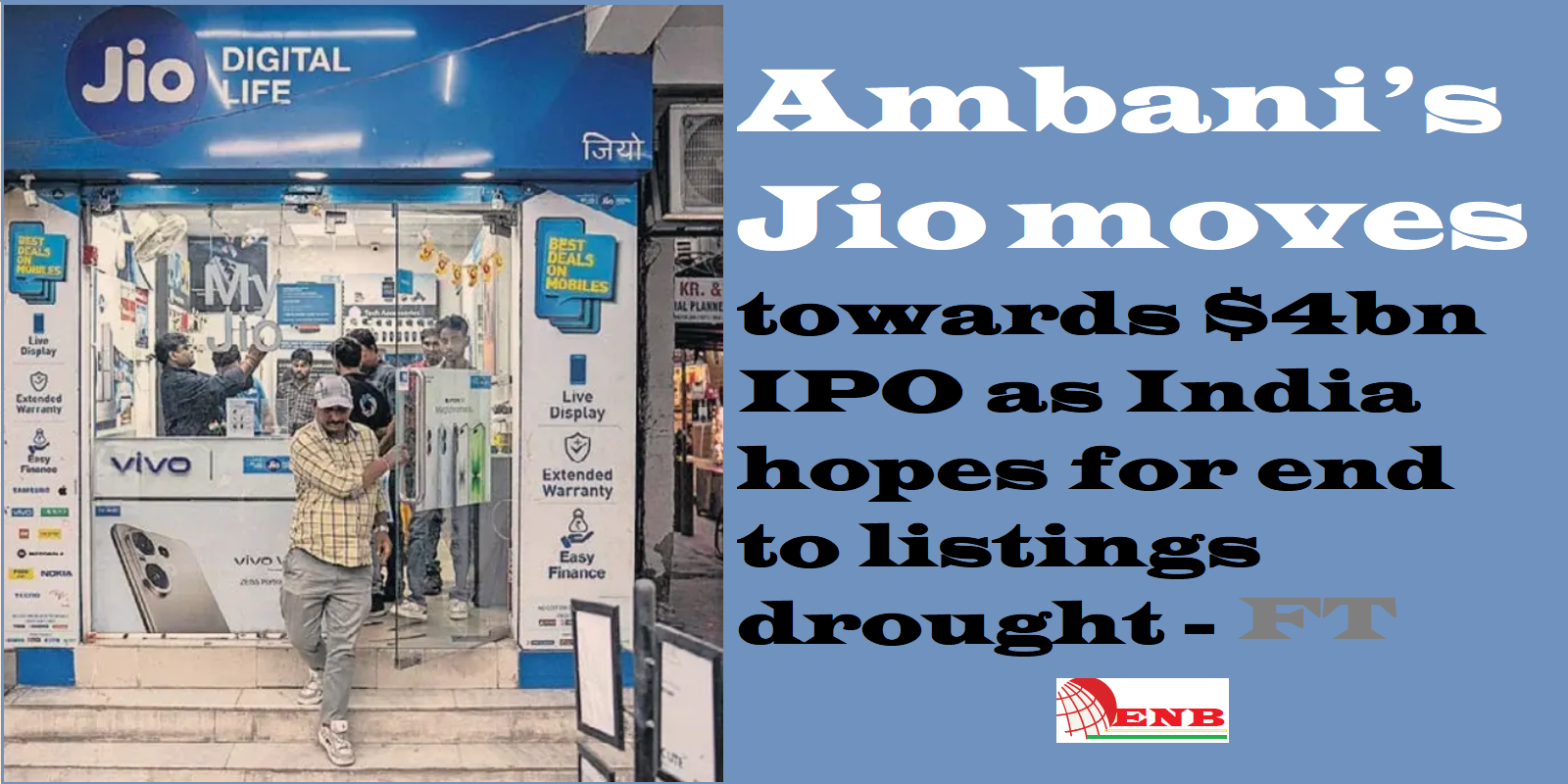
Jio could file a draft prospectus for its expected $4bn IPO with India’s capital markets regulator just before Ambani’s closely watched annual speech today to shareholders of his oilto-telecoms conglomerate Reliance Industries, according to two people familiar with his plans. The value would make it India’s largest IPO.
In his speech last August, Ambani, one of Asia’s richest men, promised to deliver the longawaited listing of India’s largest wireless operator in the first half of this year.
He is on course to miss that deadline after a testing year for Reliance. Its share price has fallen about 15 per cent this year and net profit for the three months to March dropped 13 per cent year on year as Reliance’s mainstay refining business was affected by turmoil in the Gulf. Reliance did not respond to a request for comment.
The later-than-expected listing of Jio comes against the backdrop of a weak Indian equity market, with the US-Israeli war with Iran putting the brakes on what had been set to be a third consecutive record year for IPOs.
At the start of this year, investment bankers in Mumbai were touting a deep pipeline of upcoming listings that they predicted would raise more than the just over $20bn secured last year.
However, along with Jio, marquee listings such as Walmart-owned PhonePe were paused following the onset of the Middle East conflict, which disproportionately hit India given that about 90 per cent of its oil is imported.
The total value of Indian IPOs so far this year is down 39 per cent year on year to Rs198bn ($2.1bn), according to Indian capital market research site Prime Database.
The war “basically sent the volatility indices across the globe in a tizzy, including in India”, said Anurag Byas, India head of global markets solutions at Rothschild.
“Whenever such events come there is always a slowdown in the IPO markets, which require liquidity as well as a positive outlook to flourish.”
The conflict has also put pressure on the rupee, which has hit record lows in recent months, as well as on India’s equity markets, which have lost ground to Asian rivals due to the country’s lack of AI-linked businesses. India’s bluechip Nifty 50 index has fallen about 8 per cent this year and its stock market capitalisation has been overtaken by Taiwan and South Korea.
Foreign funds have sold a net $30.7bn of Indian equities this year, the largest outflows on record, according to securities depository NSDL.
Domestic investors, who form the bedrock of a once-booming stock market, last month reduced their net monthly flows into local mutual funds by the most in three years.
“India lacks AI,” said Prashant Jain, founder and chief investment officer of 3P Investment Managers in Mumbai. “This Iran fear on the currency, oil, all of that drove even further
outflows.”
Nilesh Shah, managing director of Kotak Mahindra Asset Management, said that many companies and owners looking to list were still expecting to achieve valuations similar to
those in late 2024, when the broad Nifty 500 index was at record highs.
“Those were the heady days,” Shah said. “There is a big mismatch between the valuation expected by investors visà-vis valuation expected by the promoters or the issuer,” he said, using an Indian legal term for founders.
Indian markets enjoyed some reprieve this week, with the Nifty 50 gaining 1 per cent on Monday after US President Donald Trump said a preliminary agreement had been reached between the US and Iran to reopen the Strait of Hormuz, the vital gateway for much of India’s energy imports.
With that uncertainty removed, the IPO market is expected to pick up in the second half as it did last year, said Rothschild’s Byas.
However, Jain at 3P Investment Managers said that any resumption of buying was likely to take place mostly in the secondary market, with investors more discerning after numerous post-IPO flops. Macquarie Capital late last year said in a note that 40 per cent of Indian stocks delivered negative returns one month after listing.
For IPOs, “the quantum will be lower, I think, than what we saw in the last two years”, said Jain. “Investors are a lot more conscious of quality and price.”