Brazil’s currency plunges most since 1999 after Lula’s election victory
Michael Pooler in São Paulo and Joseph Cotterill in London
©FT YESTERDAY 26-06-26
Purchesed Article-ENB
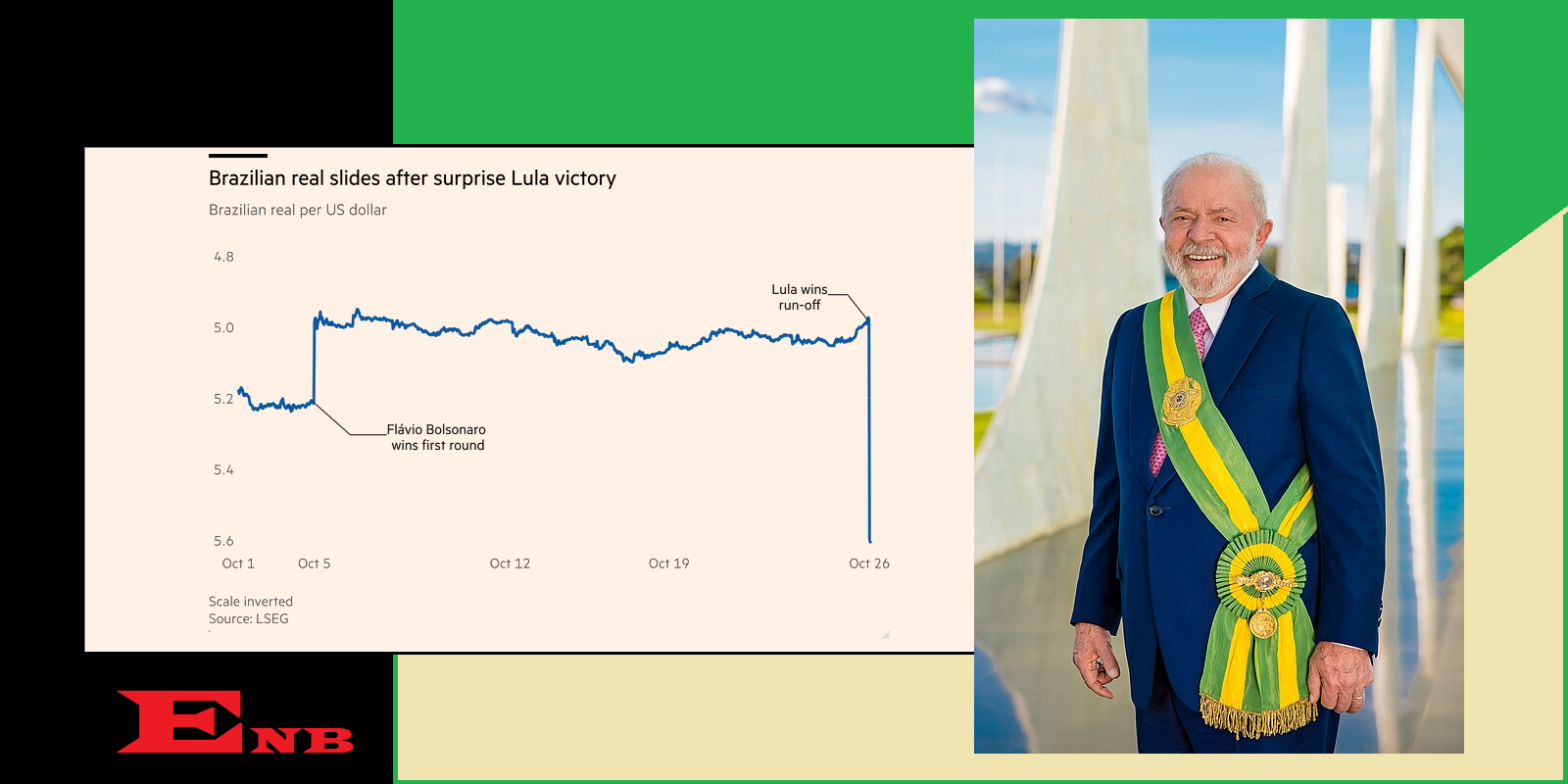
Brazil’s currency plunged the most since 1999 on Monday after President Luiz Inácio Lula da Silva’s surprise re-election victory ignited concerns over public debt and spending in Latin America’s largest economy.
The Brazilian real tumbled 8 per cent against the US dollar to R$5.41 in a chaotic trading session following the leftwing incumbent’s triumph over hard-right challenger Flávio Bolsonaro in a run-off vote on Sunday.
São Paulo’s benchmark Bovespa equity index shed 13.9 per cent after briefly triggering an emergency trading halt, while bets on future long-term interest rates rose sharply and yields on some domestic bonds surged past 15 per cent.
It was the worst day for the Bovespa since the market ructions in 2020 prompted by the coronavirus pandemic.
The sell-offs wiped out a rally since the opposition candidate, who had led polls as the favourite, topped a first-round ballot earlier this month with promises of pro-business policies.
It underscored rising market concerns about Brazil’s public finances, piling pressure on the 80-year-old Lula to take action to shore up the government’s accounts.
“The local market has sold off dramatically,” said Graham Stock, senior sovereign strategist at asset manager RBC BlueBay. “These are huge moves . . . It’s a clear message that fiscal adjustment is the priority.”
However, that task could prove politically challenging for the former union leader, who previously ruled from 2003 to 2010 and returned to office four years ago.
On the campaign trail, Lula made costly spending pledges, including free public transport at weekends, debt forgiveness for individuals and increased welfare payments. Critics accused him of election giveaways to secure votes.
Lula’s 51.8 per cent of votes in the tiebreaker versus 48.2 per cent for his adversary, the 45-year-old son of jailed ex-president Jair Bolsonaro, stunned many investors who had bet on a change of government next year.
They hoped the younger Bolsonaro would be willing to tackle Brazil’s large budget deficit and thereby bring down its double-digit interest rates, which are a drag on growth and hurt household finances.
“The result wrongfooted a market that had increasingly priced a Bolsonaro victory . . . investors had been anticipating a better chance of fiscal consolidation,” said Jim Reid, head of global macro at Deutsche Bank.
Fred Nobre, portfolio manager at local brokerage and investment firm Warren Brasil added: “The sentiment is very poor. It’s the worst day for asset performance in many years.”
As Lula has pursued a tax-and-spend approach to spur economic growth, the IMF has projected Brazil’s fiscal deficit will be equal to about 8 per cent of GDP this year.
Economists warn public debt — at about 83 per cent of GDP — is relatively high for an emerging economy and one reason why the central bank has kept interest rates high, with its policy rate currently at 13.75 per cent.
“Unless Lula provides clarity on the country’s fiscal issues, interest rates will likely remain high, the Brazilian real will depreciate and GDP growth will be limited by the tight conditions,” said Aldo Ruiz, emerging market equities analyst at Federated Hermes.
Despite Lula’s historic victory, he will face a hostile Congress dominated by conservatives, many allied with Bolsonaro. Analysts say this will make governing harder and could restrain his ability to pursue a looser fiscal agenda.
Nevertheless, more spending measures Lula announced before the run-off vote “mean that the starting point for much-needed fiscal consolidation is higher now”, said Kurt Knowlson, portfolio manager at Aviva Investors.
Investors’ focus will now be on Lula’s choice of finance minister to replace the interim incumbent.
Stock at RBC BlueBay said: “People will be looking for a statement of fiscal intent on the part of the Lula administration, and a key part of that will be the appointment of a finance minister.”
Before Sunday’s result, the real had gained 10 per cent against the US dollar this year while Brazil’s stock market had been one of the world’s best performing, up 38 per cent in dollar terms, only slightly behind South Korea’s semiconductor-heavy index.
Lula’s stunning comeback meets fiscal reality
Financial stocks were among the hardest hit on São Paulo’s bourse, with an index tracking the sector plummeting 22 per cent on Monday. Investment bank BTG Pactual fell 25 per cent, state-controlled lender Banco do Brasil lost 29 per cent and commercial bank Bradesco lost 22 per cent.
Among US-listed Brazilian companies, shares in XP, a digital brokerage, fell 48 per cent. Nubank, one of the world’s biggest fintechs, fell 17 per cent.
The impact was felt in overseas markets. The yield on Brazil’s dollar-denominated bonds due in 2036 rose from 6.72 per cent to 6.94 per cent, while shares in Spain’s Banco Santander, which has a large Brazilian unit, fell 3.1 per cent.