Iran’s missiles and drones have hit Gulf infrastructure sites at least 135 times
Iran’s missiles and drones have hit Gulf infrastructure sites at least 135 times, causing cascading failures that Gulf states have often concealed. Despite repeated official statements that the damage came from debris, Reuters found the equipment struck was, time and again, exactly what mattered most.
LONDON
Iran and its proxies have carried out dozens of pinpoint strikes on infrastructure in the Gulf since the start of the war, systematically disabling critical equipment and causing cascading failures and economic damage region-wide in a deft campaign that helps explain how the Islamic Republic has held its own against the more powerful US military.
Iran and the allies it arms went after vital oil-routing systems at Fujairah in the United Arab Emirates, the main port outside the Strait of Hormuz, disabling operations for weeks. They hit Qatar’s Ras Laffan liquefied natural gas facility, striking two of the “cold boxes” that house cooling equipment that liquefies gas. They targeted airports across at least four countries, this month striking one in Saudi Arabia four days in a single week. And they incinerated a pumping station and damaged two others along a key Saudi pipeline, cutting off another main bypass around Iran’s blockade of Hormuz.
Attacks like these on Gulf infrastructure have been announced without detail during the war by governments in the region and other players. But a Reuters investigation reveals how precise these strikes have been, the resulting failure of critical equipment at key facilities, and the extent of the damage – both physical and economic.
Iran has targeted infrastructure across the Gulf Arab countries – in Saudi Arabia, the UAE, Iraq, Qatar, Kuwait, Oman and Bahrain. In all, the Islamic Republic has launched at least 135 drone and missile attacks on at least 84 infrastructure sites in the Gulf since the US and Israel launched a bombing campaign against Iran on February 28, Reuters found.
The attacks have spread fear across the Gulf, sent oil prices soaring and helped Iran blunt months of American military pressure. Coupled with the Islamic Republic’s blockade on the Strait of Hormuz, the ability to launch precision attacks creates an enduring threat to its Gulf Arab neighbors and gives Iran huge sway over the global economy and leverage in its peace negotiations with the US.
Some targets are hidden beneath rooftops and sunshades, invisible from space. Others span just a few meters. Many have purposes not immediately obvious to anyone without expertise in fields like oil refining, nuclear technology or smelting.
Without visiting the sites, Reuters could not always determine how successful Gulf air defenses were or the full extent of the damage. But time and again, Reuters found, the Iranian strikes were precise and the equipment struck was vital.
Ryan Stevens, a former US Marine Corps special operations airstrike coordinator who reviewed Reuters’ findings, said Iran’s strikes showed “precision, targeting expertise, and patience.”
The US, which has imposed a blockade on Iranian oil, repeatedly downplays Iran’s capacity for destruction. Arab Gulf countries often fail to acknowledge major damage and frequently blame harm to their facilities on falling debris from successful interceptions of Iranian munitions.
“US Central Command has been crystal clear in communicating the threats posed by Iran regionally and globally,” said US Navy Captain Tim Hawkins, a CENTCOM spokesman. He said the US has repeatedly condemned Iran “for indiscriminately targeting more than a dozen neighboring countries and hundreds of commercial ships as well as risking millions of innocent lives over the past seven months.”
Iran’s mission to the United Nations in Geneva, which is responsible for international media queries, did not respond to a detailed request for comment.
The success of Iran’s systematic infrastructure assault is another example of how the Islamic Republic has withstood years of international economic sanctions and now months of war with the US and Israel. In previous reports, Reuters has shown how Iran exploits crypto exchanges and illegal gambling networks to tap illicit revenues and circumvent sanctions, how the Islamic Revolutionary Guard Corps consolidated control of Hormuz, and how the war has ushered in a new era of repression.

Some places suffered periods of near-daily bombardment and face billions of dollars in repairs and lost revenue. Others, like one of the world’s largest aluminum smelters in Abu Dhabi, were devastated in a single day. Some of the attacks were carried out by the Iran-backed Houthis in Yemen and the Iraqi Shiite militias controlled from Tehran.
Among those hit the most was the Fujairah port, whose location just south of Hormuz allowed the UAE to bypass Iran’s blockade. The port served as a life raft for global trade by easing the most severe disruption to oil supplies in decades.
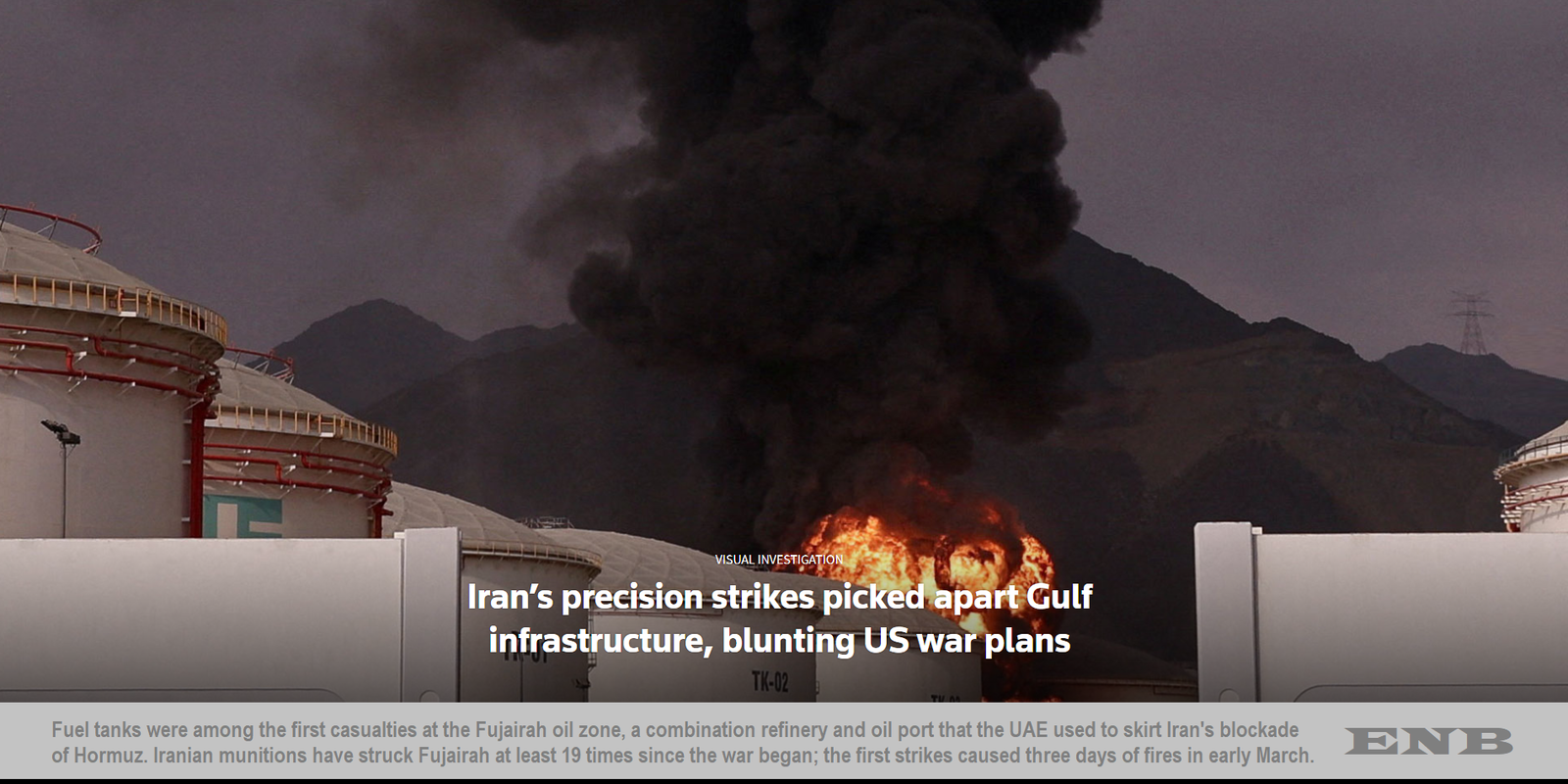
In all, Reuters found that Iranian drones and missiles have struck Fujairah at least 19 times since the war began on February 28, crippling critical pieces of its operations.
“We were watching it come in and watching the helicopters blast the drones out of the sky,” said a foreign businessman who watched a wave of attacks on Fujairah in mid-March from a nearby road. His description of the scene was supported by a Reuters review of photos of the attack. “They were sending swarms of drones and one or two got through.”
Reuters interviewed 36 people familiar with the infrastructure attacks, compiled images and videos of the strikes, and analyzed official statements and data from radar, optical and weather satellites for evidence of the damage and timing of attacks. Reporters presented the resulting findings before publication to facility operators and national governments hit by the attacks.
Oil tanks burn in Oman’s Salalah port after a strike on oil storage facilities. Maritime security firm Ambrey said the storage facilities were hit on March 11, the day this video was released. Oman’s state news agency said there was no supply disruption.
In at least 34 official statements following strikes, governments emphasized that any damage was caused by falling debris from successful interceptions. Gulf military air defenses are located near some of the most sensitive sites, including what Janes, the defense intelligence company, confirmed as American-made Patriot missile defenses visible by satellite that were positioned about 3 kilometers north of Fujairah.
“History has shown that instability in the Middle East often extends beyond the region’s borders, with far-reaching repercussions,” the UAE government said in response to detailed questions about the Reuters findings. “In this regard, renewed efforts to de-escalate tensions are essential to prevent the potential escalation into a broader conflict.”
Gulf states are suppressing information about the toll. It is illegal in the United Arab Emirates, Bahrain, Qatar, Kuwait and Saudi Arabia to take or distribute certain photos or video of the aftermath of strikes. The countries also routinely cite laws against the spread of rumors and misinformation when restricting reporting about strikes. Reuters and other international media have published verified visual evidence of strikes during the war.
“Gulf states now treat damage assessments as if they were state secrets,” said Matthew Reed, president of the oil consultancy firm Foreign Reports. The US and Israel have also kept damage to US bases and Israeli sites under wraps, but many details have emerged through reports by governments and media, including Reuters.
Bahrain’s government, the only Gulf state to respond to questions about the restrictions, said they were in place “to protect public safety, safeguard the integrity of investigations, and prevent such material being used to assess or plan further attacks.”
Iran’s attacks on the Gulf’s economic infrastructure have come in tandem with strikes on American military assets in the region. The US Defense Department’s inspector general told Congress Iran hit hundreds of structures on US bases, in addition to dozens of aircraft.
“Every single target was civilian: Airports, terminals, refineries, gas processing plants, residential areas, shopping malls, and most recently, the Barakah nuclear power plant.”
To gauge the extent of the infrastructure damage and what specifically was hit, Reuters shared its findings and imagery with 11 insiders from the industries of the sites struck, ex-Marine Stevens, another former American service member who now works in security in the region, and a former US security official with expertise in counter-terrorism and satellite analysis.
All 14 said it was highly improbable that damage to essential equipment at dozens of major infrastructure sites was caused primarily by debris falling haphazardly from the sky. Many of them cited visual evidence of explosive detonations, rather than just the impact of a chunk of metal, and pointed to the operational importance of the targets themselves.
Gulf officials have publicly called for a peace deal that addresses Iran’s drone and missile programs, fearing they will threaten the region far into the future. Saudi Arabia’s crown prince directly asked US President Donald Trump for military assistance after a series of attacks in early September by Yemen’s Houthis and was rebuffed, Reuters has reported.
A September 10 attack on the Saudi East-West Pipeline – another main bypass around Hormuz – suspended the flow of crude there, threatening up to 4% of the global oil supply. Saudi Arabia said that the attack came from militias in Iraq, which are armed and backed by Iran. Even more disruptive were Iran’s strikes on Qatar’s Ras Laffan LNG plants, which threatened nearly 20% of the world’s liquefied natural gas flows.


In an interview with Reuters in March, QatarEnergy chief Saad al-Kaabi estimated full repairs to the critical LNG cold boxes destroyed in two Iranian strikes would take three to five years.
The Ras Laffan LNG plant was one of at least four infrastructure sites across the Gulf that will take about a year or more for full restoration. Also among them are Qatar's Pearl gas-to-liquids refinery, the UAE’s Habshan Gas Complex, and the Emirates Global Aluminium Al Taweelah smelter, according to company statements and an assessment by IIR Energy, an intelligence and analytics firm.
“Every single target was civilian: Airports, terminals, refineries, gas processing plants, residential areas, shopping malls, and most recently, the Barakah nuclear power plant,” Sultan Al Jaber, the chief executive officer of the Abu Dhabi National Oil Company, known as ADNOC, said in a May interview with the Atlantic Council.
“They are targeting our infrastructure,” said Al Jaber, who is also the UAE minister of industry and advanced technology. “But what they're really targeting is our way of life.”
The governments of Qatar, Saudi Arabia, Kuwait and Iraq did not respond to requests for comment, nor did ADNOC.
“Well-chosen targets”

Originally envisioned as an economic development project, Fujairah port started full operations in 1983.
That same year, a secret US Central Intelligence Agency assessment found Iran was likely to respond to perceived threats with attacks on energy infrastructure in Kuwait, Bahrain, Saudi Arabia, Qatar and the UAE. That assessment, released in 2019, found that “even a few attacks against well-chosen targets could do considerable damage to Gulf oil facilities.”
Iran struck the UAE more than any of its other Gulf neighbors during the first two months of the war, and Fujairah was the most targeted site in the country, the Reuters examination found. For the first three months of the war, the port was either under attack or making repairs.

The first Fujairah attack was announced on March 3. Two days later, the flaming tanks could still be seen from space. Two oil storage firms suspended operations.
The next attack, announced on March 9, did more than destroy fuel. Satellite imagery showed this strike took out the first matrix manifold, a transfer system of 62 pipelines that feeds crude oil and finished petroleum products from oil terminals to shipping berths.
Emirati officials blamed the damage from the first two attacks on falling debris.
Ramanan Krishnamoorti, a petroleum engineering professor at the University of Houston who reviewed the Reuters findings, said it stretched credibility that debris could simply have tumbled onto the matrix manifold. “This is a wound to the brain and heart.”
More strikes came on March 14, 16 and 17, beginning hours after the US attacked military targets at Iran's Kharg Island oil export terminal. One of these strikes damaged Fujairah’s other matrix manifold, according to a Reuters analysis of satellite imagery, four experts who reviewed the imagery, and a person familiar with the damage.

The damage to the second manifold has not been reported previously. It explains why oil loading at Fujairah fell to 440,000 barrels per day in the week beginning March 16, less than half of the daily average in 2025, according to export data from analytics firm Kpler.
The war pushed Brent oil future prices near or above $120 a barrel in March, April and May, up from around $70 per barrel in February. Brent closed yesterday at $106.
Thomas Warrick, former deputy assistant secretary for counter-terrorism policy at the US Department of Homeland Security, said Iran has plenty of people “who understand the oil industry and people who know how to build and aim missiles.”
Before the war, Iran had the largest stockpile of ballistic missiles in the Middle East, including cluster munitions that are difficult for air defenses to block, according to the US government. In addition, Iran has a thriving drone industry; pre-war it was capable of producing around 10,000 a month, with the Shahed as the flagship explosive aircraft.
In at least six government statements since the conflict began on February 28, Emirati authorities blamed the damage on debris from intercepted Iranian drones or missiles. No statement indicated major damage.
“American forces have and continue to stand with regional partners in defending against Iranian threats, intercepting thousands of attack drones and missiles with an integrated shield that has saved countless lives,” said Hawkins, the CENTCOM spokesman.
Repairs proceeded after the mid-March strikes, with satellite imagery showing cranes at damaged sites. At the end of March, Fujairah's exports hit a weekly record of 3.2 million barrels per day, according to Kpler, which began tracking data at the port in 2013.
But Iran kept attacking. An April 6 strike hit a structure housing critical oil-routing equipment for ADNOC, according to a Reuters analysis of satellite imagery, which was confirmed by Warrick and a person familiar with Fujairah’s layout.
Then, on May 4, the Iranians hit Fujairah again with a drone, smashing a collection of pipes leading to the first matrix manifold that was damaged in March. The primary bypass route for UAE crude around the Strait of Hormuz was again in flames. But, more critically, Fujairah’s exports of refined petroleum essentially stopped for a month. Only a single ship went out from the day of the attack until June 1, according to Kpler data.

Refined petroleum exports would not recover until September.
The Emirates acknowledged the May 4 Iranian drone strike. The Iranians hit at least one other target in the UAE, the Barakah Nuclear Power Plant, on May 17.
Then, in June, the UAE agreed to unlock at least $10 billion in Iranian funds that had been frozen in the Emirati banking system, four sources with knowledge of the arrangement told Reuters at the time. They said $3 billion was released. In return, according to two of those sources, Iran agreed to stop attacking the UAE.
The UAE foreign ministry denied any agreement. In a statement it said that “ no frozen Iranian funds have been released, transferred or facilitated through the UAE.”
A senior Iranian official in August confirmed the transfer of funds but told Reuters the transaction had nothing to do with attacks on the UAE. It was due, he said, “to the correction of the UAE’s behavior.”
There have been no reports of strikes on UAE infrastructure since May 17.
In September, as Iran bombed ADNOC tankers at sea, Fujairah hit a monthly record of 2.62 million barrels per day for all its exports. Refined fuel and crude were flowing like never before.
Iran’s Intelligence
US officials believe Iran may have received intelligence from Russia and China. In addition, Iran relies upon networks of informants with access to sensitive sites to pass along photos and location information, according to three officials familiar with the issue – one from Iran and two in the Gulf.
Asked about intelligence sharing, China’s Foreign Ministry said it “consistently and strictly fulfilled its international obligations.” Russia did not respond to a request for comment.
The three officials said Iran had information including the Barakah Nuclear Energy Plant’s floorplan and the location of an electrical substation that was struck at the plant.
The UAE said the drone that struck the nuclear plant on May 17 was one of three sent “by armed factions in Iraq.” The strike on the substation forced one of its four reactors onto emergency diesel generators, according to the International Atomic Energy Agency.
In imagery captured June 16, the earliest clear view Reuters could obtain, there was damage in two places on the roof of a building housing the controls for the plant’s electricity lines – about 130 meters from one of the reactors.

The attack, IAEA Director General Rafael Grossi said, demonstrated a detailed level of knowledge about the plant.
"This means whoever was or is behind this knew exactly what they were doing,” Grossi said during a June 2 visit to the UAE.
Emirates Nuclear Energy Corporation, which operates the plant, did not dispute the analysis of the damage. The IAEA did not respond to a request for comment.
“The plant's safety systems and established procedures responded as designed, nuclear safety was maintained, there were no injuries or radioactive releases, radiation levels remained within normal ranges and there was no risk to the public or the environment,” ENEC said in a statement to Reuters.
For Kuwait, as with the UAE, having a US military presence and advanced American weaponry weren’t enough to stop the attacks.
Iran systematically hit Kuwait’s energy export infrastructure and its airport almost as soon as the war began. Iranian strikes homed in on a sprawling industrial area in Ahmadi Governorate, about 50 kilometers south of Kuwait City. The zone encompasses the Mina Al-Ahmadi and Mina Abdulla refineries, Shuaiba Port and the Shuaiba power and desalination plant.
The Kuwait Port Authority suspended operations for 24 hours on the first day of the war after debris fell near Shuaiba Port. Within three weeks, the neighboring Mina Al-Ahmadi and Mina Abdulla refineries were also struck.
In April, Kuwait didn’t export a single barrel of crude oil, a first since 1991, according to tanker-monitoring firm TankerTrackers.
“This means whoever was or is behind this knew exactly what they were doing.”
By the end of July, Iranian projectiles had damaged at least 13 structures across the vast Shuaiba industrial area, satellite imagery shows.
The attacks went well beyond refineries, oil fields and other energy facilities.
Iranian munitions hit airports in Bahrain, Kuwait and especially the UAE and Saudi Arabia. The deadliest attack, blamed on Houthis, killed 12 people at Saudi Arabia’s King Khalid International Airport on Saturday.
Kuwait’s airport was struck eight times. One hit came two days after Kuwait had reopened a major terminal upon completing repairs from a prior attack.
Iran struck advanced digital infrastructure such as Amazon data centers in the UAE and in Bahrain, where service remained down six months later because the damaged equipment couldn’t be fixed. Amazon declined to comment directly about the Reuters findings but pointed to a public statement from September 15 saying the company continued “to work on recovering regional resources.”
And Iran cut off operations for all 1,262 smelting cells at the Emirates Global Aluminium Al Taweelah smelter. It took two months until the first cell could be restarted. By late August, only a quarter of them had been brought online, the company said. Production is not expected to return to normal until 2027, according to the company.
The Iranian attack on the smelter hit the facility’s power plant and one of its three smelting cell lines, arrays of hundreds of pots that produce molten aluminum, said Frank Davis, who worked in the aluminum industry for 42 years at nine smelters around the world and has visited the EGA plant. Davis reviewed satellite images obtained by Reuters. A strike on one cell line would not affect the two others, he said. But the strike on the power plant froze operations entirely, he said.
“What a shame, too,” Davis said. “It is an extraordinary facility."
Emirates Global Aluminium did not respond to a request for comment.
The global price of aluminum climbed 5% to a four-year high after the attacks on the UAE smelter and a less-destructive hit the same weekend on a smelter in Bahrain.
“The deliberate targeting by Iran of facilities that communities rely on for power, water, travel and their livelihoods is a clear violation of international law,” Bahrain’s government statement said. “The safety of everyone who lives in and visits Bahrain remains our priority. Where incidents have occurred, the authorities have acted swiftly to protect lives and contain damage.”
Most dramatically, Iran went after the power and water supply in Kuwait.
It was Trump who first publicly threatened the water supply of Iran in March. But it was the Iranians who turned that threat into a reality for its neighbors, said Michael Christopher Low, director of the Middle East Center at the University of Utah.
The threat was especially acute for Kuwait, a desert country that draws 90% of its drinking water from desalination plants. These facilities are often connected to coastal power plants because filtering the water takes massive amounts of heat and electricity.
Reuters found Iran hit at least four of Kuwait’s eight dual power-and-desalination plants from March 2 through July 20. Some were struck repeatedly. During one four-day period in July, Iran attacked what the government described as “several” desalination plants, including one at least twice in that brief period.

Low said Kuwait does not have the natural water resources to survive without its desalination plants. “If you were to attack enough of their capacity, we’re talking about running out of water in days or weeks,” he said.
Kuwait’s government conducted a campaign asking citizens to conserve electricity and water in “the spirit of shared responsibility.”
Red Sea Front
Oil and gas exports function as a system – from wells that extract, to pipelines that transport across hundreds of kilometers, to refineries that process, to ports where ships can load cargo bound for global markets.
In Saudi Arabia, the Gulf’s largest petrostate, this web offers an almost inexhaustible number of targets – a weakness that has been flagged repeatedly over decades, including in the 1983 CIA report. The kingdom produces around 10% of the world’s crude as well as natural gas and petrochemicals.

Nearly all of Saudi Arabia’s oil exports flow through two main ports. The largest share typically flows through its Ras Tanura port on the Gulf. But the kingdom can also export oil from the large King Fahd Industrial Port in Yanbu, the largest on the Red Sea coast.
When the war started, Yanbu and the East-West Pipeline leading to it became a critical outlet for Saudi oil to avoid Hormuz. Most ships that sail from the Red Sea port must instead pass Houthi-controlled territory in Yemen and the narrow Bab al-Mandeb Strait.
In March and April, more than 1,000 kilometers from the Iranian border, drones hit Yanbu at least twice, according to two industry sources familiar with the operations.
The Iranians hit Saudi Aramco Mobil Refinery Limited's Yanbu Refinery with a drone on March 19, limiting production to about 70% of capacity until April 9, said Hillary Stevenson, vice president of energy intelligence at IIR Energy. Scorch marks appeared in a satellite image of Yanbu from around that date, but Reuters could not determine what precisely was hit at the refinery.

Attacks on the Red Sea then went quiet as an initial ceasefire between the US and Iran took hold in early April.
But on July 13, after the ceasefire agreement fell apart, commanders from Iran’s Islamic Revolutionary Guard Corps flew to Yemen bearing missile and drone equipment for the Houthis, Reuters reported.
The next day, Trump promised strikes against Iranian infrastructure. A Reuters visual analysis shows that from July 16 to 18, US forces hit at least three bridges and a tunnel along the main roads leading to the southern Iranian port of Bandar Abbas, headquarters of Iran’s navy along the Strait of Hormuz.
The Houthis attacked Saudi Arabia in retaliation. The Saudis’ Red Sea petroleum operations were heavily targeted. Iran has said it is not responsible for the actions of the Houthis, who claimed responsibility for the strikes. The Houthi spokesman did not respond to a request for comment about the attacks.
The Jazan refinery, less than 100 kilometers from Yemen’s border, was hit at least four times from July 25 through September 7, Reuters found. The first of those attacks damaged the refinery’s tank farm and the adjacent Integrated Gasification Combined Cycle complex, which transforms oil into the gas that powers the refinery, said Stevenson of IIR Energy.
Jazan’s refining volumes dropped to zero after the attacks, according to Stevenson and two people familiar with Aramco operations. Kpler said only one ship has been loaded at the refinery since July 24.
Since the start of the war, Iranian-linked strikes have damaged five of Saudi’s nine biggest refineries and three of its major oil processing hubs, including what Aramco describes as the world’s largest, Reuters found.
Saudi daily oil production dropped below 7 million barrels for most of the first six months of the war, down from over 10 million barrels pre-war. That translates into a loss of over $50 billion at current prices.
Major Western energy firms, including ExxonMobil and Shell, operate sites as joint ventures and have reported tens of millions of dollars in losses all told because of the strikes. Aramco, ExxonMobil and Shell did not respond to requests for comment.
On September 7, Iran’s parliament speaker made the intent of the attacks explicit.
“It’s simple: the oil and gas production chain here is sprawling, accessible, and exposed,” the speaker, Mohammad Baqer Qalibaf, wrote in a post on X. “American oil and gas companies across these waters and facilities share that exposure.”
Three days later, an aerial attack hit three pumping stations in the Saudi desert, turning one of them into a blackened husk and halting the flow of crude along the East-West Pipeline to Yanbu. Oil again popped above $100 a barrel.
Another alternative to the Strait of Hormuz was closed.


Thomas Warrick, former deputy assistant secretary for counter-terrorism policy at the US Department of Homeland Security, said Iran has plenty of people “who understand the oil industry and people who know how to build and aim missiles.”
Before the war, Iran had the largest stockpile of ballistic missiles in the Middle East, including cluster munitions that are difficult for air defenses to block, according to the US government. In addition, Iran has a thriving drone industry; pre-war it was capable of producing around 10,000 a month, with the Shahed as the flagship explosive aircraft.
In at least six government statements since the conflict began on February 28, Emirati authorities blamed the damage on debris from intercepted Iranian drones or missiles. No statement indicated major damage.
“American forces have and continue to stand with regional partners in defending against Iranian threats, intercepting thousands of attack drones and missiles with an integrated shield that has saved countless lives,” said Hawkins, the CENTCOM spokesman.
Repairs proceeded after the mid-March strikes, with satellite imagery showing cranes at damaged sites. At the end of March, Fujairah's exports hit a weekly record of 3.2 million barrels per day, according to Kpler, which began tracking data at the port in 2013.
But Iran kept attacking. An April 6 strike hit a structure housing critical oil-routing equipment for ADNOC, according to a Reuters analysis of satellite imagery, which was confirmed by Warrick and a person familiar with Fujairah’s layout.
Then, on May 4, the Iranians hit Fujairah again with a drone, smashing a collection of pipes leading to the first matrix manifold that was damaged in March. The primary bypass route for UAE crude around the Strait of Hormuz was again in flames. But, more critically, Fujairah’s exports of refined petroleum essentially stopped for a month. Only a single ship went out from the day of the attack until June 1, according to Kpler data.
Refined petroleum exports would not recover until September.
The Emirates acknowledged the May 4 Iranian drone strike. The Iranians hit at least one other target in the UAE, the Barakah Nuclear Power Plant, on May 17.
Then, in June, the UAE agreed to unlock at least $10 billion in Iranian funds that had been frozen in the Emirati banking system, four sources with knowledge of the arrangement told Reuters at the time. They said $3 billion was released. In return, according to two of those sources, Iran agreed to stop attacking the UAE.
The UAE foreign ministry denied any agreement. In a statement it said that “ no frozen Iranian funds have been released, transferred or facilitated through the UAE.”
A senior Iranian official in August confirmed the transfer of funds but told Reuters the transaction had nothing to do with attacks on the UAE. It was due, he said, “to the correction of the UAE’s behavior.”
There have been no reports of strikes on UAE infrastructure since May 17.
In September, as Iran bombed ADNOC tankers at sea, Fujairah hit a monthly record of 2.62 million barrels per day for all its exports. Refined fuel and crude were flowing like never before.
Iran’s Intelligence
US officials believe Iran may have received intelligence from Russia and China. In addition, Iran relies upon networks of informants with access to sensitive sites to pass along photos and location information, according to three officials familiar with the issue – one from Iran and two in the Gulf.
Asked about intelligence sharing, China’s Foreign Ministry said it “consistently and strictly fulfilled its international obligations.” Russia did not respond to a request for comment.
The three officials said Iran had information including the Barakah Nuclear Energy Plant’s floorplan and the location of an electrical substation that was struck at the plant.
The UAE said the drone that struck the nuclear plant on May 17 was one of three sent “by armed factions in Iraq.” The strike on the substation forced one of its four reactors onto emergency diesel generators, according to the International Atomic Energy Agency.
In imagery captured June 16, the earliest clear view Reuters could obtain, there was damage in two places on the roof of a building housing the controls for the plant’s electricity lines – about 130 meters from one of the reactors.
The attack, IAEA Director General Rafael Grossi said, demonstrated a detailed level of knowledge about the plant.
"This means whoever was or is behind this knew exactly what they were doing,” Grossi said during a June 2 visit to the UAE.
Emirates Nuclear Energy Corporation, which operates the plant, did not dispute the analysis of the damage. The IAEA did not respond to a request for comment.
“The plant's safety systems and established procedures responded as designed, nuclear safety was maintained, there were no injuries or radioactive releases, radiation levels remained within normal ranges and there was no risk to the public or the environment,” ENEC said in a statement to Reuters.
For Kuwait, as with the UAE, having a US military presence and advanced American weaponry weren’t enough to stop the attacks.
Iran systematically hit Kuwait’s energy export infrastructure and its airport almost as soon as the war began. Iranian strikes homed in on a sprawling industrial area in Ahmadi Governorate, about 50 kilometers south of Kuwait City. The zone encompasses the Mina Al-Ahmadi and Mina Abdulla refineries, Shuaiba Port and the Shuaiba power and desalination plant.
The Kuwait Port Authority suspended operations for 24 hours on the first day of the war after debris fell near Shuaiba Port. Within three weeks, the neighboring Mina Al-Ahmadi and Mina Abdulla refineries were also struck.
In April, Kuwait didn’t export a single barrel of crude oil, a first since 1991, according to tanker-monitoring firm TankerTrackers.
“This means whoever was or is behind this knew exactly what they were doing.”
By the end of July, Iranian projectiles had damaged at least 13 structures across the vast Shuaiba industrial area, satellite imagery shows.
The attacks went well beyond refineries, oil fields and other energy facilities.
Iranian munitions hit airports in Bahrain, Kuwait and especially the UAE and Saudi Arabia. The deadliest attack, blamed on Houthis, killed 12 people at Saudi Arabia’s King Khalid International Airport on Saturday.
Kuwait’s airport was struck eight times. One hit came two days after Kuwait had reopened a major terminal upon completing repairs from a prior attack.
Iran struck advanced digital infrastructure such as Amazon data centers in the UAE and in Bahrain, where service remained down six months later because the damaged equipment couldn’t be fixed. Amazon declined to comment directly about the Reuters findings but pointed to a public statement from September 15 saying the company continued “to work on recovering regional resources.”
And Iran cut off operations for all 1,262 smelting cells at the Emirates Global Aluminium Al Taweelah smelter. It took two months until the first cell could be restarted. By late August, only a quarter of them had been brought online, the company said. Production is not expected to return to normal until 2027, according to the company.
The Iranian attack on the smelter hit the facility’s power plant and one of its three smelting cell lines, arrays of hundreds of pots that produce molten aluminum, said Frank Davis, who worked in the aluminum industry for 42 years at nine smelters around the world and has visited the EGA plant. Davis reviewed satellite images obtained by Reuters. A strike on one cell line would not affect the two others, he said. But the strike on the power plant froze operations entirely, he said.
“What a shame, too,” Davis said. “It is an extraordinary facility."
Emirates Global Aluminium did not respond to a request for comment.
The global price of aluminum climbed 5% to a four-year high after the attacks on the UAE smelter and a less-destructive hit the same weekend on a smelter in Bahrain.
“The deliberate targeting by Iran of facilities that communities rely on for power, water, travel and their livelihoods is a clear violation of international law,” Bahrain’s government statement said. “The safety of everyone who lives in and visits Bahrain remains our priority. Where incidents have occurred, the authorities have acted swiftly to protect lives and contain damage.”
Most dramatically, Iran went after the power and water supply in Kuwait.
It was Trump who first publicly threatened the water supply of Iran in March. But it was the Iranians who turned that threat into a reality for its neighbors, said Michael Christopher Low, director of the Middle East Center at the University of Utah.
The threat was especially acute for Kuwait, a desert country that draws 90% of its drinking water from desalination plants. These facilities are often connected to coastal power plants because filtering the water takes massive amounts of heat and electricity.
Reuters found Iran hit at least four of Kuwait’s eight dual power-and-desalination plants from March 2 through July 20. Some were struck repeatedly. During one four-day period in July, Iran attacked what the government described as “several” desalination plants, including one at least twice in that brief period.
Low said Kuwait does not have the natural water resources to survive without its desalination plants. “If you were to attack enough of their capacity, we’re talking about running out of water in days or weeks,” he said.
Kuwait’s government conducted a campaign asking citizens to conserve electricity and water in “the spirit of shared responsibility.”
Red Sea Front
Oil and gas exports function as a system – from wells that extract, to pipelines that transport across hundreds of kilometers, to refineries that process, to ports where ships can load cargo bound for global markets.
In Saudi Arabia, the Gulf’s largest petrostate, this web offers an almost inexhaustible number of targets – a weakness that has been flagged repeatedly over decades, including in the 1983 CIA report. The kingdom produces around 10% of the world’s crude as well as natural gas and petrochemicals.
Nearly all of Saudi Arabia’s oil exports flow through two main ports. The largest share typically flows through its Ras Tanura port on the Gulf. But the kingdom can also export oil from the large King Fahd Industrial Port in Yanbu, the largest on the Red Sea coast.
When the war started, Yanbu and the East-West Pipeline leading to it became a critical outlet for Saudi oil to avoid Hormuz. Most ships that sail from the Red Sea port must instead pass Houthi-controlled territory in Yemen and the narrow Bab al-Mandeb Strait.
In March and April, more than 1,000 kilometers from the Iranian border, drones hit Yanbu at least twice, according to two industry sources familiar with the operations.
The Iranians hit Saudi Aramco Mobil Refinery Limited's Yanbu Refinery with a drone on March 19, limiting production to about 70% of capacity until April 9, said Hillary Stevenson, vice president of energy intelligence at IIR Energy. Scorch marks appeared in a satellite image of Yanbu from around that date, but Reuters could not determine what precisely was hit at the refinery.
Attacks on the Red Sea then went quiet as an initial ceasefire between the US and Iran took hold in early April.
But on July 13, after the ceasefire agreement fell apart, commanders from Iran’s Islamic Revolutionary Guard Corps flew to Yemen bearing missile and drone equipment for the Houthis, Reuters reported.
The next day, Trump promised strikes against Iranian infrastructure. A Reuters visual analysis shows that from July 16 to 18, US forces hit at least three bridges and a tunnel along the main roads leading to the southern Iranian port of Bandar Abbas, headquarters of Iran’s navy along the Strait of Hormuz.
The Houthis attacked Saudi Arabia in retaliation. The Saudis’ Red Sea petroleum operations were heavily targeted. Iran has said it is not responsible for the actions of the Houthis, who claimed responsibility for the strikes. The Houthi spokesman did not respond to a request for comment about the attacks.
The Jazan refinery, less than 100 kilometers from Yemen’s border, was hit at least four times from July 25 through September 7, Reuters found. The first of those attacks damaged the refinery’s tank farm and the adjacent Integrated Gasification Combined Cycle complex, which transforms oil into the gas that powers the refinery, said Stevenson of IIR Energy.
Jazan’s refining volumes dropped to zero after the attacks, according to Stevenson and two people familiar with Aramco operations. Kpler said only one ship has been loaded at the refinery since July 24.
Since the start of the war, Iranian-linked strikes have damaged five of Saudi’s nine biggest refineries and three of its major oil processing hubs, including what Aramco describes as the world’s largest, Reuters found.
Saudi daily oil production dropped below 7 million barrels for most of the first six months of the war, down from over 10 million barrels pre-war. That translates into a loss of over $50 billion at current prices.
Major Western energy firms, including ExxonMobil and Shell, operate sites as joint ventures and have reported tens of millions of dollars in losses all told because of the strikes. Aramco, ExxonMobil and Shell did not respond to requests for comment.
On September 7, Iran’s parliament speaker made the intent of the attacks explicit.
“It’s simple: the oil and gas production chain here is sprawling, accessible, and exposed,” the speaker, Mohammad Baqer Qalibaf, wrote in a post on X. “American oil and gas companies across these waters and facilities share that exposure.”
Three days later, an aerial attack hit three pumping stations in the Saudi desert, turning one of them into a blackened husk and halting the flow of crude along the East-West Pipeline to Yanbu. Oil again popped above $100 a barrel.
Another alternative to the Strait of Hormuz was closed.