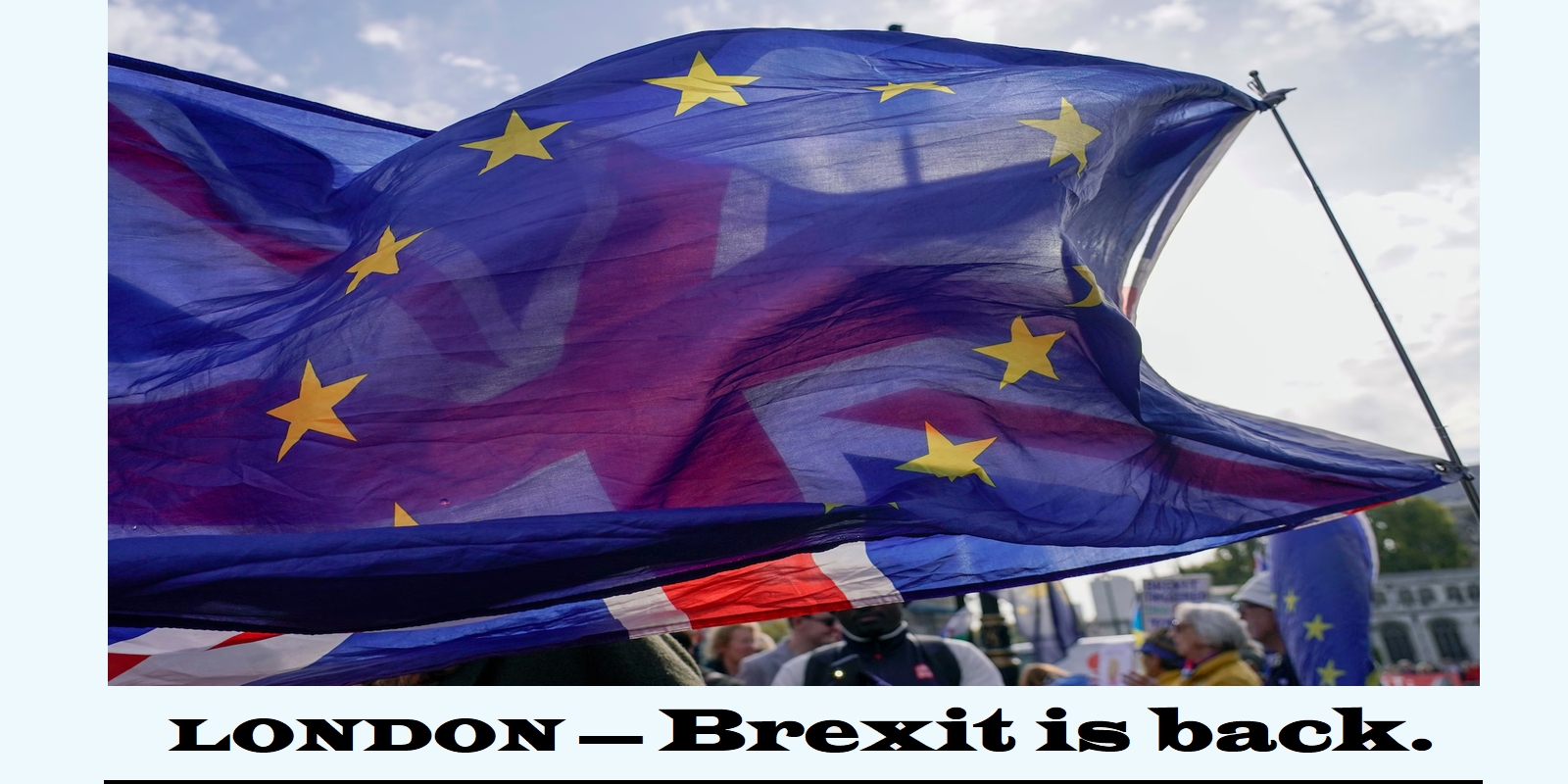
A future move to rejoin the European Union outright is no longer unthinkable, British political analysts say. (Alberto Pezzali/AP)
10 years on, Britain reopens the Brexit fight — this time embracing the E.U.
Prime Minister Andy Burnham has signed the most concrete unwinding of the severance since 2016, as more Britons say leaving the European Union was a mistake.
November 20, 2026 By Steve Hendrix W . Post
LONDON — Brexit is back.
The United Kingdom’s shocker vote to leave the European Union in 2016 and the bitter divorce that followed had become a third rail in British politics: The only thing more toxic than Brexit was any talk of reopening the fight, even for those who opposed it.
But a souring public, a stalled economy and a world order upended by President Donald Trump and Russian President Vladimir Putin mean that Brexit regret is no longer taboo. A serious effort to restore pre-Brexit ties to the E.U. is underway and gaining momentum. And a future move to rejoin the E.U. outright is no longer unthinkable, political analysts say.
Prime Minister Andy Burnham traveled to Brussels on Friday and reached agreement on the most concrete unwinding of the separation since 2016, brushing aside warnings from Conservative and Reform U.K. leaders that Britain has had enough Brexit brawling.
The deal is modest. Britain will align with E.U. food safety rules, scrapping many of the border checks that have choked food exports since Brexit. The two sides will link carbon markets, shielding British manufacturers from the bloc’s new tax on carbon-intensive imports.
The agreement will allow young Britons and Europeans to live and work in each other’s countries for up to three years. Talks will continue on what exchange students would have to pay in tuition, Burnham and E.U. leaders said at news conference following the summit.
“Today we draw the line on a decade of drift and division by reconnecting with old friends, by building a much more constructive relationship with our nearest neighbors and our largest market,” Burnham said.
He promises more to come. Burnham has described these agreements as just the start of a national conversation over Britain’s future place in Europe, with options including going “all the way” to formally reentering the E.U.
Burnham has said he would like to see Britain rejoin in his lifetime. Some senior Labour leaders are ready to move faster. On Wednesday, Labour lawmaker and former deputy prime minister David Lammy proposed including a pledge to rejoin as part of the party’s official platform before the next election.
Peter Kyle, a former business and trade minister who had advised against reopening the debate earlier this year, now says Burnham should campaign on putting a rejoining referendum before voters in the next government.
Labour is rapidly concluding that talk of rejoining is safe politics as polls have traced growing levels of Brexit regret, political analysts said. Since 2022, a majority of respondents in YouGov tracking polls have said leaving the E.U. was a mistake.
“The British political class is catching up with the rest of the country,” said Mark Leonard, director of the European Council on Foreign Relations, which commissioned its own survey of Britons this year showing that 75 percent want closer ties and 33 percent would pick full membership as their top preference. “It is clear from opinion polls that there is a settled view across the country that Brexit has been bad for Britain.”
The economic verdict has been harsh. A National Bureau of Economic Research study estimated that by 2025 Brexit had cut British gross domestic product per capita by up to 8 percent and investment by as much as 18 percent.
Business groups have called for years to restore E.U. ties that would cut the border checks, customs paperwork and duplicate regulation that have dogged exporters since 2021.
But Brexit supporters have fiercely resisted any calls to unwind a referendum that passed by 52 percent to 48 percent. And while support for renewing ties to Europe has risen sharply, it falls when Britons are asked about possible trade-offs, such as adopting the euro or relaxing entry requirements, all issues that would require hard bargaining with Brussels.
Reform U.K. leader Nigel Farage, a key architect of the Brexit vote, said Burnham’s moves to restore ties were a “total betrayal” of voters. Conservative leader Kemi Badenoch said Labour leaders were “taking us backwards,” and former prime minister Boris Johnson called reopening the debate “madness.”
But the politics have shifted beneath their feet, said Tim Bale, a professor of politics at Queen Mary University of London.
As Brexit has become the status quo, its authors now have to own its unpopular consequences, Bale said. About 6 million Britons have died in the decade since the referendum, and polling shows younger voters tend to be significantly friendlier toward Europe.
As Farage’s Reform party has fallen in the polls in recent months, Burnham may see a chance to highlight Brexit as a way to win back liberal voters who had drifted away from Labour.
“We’ve gotten used to the idea that anything to do with Brexit plays into Farage’s hands,” Bale said. “That logic has now reversed.”
As the politics have shifted, so have real-world conditions. Brexit passed when tariffs were low and hopes for lucrative bilateral free-trade deals with the United States and China were high. Europe was largely free from war.
Now, Russia has launched a full-scale invasion of Ukraine, forcing the E.U. to shift toward defense spending and security cooperation. Trump has destabilized NATO, imposed tariffs and shaken European and British faith in the U.S. as a solid transatlantic partner.
Pro-Brexit voters got less stability, prosperity and security rather than more, Leonard said.
“Because of this disjunction between what ‘Leave’ voters wanted and what they were given, a number of people now feel differently about the relationship with Europe when they look at the future,” Leonard said.
Governments on both sides see new reasons to renew closer ties. European Council President António Costa said Thursday that by deepening cooperation, “we can strengthen our ability to address the challenges of our time, strengthen our resilience and promote security and stability in Europe and beyond.”
But fully rejoining would not be fast or easy. Britons will want to keep the pound as their currency and to stay out of Europe’s passport-free Schengen zone. Brussels is unlikely to tolerate too much cherry-picking of some E.U. policies over others and diplomats privately fret that Britain could soon hit the limit of its piecemeal approach to expanding ties with the bloc.
But analysts say a rejoin deal is not impossible. Britain’s economy is roughly a fifth the size of the E.U.’s, a prize for a bloc seeking heft against Washington and Beijing, and it boasts one of the continent’s biggest defense budgets. And other E.U. members have carve-outs: Denmark didn’t adopt the euro, for example, and Ireland is outside Schengen.
Those who want to unwind more of Brexit see hope in the deal announced Friday.
“This is a proof of concept that there can be a benefit to both sides from a closer relationship,” Leonard said. “That’s going to be used as background to this bigger discussion on the future which Andy Burnham is going to launch.”
Ellen Francis contributed from Brussels.