US gathers the most air power in the Mideast since the 2003 Iraq invasion

Yet it still couldn’t be determined whether President Trump would order strikes against Iran – and if he did, whether the aim would be to halt Iran’s already-battered nuclear program, wipe out its missile force or try to topple the regime.
Over the past few days, the US has continued to move cutting-edge F-35 and F-22 jet fighters toward the Middle East, according to flight-tracking data and a US official. A second aircraft carrier loaded with attack and electronic-warfare planes is on the way. Command-and-control aircraft, which are vital for orchestrating large air campaigns, are inbound. And critical air defences have been deployed to the region in recent weeks.
The firepower will give the US the option of carrying out a sustained, weekslong air war against Iran instead of the one-and-done “Midnight Hammer” strike the US carried out in June against three Iranian nuclear sites, US officials said.

Mr Trump has received several briefings on his military options should he choose to strike, all of them designed to maximise damage to Iran’s regime and its regional proxies, US officials said.
Mr Trump hasn’t yet decided whether to order strikes against Iran, the US officials said. His national-security advisers discussed Iran during a meeting in the White House’s Situation Room on Wednesday, according to a senior administration official.
Mr Trump has signalled that he would prefer a diplomatic agreement that, if the US got everything it wanted, would see Iran’s nuclear programs eliminated, regional proxy forces disbanded and ballistic missiles dismantled. Iran is seen as unlikely to agree to the last point, since it doesn’t have much of an air force and relies on missiles as its main deterrent. Mr Trump has indicated that he mainly cares about the nuclear issue, telling reporters he would like Iran to stop enriching uranium.
Meanwhile, some advisers and foreign leaders, such as Israeli Prime Minister Benjamin Netanyahu, are telling Mr Trump that he should use US military pressure to squeeze more concessions out of Tehran. Israel in particular wants to see an end to Iran’s ballistic-missile production, according to officials.
Not all of the weapons the US could use to strike Iran are currently in the Middle East, nor even need to be. B-2 stealth bombers have long trained to carry out Middle East missions directly from the US, as they did in June against Iran’s nuclear facilities, or from the joint US-UK base at Diego Garcia in the Indian Ocean. Other long-range US bombers can do the same.
Mr Trump wrote in a social-media post Wednesday that “it may be necessary for the US to use Diego Garcia,” a UK-controlled island in the Indian Ocean, for an attack if Iran doesn’t make a nuclear deal. Mr Trump also said the US could use the Fairford air base in the UK during the operation.
The US military, with its stealth technology and standoff precision weapons, has an overwhelming advantage over Iran, whose air defences were battered by Israel last year.
Iran has some cards to play in a sustained campaign, including a still-sizeable missile arsenal that could be directed at US bases and allies in the region, and military forces that could try to close the Strait of Hormuz, a vital sea lane for oil tankers.
Given the uncertainties, some former military officers said a diplomatic agreement could be preferable to war.
“Frankly, the best that could come out of this is that the dramatic increase in deployed forces will be significant enough of an indicator that Trump is not messing around with the use of force,” thus prompting Iran’s leaders to come to an agreement, said David Deptula, a retired three-star Air Force general who played a major role in the 1991 Desert Storm campaign against Iraq.
But US and foreign officials are increasingly pessimistic that Iran will agree to the US’s demands. Instead, they said, Tehran might only be willing to suspend its nuclear-enrichment activities for a short period – perhaps until Mr Trump is out of office.
Iran hopes it can use negotiations to delay any US attack, but it also realises that Mr Trump is likely to grow frustrated with prolonged talks and order strikes, according to foreign officials familiar with Tehran’s thinking.
Mr Trump has repeatedly threatened an attack on Iran should negotiations fail. “I don’t think they want the consequences of not making a deal,” he told reporters Monday.
The US Air Force has recently moved dozens of jet fighters and support aircraft to Muwaffaq Salti Air Base in Jordan and Prince Sultan Air Base in Saudi Arabia, according to flight-tracking data. These include additional F-35s, F-15s, F-16s, E-3 Airborne Warning and Control System and E-11 Battlefield Airborne Communications Node aircraft. More fighter aircraft are on their way.
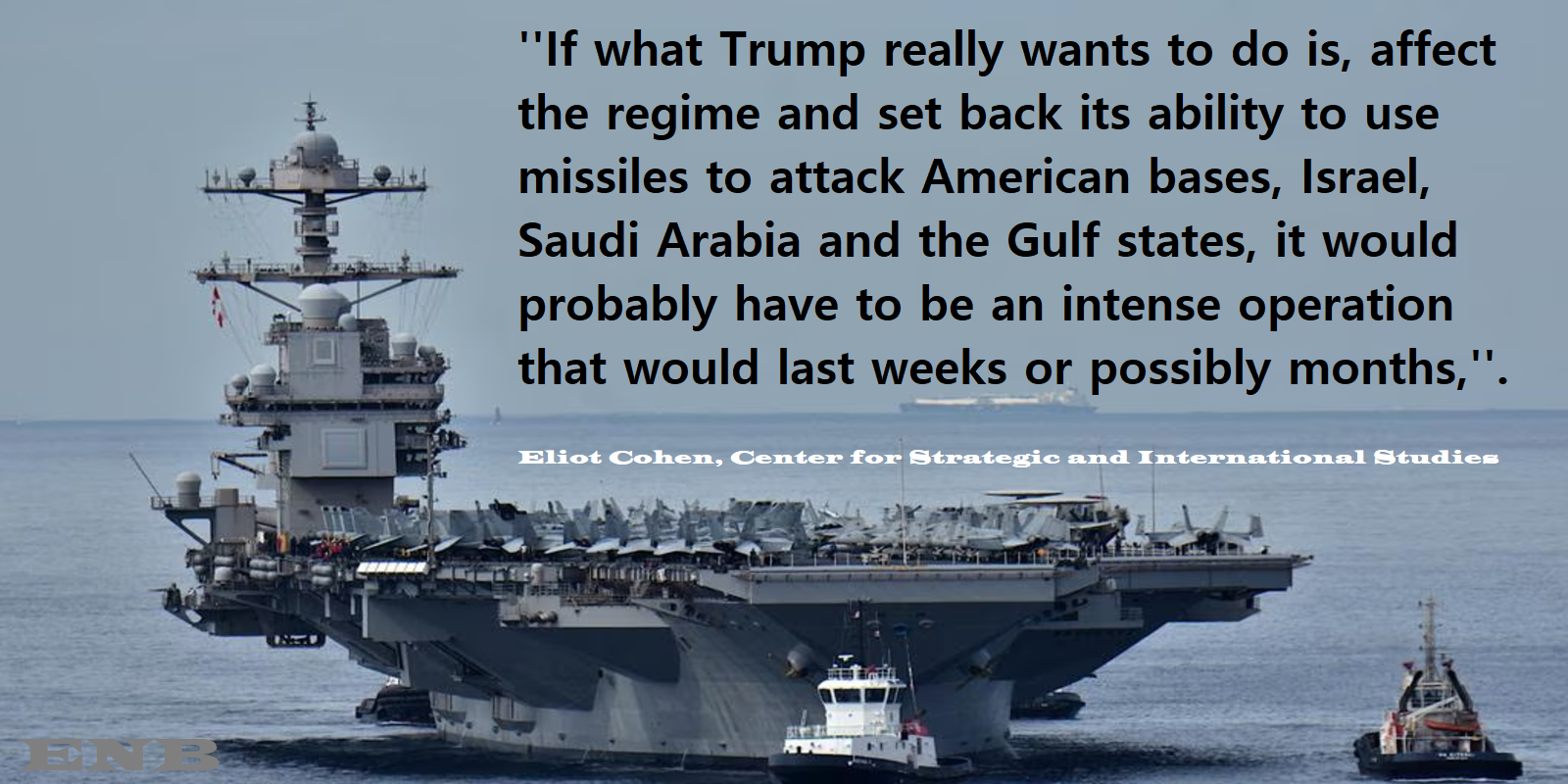
Meanwhile, the US Navy currently has 13 ships in the Middle East and the eastern Mediterranean Sea to support a potential operation, including the aircraft carrier USS Abraham Lincoln and nine destroyers capable of defending against ballistic missiles, according to a Navy official. A second aircraft carrier, the USS Gerald R. Ford, and the four destroyers in its strike group are on their way.
The Pentagon has also moved additional land-based air defences into place across the Middle East, The Wall Street Journal previously reported.

For Operation Iraqi Freedom in 2003, the US Air Force positioned 863 aircraft in the Middle East. Operation Desert Storm in 1991 included 1,300 US aircraft from the Air Force, Navy and Marine Corps, according to information from Air & Space Forces Magazine.
Today’s circumstances are different. The US Air Force is far smaller now, and there are no US and allied ground forces to support. Nor is there much of an international coalition, unless the Israeli air force joins the campaign.
Unlike in 1991, Saudi Arabia and the United Arab Emirates have put their airspace off-limits for potential US strikes. Many of the US warplanes are concentrated in Jordan.
But military technology, including the ability to carry out precision strikes, employ stealth technology and use space, has improved.
The Trump administration is still unsure what might come after a bombing campaign. Secretary of State Marco Rubio told lawmakers in January that the US has no clarity on who would assume power if Supreme Leader Ali Khamenei fell. Many analysts believe the Islamic Revolutionary Guard Corps leader would likely take control.
Antiregime Iranians, whom Mr Trump promised to support during protests that government authorities violently suppressed in January, might revive demonstrations after a US bombing campaign, sensing an opportune moment to increase public pressure on their rulers. This, however, could also present the US with a dilemma on whether to prolong the air war if the regime were to crack down again.
Eliot Cohen, who led a study of the use of air power in Desert Storm for the Air Force and is now a scholar at the Center for Strategic and International Studies, said that a punishing air campaign might try to weaken Iran’s leadership in a way that surviving members of the elite would agree to a far-reaching accommodation with Washington.
“If what Trump really wants to do is affect the regime and set back its ability to use missiles to attack American bases, Israel, Saudi Arabia and the Gulf states, it would probably have to be an intense operation that would last weeks or possibly months,” he said.
The Wall St Journal