Graphics
Maps and charts of the Iran crisis
March 3, 2026
Flights interrupted due to Middle East conflict
By Clare Farley, Travis Hartman and Ally J Levine
Global air travel remained heavily disrupted as war in Iran kept major Middle Eastern airports closed or severely restricted in one of the sharpest aviation shocks in recent years. Key transit airports, including Dubai and Abu Dhabi in the United Arab Emirates and Doha in Qatar, were impacted as much of the region’s airspace remained closed after U.S. and Israeli strikes killed Iranian Supreme Leader Ayatollah Ali Khamenei.
The ripple effects were felt far beyond the Middle East, with tens of thousands of passengers stranded as far away as Bali, Kathmandu and Frankfurt. Thousands of flights have been affected across the Middle East, according to data on flight‑tracking platform FlightAware, and airspace over Iran, Iraq, Kuwait, Israel, Bahrain, the UAE and Qatar remained virtually empty, maps by Flightradar24 showed.


No commercial air traffic is noted over a large swath of a map of the middle east.
Carriers that offer non-stop Asia-Europe flights are able to bypass the closed Middle Eastern airspace by flying north via the Caucasus then Afghanistan or south via Egypt then Saudi then Oman.But it may add to flight times and fuel usage, driving up costs at a time when oil prices have spiked, in a move that could lead to higher fares over the longer term.
“Right now the whole of the Middle East is out of bounds, which is a high price for some airlines,” said Subhas Menon, head of the Association of Asia Pacific Airlines.
A map showing partially, intermittently or completely closed airspaces around Iran and diverted flight corridors.
Dubai International Airport sustained damage during Iran’s attacks, while Emirates, the world’s largest international carrier, said it had suspended all operations to and from its Dubai mega-hub. On March 2 at 1400 GMT, a Dubai Airports spokesperson said a small number of flights were permitted to operate but advised travellers to not visit either of Dubai’s airports unless directly contacted by their airlines.
The flight-tracking service said that a new pilot bulletin had extended the closure of Iranian airspace until at least 0830 GMT on March 3, though regional airline sources said there was no certainty on how long the conflict-related turmoil would continue.

Bar chart of flight cancellations in the Middle East from Feb. 25–March 2. Cancellations jump Feb. 28–March 2, reaching 1,519, 2,460 and 2,187. Bars show Dubai International Airport versus other airports, with Dubai making up about half.
March 2, 2026 20:20 GMT
Just one in four Americans approve of Iran strikes
By Prinz Magtulis and Jason Lange

A bar chart showing the number of U.S. survey respondents that approved and disapproved of President Trump’s attack on Iran.
Only 27% of respondents said they approved of the strikes, which were conducted alongside Israeli attacks on Iran, while 43% disapproved and 29% were not sure.
Sentiment varied across party lines with 55% of respondents registered as Republicans saying they approved of the strikes, while only 7% of Democrats did. Only 19% of independents also signaled approval.
The poll, which closed on Sunday, also showed that 56% of Americans think Trump, who has also ordered strikes in Venezuela, Syria and Nigeria in recent months, is too willing to use military force to advance U.S. interests. The vast majority of Democrats - 87% - held this view, as did 23% of Republicans and 60% of people who don’t identify with either political party.
The attack has killed four U.S. service members and prompted retaliatory missile and drone strikes by Iran on Israel and other Gulf nations.

A bar chart showing the results of a survey asking U.S. adults what they think of Trump’s use of military force on attacking Iran.
March 2, 2026 18:33 GMT
The global chokepoint in the Strait of Hormuz
By Prasanta Kumar Dutta, Pasit Kongkunakornkul, Anurag Rao and Mariano Zafra

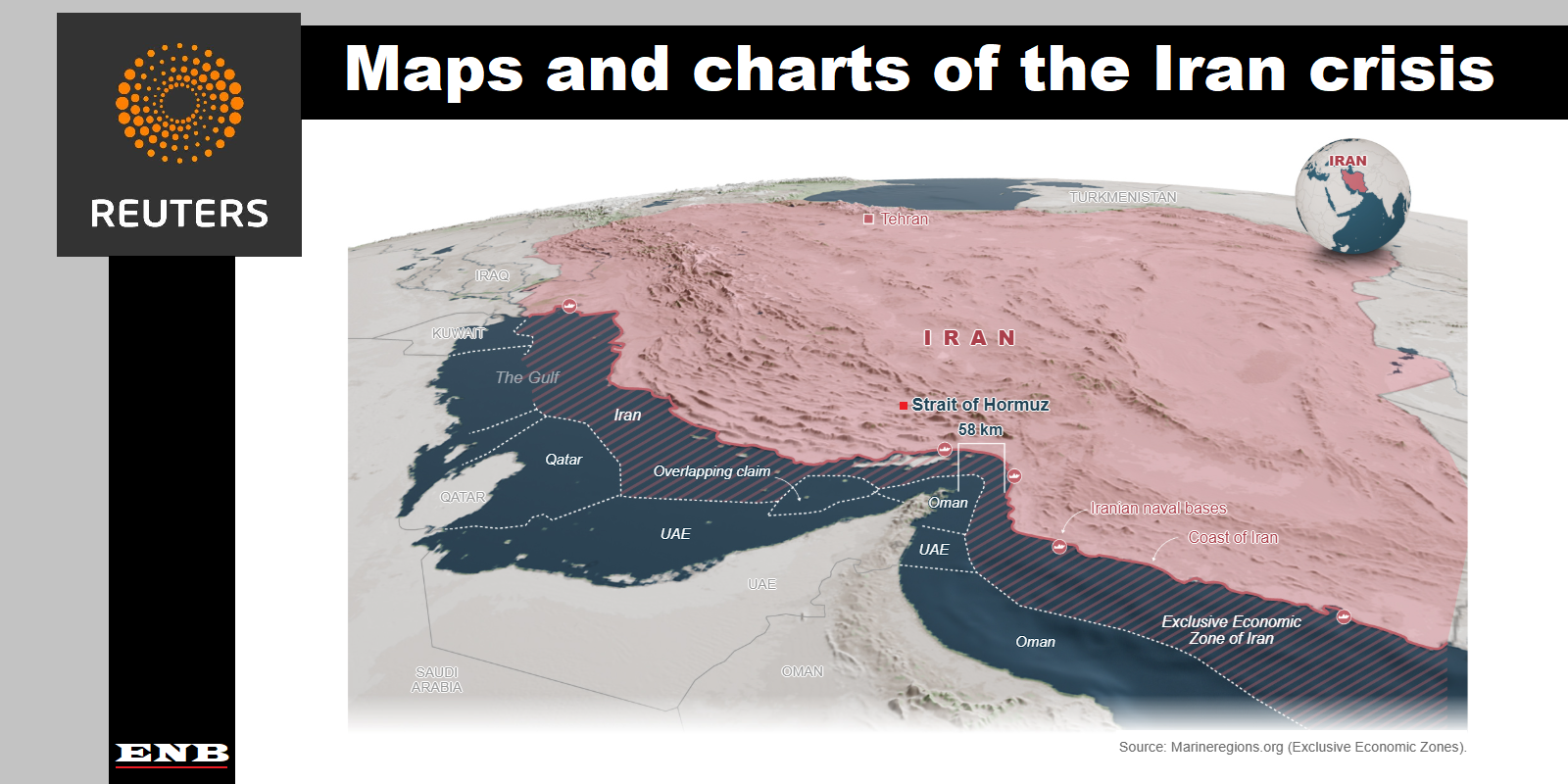
A map showing the Strait of Hormuz and the Exclusive Economic Zones in the The Gulf.
The steady flow of Gulf oil shipments to Europe, the United States and Asia through the narrow shipping lanes of the Strait of Hormuz has created the world’s largest oil transit chokepoint.
After the United States and Israel launched the most ambitious attack on Iran in decades, Tehran’s ability to disrupt transit in the strait has rattled markets and choked trade.
Already, oil prices have risen sharply and analysts expect them to remain elevated over the coming days while markets focus on the impact of escalating Middle East conflict on supplies through the strait.

A line chart showing Brent and U.S. crude oil prices from January 1, 2026, to March 2, 2026, which saw sharp rises in both crude oil prices since the U.S. and Israel began attacks on Iran on February 28.
More than 20 million barrels of crude, condensate and fuels passed through the strait daily last year on average, data from analytics firm Vortexa showed.
OPEC members Saudi Arabia, Iran, the United Arab Emirates, Kuwait and Iraq export most of their crude via the strait, mainly to Asia.
Qatar, among the world’s biggest liquefied natural gas exporters, sends almost all of its LNG through the strait.

A stacked bar chart showing the percentage of total oil flows through the Strait of Hormuz in the world maritime oil trade, between 2020 and 2024 (annually) and 2025 (first quarter), fluctuating between 27% and 29%.
Shipping through the strait between Iran and Oman, which carries around one-fifth of oil consumed globally as well as large quantities of gas, has ground to a near halt after vessels in the area were hit as Iran retaliated to U.S. and Israeli strikes.

A regional map of Iran and the Gulf shows dense blue shipping routes converging heavily at the Strait of Hormuz, with the darkest, thickest lines indicating the busiest lanes. Red dots mark “US and Israeli strikes” across southern/central Iran; dark blue dots mark “Iran’s retaliatory attacks” near Iraq, Kuwait, Bahrain, Qatar and the UAE.
Several tanker owners, oil majors and trading houses have suspended crude oil, fuel and liquefied natural gas shipments via the Strait of Hormuz after the U.S. and Israel attacked Iran, trading sources said on Saturday.
“Our ships will stay put for several days,” one top executive at a major trading desk said. Satellite images from tanker trackers showed vessels backed up next to big ports, such as Fujairah in the United Arab Emirates, and not moving through Hormuz.
Iran’s ability to disrupt the strait
Iran has said it closed navigation through the critical waterway, and shipping has ground to a near halt after vessels in the area were hit as Iran retaliated to U.S. and Israeli strikes.
The U.S.-flagged products tanker Stena Imperative was damaged by “aerial impacts” while berthed in the Middle East Gulf, the vessel’s owner Stena Bulk and its U.S. manager Crowley said in a statement, and a shipyard worker was killed as a consequence of the impact.
On Sunday, a projectile hit the Marshall Islands-flagged product tanker MKD VYOM, killing a crew member as the vessel sailed off the coast of Oman, its manager said on Sunday, and two other tankers were also damaged.
Also on Sunday, a projectile hit the Gibraltar-flagged oil bunkering tanker Hercules Star off the UAE coast, manager Peninsula said in a statement. The tanker returned to anchorage in Dubai on Sunday morning and the crew were safe, Peninsula added.
In addition to direct attacks on ships via missiles and drones, Tehran may also deploy mines in the strait.
U.S. intelligence estimates Iran has stockpiled as many as 6,000 mines, including drifting, limpet, bottom and moored mines.
“Floating and naval mines pose a severe asymmetric threat in these confined waters, particularly in the Strait of Hormuz’s narrow transit lanes, where shallow depths and Iran’s coastal positioning enable swift, potentially deniable deployment from fast attack craft, submarines, or other platforms,” said Scarlett Suarez, senior intelligence analyst with UK based maritime risk intelligence and cybersecurity specialists Dryad Global.
“Although no large-scale mining or confirmed mine detections have been reported amid the ongoing crisis, persistent threats and the potential for partial or targeted use remain credible.”

March 2, 2026 15:07 GMT
The attack on Iran’s power structure
By Adolfo Arranz and Han Huang

*Claimed killed by Israel Defense Forces
(1) Mousavi was appointed to second highest commander after Supreme Leader when his predecessor Mohammad Bagheri was killed during US strikes in 2025.
(2) Pakpour was appointed after his predecessor Hossein Salami was killed during US strikes in 2025. Iran says he was replaced by Ahmad Vahidi.
As of March 3, 2026.
Iran’s Supreme Leader Ali Khamenei was killed on Saturday, Iranian officials confirmed, after the United States and Israel launched the most ambitious attack on Iranian targets in decades.
Israel also said the attacks killed several key figures in Iran’s military leadership.
Israeli military operations over the past two years had already killed some of Iran’s senior military officials and severely weakened several of Tehran’s once-feared proxy forces across the Middle East.
A diagram showing military leaders in Iran and those who have been killed during US and Israeli attacks.
On Sunday, Iranian President Masoud Pezeshkian said a leadership council composed of himself, the judiciary head and a member of the powerful Guardian Council had temporarily assumed the duties of Supreme Leader.
Security chief Ali Larijani accused the United States and Israel of trying to plunder and disintegrate Iran and warned “secessionist groups” of a harsh response if they attempted any action, state television said on Sunday, after the two countries launched a wave of air attacks on Iran that included the bombing of a girls’ primary school. Reuters could not independently confirm the reports from the state media.

A diagram showing the structure of Iranian government.
Following the killing of Khamenei on Saturday, many senior U.S. officials remain skeptical that the U.S. and Israeli military operation against the Islamic Republic will lead to a regime change in the near term.
The U.S. intelligence discussions about the implications of a possible Khamenei killing have not been limited to whether it might lead to a change in government leadership.
Two of the U.S. officials said that, since January, there has been significant debate - but no consensus - among officials of various agencies about the extent to which Khamenei’s killing would lead to a significant shift in the way Iran approached negotiations with the U.S. regarding its nuclear program.
U.S. officials have also debated the extent to which Khamenei’s death or ouster would deter the country from rebuilding its missile or nuclear facilities and capacities, said those officials, who requested anonymity to discuss sensitive internal conversations.
March 1, 2026 10:27 GMT
Where US and Israeli forces struck Iran

By Mariano Zafra and Jon McClure
A map of US and Israeli strikes on Iran and Iranian retaliatory strikes.
The United States and Israel launched their most ambitious attacks on Iran in decades on Saturday in an operation that killed Supreme Leader Ayatollah Ali Khamenei.
The biggest foreign-policy gamble of U.S. President Donald Trump’s presidency comes after he campaigned for reelection as a “peace president” and after saying he preferred a diplomatic solution to the standoff with Iran.
The United States unleashed an array of weaponry against Iranian targets on Saturday, including Tomahawk cruise missiles, stealth fighters, and for the first time in combat, low-cost one-way attack drones modelled after Iranian designs.
Iran has called the strikes unprovoked and illegal and responded with missiles fired at Israel and at least seven other countries, including Gulf states that host U.S. bases.
Edited by Jon McClure, Rebecca Pazos, Julia Wolfe