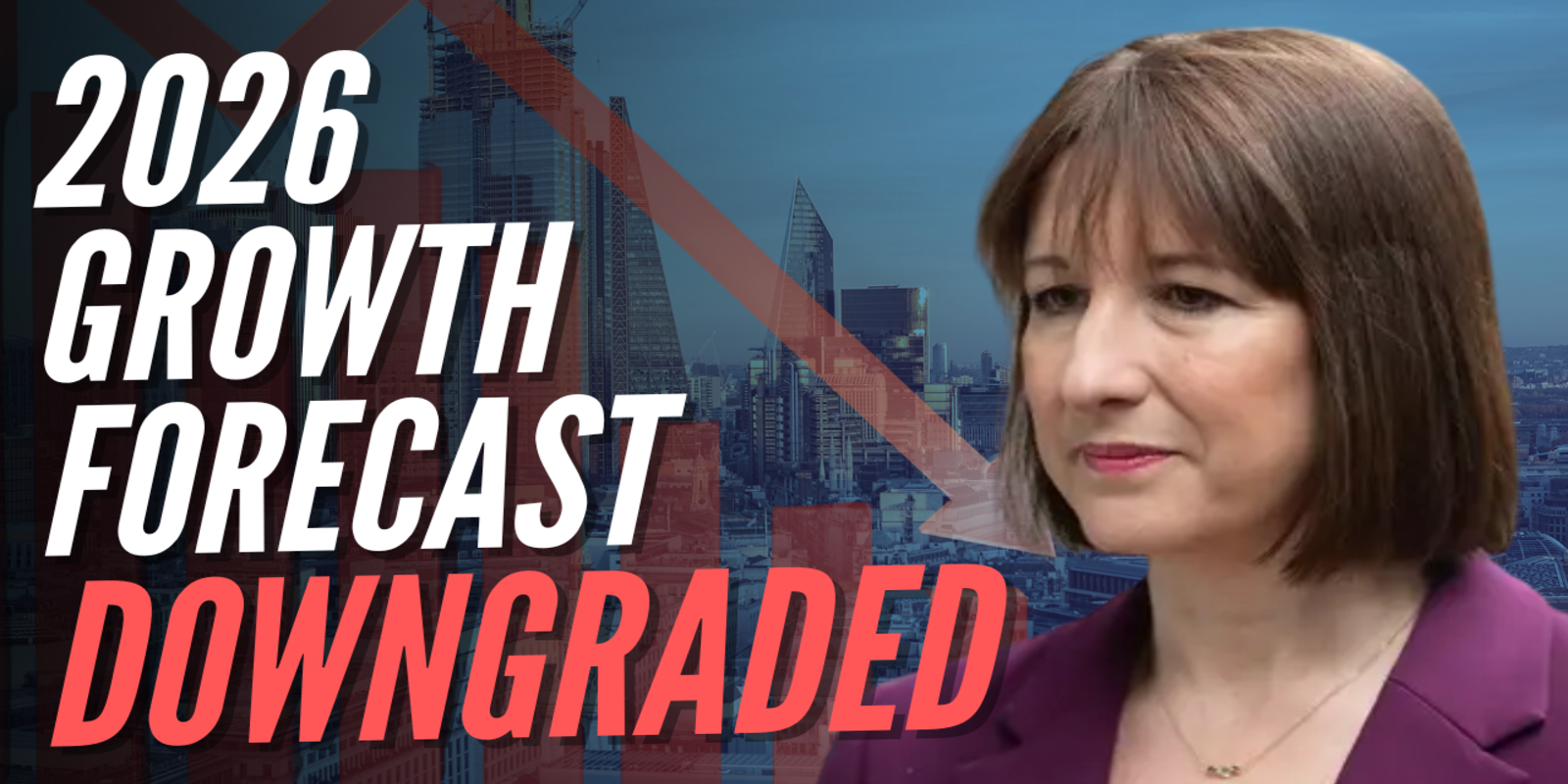
IMF Downgrades Next Year’s Growth Forecast
The International Monetary Fund has cut its 2026 UK growth forecast from 1.4% to 1.3%. Bad news ahead of the Winter Budget…
Although the IMF slightly boosted its growth forecast for 2025 from 1.2% to 1.3%, UK inflation is set to surge to the highest in the G7 in 2025 and 2026. The IMF now predicts inflation will surge by 0.2% to 3.4% in 2025, and 2.5% in 2026 – above previous predictions. Shadow Chancellor Mel Stride said:
“Since taking office, Labour have allowed the cost of living to rise, debt to balloon, and business confidence to collapse to record lows. Taxes are rising to record highs and families are being squeezed from all sides.”
Not the record Reeves was going for…
IMF downgrades global growth forecast amid Middle East conflict
14-Apr-2026 CGTN
The International Monetary Fund (IMF) has downgraded its global economic outlook for 2026 amid the ongoing conflict in the Middle East, saying the war has thrown the global economy off a previously steady growth path.
In its latest World Economic Outlook report, the IMF projects global GDP to rise 3.1% in 2026, a downward revision of 0.2 percentage point from its January forecast. The 2027 growth forecast stayed unchanged at 3.2%.
The downward revision for 2026 is largely driven by disruptions from the conflict in the Middle East that is impacting commodity markets, inflation expectations and financial conditions, said the IMF, which was poised to upgrade global growth before the war.
Current projections were partly offset by positive carryover from recent strong year-end data and lower-than-expected US tariff rates.
"Prior to the war, we were poised to upgrade our global growth forecast, reflecting continued momentum in the global economy supported by a tech investment boom, some moderation in trade policy tensions, fiscal support in some countries, and accommodating financial conditions. War in the Middle East will overwhelm these underlying forces," it wrote in the report's foreword.
Meanwhile, global headline inflation is expected to increase to 4.4% in 2026 and decline to 3.7% in 2027, marking upward revisions for both years, according to the report.
The IMF noted that its "reference forecast" assumes that the current war will remain limited in duration, intensity and scope, with resulting disruptions fading by mid-2026.
However, in an "adverse" scenario marked by larger and more persistent increases in energy prices, global growth would slow further to 2.5% in 2026, while inflation would rise to 5.4%. In a "more severe" scenario, involving greater damage to energy infrastructure in the conflict region, global growth would fall to around 2% in 2026, with headline inflation surging to above 6% by 2027.
Given the shifting economic and geopolitical landscape, the IMF emphasized the importance of preserving price and financial stability, safeguarding fiscal sustainability and implementing structural reforms, as well as addressing domestic imbalances and trade restrictions.
It also called for countries to enhance coordination to restore stability in international economic relations.
IMF downgrades global growth outlook as Iran war hits prices - as it happened
By Kylie MacLellan, Estelle Shirbon, Farouq Suleiman, Zoe Law, Jenna Zucker and Howard Goller
Summary
- IMF cuts global 2026 growth forecast to 3.1%
- Outlook has worsened due to war in Iran
- Downgrade sharper for emerging economies
- IMF sees world drifting toward 'adverse scenario'
- If you can't see the content of video posts, please adjust your cookie settings
David Lawder
Tehran, Iran April 14, 2026. REUTERS/Thaier Al Sudani
The IMF cut its growth outlook due to Middle East war-driven energy price spikes, but said the world was already drifting toward a more adverse scenario.
With massive uncertainty over the conflict, the IMF presented three growth scenarios: weaker, worse and severe, depending on how the war unfolds.
The IMF chose the most benign scenario for its World Economic Outlook "reference forecast," which assumes a short-lived conflict and oil prices normalizing in the second half of 2026, with an $82 per-barrel average for the year. That's well below Tuesday's benchmark Brent crude futures price of around $96.
Just minutes after releasing the outlook, IMF chief economist Pierre-Olivier Gourinchas said it may already be outdated.
He told reporters that with continued energy disruptions and no clear path to ending the conflict, the IMF's "adverse scenario" looks increasingly likely.
The IMF also cut the growth estimate for emerging market and developing economies, where GDP tends to be more dependent on oil inputs.
Nigeria's finance minister Wale Edun, who chairs the G24 group of developing countries, asked the IMF and World Bank to provide more liquidity support, given what he called the negative flow of concessional financing to developing economies.
Meanwhile, U.S. Treasury Secretary Scott Bessent pushed back against warnings from the IMF and the World Bank, adding that the U.S. would cycle through higher prices very quickly.
You can read more about the IMF's growth outlook here and continue to follow our IMF coverage here.
Libby George
G24 to multilateral institutions: 'We would like them to do more'
The leaders from the G24 group of developing countries have just held a press conference during the IMF and World Bank spring meetings.
Nigeria's finance minister Wale Edun, who chairs the G24, said the group would like the IMF and World Bank to provide more liquidity support, given what he called the negative flow of concessional financing to developing economies.
"We would like them to do more," Edun said.
He said the support for vulnerable citizens amid the Iran war must be “targeted and temporary.”
It is important to avoid a return to generalized subsidies and a relapse into policies that have not proven successful, he added.
He also said if interest rates are raised too early or too high, it can do damage to the transformations that are taking place in some developing economies.
Hugo Dixon
Asked if there were vulnerabilities in the Russian banking system amid the Middle East war, Jason Wu, the IMF's assistant director overseeing the Global Markets Analysis division, said the Fund was cognizant of the fact that non-performing loans in the banking sector had risen.
David Lawder and Rodrigo Campos
The International Monetary Fund has cut its 2026 global growth forecast to 3.1%, down 0.2 percentage points from its previous projection in January, before the U.S. and Israel launched a war on Iran.
But the world may be already drifting towards its "adverse scenario" forecast of 2.5% global growth in 2026, IMF Chief Economist Pierre-Olivier Gourinchas said at a press conference in Washington, D.C.
Gourinchas said the 3.1% forecast assumes that the Iran war is resolved quickly and that energy prices normalize in the second half of 2026, but acknowledged that the war's developments are fluid and changing daily. He said the reference forecast was "not quite yet" irrelevant.
"I would say that we are somewhere in between the reference scenario and the adverse scenario," Gourinchas said.
"And of course, every day that passes and every day that we have more disruption in energy, we are drifting closer towards the adverse scenario."
The IMF also lowered its 2026 growth forecast for emerging market and developing economies to 3.9% from its view of 4.2% in January.
The downgrade is sharper than for advanced economies, underscoring that much of the developing world remains more exposed to oil shocks, currency weakness and swings in investor sentiment.
"The current hostilities in the Middle East pose immediate policy trade-offs: between fighting inflation and preserving growth and between supporting those affected by the rising cost of living and rebuilding fiscal buffers," the IMF said in its World Economic Outlook.
Andrea Shalal
Bessent shrugs off IMF and World Bank's warnings on inflation
U.S. Treasury Secretary Scott Bessent pushed back against warnings from the IMF and the World Bank.
"I think that they probably overreacted, but we'll see," Bessent told reporters in Washington.
The IMF and World Bank have flagged higher energy prices and supply disruptions as risks that could weigh on growth and keep inflation elevated, especially for energy‑importing economies, including parts of Europe and Asia.
Bessent said he was skeptical that the inflationary impact would be long-lasting, especially in the United States. He said he was confident that the U.S. would cycle through higher prices very quickly.
He contrasted the U.S. approach with that of some governments abroad that are using consumer or industrial subsidies to cushion price shocks, arguing those measures could entrench inflation by increasing borrowing.
Andrea Shalal
Bessent says China an 'unreliable partner' for hoarding oil
U.S. Treasury Secretary Scott Bessent said China had been an unreliable global partner during the Middle East war by hoarding oil supplies and limiting exports of certain goods, like they hoarded medical supplies during the pandemic.
Bessent told reporters he had spoken with Chinese officials about the issue. He dodged a question about whether the dispute would derail U.S. President Trump's plan to visit Beijing at the end of the month, but said Trump and Chinese President Xi Jinping had a very good working relationship.
"I think the message for the visit is stability. We've had great stability in the relationship since last summer; that emanates from the top down," he said. "I think that communication is the key."
David Lawder
IMF not seeing evidence of wage-price spiral in Britain
As we covered earlier, Britain suffered the sharpest cut to economic growth forecasts of any Group of Seven economy in the IMF's latest report.
The IMF is not seeing evidence of a wage-price spiral in Britain at the moment, IMF Chief Economist Pierre-Olivier Gourinchas said, referring to a situation where higher prices fuel demands for higher wages which in turn fuel price increases.
The Fund's chief economist said it anticipates only a small increase in core inflation in Britain due to war-driven energy price spikes.
He said that core UK inflation is now forecast around 2.7% for 2026, up from 2.2% forecast in January, despite Britain's heavy dependence on gas imports.
"The UK economy still has a negative output gap in our estimate, so there is quite a bit of slack, and that actually is moderating some of the wage pressures," Gourinchas told a news conference.
"Now we'll have to see and watch how the increase in energy prices, especially when they get to consumers, whether that translates into a different dynamic."
Gourinchas warns against risk of ongoing inflation problem
The IMF chief economist drew comparisons between the current situation and events linked to the oil price shocks of the 1970s.
He said the global economy now was much less oil-dependent than it was back then, but countries nonetheless needed to diversify their sources of energy to domestic supplies and renewables.
The lesson from the 1970s, he said, was that it was important to prevent an energy shock from turning into an ongoing inflation problem.
In that regard, he said central banks should be attentive to signs of a wage-price spiral, which is when rising prices prompt demands for higher wages, which in turn fuel inflation.
However, IMF Chief Economist Pierre-Olivier Gourinchas said central banks did not need to step on the brakes right away, referring to measures such as raising interest rates to dampen inflation.
IMF: China needs to rebalance towards domestic consumption
David Lawder
As we reported earlier, the IMF forecast China's growth for 2026 at 4.4%, down a tenth of a point from its January projection as the higher energy and commodity costs are partly offset by lower U.S. tariff rates and government stimulus measures.
Asked about the IMF outlook for China, IMF Chief Economist Pierre-Olivier Gourinchas said the Chinese economy would still decelerate in 2027 due to weak domestic consumption.
He added that China needed to rebalance its growth drivers from exports towards domestic consumption.
David Lawder
Hormuz tolls burden would likely fall on consumers, IMF says
Iranian officials have raised the idea of charging a toll for using the Strait of Hormuz, which has been effectively shut since the war began on February 28.
The burden from any system of tolls for shipping passing through the Strait of Hormuz would likely fall on consumers, IMF Chief Economist Pierre-Olivier Gourinchas said.
He cautioned that the IMF had not done a detailed analysis of tolls for the crucial waterway.
Gourinchas says world between reference and adverse scenarios
As we mentioned earlier, the IMF envisaged three possible scenarios depending on how the Iran war unfolds.
Gourinchas said that the global economy was currently on a trajectory somewhere between the "reference" and "adverse" scenarios.
He said that with every day that passes with more disruption in energy prices and supply chains, the world was drifting closer to the adverse scenario.
Ciara Lee
Along with countries like Egypt and Pakistan, Sri Lanka is in a group of import-reliant, lower-income countries that are feeling the ripple effects from the US-Israeli war on Iran.
The IMF also cut its growth estimate for emerging economies
Rodrigo Campos
The IMF lowered its 2026 growth forecast for emerging market and developing economies to 3.9% from its view of 4.2% in January.
The downgrade is sharper than for advanced economies, underscoring that much of the developing world remains more exposed to oil shocks, currency weakness and swings in investor sentiment.
The global lender said the Iran war's impact would vary widely and depend on a country's proximity to the conflict, trade and financial links, exposure to remittances and energy dependence.
"The current hostilities in the Middle East pose immediate policy trade-offs: between fighting inflation and preserving growth and between supporting those affected by the rising cost of living and rebuilding fiscal buffers," the IMF said.
It said the countries most at risk are commodity-importing emerging economies with existing weaknesses where higher import bills, weaker currencies and reduced capital inflows could feed inflation and intensify financing stress.
William Schomberg
Britain hit with big growth downgrade
Britain suffered the sharpest cut to economic growth forecasts of any Group of Seven economy.
The downgrade reflects the country's costly exposure to the inflationary impact of the Iran war.
The IMF said Britain's economy was now on course to grow by 0.8% in 2026, down from a previous projection of 1.3%.
That leaves Britain with the same growth forecast as Germany and just below France - but bottom of the G7 on a per capita basis.
The IMF blamed the weaker outlook on the U.S.-Israeli war with Iran, which initially doubled the price of natural gas that Britain relies on heavily, and on slower Bank of England interest rate cuts due to the energy price shock.
Speaking ahead of the forecasts, British finance minister Rachel Reeves told Britain's Mirror newspaper she was "very frustrated and angry" over what she described as the United States' failure to have a clear exit plan or objectives for the war in Iran.
"That is a folly and it is one that is affecting families here in the UK but also families in the U.S. and around the world," she said.
Germany faced the largest downgrade among big euro zone economies, with the IMF expecting German growth rates of 0.8% in 2026 and 1.2% in 2027, down 0.3 percentage points for both years.
What the IMF said about major economies
David Lawder
THE UNITED STATES
The IMF shaved its U.S. growth outlook for this year to 2.3%, down just a tenth of a percentage point from January, reflecting the positive effect of tax cuts, the lagged effect of interest rate cuts and continued AI data center investment partly offsetting the higher energy costs.
These effects are expected to continue in 2027, with growth next year now forecast at 2.1%, up a tenth of a point from January.
THE EURO ZONE
The euro zone, still struggling with higher energy prices caused by Russia's 2022 invasion of Ukraine, takes a bigger hit from the Middle East conflict, with its growth outlook falling 0.2 percentage points in both years to 1.1% in 2026 and 1.2% for 2027.
JAPAN
Japan's growth is largely unchanged under the most benign scenario at a weak 0.7% for 2026 and 0.6% for 2027, but the IMF said that it expects the Bank of Japan to hike rates at a slightly faster pace than anticipated six months ago.
CHINA
The IMF forecast China's growth for 2026 at 4.4%, down a tenth of a point from January as the higher energy and commodity costs are partly offset by lower U.S. tariff rates and government stimulus measures.
But the IMF said headwinds from a depressed housing sector, a declining labor force, lower returns on investment and slower productivity growth will cut China's 2027 growth to 4.0%, a forecast unchanged from January.
Without the Iran war, the IMF would have upgraded its outlook
David Lawder
Without the Iran war, the IMF would have upgraded its outlook
Absent the Middle East conflict, the IMF said it would have upgraded its growth outlook by 0.1 percentage point to 3.4%, due to a continued technology investment boom, lower interest rates, less severe U.S. tariffs and fiscal support in some countries.
But the war has created a far bigger risk to the global economy than President Donald Trump's initial wave of steep tariffs did a year ago, IMF Chief Economist Pierre-Olivier Gourinchas told me in an interview earlier.
"What's happening in the Gulf is potentially much, much larger, and that's what our scenarios are kind of documenting," he said.
The IMF presented three growth scenarios
David Lawder
With massive uncertainty over the Middle East conflict, the IMF presented three growth scenarios depending on how the war unfolds.
The World Economic Outlook's most optimistic "reference scenario" assumes a short-lived Iran war and forecasts 3.1% real global GDP growth for 2026, down 0.2 percentage point from its previous forecast in January.
Under this scenario, oil prices average $82 per barrel for all of 2026, a decline from recent levels of around $100 for the Brent benchmark futures price.
Under the "adverse scenario" of a longer conflict that keeps oil prices around $100 per barrel this year and $75 in 2027, the IMF predicts global GDP growth would fall to 2.5% this year. The IMF had forecast in January that oil would decline to about $62 in 2026.
And the IMF's worst-case "severe scenario" assumes an extended and deepening conflict and much higher oil prices that prompt major financial market dislocations and tighter financial conditions, slashing global growth to 2.0%.
"This would mean a close call for a global recession," the IMF said, adding that growth has been below that level only four times since 1980 - with the last two severe recessions in 2009, following the financial crisis, and in 2020 as the COVID-19 pandemic raged.
David Lawder
'Stepping on the brakes will be painful'
I have been speaking to IMF Chief Economist Pierre-Olivier Gourinchas about how policy makers should respond to the current situation.
He said central banks may need to inflict much more economic pain to control inflation fueled by a long Middle East war than they did to control the spike in prices after the pandemic.
When Russia's invasion of Ukraine in 2022 drove oil prices above $100 a barrel, an already overheated post-COVID economy meant small increases in interest rates went a long way to cool demand, Gourinchas said.
But with much more slack in today's economy, including a weaker labor market and ample supplies of most goods and services, much stronger monetary tightening may be needed, particularly if inflation expectations become unanchored, Gourinchas said.
"Stepping on the brakes will be painful" in such an environment, Gourinchas told me.
"You may have to inflict a lot more pain to get the same disinflation result."
However, it's far from clear how hard central banks may need to push back against the effects of rising prices for oil, gas and other commodities considering the uncertainty over how the conflict will develop.