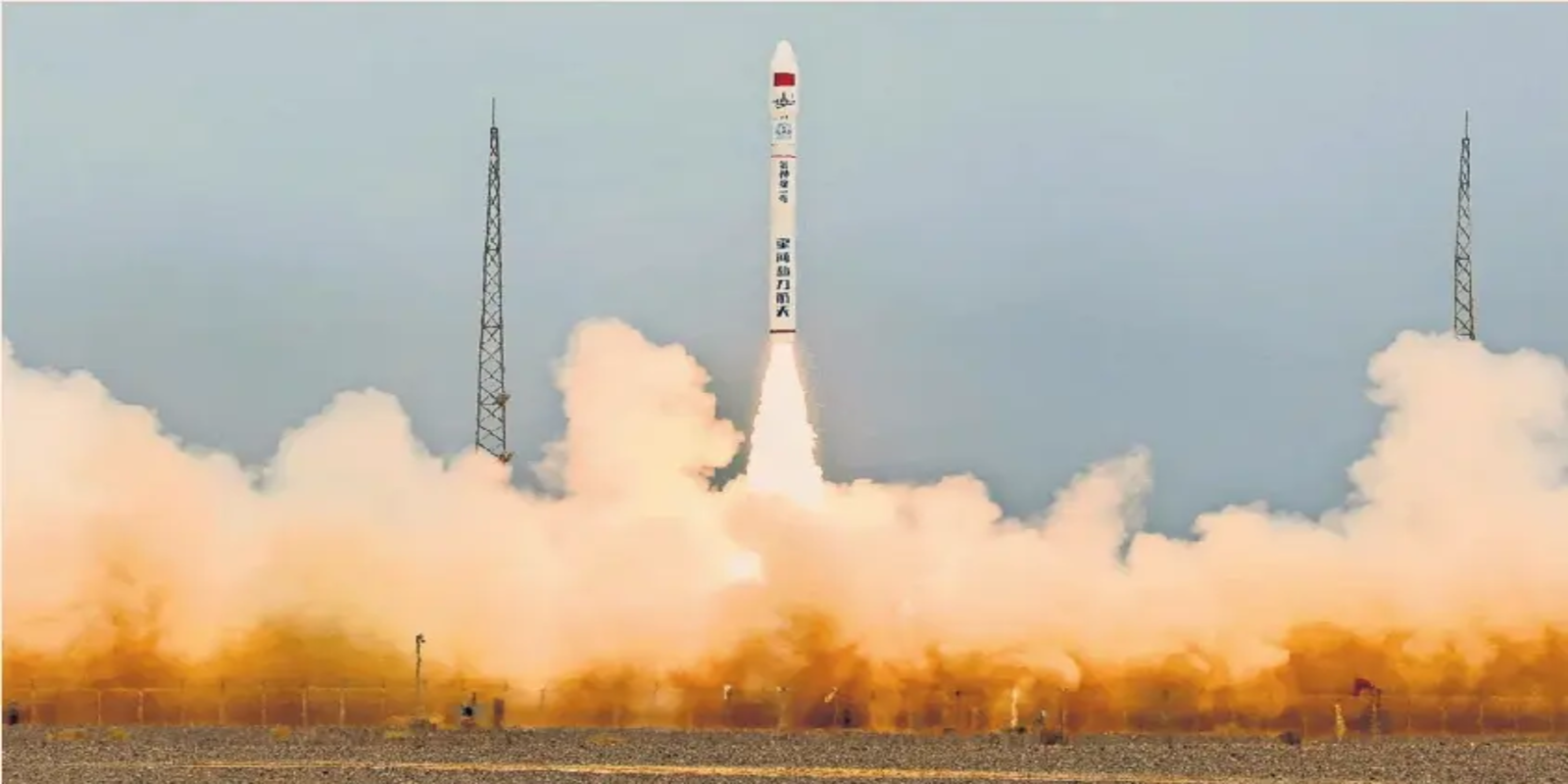
Bound for orbit: a rocket blasts off from the Jiuquan satellite launch centre in north-west China in June 2024 carrying the TEE-01B satellite
Tehran deploys Chinese satellite to target US bases across Middle East
▸ Craft bought by IRGC space force ▸ Images of military sites captured ▸ Beijing denies involvement
FT REPORTERS Miles Johnson, Peter Andringa, Alison Killing and Charles Clover in London and Demetri Sevastopulo in Washington. Additional reporting by Chris Campbell in London and Joe Leahy in Beijing
Iran secretly acquired a Chinese spy satellite that has given the Islamic republic a powerful capability to target US military bases across the Middle East during the war, a Financial Times investigation has revealed.
Leaked Iranian military documents show the satellite — TEE-01B — was acquired by the Islamic Revolutionary Guard Corps’ Aerospace Force for about Rmb250mn ($36.6mn) in 2024 after its launch into space from China. The force oversees Iran’s ballistic missile, drone and space programmes.
Time-stamped co-ordinate lists, satellite imagery and orbital analysis show that Iranian commanders have used the satellite to monitor US military sites. The images were taken in March before and after drone and missile strikes on those locations.
TEE-01B was built and launched by Earth Eye Co, a Chinese company that offers “in-orbit delivery”, a model under which spacecraft launched in China are transferred to overseas customers after reaching orbit. As part of the agreement, the IRGC was granted access to commercial ground stations operated by Emposat, a Beijing provider of satellite control and data services.
The use of a Chinese-built satellite by the IRGC during a war where Tehran has targeted its neighbours is highly sensitive. China is the largest trading partner of the Gulf countries and the largest buyer of their oil.
The logs show that the satellite captured images of Prince Sultan Air Base in Saudi Arabia on March 13, 14 and 15. On March 14, US President Donald Trump confirmed US planes at the base had been hit.
The satellite also conducted surveillance of Muwaffaq Salti Air Base in Jordan, locations close to the US Fifth Fleet naval base in Bahrain and Erbil airport, Iraq, around the time of IRGC-claimed attacks on those areas.
“This satellite is clearly being used for military purposes as it is being run by the IRGC’s Aerospace Force and not Iran’s civilian space programme,” said Nicole Grajewski, an expert on Iran at Sciences Po university. “Iran really needs this foreign-provided capability.”
Earth Eye Co says on its website that it has made one “in-orbit” transfer to an unnamed country that was part of China’s Belt and Road Initiative. Iran joined B&R in 2021. It adds that the satellite was intended for use in “agriculture, ocean monitoring, emergency management, natural resource supervision, and municipal transportation”.
Under the deal, Emposat provides the IRGC with the software and network to run the satellite. These would allow the IRGC to direct the satellite’s operations from anywhere in the world.
“This amounts to a dispersion strategy for Iran’s space assets,” said Jim Lamson, a former CIA analyst focused on Iran and a senior research associate at the James Martin Center for Nonproliferation Studies. “Iran’s satellite ground stations . . . can be hit very easily. You can’t just hit a Chinese ground station located in another country.”
China’s foreign ministry dismissed the FT reports as “untrue”, adding: “Recently, certain forces have been keen to fabricate rumours and maliciously link them to China.”
Earth Eye and Emposat did not respond to requests for comment.
The CIA declined to comment. The White House referred to comments Trump made at the weekend when he said China would face “big problems” if it gave Iran air defence systems.