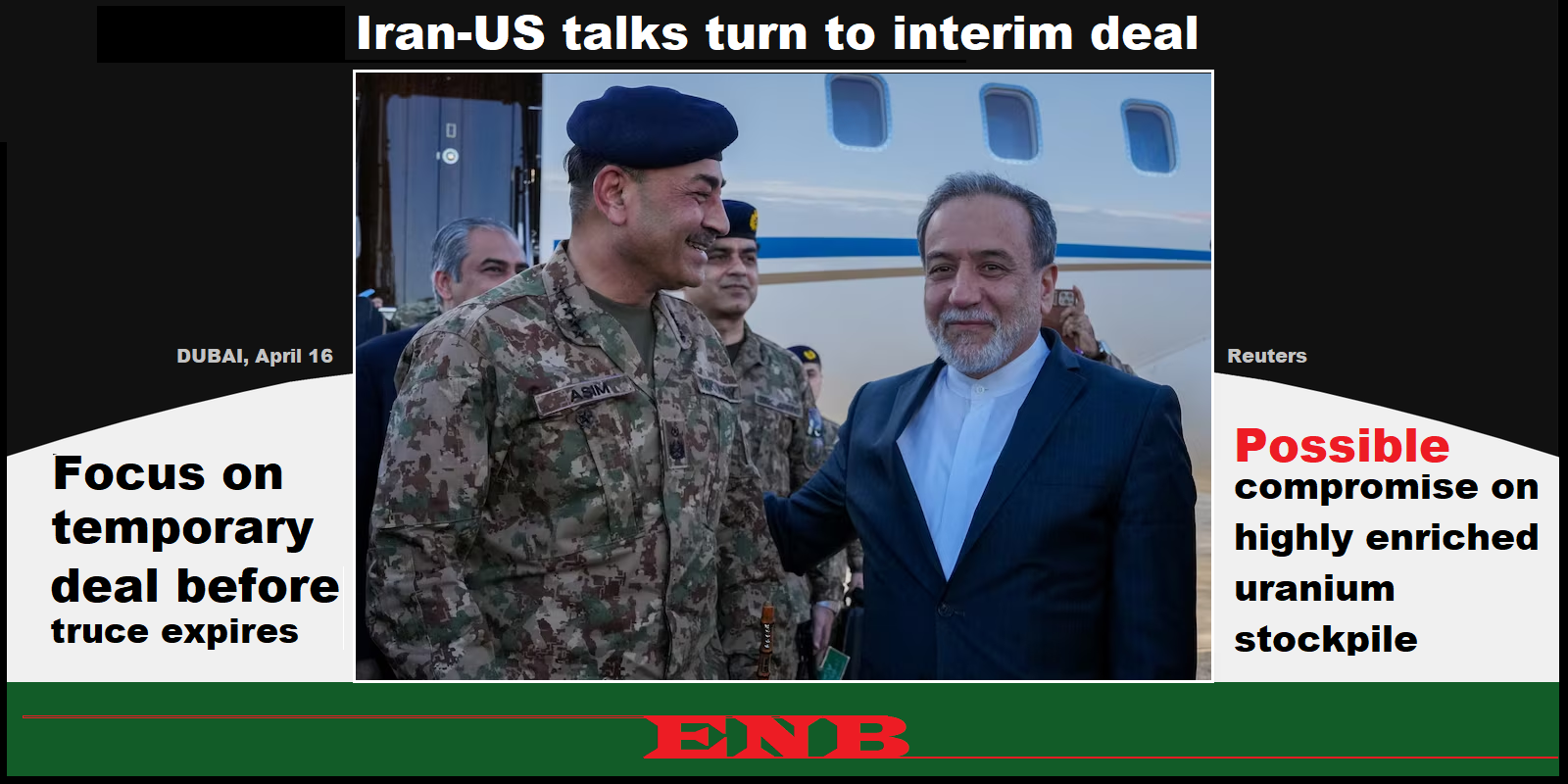
Iran-US talks turn to interim deal
amid rifts over nuclear work, Iranian sources say
By Parisa Hafezi, John Irish and Francois Murphy April 16, 2026
Summary
- Iran, US make limited progress, major nuclear gaps remain
- Focus on temporary deal before truce expires
- Possible compromise on highly enriched uranium stockpile
DUBAI, April 16 (Reuters) - U.S. and Iranian negotiators have scaled back ambitions for a comprehensive peace deal and are instead seeking a temporary memorandum to prevent a return to conflict, two Iranian sources told Reuters.
The shift follows last weekend's inconclusive talks in Islamabad, where deep differences over Iran’s nuclear programme — including the fate of its enriched uranium stockpiles and how long Tehran should halt nuclear work — have continued to threaten progress, despite U.S. officials and Pakistani mediators talking up prospects.
A senior Iranian official said the two sides had started to narrow some gaps, including over how to manage the Strait of Hormuz, a vital route for about 20% of the world's oil and gas needs that has been closed to most ships for weeks.
Iran, which has faced crippling U.S. sanctions for years, wants a memorandum to include Washington unfreezing some Iranian funds, in return for allowing more ships through the strait, said the senior official, who asked not to be named because of the sensitivity of the matter.
A source briefed by Tehran said on Wednesday that Iran could let ships sail freely through the Omani side of the Strait of Hormuz without risk of attack under proposals it has offered in talks with the U.S., providing a durable deal is clinched.
But more than halfway through a two-week truce, deeper splits remain. The senior official said these included agreeing on the fate of Iran’s stockpile of highly enriched uranium (HEU), which the U.S. wants removed, and the duration of any halt to Iranian nuclear work, notably uranium enrichment.
Iran has long demanded Washington acknowledge its right to enrich uranium, which Tehran says it only seeks for peaceful purposes but which Western powers and Israel say is aimed at building nuclear weapons.
A Western diplomat said the nuclear issue "remains a core obstacle".
If a memorandum to halt the conflict is reached, the two sides are expected to have 60 days to negotiate a final deal, which would require involvement of experts and the International Atomic Energy Agency (IAEA), the Iranian sources said.
A previous international deal curtailing Iran's nuclear work in return for sanctions relief was signed in 2015 but it took almost two years to negotiate. President Donald Trump scrapped that pact in 2018.
The Iranian sources said the United States is demanding a halt to Iran's nuclear enrichment work for 20 years, while Iran wants to limit it to three to five years. Tehran also wants a timetable for lifting sanctions of U.N., U.S. and EU, they said.
Iran has also in the past refused a U.S. demand to ship out its entire stockpile of uranium which has been enriched to 60%, a level that is far higher than levels needed for civilian uses.
However, Iranian sources said there were signs a compromise could emerge. One source said that, while Iran was not ready to send all its highly enriched uranium (HEU) abroad, part of it could be sent to a third country.
He said some HEU was needed for medical purposes and for a research reactor in Tehran which runs on relatively small amounts of uranium enriched to around 20%.
The IAEA estimates Iran had 440.9 kg of uranium enriched to 60% when Israel and the United States launched their first attacks on Iranian nuclear facilities in June 2025. Exactly how much of that has survived is unclear.
IAEA chief Rafael Grossi said in March that what remained of that stock was “mainly” stored in a tunnel complex in Isfahan, and that his agency believed slightly more than 200 kg of it was there. It also believes some is at the sprawling nuclear complex at Natanz, where Iran had two enrichment plants.
A second Western diplomat said: "The 440 kg HEU remains cause for concern because it allows Iran to have what we call sufficient quantities to build a number of nuclear bombs quite quickly, because the final enrichment phase is relatively quick.”
Reporting by Parisa Hafezi in Dubai, John Irish in Paris and Francois Murphy in Vienna, writing by Parisa Hafezi Editing by Peter Graff, William Maclean
Pakistan ramps up mediation efforts
Pushing for second round of US-Iran negotiation
By Zhang Yuying and Zhang Wanshi
Published: Apr 16, 2026 Global Times
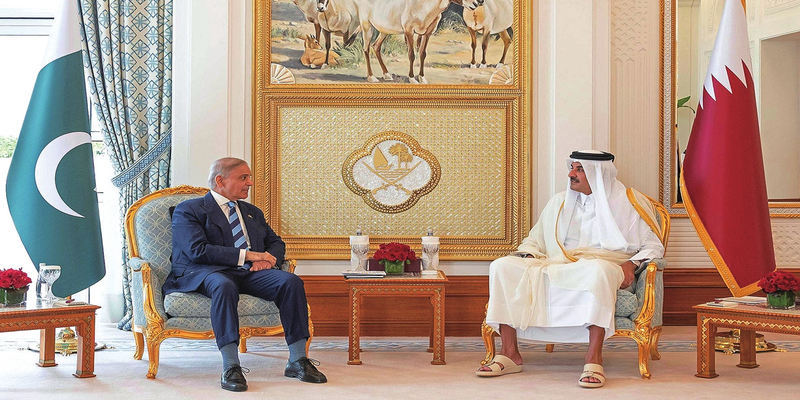
Pakistan is ramping up mediation efforts regarding US-Iran conflict. Prime Minister Shehbaz Sharif met Qatar's Emir Thursday to call for de-escalation, while a Pakistani delegation is having talks in Iran to pave the way for a second round US-Iran negotiation in Islamabad.
Prime Minister Shehbaz Sharif on Thursday met with Qatar's Emir Tamim bin Hamad bin Khalifa Al Thani and stressed the importance of de-escalation and dialogue amid the ongoing regional situation, Pakistani media outlet Dawn reported.
The prime minister, accompanied by a high-level delegation, is undertaking official visits to Saudi Arabia, Qatar and Turkey from April 15 to 18, read the report.
Shehbaz said on X that "We discussed the evolving regional situation, particularly in the Gulf region, and underscored the importance of de-escalation, dialogue, and close international coordination to ensure peace and stability," per Dawn.
The trip came as Iran's top negotiator and speaker of its Parliament, Mohammad Bagher Ghalibaf, met on Thursday with a Pakistani delegation led by the head of the Army, Field Marshal Syed Asim Munir, according to Mehr, a semiofficial Iranian news agency, the New York Times reported.
Earlier, Pakistan, which is mediating between Iran and the US, said it expected to host a second round of peace negotiations between the two countries, per the report.
Tahir Andrabi, a spokesman for Pakistan's foreign ministry, said on Thursday that a second round was expected in Islamabad, Pakistan's capital, after initial talks there ended on Sunday without an agreement, according to the New York Times.
Per a report by the Bloomberg, Pakistan's army chief Munir and Pakistan's Interior Minister Mohsin Naqvi along with a delegation from the country arrived in Iran's capital "as part of the ongoing mediation efforts," Pakistan's military said in a statement.
Iran's foreign minister, Abbas Araghchi, took part in a preliminary meeting Wednesday with Munir, AP reported, citing Iranian state media. According to DW, Munir is seen as one of the most influential intermediaries between the US and Iran.
The White House said any further talks would likely take place in the Pakistani capital of Islamabad, though no decision had been made on whether to resume negotiations, according to AP.
White House press secretary Karoline Leavitt said on Wednesday that "The Pakistanis have been incredible mediators throughout this process, and we really appreciate their friendship and their efforts to bring this deal to a close." Leavitt further stressed "So they are the only mediator in this negotiation," according to the New York Post.
According to BBC, Israeli Prime Minister Benjamin Netanyahu is set to speak to the Lebanese President Joseph Aoun on Thursday, cabinet security member Galia Gamliel says on Israeli Army radio.
It comes after US President Donald Trump posted on Truth Social on Wednesday night that Israeli and Lebanese leaders will be speaking "tomorrow."
However, an official in Lebanon's presidential office has told the BBC that Lebanon is not aware of any upcoming contact with Israel.
While the initial US-Iran negotiation failed to lead to positive outcomes, both sides have kept a willingness to maintain communication through follow-up remarks and practical moves. This has created conditions for a future resumption of negotiations, which also reflects the mainstream expectations of the international community, Zhu Yongbiao, director of the Center for Afghanistan Studies at Lanzhou University, told the Global Times on Thursday.
Pic: Qatar's Emir Tamim bin Hamad bin Khalifa Al Thani (right) speaks with Pakistan's Prime Minister Shehbaz Sharif during their meeting in Doha, Qatar, on April 16, 2026. Photo: VCG