Oil plunges as US and Iran boost peace hopes by declaring Hormuz strait open
ANDREW ENGLAND AND MALCOLM MOORE — LONDON HUMZA JILANI — ISLAMABAD STEFF CHÁVEZ — WASHINGTON Additional reporting by Alice Hancock FT 17-04-2026
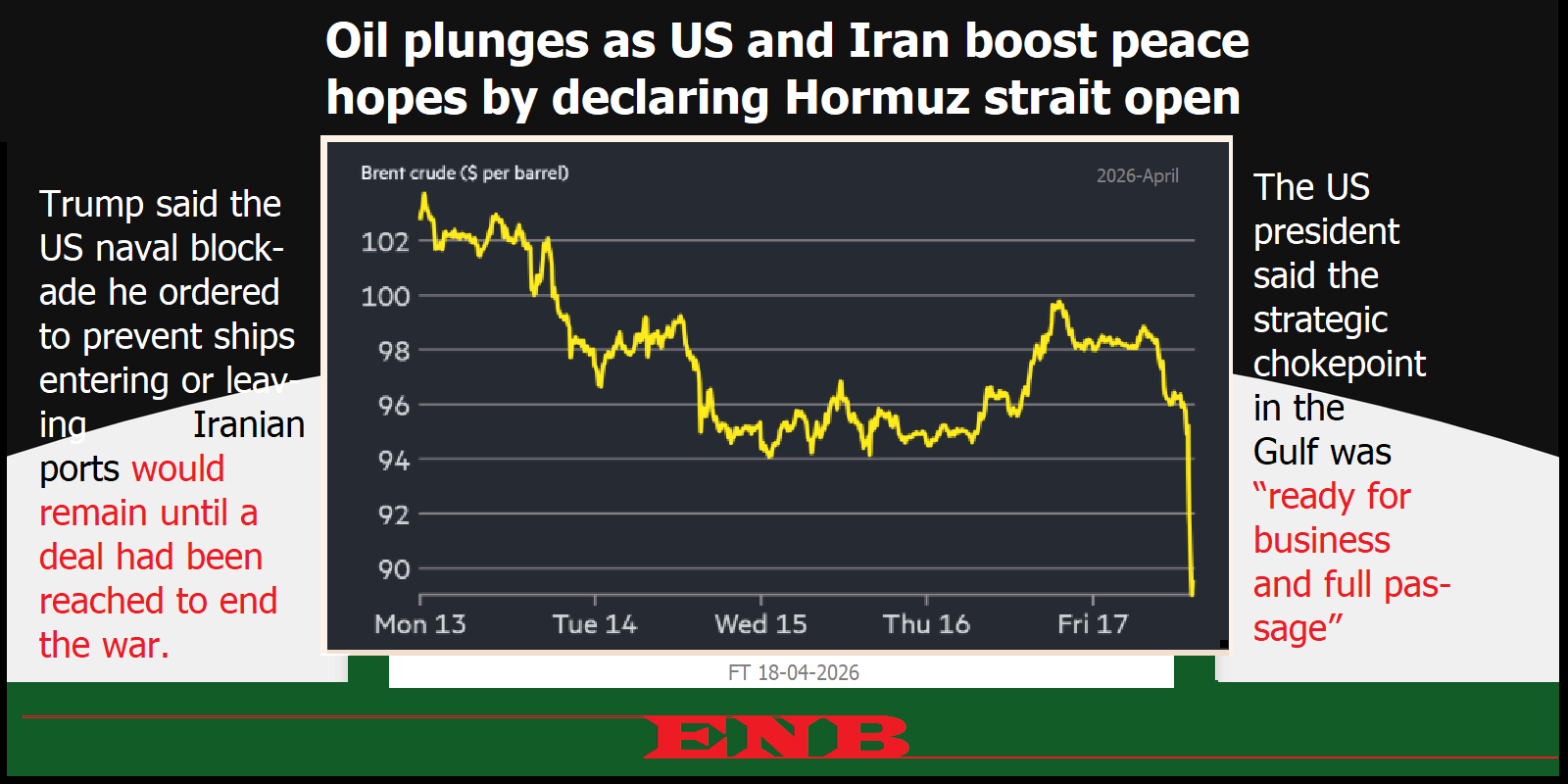
Oil prices tumbled yesterday after the US and Iran declared the Strait of Hormuz open for shipping and Donald Trump signalled that the war with Tehran was close to an end.
The US president said the strategic chokepoint in the Gulf was “ready for business and full passage”, thanking Iran after foreign minister Abbas Araghchi said the strait would be “completely open” for the remainder of a two-week ceasefire that expires on Tuesday night.
Hopes of an end to the war spurred Brent crude, the oil benchmark, to drop more than 11 per cent to about $88 a barrel, its lowest for five weeks, while European gas prices fell 10 per cent.
Stocks and bonds rallied, with the S&P 500 rising 1.2 per cent, on course for a weekly gain of almost 5 per cent.
While several oil executives raised concerns over the strait being mined, a handful of vessels appeared to be preparing to exit the Gulf.
Ship-tracking satellites showed at least 15 vessels, including a Greekowned oil tanker and three container ships belonging to the French shipping line CMA CGM, heading for the strait.
The closure of the waterway for the past seven weeks has triggered a global energy crisis and provided Tehran with a significant source of leverage.
The declarations that the strait was open came after the US pressed Israel to pause its offensive against Hizbollah in Lebanon, an Iranian condition to allow ships to pass. Iran would still insist that vessels gain permission from the Islamic Revolutionary Guard Corps before transiting the strait, an official told state TV.
Trump said the US naval blockade he ordered to prevent ships entering or leaving Iranian ports would remain until a deal had been reached to end the war. The process, Trump said yesterday, “should go very quickly in that most of the points are already negotiated”.
Diplomats warned no talks were scheduled and differences over Iran’s nuclear project continued to be the main barrier. Pakistan has been leading mediation, with one non-Pakistani diplomat saying Islamabad was seeking an extension of the truce in case an agreement was not sealed before it expired.