Israeli strikes kill a journalist and injures another in Lebanon
Lebanese officials say rescue teams came under fire while trying to aid Amal Khalil, a reporter, and Zeinab Faraj, a photojournalist
Ashley Ahn Thu Apr 23 2026 Irish Times
Israeli strikes killed one journalist and wounded another in southern Lebanon on Wednesday, rattling a tenuous ceasefire between Israel and Lebanon.
The Lebanese ministry of public health said the Israeli military had targeted the journalists in the town of Tayri, where they took shelter in a nearby house after an air strike struck a vehicle in front of the car they were travelling in.
About an hour and a half later, a second strike hit the house they were hiding in, according to a statement by a Lebanese newspaper Al-Akhbar, which employed the journalist who was killed.
The Lebanese Red Cross said its teams came under fire while trying to evacuate the journalists from the house, forcing them to withdraw. The rescue crews were targeted by a warning strike and machine-gun fire, the Lebanese health ministry said.
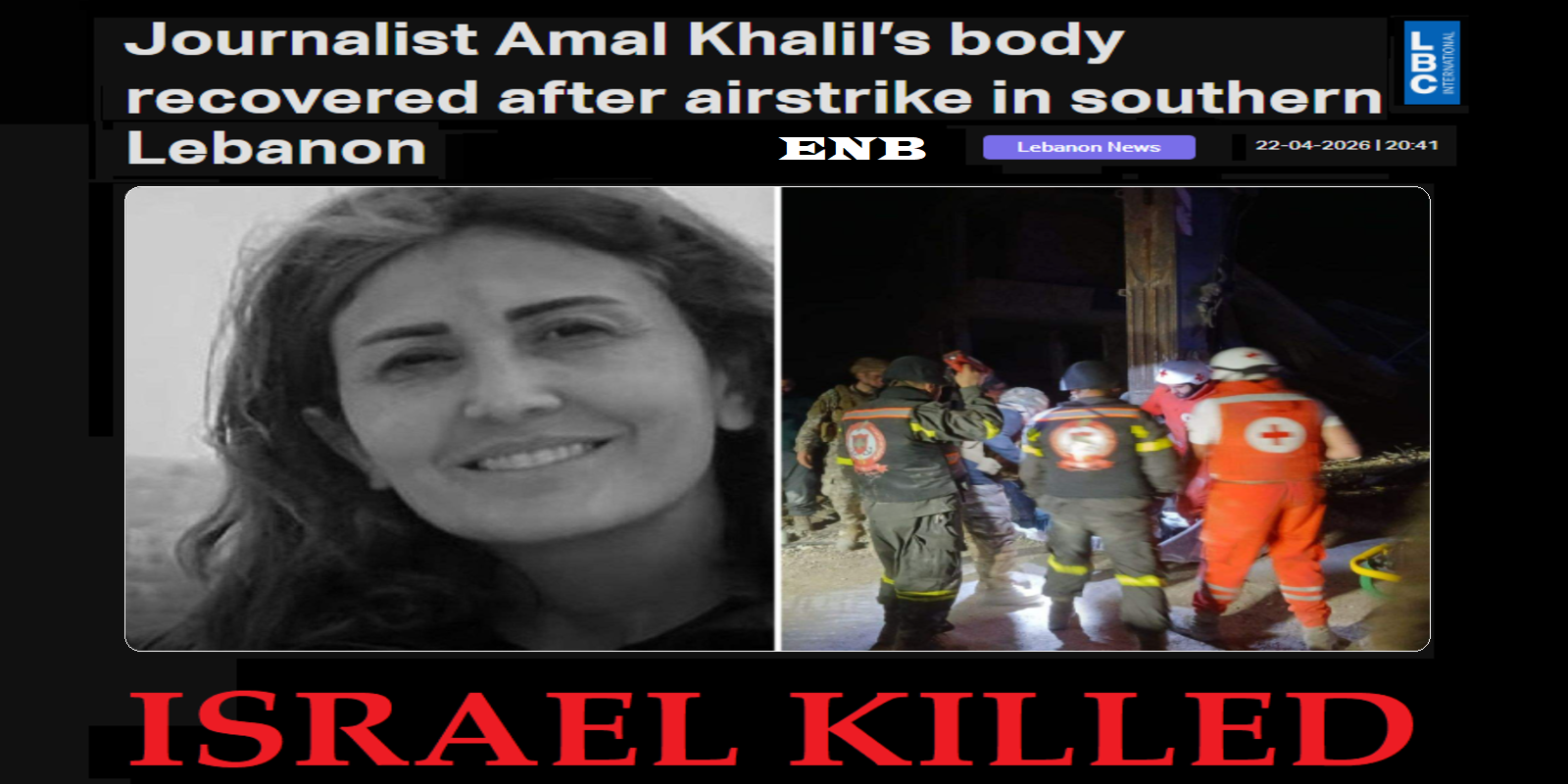
Zeinab Faraj, a photojournalist, was rescued from the house. The other journalist, Amal Khalil, who was a reporter for Al-Akhbar, remained trapped under rubble for hours before emergency medics recovered her body, according to the Lebanese Civil Defense.
In addition to Khalil, the two people in the car in front of her were killed in the strikes, Al-Akhbar reported.
Amid the 10-day truce between Israel and Lebanon, Israel has continued strikes against what it says are Hizbullah targets in southern Lebanon, citing its right to self-defence. Hizbullah, the Iranian-backed militia group, said it had fired rockets and drones into Israel on Tuesday in response to what it said were violations of the ceasefire.
Earlier on Wednesday, the Lebanese News Agency reported that an Israeli drone strike killed one person and wounded two others in another part of the country.
The Lebanese health ministry called the strikes in Tayri a “blatant double breach, involving both the obstruction of rescue efforts for a civilian known for her media and humanitarian work, and the direct targeting of an ambulance clearly marked with the Red Cross.”
The Israeli military denied in a statement that it had prevented rescuers from reaching the injured journalists and said the incident was under investigation.
A spokesperson for the Israeli military said Israeli forces had spotted two vehicles emerging from a military building used by Hizbullah. The military observed the vehicles cross what the spokesperson called the forward defence line, determining the move to be a violation of the truce agreement.
The spokesperson confirmed the Israeli military had struck one of the vehicles and the building some of the occupants of the second vehicle had taken shelter in.
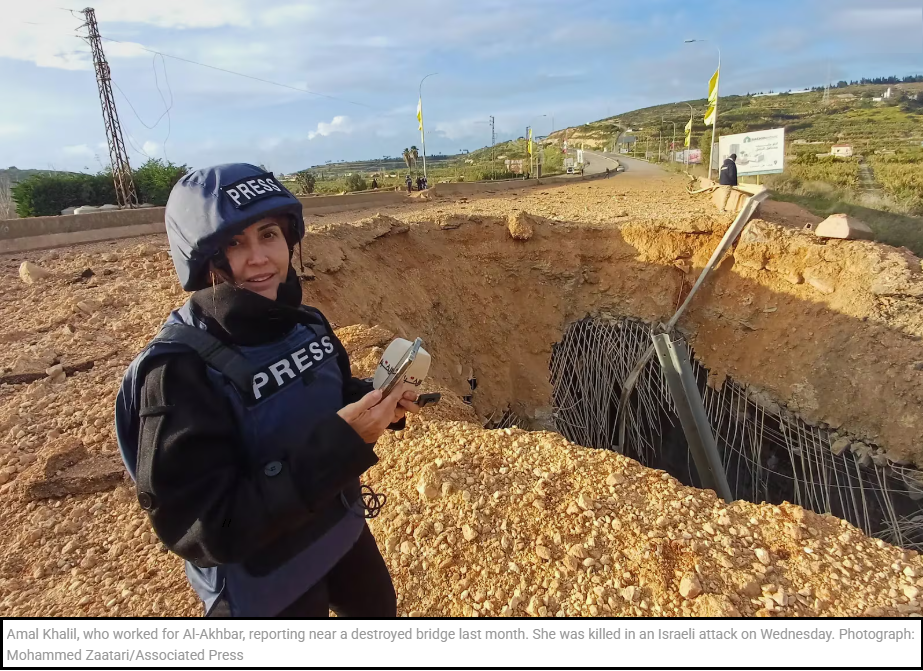
Khalil had covered southern Lebanon, where Hizbullah exercises strong control, since at least 2006. In a tribute to Khalil, a colleague from Al-Akhbar said she embodied the resilience of the southern Lebanese through her relentless reporting, refusing to leave the front lines of war where thousands of Lebanese had been displaced.
Founded in 2006, Al-Akhbar is a popular Lebanese newspaper that champions leftist causes while supporting Hizbullah’s fight against Israel. The paper has close ties to Hizbullah, operating under its protection and securing access to high-ranking officials for interviews.
“As with every act of aggression, wearing a press vest did not protect those who wore it from the treachery of the Israeli enemy,” Al-Akhbar said in a statement. “Instead, it has become a danger to journalists’ lives, as part of a systematic Israeli policy aimed at silencing anyone who seeks to expose the crimes and practices of the occupation.”
In a forceful statement on social media, Nawaf Salam, the Lebanese prime minister, accused the Israeli military of war crimes for targeting journalists and obstructing access to medical aid. He said the Israeli military has long targeted journalists in southern Lebanon and that Lebanon would pursue legal action in the International Criminal Court.
The Committee to Protect Journalists said it was outraged by the attack and that it raised serious concerns of deliberate targeting.
“The repeated strikes on the same location, the targeting of an area where journalists were sheltering and the obstruction of medical and humanitarian access constitute a grave breach of international humanitarian law,” said Sara Qudah, CPJ’s regional director for the Middle East and North Africa.
Lebanese journalist Amal Khalil killed in Israeli strike on a house where she took cover, paper says
By BASSEM MROUE and SARAH EL DEEB
April 23, 2026 AP
BEIRUT (AP) — A Lebanese journalist was killed Wednesday in an Israeli airstrike on a house in southern Lebanon where she had taken cover while reporting on the Israel-Hezbollah war. Her body was only retrieved from the rubble hours later, rescue workers said.
The daily Al-Akhbar newspaper says its reporter Amal Khalil was killed in the southern village of al-Tiri.
Khalil had been covering the conflict in Lebanon between Israel and the Lebanese Hezbollah militant group that resumed in early March, in the shadow of the U.S.-Israeli war in Iran. She took cover in the house in al-Tiri after an earlier Israeli airstrike hit near the car she was traveling in with another colleague.
The Lebanese health ministry said the first strike killed two people. A second Israeli strike then hit the house in al-Tiri where Khalil and her colleague Zeinab Faraj had taken cover.
At first, rescue workers were able to get to Faraj, who was seriously wounded, and retrieve the bodies of two killed in the first airstrike. But they were fired on by Israeli forces so they were forced to halt attempts to reach Khalil, the ministry said.
Khalil remained under the rubble for hours before the Lebanese army, civil defense and the Lebanese Red Cross were able to get to the scene hours later. Khalil’s body was retrieved shortly before midnight, at least six hours after the strike.
Israel’s military said individuals in the village had violated the ceasefire, endangering its troops. Israel denied that it targets journalists or that it prevented rescue teams from reaching the area. It said the incident was under review.
“Killing of journalists is a crime and a flagrant violation of international and humanitarian law,” said Lebanon’s Information Minister Paul Morcos.
Khalil’s death comes on the eve of the second round of direct talks between Israeli and Lebanese officials in Washington on extending the ceasefire that went into effect last Friday.
Khalil, who was from southern Lebanon, had been covering the area since 2006 for al-Akhbar. Her latest reporting was about Israeli demolitions of Lebanese homes in villages where Israeli troops are now positioned inside Lebanon.
Her death brings to nine the number of journalists killed in Lebanon so far this year. At least 2,300 people have been killed in Israeli strikes and more than 1 million displaced since the latest Israel-Hezbollah war erupted on March 2.
Earlier on Wednesday, Reporters Without Borders called for international pressure on the Israeli army to allow Khalil’s rescue. Committee to Protect Journalists expressed its “outrage” at the apparent targeting of the two journalists and warned the obstruction of rescue efforts “may amount to a war crime.”
Lebanon’s President Joseph Aoun asked the Lebanese Red Cross to coordinate with the Lebanese army and U.N. peacekeepers “to carry out the rescue operation” as quickly as possible.
In late March, an Israeli airstrike on southern Lebanon killed three journalists covering the war. Hezbollah’s al-Manar TV said its longtime correspondent Ali Shoeib was killed. Israel’s military said it had targeted Shoeib, accusing him of being a Hezbollah intelligence operative, without providing evidence.
Also killed in the same strike was reporter Fatima Ftouni, who worked for the Beirut-based Al-Mayadeen TV along with her brother Mohammed Ftouni, a video journalist.
Days earlier, an Israeli airstrike on an apartment in central Beirut killed Mohammed Sherri, the head of political programs at Hezbollah’s at Al-Manar TV, along with his wife.
SARAH EL DEEB: Associated Press writer Abby Sewell in Beirut contributed to this report.
El Deeb is part of the AP’s Global Investigative team. She is based in the Middle East, a region she covered for two decades
Amal Khalil, who worked for Al-Akhbar, reporting near a destroyed bridge last month. She was killed in an Israeli attack on Wednesday. Photograph: Mohammed Zaatari/Associated Press