US, Iran no closer to ending war as Gulf clashes flare
By Idrees Ali, Erin Banco and Hatem Maher May 9, 2026
Summary
- Sporadic attacks in Strait of Hormuz, UAE hit by Iranian missiles and drones
- CIA analysis suggests Iran can withstand US blockade for months
- US expands sanctions on Iran-linked entities, warns allies over lack of support
WASHINGTON/CAIRO, May 9 (Reuters) - The U.S. and Iran appeared no closer on Saturday to finding an end to their war after the two sides traded fire in the Gulf amid a tenuous ceasefire, while a U.S. intelligence analysis concluded Tehran could withstand a naval blockade for months.
Recent days have seen the biggest flare-ups in fighting in and around the Strait of Hormuz since a ceasefire began a month ago, and the United Arab Emirates came under renewed attack on Friday.
Washington has been awaiting Tehran's response to a U.S. proposal that would formally end the war before talks on more contentious issues, including Iran's nuclear program. Speaking in Rome on Friday, Secretary of State Marco Rubio said the U.S. was expecting a response that day, although an Iranian foreign ministry spokesperson said Tehran was still weighing its response.
CLASHES TEST CEASEFIRE
Sporadic clashes continued on Friday between Iranian forces and U.S. vessels in the Strait of Hormuz, Iran's semi-official Fars news agency reported. The Tasnim news agency later cited an Iranian military source saying the situation had calmed but warning more clashes were possible.
The U.S. military said it struck two Iran-linked vessels attempting to enter an Iranian port, with a U.S. fighter jet hitting their smokestacks and forcing them to turn back.
Tehran has largely blocked non-Iranian shipping through the strait since the war began with U.S.-Israeli airstrikes across Iran on February 28. Before the war, one-fifth of the world's oil supply passed through the narrow waterway.

A map showing the inbound and outbound shipping lanes in the Strait of Hormuz, in addition to the the maritime boundary between Oman and Iran.
The U.S. imposed a blockade on Iranian vessels last month. But a CIA assessment indicated Iran would not suffer severe economic pressure from a U.S. blockade of Iranian ports for about another four months, according to a U.S. official familiar with the matter, raising questions over President Donald Trump's leverage over Tehran in a conflict that has been unpopular with voters and U.S. allies.
A senior intelligence official characterised as false the “claims” about the CIA analysis, which was first reported by the Washington Post.
Clashes extended beyond the waterway. The UAE said its air defences engaged with two ballistic missiles and three drones from Iran on Friday, with three people sustaining moderate injuries.
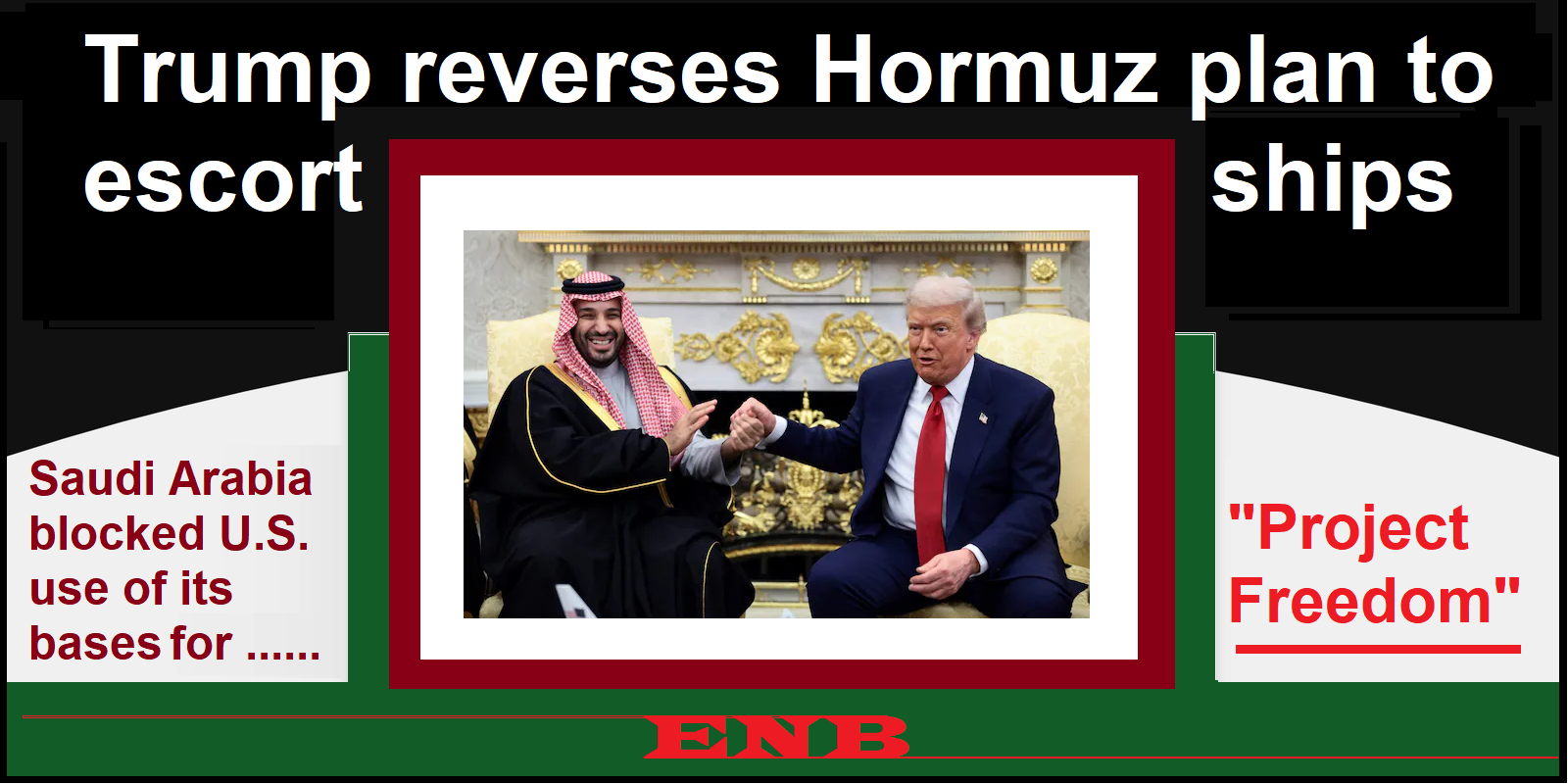
Iran has repeatedly targeted the UAE and other Gulf states that host U.S. military bases. In what the UAE called a major escalation, Iran stepped up attacks this week in response to Trump's announcement of "Project Freedom" to escort ships in the strait, which he paused after 48 hours.
Trump said on Thursday the ceasefire, announced on April 7, was still holding despite the flare-ups, while Iran accused the U.S. of breaching it.
"Every time a diplomatic solution is on the table, the U.S. opts for a reckless military adventure," Foreign Minister Abbas Araqchi said on Friday. Iran's Mehr news agency reported that one crew member was killed, 10 wounded and six missing after a U.S. Navy attack on an Iranian commercial ship late on Thursday.

A map showing the inbound and outbound shipping lanes in the Strait of Hormuz, in addition to the the maritime boundary between Oman and Iran.
U.S. PURSUES DIPLOMACY, STEPS UP SANCTIONS
The U.S. has found little international support in the conflict. After meeting with Italian Prime Minister Giorgia Meloni, Rubio questioned why Italy and other allies were not backing Washington's efforts to reopen the strait, warning of a dangerous precedent if Tehran were allowed to control an international waterway.
While pursuing diplomacy, the U.S. also ratcheted up sanctions to pressure Iran.
Days before Trump travels to China to meet President Xi Jinping, the U.S. Treasury on Friday announced sanctions against 10 individuals and companies, including several in China and Hong Kong, for aiding efforts by Iran's military to secure weapons and raw materials used to build Tehran's Shahed drones.
Treasury said in a statement it was prepared to act against any foreign company supporting illicit Iranian commerce and could impose secondary sanctions on foreign financial institutions including those connected to China's independent oil refineries.
Reporting by Reuters Newsrooms; Writing by Chang-Ran Kim; Editing by William Mallard
Idrees Ali-Thomson Reuters
National security correspondent focusing on the Pentagon in Washington D.C. Reports on U.S. military activity and operations throughout the world and the impact that they have. Has reported from over two dozen countries to include Iraq, Afghanistan, and much of the Middle East, Asia and Europe. From Karachi, Pakistan.
Erin Banco-Thomson Reuters
Erin Banco is a national security correspondent focusing on the intelligence community. She covers everything from the wars in Ukraine and Gaza to U.S. covert operations overseas. She previously worked at POLITICO as a national security reporter. Banco has a long history covering the Middle East region, from Cairo to Baghdad to Aleppo where she’s reported on the Arab Spring and its aftermath, including the civil war in Syria and the rise of ISIS. Her 2017 book, Pipe Dreams, focuses on the development of the oil and gas industry in the northern Kurdistan region of Iraq. Banco attended The University of Wisconsin-Madison, where she majored in Arabic and journalism. She earned a master’s in public administration from Columbia University’s School of International and Public Affairs in 2014.