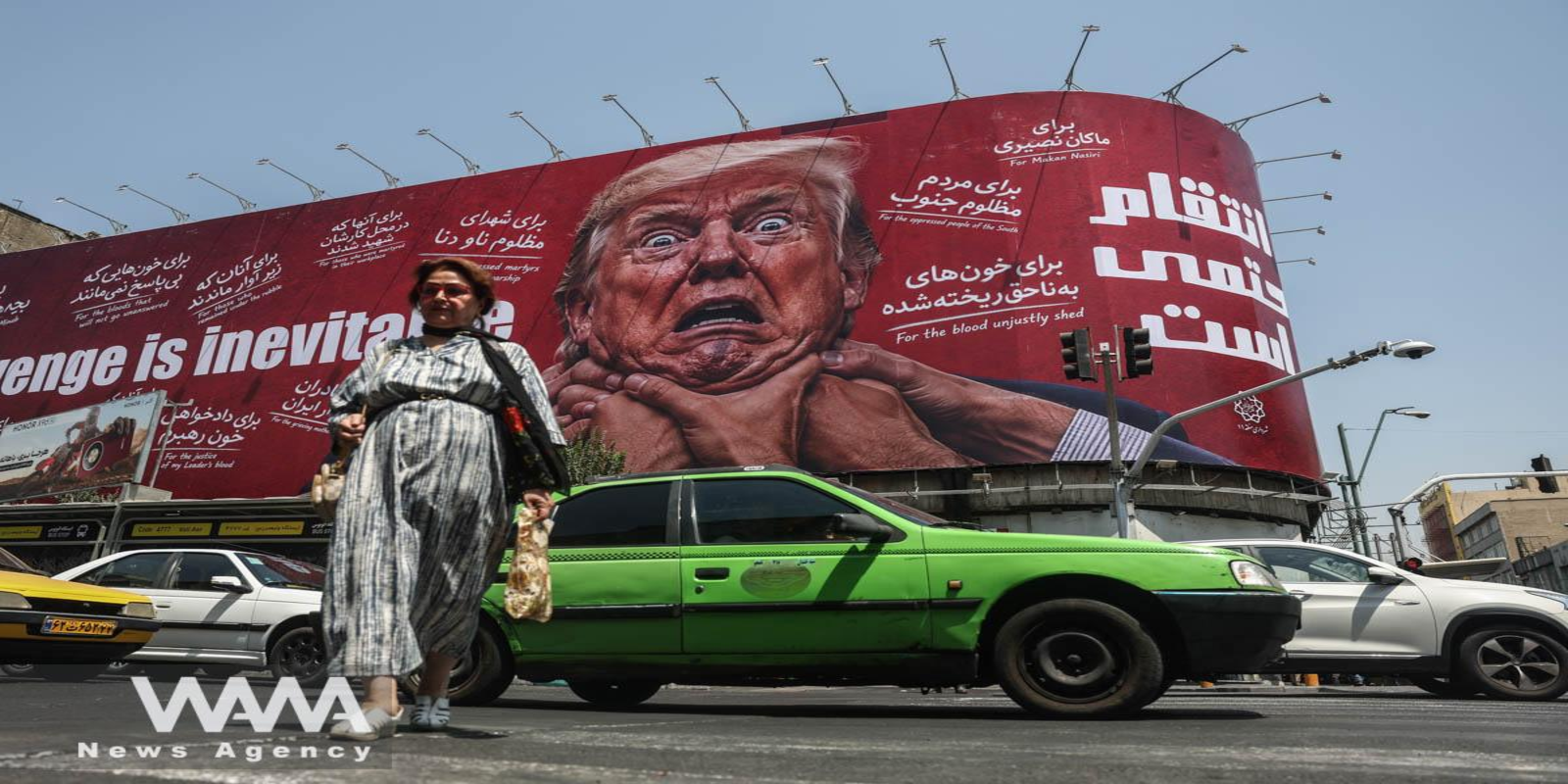
People walk near a billboard depicting U.S. President Donald Trump on a building in Tehran, Iran, July 27, 2026. Majid Asgaripour/WANA (West Asia News Agency)
The Region on the Brink of Explosion
30 July 2026 WANA News
WANA (Jul 30) – The situation in the Middle East—particularly in the strategically vital Persian Gulf—is deteriorating by the hour, steadily moving toward what could become its most dangerous and complex phase yet, one that may prove far more consequential than the recent war.
During the conflict, following the joint U.S. and Israeli military strikes on Iranian territory, the war expanded across the region, just as Tehran had previously warned it would. However, because regional attention remained overwhelmingly focused on the attack against Iran, missile and drone strikes on U.S. positions in Persian Gulf states received comparatively little attention.
Despite repeated protests from those governments, the attacks were largely overshadowed by the broader conflict with Iran and by widespread Arab public approval of Tehran’s retaliatory strikes against Israel.
The situation has now changed to some extent. With Israel no longer at the center of the latest confrontation alongside the United States, and with no direct exchange of attacks currently taking place between Tehran and Tel Aviv, both the nature of the confrontation and regional perceptions of it are beginning to shift.
At the same time, the announcement of an operation aimed at breaking the blockade of Sanaa, the expansion of the conflict to the Bab el-Mandeb Strait, and the reported blockade of Saudi Arabia have pushed the region into a new phase of heightened tension. Saudi airstrikes on Yemen, followed by missile attacks by the Houthis on key Saudi oil and infrastructure facilities, have further intensified the crisis.
Riyadh has now entered the conflict openly and directly, and on Tuesday night reportedly joined the United States in carrying out airstrikes against Popular Mobilization Forces (PMF) targets inside Iraq.
Saudi Arabia’s direct military involvement carries significant potential to widen the conflict and suggests that the region may be approaching a complex, multi-layered crisis. As tensions involving Riyadh escalate, it cannot be ruled out that other regional powers, including Pakistan and Egypt, could also become drawn into the confrontation.
The greatest danger facing the region now is that the U.S.-Israeli war against Iran is increasingly being perceived—at least by segments of regional public opinion and political circles—as evolving into an Iranian-Arab conflict. Such a shift could inflame long-standing ethnic and sectarian divisions across the Middle East and, in the process, push the conflict with Israel into the background.
In recent months, regional governments, themselves affected by the spillover from the war against Iran, sought—however reluctantly—to contain the crisis and pursue a swift diplomatic resolution out of concern over the potentially devastating consequences of a wider conflict.
In recent weeks, however, particularly following the latest developments, signs have emerged of growing alignment between some regional governments and Israel around the objective of resolving the Iran issue through this conflict and preventing any strategic balance from shifting in Tehran’s favor.
It increasingly appears that regional states are being drawn, one after another, into a broader bloc confrontation according to a defined scenario. Even if Israel is not the architect of such a strategy, it could ultimately emerge as its principal beneficiary.