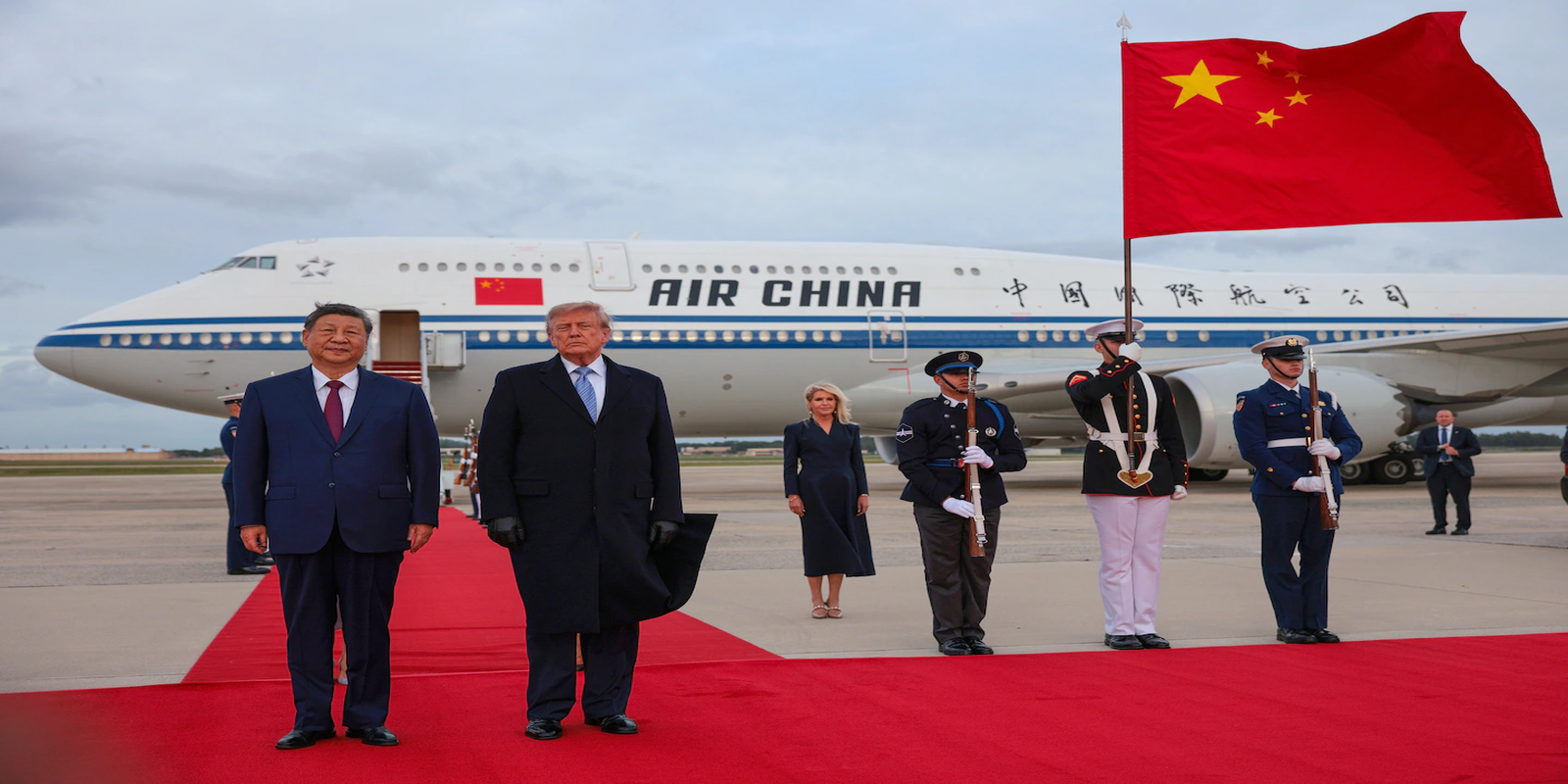
Chinese President Xi Jinping and President Donald Trump at Joint Base Andrews on Wednesday. (Chip Somodevilla/Getty Images)
Trump gives Xi Jinping rare airport welcome as summit visit begins
Greeting on the tarmac is an unusual gesture not typically extended to foreign heads of state, underscoring Trump’s desire to court the Chinese leader.
September 23, 2026
By Cat Zakrzewski and Michael Birnbaum
JOINT BASE ANDREWS, Md. — President Donald Trump welcomed Chinese President Xi Jinping to Washington on Wednesday in an unusual ceremony at the airport that demonstrated how much the U.S. leader is seeking to put on a show for his counterpart.
Xi’s arrival kicked off the first Chinese state visit to Washington in more than a decade, and Trump has sought to stage-manage it extensively. Both leaders are attentive to the symbolism of even the smallest gestures.
U.S. leaders by custom do not greet arriving heads of state at the airport, holding back at the White House to offer a reception on their own turf. And Xi did not greet Trump at the Beijing airport when the U.S. president flew there in May. Chinese diplomacy often focuses on tit-for-tat symmetry during carefully managed visits; Trump’s show of hospitality was an effort to go beyond his Beijing reception as a gesture to his guest.
Xi’s Air China 747 touched down shortly before 6 p.m., and uniformed U.S. military personnel rushed to roll out a red carpet and smooth it down as senior Chinese officials watched from the opened airplane door. Trump’s armored limousine pulled up, and he and first lady Melania Trump walked up the carpet to the base of the plane’s stairs.
The Chinese leader and his wife, Peng Liyuan, walked down the stairs and shook hands with the Trumps. Then they stood as the anthems were played.
Later, after returning to the White House, Trump told reporters that “We have a packed house tomorrow night for President Xi.” He boasted of the speed at which he was constructing a new ballroom to host future state dinners.
The leaders are expected to work through an array of issues in meetings Thursday and Friday as they manage the complicated relationship between the world’s largest powers. Trump has worked to pull manufacturing back to the U.S. and has sought Chinese cooperation in doing so. Xi, meanwhile, has sought to take advantage of a relatively sympathetic U.S. leader to impose more pressure on Taiwan and expand Chinese influence over global affairs.
Trump will also seek to limit China’s involvement in the war with Iran.
“I’ll be talking about that and many other subjects but it’s all coming along, including that,” he said.
The previous cases of U.S. presidents greeting guests at the airport underscored the unusual nature of Trump’s gesture: Presidents Ronald Reagan, George W. Bush and Barack Obama all trundled to airports to greet popes, the rare world leader who might be thought to pull rank over a U.S. president. Richard M. Nixon greeted Japanese Emperor Hirohito at the same Anchorage military base where Trump met Russian President Vladimir Putin last year.
Trump went to great lengths to provide a lavish welcome for Xi. Color teams held the Chinese and American flags. A U.S. Air Force band played a fanfare and the U.S. and Chinese national anthems. And the president treated Xi to flyovers from two B-1 bombers — a double-edged moment that simultaneously flexed military might to a rival and also upped the ceremony.
The flyover, which took place as the U.S. anthem was playing and Trump was saluting, was so loud that the president winced and momentarily ducked his head, later smiling and appearing to comment about the noise to Xi, who did not visibly react to the flyover.
The bulk of the substantive part of Xi’s visit is planned for Thursday, with the two leaders sitting down to discuss issues that include investment, the future of artificial intelligence, and how to manage Beijing and Washington’s global competition.
But there will be lighter moments — including a Friday visit to the National Archives, where the leaders are expected to look at some of the United States’ foundational documents.
Trump and Xi may see each other two more times this year, a pace with little recent precedent. Xi will host Asia-Pacific Economic Cooperation leaders in Shenzhen, China, in November, while Trump will welcome leaders of the Group of 20 economic powers in Miami in December.
Expectations for major announcements this week are muted — but U.S. officials argue that a heavy pace of meetings between the leaders may in itself be a positive development, since it can build trust and avoid miscommunications if the two men can develop a rapport.
Xi’s arrival also highlighted the tensions between his authoritarian government and its critics. Hundreds of protesters as well as Xi supporters began gathering in the midafternoon, staking out key points on Xi’s motorcade route from Andrews, which is just south of the city, to downtown Washington. Fights broke out near the air base between the two groups. Video of one incident showed a woman and a man scuffling over an anti-Chinese Communist Party cardboard plaque.
Outside the Waldorf Astoria on Constitution Avenue, where protesters were expecting Xi to stay, D.C. police and National Guard members separated supporters waving oversize Chinese flags from protesters dressed as Winnie the Pooh.
The two sides hurled Chinese slurs at each other as supporters attempted to drown out protesters with megaphone sirens and Chinese patriotic songs.
The visit will also be a measure of Trump’s efforts to remake central Washington, where he has put up new fences and crowd control measures around Lafayette Square, the park north of the White House that has traditionally been a place for protesters to gather.
Now protests will be kept much further away from the White House grounds, which Trump has also sought to remake ahead of Xi’s visit, redoing the North Portico’s columns and adding a helipad in the shape of the presidential seal which he is also hoping to use as an entertainment space.
Some of the pomp may be kept off camera, however, because of Trump’s effort to ban CNN, MS NOW and Politico journalists from the White House. That has led to an effective boycott by the television networks, including Fox News, that operate the shared camera pool of the president’s movements.
No major U.S. outlet carried Xi’s arrival live — including Fox, which aired a live interview with Treasury Secretary Scott Bessent. Reuters operated a feed that was shared with subscribers, while Real America’s Voice, a pro-Trump outlet, carried its own coverage.
Cate Cadell and Katherine Doyle contributed to this report.