Former IMF deputy Gita Gopinath: ‘It’s straight-out protectionism’
The economist on Trump’s tariffs, looming threats to the dollar — and why we’re living through a ‘great gamble’
FT Claire Jones 28-08-2026
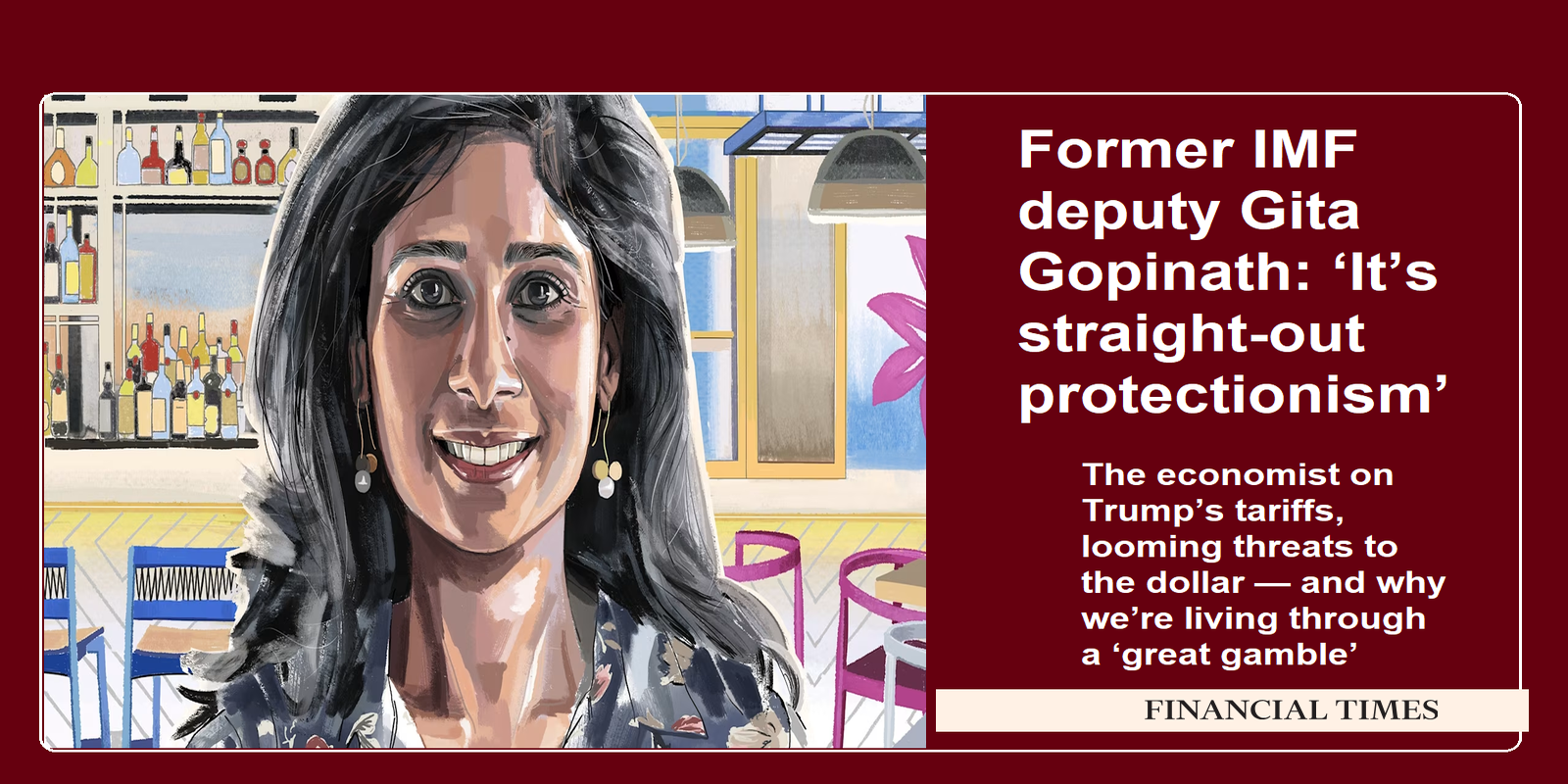
It’s 1pm on a sweltering August afternoon and Gita Gopinath’s choice of lunch venue has proven prescient. We meet at Sumiao Hunan Kitchen, a bustling Chinese restaurant a couple of stops on the T from her Harvard base, amid an online debate over an article she recently co-authored. The piece, which appeared in The Economist, countered the prevailing view that Beijing’s undervalued yuan currency is the driving force behind imbalances in the global economy.
I have not long arrived, 15 minutes early, when the former second-in-command at the IMF walks in, dressed casually in a dark blue floral shirt, jeans and pumps.
When I ask if she’s still happy she chose Chinese food, she laughs. The choice, she insists, has nothing to do with her assessment of the world’s second-largest economy. “I like this restaurant — it’s actually creative and authentic.” Authentic, it turns out, means lots of spice.
As the fund’s First Deputy Managing Director, and chief economist before that, she was responsible for shaping the organisation’s economic response to the Covid pandemic and helped steer programmes on Ukraine and perennial economic problem child Argentina.
Now back in academia, it is clear Gopinath intends to use her newfound freedom to speak out in defence of the postwar economic order of free trade and financial integration coming under unprecedented attack from the Trump administration.
Before we turn to the US president’s policies and the potential economic repercussions for the dollar’s dominance of the global economy, Gopinath takes on the online critics of her stance on China.
She believes many people have misread her article, written with former IMF chief economist Pierre-Olivier Gourinchas and Hélène Rey, soon to join the Bank for International Settlements, as letting officials in Beijing off the hook.
Her argument, she says, was that pressing these officials to strengthen domestic demand would do more for the rest of the world than focusing narrowly on the exchange rate. “Frankly, I think, if that isn’t fixed, you’re not going to get a big demand stimulus for the rest of the world from the exchange-rate correction.”
I joke to my former colleagues that I can now use my whole vocabulary. I can actually say ‘trade wars’ instead of ‘trade tensions’
The waiter has already been over to our table a couple of times, only to find us locked in conversation. On his third visit, we quickly scan the menu before Gopinath picks out a couple of her favourite items for us to share from the summer menu. I add a spicy cucumber side dish and some brown rice. We both choose a mocktail — Gopinath the Mango Sticky Rice, while I go for the Lychee Blossom.
I ask about the US and Japan’s unusual intervention in late July to prop up the yen.
Gopinath says “everything” about the way it was designed points to US Treasury secretary Scott Bessent being “very concerned” about the consequences of a weak yen for the $32tn US Treasury market.
Japan is the largest official foreign holder of US Treasuries. If its currency weakens again, Tokyo could sell its Treasury bonds for dollars, which it would then sell to buy yen and fund its intervention — potentially raising Washington’s financing costs in the process.
Gopinath believes Bessent has also encroached on the Federal Reserve’s terrain — and risks damaging the dollar’s reputation as the world’s most important currency.
She points to his call in recent weeks for the central bank to “upsize” one of its crisis-fighting backstops, known in the catchy official parlance as the Foreign and International Monetary Authorities Repo Facility, as affecting the US central bank’s rights to set monetary policy free from political pressure.
If the Fed followed Bessent’s advice, Japan could obtain dollars without immediately needing to sell more of its Treasury holdings outright. While Bessent’s actions are not having “a very big negative effect” on the US currency right now, undermining the central bank is “exactly the kind of thing you need to be sensitive about”.
I ask Gopinath about the new head of the US central bank, Kevin Warsh, who was nominated by Trump in January and took the helm in late May. After a brief honeymoon period, Warsh has come under fire from many on Wall Street, who say he has not done enough to explain how he plans to lower a US inflation rate that has been too high for more than half a decade.
Gopinath knows Warsh well through the Group of Thirty, an elite body of top officials and financiers, of which Warsh was until recently a member, and believes the Fed chair genuinely intends to bring inflation back under control. But he has communicated poorly on how he plans to do so. “His intentions are there,” she says. “The first press conference I thought was fine, the second . . . was not his finest moment.”
The food is laid out. Both the 13-spiced jumbo shrimp bowl and the jumbo pan of spicy cumin lotus root look delicious, though I notice with some trepidation the quantity of chillies on each. The spicy cucumbers look less intimidating, so I try those as Gopinath heads straight for the lotus root. “I hope the temperature’s not too much,” she says.
She acknowledges the complexity of the task Warsh faces in trying to work out how to get monetary policy for the world’s largest economy right. She is less sympathetic when it comes to President Donald Trump’s attempts to upend the economic order that she has devoted her life’s work to.
Trump returned to the White House in January 2025 intent on ripping up a free-trade rule book that he blames for destroying the country’s manufacturing base.
Menu
Sumiao Hunan Kitchen
270 Third Street, Cambridge, Massachusetts 02142
13-spiced jumbo shrimp $34
Spicy cumin lotus roots $24
Spicy crunchy cucumber $12
Brown rice $4.50
Mango Sticky Rice mocktail $9
Lychee Blossom mocktail x2 $18
Total inc tax and tip $133.98
Gopinath agrees that proponents of the status quo had blind spots — such as failing to warn Germany about being so beholden to Russian energy, and doing too little to help workers who lost their jobs due to globalisation. But the high tariffs that have dominated Trump’s economic agenda in his second term constitute “straight-out protectionism in an extreme form — and it’s not just about countries you think you have some rivalry with, but towards your allies.
“I don’t know any economist who’d say this is a good set of policies.”
I ask if there are parallels between Trump’s and Indian premier Narendra Modi’s disdain for mainstream economic thought and the institutions, such as the IMF and Harvard, that practise it.
Many economists, including Gopinath’s office neighbour Amartya Sen, criticised the Indian government’s shock decision in November 2016 to ban 86 per cent of cash overnight, with no warning, as part of a crackdown on the shadow economy. Modi responded to Sen by declaring that “hard work” was “more powerful than Harvard”.
Gopinath replies swiftly: “I never thought I’d say this, but I think the economic policies in the US are more heterodox compared to the policies in India. Quite obviously so.”
Some IMF staff feared the Trump administration would implement the plan set out in the rightwing Heritage Foundation’s Project 2025 manifesto and withdraw the US from both the IMF and the World Bank, in which it is the largest shareholder.
Concerns that the US would pull the plug on the IMF proved unfounded, though the fund has come under pressure from Bessent to scale back its efforts on climate finance and focus on its core mission of maintaining the stability of the global economic and financial system.
Gopinath announced her resignation in July 2025, leaving the following month to take on the position of Gregory and Ania Coffey Professor of Economics here at Harvard. Her replacement was Dan Katz, formerly Bessent’s chief of staff.
When I last interviewed her at the IMF, we were surrounded by press officers and every carefully worded answer came after a long pause. She seems liberated now.
“I joke to my former colleagues that I can now use my whole vocabulary. I can actually say ‘trade wars’ instead of ‘trade tensions’ . . . There’s always a sense that you don’t want to trigger a crisis in a country, for sure,” she says — though she adds that she was “probably way more guarded” than she needed to be.
I try the shrimp. They are so succulent and tasty that I rashly eat a couple more. And then wince. The dish has the sort of spiciness that creeps up on you before hitting you sharply in the back of the throat. I try not to let it show — and fail miserably. “Are you OK? Is the spice getting to you?”
She suggests another glass of Lychee Blossom.
The career that took Gopinath close to the pinnacle of the IMF began by chance.
At school in Mysore, in the south-western state of Karnataka, Gopinath was obsessed with science. But her father and some cousins convinced her to try for the Indian Administrative Service — an elite government service — and thought studying economics in Delhi would help.
Having met plenty of high-ranking officials, I can tell you, you don’t go away thinking, ‘Wow, this is a meritocracy how these people got these jobs’
By the time Gopinath arrived in 1989 at the highly competitive Lady Shri Ram College, however, she had decided to apply for political science as a backup. When she said she would like to try out for economics too, the principal — a political scientist — became annoyed. “I got super nervous and said ‘sure, sure, put me down for political science.’”
A senior student — responsible for registering people for the course — intervened. “If it was not for her, I would have done political science. It was completely random,” she says.
India’s balance of payments crisis in the early 1990s brought the IMF to the country and, for Gopinath, the dismal science to life. After a master’s at the Delhi School of Economics, she headed to the University of Washington and then to Princeton, where her doctoral advisers were Gourinchas, future Fed chair Ben Bernanke and Kenneth Rogoff.
She credits Rogoff as her biggest professional mentor, saying that he was ahead of his time in doing all he could to encourage his female students. “The fact that there are quite a few women in international finance [shows] Ken has [had] an important role to play,” she says.
Gopinath has spoken out about some of her experiences, including being constantly interrupted and even told to move seats to clear the way for the IMF chief economist — which, at the time, was the role that she herself occupied. In May, she posted an image on X of the meeting between Trump and Chinese President Xi Jinping, with both leaders surrounded by teams made up entirely of men, with the caption: “A painting of the end of meritocracy”.
“Having met plenty of high-ranking officials, I can tell you, you don’t go away thinking, ‘Wow, this is a meritocracy how these people got these jobs,’” she says.
While her schedule at Harvard is nowhere near as hectic as it was during her time at the IMF, Gopinath continues to travel the world — including back to India. She expects to make four trips this year to see her parents, elder sister and other family members.
Gopinath is a US national and an overseas citizen of India. I ask her if America still feels like home. Very much so, she says. “It’s a great country, no doubt about that . . . it frees you up from a whole lot of daily worries that people have in many countries — including India.
“Sometimes at 2am, I’m filling gas at a gas station and I’m not worried. And that is so liberating because it frees you up to do much more exciting work. I definitely feel much safer here than, for example, if I were in Delhi, [where] I’d be careful about where I was going.”
I ask her whether she is enjoying the food or if it’s too bland for her taste. The combination of the spicy prawns with the plainer vegetable dishes “works well”, she says, adding — with a diplomacy that betrays her years spent at the IMF — that the two milder dishes “balance things out”.
What the US has been fantastic at is drawing talent from around the world. That used to be valued . . . now, we’re going in the other direction
Gopinath still believes US universities are the best places to pursue a doctorate in economics — even though there are many more private-sector opportunities in India now than when she left in 1994. However, Trump’s immigration clampdown would, she says, have made her think twice about coming here now. “It would [have felt] too risky, too uncertain, too unpredictable.”
She adds: “That’s a big mistake — what the US has been fantastic at is drawing talent from around the world. That used to be valued and praised and recognised, and now, unfortunately, we’re going in the other direction.”
While Gopinath lauds India for the huge economic reforms the country has made since she left, there remains a lack of jobs for young people.
Many — like she once did — continue to pursue public-sector roles, spending their twenties preparing to sit exams amid a paucity of secure private-sector jobs that offer healthcare. She worries that the advent of AI will exacerbate the problems associated with India’s complex bureaucracy — especially in an economy that has relied heavily on software services for good jobs.
“If you’re in a country where it’s hard to start a business, it’s going to bite a lot,” she says. “The US is super easy . . . In India it’s still complicated . . . If they don’t fix that ease of doing business, it’s even more consequential now than it was before AI.”
Despite the US’s lead in the AI race, its economic policymakers face the same conundrum — can the workforce adapt quickly enough?
She notices lots of her students at Harvard are worried, echoing broader student protests over recent commencement addresses that have heaped praise on AI. “Personally, it’s great technology for me — but I have domain expertise, I can combine [this] with the new technology, and that’s a lot of fun. What we have to make sure of in universities, and we also [have to] convince students of, is that they need to gain that domain expertise — without that, it substitutes you out.”
On campus, one answer may be a return to in-person exams and work done in class to ensure students have that domain expertise. “For that you’re going to have to go analogue,” she says.
Gopinath believes AI and geopolitics will define the global economy in the years to come. We are, she says, living through a period she likens to a “great gamble”.
Her own stake will involve setting up a new non-profit, the Global Economics Lab, that will run out of Harvard but will draw on a network of economists — including Gourinchas and Rogoff — based across the US.
The aim is ensuring that, even in this era of geopolitical fragmentation, the benefits of emerging technologies, such as AI and digital currencies, improve living standards everywhere and not just for a select few.
With official institutions such as the IMF constrained by the uneasy diplomacy that geopolitics has thrust on them, universities are, she says, “great places to engage on these more tricky questions”.
Gopinath already has some seed money from the university, has hired a chief of staff and research team, and is “very close” to launching a website. She will look to expand the operation with outside funds in the coming months to recruit more economists and policy staff.
“We just have no idea where all this combination [of AI and geopolitical turmoil] is heading,” she says. “The great gamble could be wonderful, or it could put us in a very difficult spot.”
Almost two hours into our lunch, the restaurant has emptied out. We have managed to eat most of what was ordered — including all of the prawns.
As we prepare to leave, we talk about Rogoff and her studies at Princeton. You’ve never looked back since, I say. “That’s also me,” she replies. “I tend not to look back.”
Claire Jones is the FT’s US economics editor
Find out about our latest stories first — follow FT Weekend on Instagram, Bluesky and X, and sign up to receive the FT Weekend newsletter every Saturday morning