Military briefing: the perils of the Hormuz escort plan
Mines, fast boats and missiles would threaten one of the most dangerous US naval missions in decades
Steff Chávez in Washington and Alice Hancock in Brussels
Published6 hours ago FT 20-03-2026
The USS Samuel B Roberts was returning from a Strait of Hormuz escort run when an Iranian contact mine exploded, ripping a nine-foot hole in its hull, splitting the bulkhead and starting a fire. Ten sailors were injured.
Almost four decades on, the Gulf incident in 1988 is a stark reminder of the military and political perils of Donald Trump’s plan for naval escorts to restart traffic through the world’s most vital waterway for energy markets.
With the world economy reeling and political pressure building, US military chiefs must calculate “what level of threat is acceptable”, said a senior former US defence official. “There’s not one cut and dried answer.”
At present, US military planners consider the risks too high. US warships, built with a single hull, are particularly vulnerable to attacks from mines and fast boats, which the Iranians have armed with small missiles and rockets. Any convoy could also be targeted by unmanned surface vessels, ballistic and cruise missiles and drones.
“Uniform leadership has been saying that the conditions are just not set to begin an escort operation right now,” said the former defence official. Any operation in the strait would need “better assurances” that those threats from Iran “are basically attrited or destroyed”.

Damage to the hull of the USS Samuel B Roberts sustained after the ship struck the mine in 1988 © Imago/Piemags/Reuters Connect
If and when commanders are satisfied that Iran’s offensive capabilities pose a tolerable risk, the US would likely start an escort operation with a relatively small convoy. This could be just two destroyers — each with about 310 troops — escorting two to four tankers.
A commercial tanker would probably lead the line of ships because they have double hulls and could absorb the hit from a mine without sinking. The destroyers protect against missiles and drones, though they also have anti-submarine and some limited anti-mine capabilities.
The ships would be spaced out over 1.5 to two miles, said retired US rear admiral Mark Montgomery, who commanded an aircraft carrier strike group. The exact formation would likely change between runs.
To prevent radar or missile blind spots as the convoy moves through the Gulf, Montgomery said he would “mix them up, merchants and warships, and the warships would be slightly biased towards the Iranian side”. The aim would be for no commercial vessel to stand between Iran and a US warship.
The ships would then travel through the strait in single file.

Somewhere between eight and 12 destroyers would probably be needed for the whole escort operation, said former admirals. Montgomery said “10 is a good number” to start but added US Central Command, which oversees American military operations in the Middle East, could want as many as 16.
John Miller, a retired vice-admiral and former commander of the US’s naval forces in the Middle East, said: “Depending on how big that group is potentially you have destroyers that would be in front of [the merchant ships], behind them, and then maybe on their flanks to escort them through.”
An escort would also require aircraft, such as F-15, F-16 or F-18 fighter jets armed with a plentiful supply of rockets to tackle any swarm attack by Iranian drones.
At present the US has 14 destroyers in the region, including six that are part of aircraft carrier strike groups. The destroyers are launching attacks and defending US forces in combat, and may not be available for an escort mission.
Any escort operation is not expected to start until the USS Tripoli, an amphibious assault ship carrying 2,200 marines, reaches the region from Japan, according to Mark Cancian, a former Pentagon official now at the Center for Strategic and International Studies think-tank. It is not expected to arrive until the end of next week.

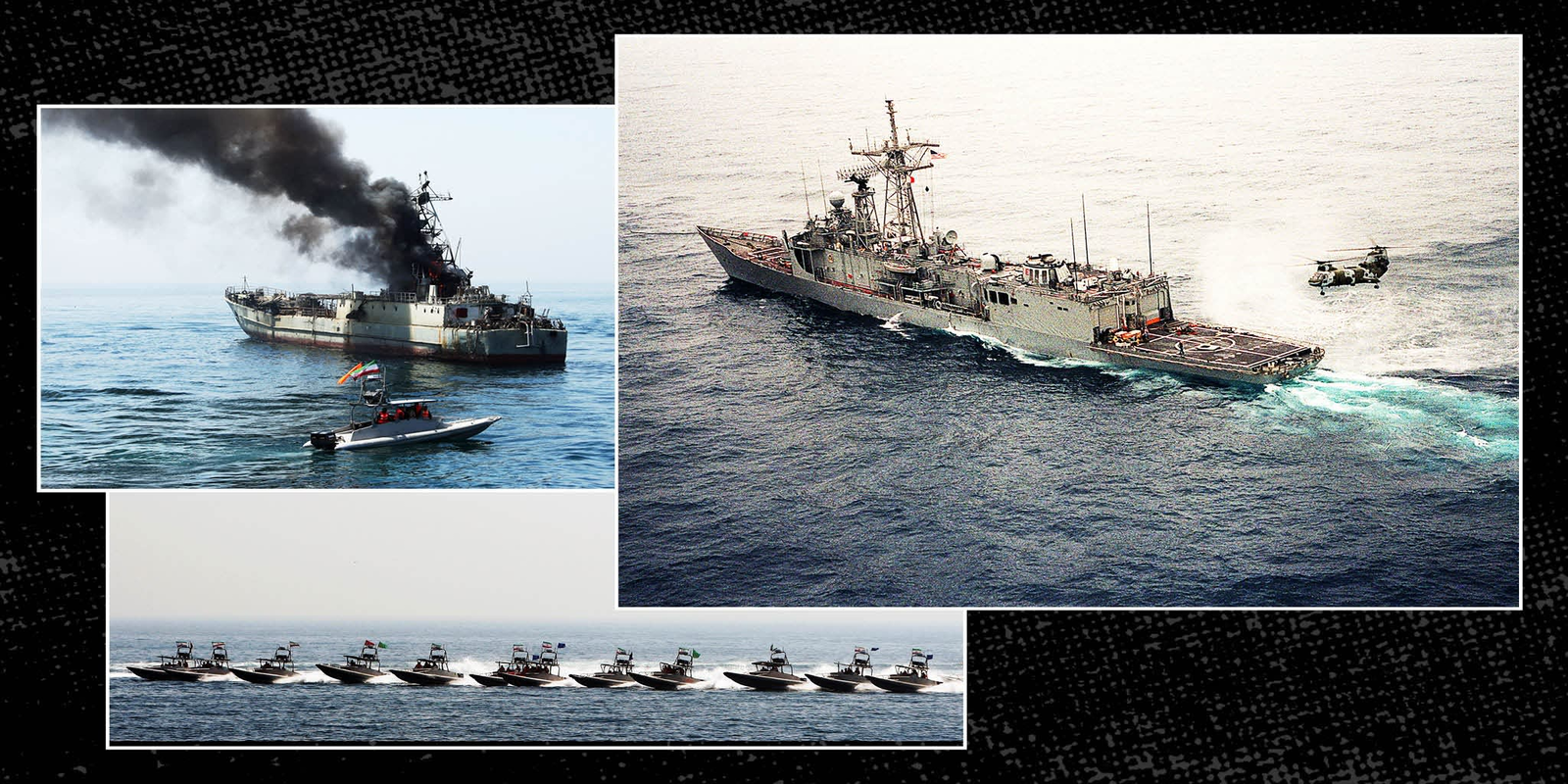
Iran’s elite Revolutionary Guards boats attack a naval vessel during a three-day military drill in the Gulf in 2010 © Mehdi Marizad/Fars news/AFP/Getty Images
Before any convoy operation, the US navy would need to pass up the Gulf — the first test of Iranian tactics and capabilities in an asymmetric assault they have prepared for decades.
Fast boats, of which there are hundreds if not thousands, are a particular concern. Hidden along Iran’s coastline, they can be loaded with an explosive charge to act almost like guided bombs.
The US is using A-10 “Warthog” aircraft in the hunt for Iranian vessels. But it would not be easy to determine whether enough fast boats had been destroyed to keep the convoys safe, according to the former officials.
“Because they are small and numerous they can be distributed widely and are probably in tunnels, large garages, hangars and parking lots,” said James Stavridis, a retired admiral who commanded US warships in the Gulf during his service. “They are not neatly arrayed row upon row in open fields, waiting for a bomb to hit.”
Miller said fast boats are “something that we really do have to deal with”.
They are “all over the place”, including in creeks and inlets, and “you’ve got to find where they’re hiding them and try to have enough surveillance and intelligence so that you can see when they’re trying to put something into the water”, Miller added.
A minesweeper would also need to pass through the strait ahead of the convoy — and the sweeper would need its own escort because it does not have a high-level integrated air defence system.
The US has been striking minelaying ships, factories and warehouses — and on Tuesday American forces dropped 5,000lb bunker-buster bombs on coastline sites holding anti-ship cruise missiles.
“At some point we’re going to have to test the waters a little bit and see how well they’re doing by starting to send some ships through,” Miller said. “It’s an operation that entails a fair amount of risk. And it’s going to be imperfect.”
He added: “It’s not the mines in the strait itself that I worry about so much, it’s the mines that can be planted inside the Gulf.”

The last time the US launched an escort operation through the strait, in July 1987, its first convoy involved five warships and two commercial vessels including the massive tanker Bridgeton.
As the line of ships moved through the Gulf, the Bridgeton hit a mine. Despite a sizeable hole in its hull, the tanker was able to continue the journey and lead the way, in effect acting as a minesweeper for the American naval ships.
Subsequent escorts went smoothly until the 25th run, when the USS Samuel B Roberts was hit. That destroyer was ultimately repaired and returned to service.
While some European allies are discussing a naval mission, this would only be for a post-conflict phase, making it increasingly likely that the US will need to mount any escort operation on its own.
“We no longer ‘need,’ or desire, the NATO Countries’ assistance — WE NEVER DID!” Trump said on social media on Tuesday, not long after calling on them to participate.
Destroyer availability may be an obstacle. Of the roughly 74 destroyers in the US’s fleet, only about a third are deployed globally at present, with another third preparing for deployment in the next six months and the final third undergoing maintenance.
“There’s not a whole lot of flex to send a lot more ships at this point to do that mission,” said the former defence official. That is partly “why there’s an interest in having allies help out”.
There is also no guarantee that a naval escort would be enough to meaningfully restart oil and liquefied natural gas tanker movements through the strait.
Even with an escort, the risks could seem too big for shipping companies to sail again, especially as they contend with sky-high insurance rates — a factor that may outweigh military protection.

Tanker owners and operators are hopeful that a military escort will relieve their vessels stuck in the Gulf. But few believe help will be forthcoming soon or be sufficient to convince shipowners to send new vessels into the Gulf. “I don’t know anyone who is counting on it,” one adviser to the industry said.
Greek shipping tycoon Evangelos Marinakis expressed frustration at the lack of co-ordination between governments. “A clear, structured and transparent framework is essential before the industry can engage in any serious discussions about resuming activity,” he said.
“We have made it clear to all parties that unless we see meaningful progress in terms of a credible military escort . . . we will not consider operating in the area.”
Erik Hånell, chief executive of tanker company Stena Bulk, said the industry was getting “very limited feedback” on the discussions or when escorts might arrive.
“Will it be one week? Will it be four weeks or will it be two days? We simply don’t have a clue right now,” he said.
Illustrations by Bob Haslett and Ian Bott and data visualisation by Alan Smith
Please use the sharing tools found via the share button at the top or side of articles. Copying articles to share with others is a breach of FT.com T&Cs and Copyright Policy. Email licensing@ft.com to buy additional rights. Subscribers may share up to 10 or 20 articles per month using the gift article service. More information can be found at https://help.ft.com/faq/gifting-and-sharing-an-article/what-is-a-gift-article/.
https://www.ft.com/content/bb6a57d6-8d54-43a7-95b4-110e51fbc5db?syn-25a6b1a6=1