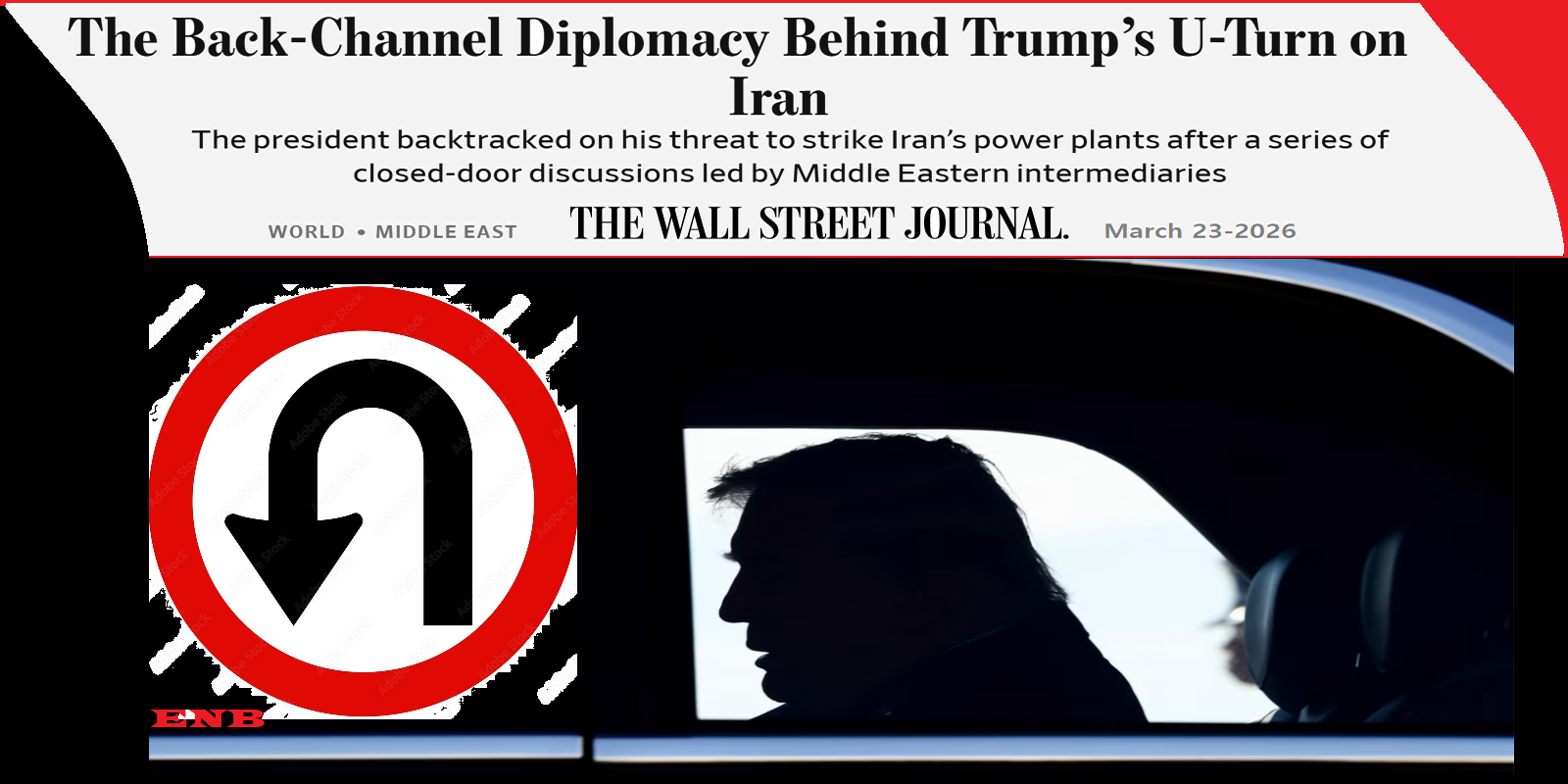
President Donald Trump seen through a car window. Kevin Lamarque/Reuters
The Back-Channel Diplomacy Behind Trump’s U-Turn on Iran
The president backtracked on his threat to strike Iran’s power plants after a series of closed-door discussions led by Middle Eastern intermediaries
By Summer Said, Alexander Ward, Benoit Faucon, Laurence Norman
March 23, 2026 WSJ
Quick Summary
- President Trump reversed his ultimatum to Iran, embracing diplomacy and postponing strikes on Iranian power plants for five days.
- President Trump’s announcement triggered a stock-market rally.
- Arab mediators expressed skepticism about a quick agreement, while Iranian officials denied discussions were taking place.
This summary was generated with AI and reviewed by an editor.
Foreign ministers from Egypt, Turkey, Saudi Arabia and Pakistan gathered before dawn Thursday in Riyadh for talks aimed at finding a diplomatic off-ramp to the war in Iran.
But there was one big problem, according to Arab officials involved in the discussions: finding a counterpart in Iran to negotiate with. Earlier that week, Israel killed Iran’s national security chief, Ali Larijani, who had been considered a viable partner who could engage with the West.
Egyptian intelligence officials managed to open a channel with Iran’s Islamic Revolutionary Guard Corps—the paramilitary group that protects the Iranian regime and is the country’s most powerful security and political entity—and put forward a proposal to halt hostilities for five days to build confidence for a cease-fire, some of the officials said.
Those discussions laid the groundwork for an abrupt reversal more than 7,000 miles away in Florida.
On Saturday night, President Trump, who spent the weekend at his Mar-a-Lago club, gave Iran an ultimatum to reopen the Strait of Hormuz within 48 hours or the U.S. military would “obliterate” the country’s power plants. Two days later, as word of the discussions in Riyadh made its way to the White House, Trump reversed course, embracing diplomacy with Tehran and putting his threatened strikes on hold.
Four foreign ministers from Egypt, Turkey, Saudi Arabia, and Pakistan meet in Riyadh.

In a handout photo from the Saudi government, the foreign ministers from Egypt, Turkey, Saudi Arabia and Pakistan meet March 19 in Riyadh. Ministry of Foreign Affairs of Saudi Arabia
Trump’s shift Monday morning followed a series of closed-door discussions—through Middle Eastern intermediaries—that U.S. officials said gave them hope an agreement to settle the conflict was possible. It also reflected a growing desire by Trump and some of his advisers to bring the war to a close, according to people familiar with the matter, as the president faces political and economic fallout from the conflict.
“These are sensitive diplomatic discussions, and the U.S. will not negotiate through the press,” said White House press secretary Karoline Leavitt. “This is a fluid situation, and speculation about meetings should not be deemed as final until they are formally announced by the White House.”
Trump’s announcement that he would postpone for five days strikes on Iranian power plants triggered a stock-market rally, giving the president a small reprieve after weeks of pain on Wall Street. The Dow Jones Industrial Average and S&P 500 posted their biggest one-day gains since early February. Brent crude, the international benchmark, ended the session down 11%, just below $100 a barrel, its lowest level since March 11.
But Arab mediators privately expressed skepticism that the U.S. and Iran could quickly reach an agreement, noting that the two sides remained far apart. Trump’s assertion that the talks were productive was met with pushback from Iranian officials, who denied that the discussions were taking place.

Narges, a woman, looks out from her destroyed apartment in Tehran, Iran, after a joint U.S. and Israeli attack. Damage in Tehran on March 21 from earlier U.S. and Israeli strikes. Majid Saeedi/Getty Images

People waving Iranian flags during a demonstration in support of the Iranian government. A pro-regime demonstration Sunday in Tehran. Majid Saeedi/Getty Images
As a condition of any deal to end the war, Iran is demanding that the U.S. and Israel pledge not to launch future attacks. Tehran is pushing for compensation for damages sustained during the war. The U.S. still wants what it sought from Iran before the war started: the dismantlement of Tehran’s nuclear work, a suspension of its ballistic missile program and a stop to its support for proxy militias.
A potential meeting
The spate of diplomacy in recent days has prompted early discussions about an in-person meeting in Pakistan or Turkey later this week between U.S. and Iranian officials, according to U.S. and Arab government aides, as well as other people familiar with the matter. The gathering hasn’t yet been completed, officials said.
Trump seems prepared to pursue a deal, telling reporters Monday that some Iranian leaders could usher in a better era of U.S.-Iran relations. “We’re dealing with some people that I find to be very reasonable, very solid,” he said. “Maybe one of them will be exactly what we’re looking for. Look at Venezuela, how well that’s working out.”
Trump first learned Saturday about the potential for discussions with Iran, and he was receptive, according to a senior administration official.
For now, Tehran is distancing itself from talks. Mohammad-Bagher Ghalibaf, Iran’s parliamentary speaker and one of the country’s top remaining officials, suggested Monday that Tehran wasn’t yet ready for negotiations with Washington.
“Iranian people demand complete and remorseful punishment of the aggressors,” he wrote in English a few hours after Trump’s initial comments. There had been no negotiations with the U.S., he asserted, adding that such optimism “is used to manipulate the financial and oil markets and escape the quagmire in which the U.S. and Israel are trapped.”
During the back-channel discussions last week, Arab leaders were especially focused on opening the Strait of Hormuz, the narrow waterway through which 20% of the world’s oil exports typically flow.
An oil products tanker in Muscat, Oman:

A tanker near Muscat, Oman, outside the strategically vital Strait of Hormuz. Elke Scholiers/Getty Images
They called for the strait to be overseen by a neutral committee that would allow safe access by all ships, the officials familiar with the discussions said. Iran’s Islamic Revolutionary Guard Corp replied that Iran should collect fees from transiting ships, just as Egypt does now with the Suez Canal, the officials said.
Gulf officials objected to the idea of fees, with Saudi Arabia saying the kingdom wouldn’t allow Iran to have the upper hand in operations in the strait, some of the officials said. They feared such a deal would entrench Iranian influence over Gulf energy exports for years to come.
Messages continued to be exchanged, with Qatar, Oman, France and the U.K. working their back channels, European and Arab officials said. Among the proposals bandied about was Pakistan hosting a meeting between U.S. and Iranian senior leaders, the officials said, adding that the U.S. quickly warmed to that idea.
The U.S. could be represented by special envoys Steve Witkoff and Jared Kushner, although there was also a possibility that Vice President JD Vance could come if a deal was close, a U.S. official said.
Tehran could send Foreign Minister Abbas Araghchi to the potential meeting, although Iranian officials have signaled they weren’t eager to repeat the previous failed negotiations between Araghchi and Witkoff. It is unclear whether Ghalibaf would be prepared to leave the country at this point and join talks—particularly if Vance didn’t attend.
Steve Witkoff listens to Donald Trump speak to reporters:

Special envoy Steve Witkoff, who was on hand as Trump spoke to reporters March 9 in Florida, could be in the American delegation for a meeting between U.S. and Iranian senior leaders. Roberto Schmidt/Getty Images
An agreement to end hostilities would shift focus to what the U.S. accomplished beyond heavily damaging Iran’s military capabilities. Analysts note the regime is battered but intact, still controls the Strait of Hormuz and could access its nuclear materials buried deep under rubble. The U.S. is still sending two Marine Expeditionary Units to the region, each with about 2,200-2,500 Marines aboard three warships.
Vance spoke Monday with Israeli Prime Minister Benjamin Netanyahu, officials said, though Netanyahu only publicly confirmed a call with Trump. Trump spoke Monday with Pakistan army chief Asim Munir, an administration official said.
‘Maybe me’
Washington will now negotiate with a more hard-line Iranian regime officially headed by new Supreme Leader Mojtaba Khamenei—whose father, wife and sister were killed in airstrikes—while strong disagreements over the Strait of Hormuz’s future remain
Asked Monday who would control the strait after the war, Trump told reporters: “Maybe me—me and the ayatollah,” he said, “whoever the next ayatollah is.”
Trump said the U.S. had been in touch with a top Iranian official whom he said was respected in Tehran but declined to name the person for fear of endangering the official.
Iran's Parliament Speaker Mohammad Bagher Ghalibaf.

Mohammad-Bagher Ghalibaf, center in 2025, Iran’s parliamentary speaker, is seen by some as a figure who could persuade Iran’s leadership to make a deal. AFP/Getty Images
Nicole Grajewski, a nonresident scholar in the Nuclear Policy Program at the Carnegie Endowment for International Peace, said that Ghalibaf, the parliamentary speaker, is one of the few remaining senior officials who could convince Iran’s political leadership and hard-liners to accept a deal.
Ghalibaf, 64 years old, is a hard-line former IRGC commander but at times has positioned himself as a pragmatist, including his terms serving as Tehran’s mayor.
“Ghalibaf has a lot of legitimacy in the eyes of the security establishment,” Grajewski said.