Two years of stability, but growth reforms remain overdue
Dhananath Fernando
By Rathindra Kuruwita
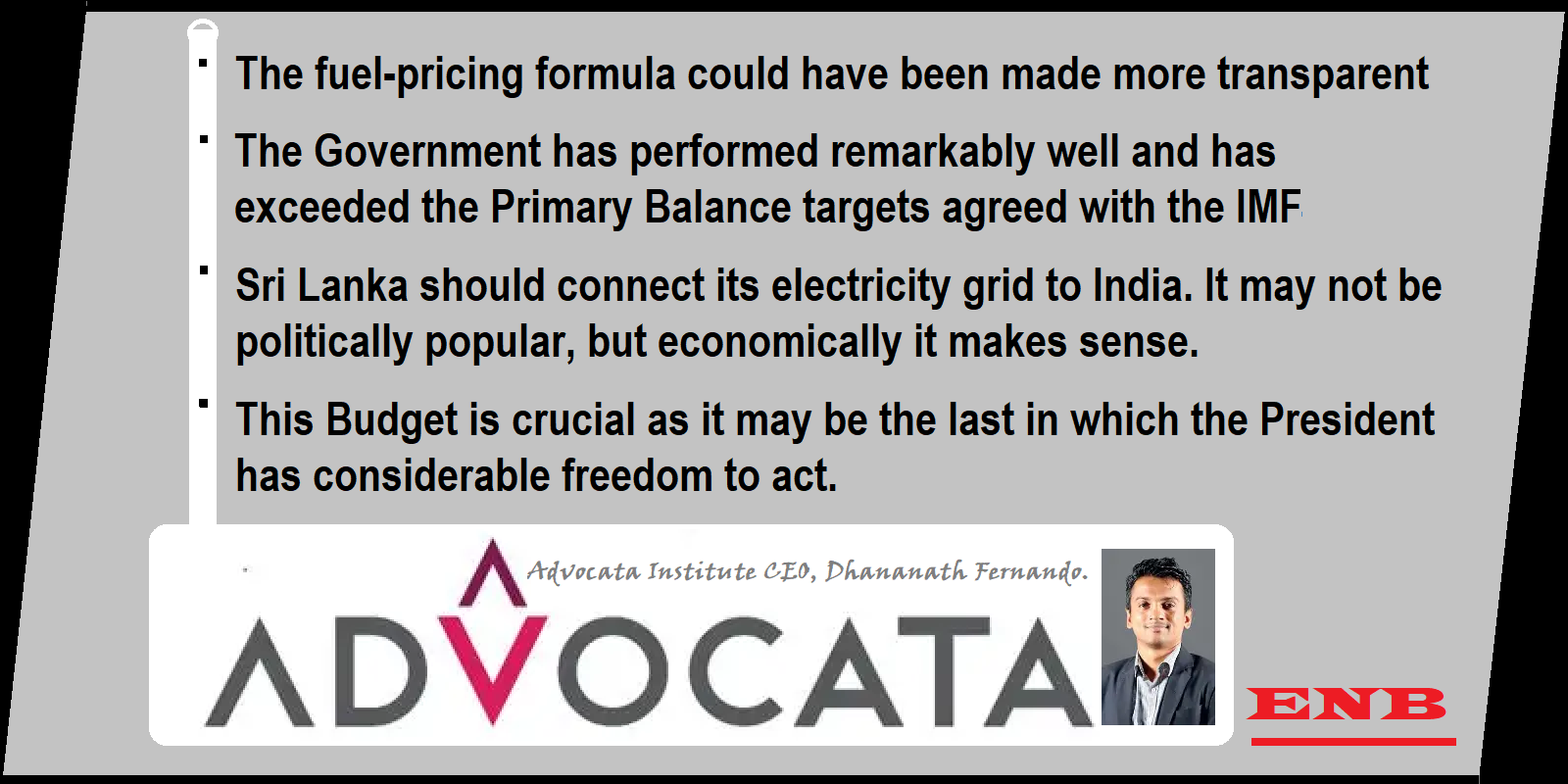
- The fuel-pricing formula could have been made more transparent
- The Government has performed remarkably well and has exceeded the Primary Balance targets agreed with the IMF
- Sri Lanka should connect its electricity grid to India. It may not be politically popular, but economically it makes sense.
- This Budget is crucial as it may be the last in which the President has considerable freedom to act.
Sri Lanka’s economy has remained broadly stable during the National People’s Power (NPP) Government’s first two years despite a series of domestic and global shocks. But with the country now facing a slowing global economy, energy pressures and weaker conditions in key export markets, the next phase will require reforms that can generate sustained economic growth, says Advocata Institute CEO, Dhananath Fernando.
Excerpts of the interview:
Q: How would you assess the economic performance of the Government over the past two years?
Looking at economic stability, I think the Government has done remarkably well. It continued with the International Monetary Fund (IMF) programme and has been very pragmatic.
There were three major shocks during the first two years: the Trump tariffs, Cyclone Ditwah and now the Middle East crisis. The first two were managed well. The third has also been managed reasonably well, although the Government could have adjusted fuel prices better.
Policy consistency was also maintained. Even during the transition of power, key officials remained in their positions, which helped preserve stability. That is a positive.
The second positive area is fiscal policy. The Government has performed remarkably well and has exceeded the Primary Balance targets agreed with the IMF. Revenue collection has also been good; vehicle imports contributed to this. The Current Account Surplus was maintained until the last three or four months, when the Middle East crisis began to affect it.
There have also been some encouraging developments in areas such as public transport and the Government appears to have identified some of the issues that matter directly to people.
Another positive development is the restructuring of the Ceylon Electricity Board (CEB). It was not carried out in the way I would advocate, because I would have preferred greater room for private-sector investment. Nevertheless, the Government has at least undertaken the unbundling of transmission, generation and distribution. That is significant because many Governments have struggled to do even that.
Where could it have done better? One area is fuel-price revisions. I think this partly contributed to the current account deficit during the past three months. Understandably, there is a limit to how much fuel prices can be increased, but the adjustments could have been handled better. The fuel-pricing formula could have been made more transparent, and revisions could perhaps have been made more frequently rather than only once a month.
Another area is the Gambling Regulatory Authority (GRA). Gambling is a sunrise industry, and if the Government intends to take it seriously, the regulatory framework needs to be stronger. An authority has been established, but the legislation and its mandate were diluted. The sector could have received greater attention.
The biggest weakness, however, has been growth reforms. We have unfortunately not seen major reforms aimed at generating growth.
Q: Can you elaborate on what you mean by growth reforms?
An economy essentially depends on land, labour and capital, together with entrepreneurship, which brings those factors together. Sri Lanka has considerable barriers in all of these factor markets.
Take land for instance, most of the land in Sri Lanka is owned by the Government. Even when an investor arrives, around 95 to 98 percent of our industrial zones are already occupied, particularly in the Western Province.
At the individual level, many people also lack clear property rights. If someone wants to build a house and approaches a bank, the bank asks for collateral. Farmers face the same problem. But if you do not have proper ownership of the land, you cannot use it effectively as collateral. As a result, you cannot unlock capital to increase productivity.
Land reform is difficult, but somebody has to address it. There is already a land-titling programme that has existed for 20 or 30 years. We need to invest more in it, digitise land records and issue proper titles.
The second area is labour. This is difficult politically, but Sri Lanka has very restrictive labour regulations. These need to be simplified. Ideally, Sri Lanka should have a unified labour code.
The regulations should also be rewritten to accommodate part-time work and flexible working hours and to make it easier for women to work according to arrangements that suit their circumstances. These reforms are important because the overall economy is already facing a labour shortage.
The third area is capital. There are restrictions on capital movements both domestically and internationally. These restrictions also need to be reformed and gradually removed.
Another labour-related issue is the free movement of people. For example, if a Sri Lankan is married to a foreign national, it can be extremely difficult for the foreign spouse to obtain the right to work here. That makes little sense, particularly when Sri Lanka has a labour shortage.
Some of the people we classify as foreigners also have Sri Lankan roots. They migrated because of difficult periods in our history. They may now be foreign citizens, but they retain links to Sri Lanka. If we can tap into that community, they bring capital, networks and know-how.
Q: Another major problem for investors, and for consumers generally, is Sri Lanka’s high electricity cost. Is there a way to reduce electricity prices, perhaps not immediately but over the longer term?
If you rank the cheaper sources of energy, you have hydropower, then sources such as Naphtha, pure solar and other renewables, followed by coal and other generation sources. The problem is that, apart from hydropower and solar, many of the cheaper conventional energy sources carry significant environmental costs.
Over the longer term, however, I think Sri Lanka should connect its electricity grid to India. It may not be politically popular, but economically it makes sense.
A grid connection would allow Sri Lanka to produce as much electricity as it can and export surpluses. At present, even when we produce additional electricity, our grid is not stable enough to handle it efficiently.
The grid, therefore, has to be upgraded. That costs a substantial amount of money. Given the current fiscal situation, it is very unlikely that the State alone will be able to finance the necessary improvements. The realistic option is to open grid development to some level of private investment.
There is also an issue with the way generation assets have been grouped following restructuring. Ideally, hydropower generation could have been placed in a separate company, coal generation in another company and other renewable generation in another.
If you combine hydropower and coal in the same company, for example, a green investment fund may be reluctant or unable to invest in that company because it also owns coal assets.
The separation could therefore have been carried further. Over the long term, I would further unbundle generation according to source: coal plants in one company, hydropower in another, and solar and other renewables separately. That would make it easier to attract specialised investment.
At the same time, we need to upgrade the grid. Only then can we properly introduce concepts such as electricity wheeling, i.e., transmission of electricity from a private generator to a separate end-user across a third-party transmission or distribution grid.
Q: Sri Lanka’s current IMF programme is approaching its conclusion. What should happen afterwards? Should Sri Lanka enter another IMF programme, or is there an alternative?
The ideal scenario would be for Sri Lanka to undertake growth reforms without IMF support.
But for that to happen, we need the institutional capacity, a clear reform agenda, a credible plan and the ability to execute it.
The problem is that global conditions are not particularly favourable. U.S. interest rates have risen, and there is an energy crisis. If Sri Lanka tries to proceed without an IMF programme and then fails to implement reforms, the consequences could be severe. We would struggle to access international capital markets. The recent Fitch upgrade to B-minus is welcome, but Sri Lankan bonds are still trading at expensive rates in the secondary market.
If we have an IMF programme, we can access financing at lower interest rates, and the programme also provides a degree of confidence to markets and rating agencies.
My preference, in principle, would be to manage without the IMF. But from a pragmatic perspective, given the uncertainty in the global economy and the remaining years of President Donald Trump’s term, it may make sense to have some form of IMF arrangement.
It may not need to be another Extended Fund Facility (EFF). A standby arrangement could perhaps be more appropriate. That would provide some checks and balances.
Governments generally do not like IMF programmes because they constrain their room for manoeuvre. That will become increasingly relevant because, after this Budget, Sri Lanka will gradually begin moving into an election cycle.
So, from a pragmatic perspective, some form of standby IMF arrangement may be the better option.
Q: Sri Lanka is also facing considerable external pressure. The Middle East conflict does not appear likely to end soon, while sanctions on Russia have affected access to some supplies. The Government has indicated that importers are losing around Rs. 200 a litre on diesel at present. If diesel prices rise significantly, what effect will that have on the economy?
There will certainly be an impact. Economic activity will slow somewhat, and inflationary pressures will increase. However, although it is not a popular decision, I think increasing diesel prices right now is the more sensible option.
The data for March and April, when the Government imposed quotas, showed extremely high fuel consumption. It was largely because of hoarding.
After the price revisions, consumption declined and subsequently stabilised.
If diesel prices are not increased now, two things can happen. The Government will effectively have to provide a large subsidy, and because consumers do not face the full cost, diesel consumption will not fall sufficiently.
If crude oil prices remain above US$100 a barrel, our import bill could then rise dramatically. That would put pressure on the currency. If the currency depreciates, fuel prices will ultimately have to rise anyway.
At that point, you would have both higher fuel prices and the broader inflationary effects of currency depreciation.
Q: Sri Lanka’s main export markets are the United States (US), the European Union (EU) and the United Kingdom (UK). Together, they account for a very large share of our exports. How do you see those economies performing, and what will that mean for Sri Lanka?
They are slowing down. Higher U.S. interest rates and the broader uncertainty are clearly affecting the American economy. Europe also faces demographic challenges and political instability. Economically and politically, the Western bloc is not performing particularly well.
Sri Lanka will inevitably feel the impact because these are important markets for us.
The alternative is to look more seriously at India, which is a growing market, and at Regional Comprehensive Economic Partnership (RCEP.) Sri Lanka has a potentially unique advantage because India is not part of RCEP. If we can develop two sets of trade arrangements, a more comprehensive agreement with India, building on the agreement we already have, and membership of RCEP – Sri Lanka would have access to both the Indian market and the wider RCEP market. That would create a distinctive value proposition for investors. If companies locate in Sri Lanka, they could potentially gain access to markets containing a very large share of the world’s population: India, China and the other RCEP economies, including Australia and New Zealand, which also have high purchasing power.
That is the way we should be thinking about the situation. However, joining the RCEP is a long journey. It is not easy. A considerable amount of preparatory work has to be done domestically, both politically and in terms of the policy framework. That is how Sri Lanka needs to respond to the relative slowdown in Western economies.
Q: What would you like to see from the coming Budget?
This Budget is crucial. In a sense, this is probably the Budget in which the President still has considerable freedom to act. Sri Lanka will gradually begin moving out of the current IMF programme after the first quarter, and the Government has not yet come under the full pressure of the next election cycle.
By the time the Budget for 2028 is being prepared, those electoral pressures will be much stronger.
In my view, reforms are already late. Even if the President begins major reforms immediately, many of the results may only become visible during a potential second term.
That is why reforms need to be implemented as quickly as possible. Only then will we begin to see the results in economic activity and improvements in people’s living standards.

ஒத்தவை:
சென்ற வாரம் இலங்கை-சண்டே ரைம்ஸ்