
Uproar over monk’s robe forces govt into damage-control mode
- President meets Mahanayakes’ representatives, explains legal position and appoints committee to recommend changes to the law concerning convicted priests
- As agitated monks launch protests, prelates urge President to initiate the legal process to grant Gnanasara Thera a presidential pardon
- Sri Lankan legal team in Saudi Arabia to file appeal for clemency for Anojan; reports say he suffered injuries during prison scuffle
- New bill to deal with organised crime gazetted, but civil society groups raise concerns over draconian provisions that erode hard-won protections
By our ST Political Desk 11-10-26
It was a situation President Anura Kumara Dissanayke would rather not have been in, but last week he and those in his government were in for a rude awakening, facing a backlash from senior members of the Buddhist clergy as well as many others over the handling of the case involving controversial monk Ven. Galagoda Aththe Gnanasara Thera.
The uproar was not due to the imprisonment of Gnanasara Thera, who was evading arrests after the Supreme Court overturned a presidential pardon granted to him by President Maithripala Sirisena for contempt of court, but over the decision by the Prisons Department to bring him to court in prison garb instead of his robes.
The televised footage of the Thera being escorted to courts in the lay attire of a white sarong and white national tunic shirt evoked almost an immediate reaction, mainly from members of the Buddhist clergy who expressed their anger over Gnanasara Thera being stripped of his robes – an action, they claimed, cannot be done bypassing the traditions and disciplinary rules established within the Buddha Sasana.
Handcuffed and in prison garb, Galagoda Aththe Gnanasara Thera is brought to court, sparking protests by Buddhist monks
While the President and the government’s initial reaction may have been to ignore the general outcry over the issues, a letter from the Mahanayake Theras of three Buddhist Nikayas (Sects) to the Commissioner General of Prisons objecting to the Gnanasara Thera being deprived of his robes elicited a prompt response, with the President inviting senior members of the Maha Sangha belonging to the three main chapters to the Presidential Secretariat to discuss the issue on Thursday.
“The discussion was held to consider the letter addressed by the Mahanayake Theras to the Commissioner-General of Prisons regarding the action taken by the Department of Prisons to remove Gnanasara Thera’s robes and present him before the court in the lay attire, as well as the situation that has arisen in society in connection with this incident and the measures that should be taken in the future to prevent similar situations,” the Presidential Secretariat said in a statement after the meeting.
While the remarks made by the President at the meeting were made public, little of the comments by the members of the Buddhist clergy present have been made public so far. A request was made by the Theras for the President to consider a pardon for Gnanasara Thera. “The court overturned the pardon granted by President Sirisena, ruling that it was not done in accordance with the law. Now, you have the opportunity to do so according to the law and grant him a pardon,” one Thera told the President at the meeting.
The President explained that a pardon could only be considered after the appeal process is concluded, adding that in Gnanasara Thera’s case this was ongoing. “My wishes should not become the law,” the President said.
The Supreme Court, in overturning the pardon granted to Gnanasara Thera, said that these conclusions do not, in any manner, signify that the President is precluded from granting a pardon to Gnanasara Thera. Any such pardon may be granted only in accordance with the law and upon due consideration of all relevant material placed before the President,” the Court said, thus keeping the door open for a fresh pardon for the monk.
At the meeting, the President defended the actions of the Prisons Department officials to deprive Gnanasara Thera of the robes, saying they had acted in accordance with the existing laws and regulations, while acknowledging that it was deeply shocking and distressing for Buddhists and the Maha Sangha to see a monk whom they respectfully paid homage to one day being seen in a different manner another day.
The President was of the opinion that new rules should be formulated regarding the manner in which Buddhist monks serving jail terms are taken outside the prison premises. Towards this end a committee was appointed. Its members are Buddha Sasana Ministry Secretary Prince Senadheera, Justice and National Integration Ministry Additional Secretary Piyumanthi Peiris, Public Administration Ministry Additional Secretary Wasantha Ariyarathna, Buddhist Affairs Commissioner-General R.M.G. Senarathna, and Prisons Department Commissioner A.C. Gajanayake.
The committee has been given two weeks to prepare a report recommending amendments to the existing laws to strengthen efficiency, good governance, security, cultural values and the rule of law within the prison.
Appointments of committees always come to the rescue of governments in difficult situations, and they have eased the pressure on the incumbent government to some extent, though not all members of the clergy are pleased with the outcome. On Friday, Venerable Kotapitiya Rahula Anunayake Thera wrote to the President, requesting a meeting with members of the Buddhist clergy representing the Kotte chapter, as they were not represented at Thursday’s meeting. The letter stated that the authority to decide whether Gnanasara Thera should retain or be deprived of his robes rests with the Kotte Sangha Sabha, of which the monk is a member.
Along with this, a writ application has been filed in the Court of Appeal challenging the prison authorities’ decision to remove Gnanasara Thera’s robes. A protest march led by Buddhist monks also began last morning from Kandy after a special religious ceremony at the Magul Maduwa (audience hall) of the Dalada Maligawa (Temple of the Tooth), demanding a pardon for Gnanasara Thera. The march will continue from Kandy to Colombo and conclude on October 15. Ven. Ulapane Sumangala Thera, who is leading the march, said they will conclude the walk at the location where Gnanasara Thera is being held and will continue to protest till he is granted a full pardon.
For President Dissanayake and those in the JVP-led National People’s Power (NPP), who have built their political careers on a healthy dose of Marxism and who should be familiar with the oft-repeated words of Karl Marx on religion being the ‘opium of the masses’, it must be sinking in that the political cost of being insensitive to the religious beliefs of the people can be heavy. And hence, the damage control measures that have been put in place, but how far they will go to appease the agitated Buddhists in particular, will be seen in the weeks ahead.
Anojan’s case
Adding to the government’s woes is also the case of Anojan Sivarasa, the 24-year-old Sri Lankan man who is facing a death sentence in Saudi Arabia over a blasphemy charge.
Sri Lanka’s Ambassador to the Kingdom of Saudi Arabia, O.L. Ameer Ajwad, visited Sivarasa at Dammam Central Prison, located about 450 kilometres from Riyadh on Thursday to inquire about his well-being and ascertain his current status. He reaffirmed the embassy’s commitment to providing all possible consular and legal assistance under the guidance of Sri Lanka’s Ministry of Foreign Affairs.
Foreign Minister Vijitha Herath told Parliament this week that Mr Sivarasa had been injured in an altercation with another prisoner and moved to another cell following which Ambassador Ajwad had visited him to inquire about his wellbeing. The minister said an argument between Mr Sivarasa and another inmate, in the same cell, had escalated into a physical fight, and he suffered scratches and fingernail injuries to his face but no knife, sharp instrument or other weapon had been used and that there was no identified threat to his life.
A Sri Lankan legal team that includes Additional Solicitor General and President’s Counsel Azard Navavi, President’s Counsel Faizer Musthapha, President’s Counsel Upul Kumarapperuma and Attorney-at-Law Hafeel Farisz is preparing an appeal to the Supreme Court of Saudi Arabia to seek clemency for Sivarasa. They are in Saudi Arabia now on behalf of the Sri Lankan government.
His case has drawn both local and international attention, with many appealing to the Saudi authorities to pardon him. The Mahanayake Theras of the Ramanna Maha Nikaya and the Amarapura Maha Nikaya submitted a memorandum to President Dissanayake on Thursday calling for the necessary state intervention to secure the release of Mr Sivarasa, while international human rights watchdog Amnesty International also urged Saudi Arabia’s authorities to urgently overturn the death sentence issued against the migrant worker on charges of blasphemy.
The UK-based organisation called on Saudi authorities to release him immediately and unconditionally given his charges stem entirely from his exercise of his right to freedom of expression.
Mr Sivarasa was arrested on 1 July, 2026, after posting a comment on Facebook deemed insulting to the Prophet Mohammad. He told the judge that he made the comment during a moment of anger and that he subsequently deleted it and published a video apology expressing remorse. He was prosecuted swiftly and, just weeks later, on 27 July, sentenced to five years in prison and a SAR 3 million fine (around USD 800,000). Less than two months later, this was increased to a death sentence on appeal on September 17.
Organised crime
Meanwile, tackling organised crime has been one of the major challenges that the NPP government has faced over the past two years. There have been some notable successes, including massive drug busts on land and at sea, as well as the arrests of a significant number of alleged drug kingpins both here and abroad. The government, however, has been found wanting in other areas, most notably, the failure to stem the high number of shootings linked to organised crime. Such shootings include brazen daylight attacks carried out in public areas and on public roads, in front of dozens of eyewitnesses. Even supposedly high security locations such as courts weren’t secure from the reach of gunmen linked to organised criminal groups, as evidenced by the fatal shooting of alleged underworld figure Sanjeewa Kumara Samararathne alias ‘Ganemulla Sanjeewa’ inside the Hulftsdorp Magistrate’s Court complex in February last year by an assassin disguised as a lawyer.
Shootings linked to organised criminal groups have long been a sore point for the NPP government, especially given the confident assertions made by some of their members prior to coming to power that a government under the NPP would easily crush organised criminal groups. Deputy Defence Minister Aruna Jayasekara, for example, received the most criticism over public comments he made prior to President Dissanayake’s victory at the 2024 presidential election regarding how an NPP government would ensure the country’s national security within a short period of coming to power. The retired army major general scoffed at those from rival political parties, claiming they “do not know national security” and invited them to bring a desk and a chair (banku) so he could give them “tuition” (private lessons) on the subject. As the shootings and the death toll from organised criminal groups climbed steadily under the NPP government, opposition politicians started mockingly referring to Mr. Jayasekara as ‘Banku-Banku,’ a nickname that has now stuck to the deputy minister.
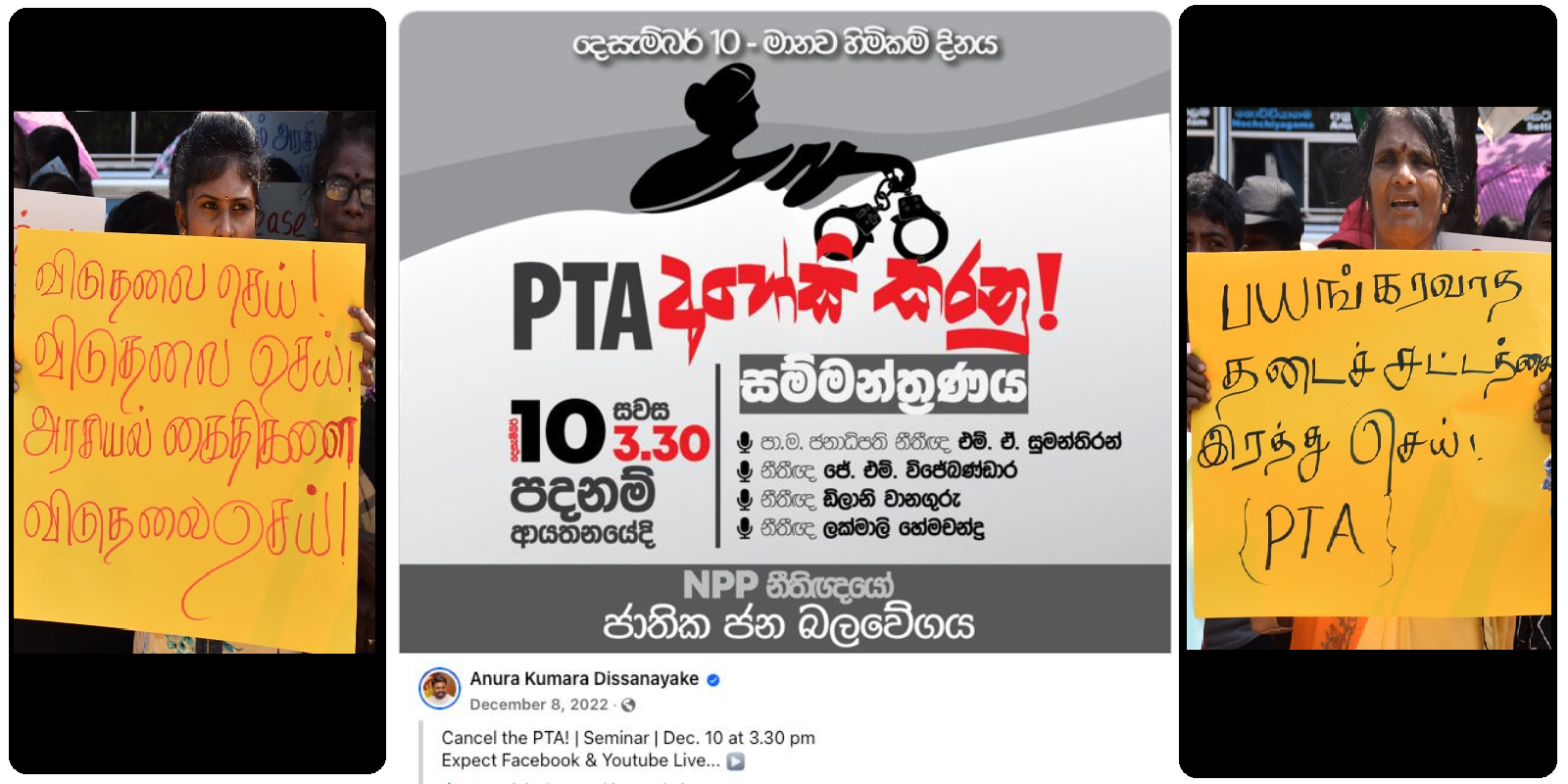
Government higher-ups including President Dissanayake himself, have complained over the past months that existing legislation has proved inadequate for the government to eradicate organised criminal groups. This claim had been cited for detaining certain alleged underworld criminals under the Prevention of Terrorism Act (PTA). The use of the PTA to detain drug-related offenders has been problematic from the start, especially given that it is a law that the NPP had pledged to repeal. In July, the Colombo High Court also ruled that charges filed under the PTA cannot be maintained against five accused, including alleged underworld gang leader Nadun Chinthaka Wickramaratne, alias ‘Harak Kata’.
‘Harak Kata’ and the other accused had been detained over an alleged conspiracy to escape from the Criminal Investigation Department (CID). The court stated that there is no legal impediment to proceeding with charges filed against the accused under the Penal Code, considering the offences they are alleged to have committed.
In keeping with its pledge to introduce new laws to tackle organised crime, the government has now gazetted the Prevention of Organised Crimes Bill. The Bill’s stated aim is to ‘give effect to the United Nations Convention Against Transnational Organised Crime; to provide for the prevention, investigation and prosecution of serious crimes through effective national and international cooperation; to protect society from the threats posed by organised criminal groups; and to provide for matters connected therewith or incidental thereto.’
The new Bill gives law enforcement agencies wide powers to go after organised criminal groups. The Bill defines ‘organised criminal group’ as a “structured group of three or more persons, existing for a period of time and acting in concert with the aim of committing one or more serious crimes in order to obtain, directly or indirectly, a financial or other material benefit.” Meanwhile, a ‘structured group’ is defined as a “group that is not randomly formed for the immediate commission of a serious crime and that does not need to have formally defined roles for its members, continuity of its membership or a developed structure.”
Under the proposed law, those convicted by a High Court of being a member of an organised criminal group for the purpose of committing a serious crime can be sentenced for a prison term of five to 20 years and a fine of up to Rs 1 million. Clause 3 of the Bill defines ‘serious crime’ as any offence punishable with four years’ imprisonment or more. It contains a lengthy schedule of what those offences are and incorporates a large number of offences that fall under other laws. They include offences that fall under the Antiquities Ordinance, Assistance to and Protection of Victims of Crime and Witnesses Act, Chemical Weapons Convention Act, Computer Crime Act, Excise Ordinance, Fauna and Flora Protection Ordinance, Gambling Regulatory Authority Act, Intellectual Property Act and the Penal Code.
The proposed new law would also allow the Secretary to the Ministry in charge of the Police (at present the Secretary to the Ministry of Public Security) to issue detention orders authorising the detention of a suspect for a period of two months at a time, which can be extended up to a maximum of one year. The detention order can be issued upon application by the Inspector General of Police (IGP) or any officer not below the rank of a Deputy Inspector General of Police authorised by the IGP in that behalf.
In determining whether any person is or acts as a member of an organised criminal group, the matters which a court may consider include, involvement in physical or virtual meetings with known members of the organised criminal group; whether that person is identified as a member by known members (whether existing or former members) of the organised criminal group; whether that person adopts the style of dress, hand signs, language or tattoos used by known members of the organised criminal group; whether that person associates with known members of the organised criminal group;whether that person has recruited or attempted to recruit any other person to be a member of the organised criminal group; whether that person habitually visits premises or meeting places known to be used by the organised criminal group, and the person knows or has reasonable grounds to believe that those premises or meeting places are owned or occupied by the organised criminal group.
The sweeping nature of the proposed Bill has already elicited alarm from some civil society groups. Releasing a statement on Thursday (8), the Centre for Policy Alternatives (CPA) stated that the Bill is “framed in broad, vague and sweeping language and contains few, if any, meaningful safeguards.” The CPA added that the Bill rolls back hard-won protections in ordinary criminal law and “creates a parallel regime of arrest and detention that has the potential to entrench torture and severely curtail fundamental rights.”
The CPA also pointed out that the new Bill was gazetted on the same day the Protection of the State from Terrorism Bill (PSTA) was tabled in Parliament, raising serious questions about the government’s timing and motive. The PSTA is being introduced with the stated aim of repealing the controversial Prevention of Terrorism Act (PTA). The CPA, though, claimed that the Prevention of Organised Crimes Bill would, in effect, reintroduce many of the PTA’s most criticised features under a different name. “This Bill would in effect completely negate even the most basic procedural improvements sought to be made by the PSTA,” the organisation charged.
The accompanying lengthy schedule of further offences captures a wide variety of offences under the Penal Code and other laws, ranging from bigamy, forgery and theft to copyright infringement, unlicensed gambling, forest offences and obstructing a public servant. CPA further notes that under clause 66, an ‘organised criminal group’ need only consist of three persons and need not have any formal structure. “These provisions are broad and vague, this is especially problematic as a person arrested in terms of this law will be entitled to much less legal safeguards than those arrested under the normal law. and will allow the executive to wide discretion in deciding.”
Referring to how a court may consider a person’s dress, hand signs, tattoos, associations and the places they visit when determining membership of an organised criminal group, the statement warns that these provisions risk criminalising association rather than conduct. It claims that they may be used against young people, marginalised communities, protesters and dissenting voices.
The absence of consultation is also evident in the drafting, the CPA states, opining that offences such as murder, rape and robbery, which carry death or rigorous imprisonment only, may arguably fall outside the Bill’s scope. “A law of this significance should not be enacted with such basic uncertainties as to its applicability,” it emphasises.
Citing these and other grave concerns, the CPA has called on the government to immediately withdraw the Prevention of Organised Crimes Bill in its present form.
The government, which is struggling to contain violent crime linked to organised criminal groups, will no doubt argue that the proposed law is necessary to decisively tackle organised crime. The broad scope of the proposed law and concerns that it may severely infringe on people’s fundamental rights, however, means that opposition to the newly gazetted Bill could grow as the days go by. This is at a time when criticism continues to mount over the draft Protection of the State from Terrorism Bill and the Non-Governmental Organisations (Registration and Supervision) Bill that the government also hopes to pass soon.

ஒத்தவை:

சென்ற வாரம் இலங்கை-சண்டே ரைம்ஸ்