Opposition plans multi-front protests against 22A regardless of SC ruling
- Govt says prepared to face any outcome, including a referendum
- Combined opposition joins civil society activists to continue campaign against amendment
- Focus on political rallies intensifies; NPP phases out presidential rallies; SJB claims credit for
- Rajapaksa family legal woes deepen; Shiranthi summoned to give statement; Interpol warrant against Basil
- SJB and UNP leaders appear on one stage while unity talks remain elusive
By our ST Political Desk 20-09-2026
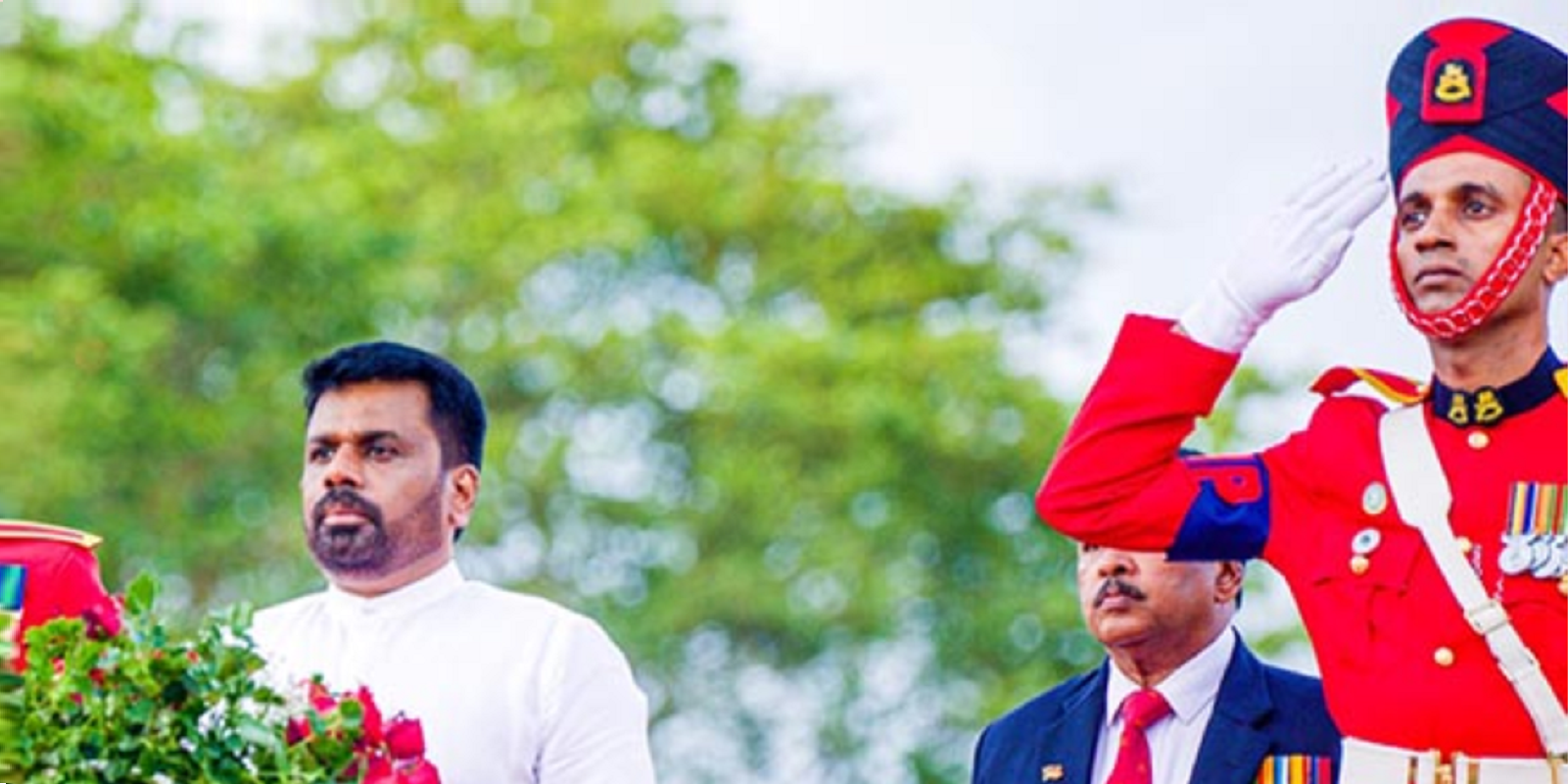
For President Anura Kumara Dissanayake, the coming week is shaping up to be one of the most pivotal weeks of his presidency. On September 23, it will be exactly two years since Mr Dissanayake was sworn in as the 9th Executive President of Sri Lanka, having emerged victorious at the presidential election held on September 21, 2024.
Even as he marks two years in office, President Dissanayake’s National People’s Power (NPP) government is moving next week to debate perhaps the most crucial piece of legislation it has presented to Parliament thus far. The 22nd Amendment to the Constitution, which proposes to increase the retirement age of superior court judges, is due to be debated in Parliament on September 24th and 25th. This is after the Speaker announces the determination of the five-judge Supreme Court bench headed by Chief Justice Preethi Padman Surasena. The bench considered more than 100 fundamental rights petitions that were filed challenging the constitutionality of the bill.
UNP leader Ranil Wickremesinghe and SJB leader Sajith Premadasa are seated together at an event in Colombo commemorating former President J.R. Jayewardene, amid ongoing party talks on a unity deal. Also in the picture are Kabir Hashim, Ranjith Madduma Bandara, Navin Dissanayake, and Lakshman Kiriella.
Meanwhile, on September 22, a three-member Trial-at-Bar of the Colombo High Court is set to deliver its verdict in the case of 25 accused indicted over the 2019 Easter Sunday terrorist attacks. The verdict is set to be delivered as a probe by the Criminal Investigation Department (CID) continues into an alleged wider conspiracy involving the attacks. That probe has already resulted in the arrest and detention of former head of the State Intelligence Service, retired Major General Suresh Sallay, under the Prevention of Terrorism Act (PTA).
The 22nd Amendment Bill proposes three substantive changes, namely: (i) raising the retirement ages of judges of the Supreme Court and the Court of Appeal (from 65 to 67 and from 63 to 65, respectively); (ii) specifying that in the case of the Chief Justice the age of retirement shall be either the date on which he/she reaches the age of 67 or the date on which a period of six years is completed from the date of appointment as Chief Justice (whichever occurs earlier); and (iii) increasing the maximum number of judges of the Court of Appeal from 19 to 24. Meanwhile, the Judicature (Amendment) Bill, also due to be debated on the same dates as the 22nd Amendment Bill, proposes to raise the retirement age of the judges of the High Court from 61 to 63 and stipulates that the compulsory retirement age of all other judges and magistrates shall be 62. The said bill also proposes to increase the maximum number of High Court judges from 110 to 120.
Those who challenged the 22nd Amendment Bill in the Supreme Court, including the Bar Association of Sri Lanka (BASL) and most opposition political parties, had urged the Supreme Court to rule that the bill violates the Constitution and can only be passed by a special two-thirds parliamentary majority and by the people at a referendum. The government, through the Attorney General, had argued that the bill is constitutional and does not need such a referendum. Government sources say the intention is to swiftly pass the bill next week if the Supreme Court determines that it only requires a two-thirds parliamentary majority to go through. If that is the case, the vote on the bill would come next Friday (25) evening at the end of the two-day debate on the 22nd Amendment Bill and the Judicature (Amendment) Bill. Thereafter, it will become law as soon as Speaker Jagath Wickramaratne places his signature on it.
After it was confirmed that an amendment to increase the retirement age of superior court judges was being drafted, the NPP government defended the move, saying such an amendment was necessary to clear a backlog of some 1.1 million cases pending in the country’s judicial system. That argument fell apart after it was pointed out that the vast majority of those cases were in the lower courts, with more than 800,000 cases at the Magistrate’s Court level and about 260,000 at the District Court level. It was only after protests against the 22nd Amendment mounted that it was announced that the government intended to increase the retirement age of all judges, including those of the lower courts; hence, the introduction of the Judicature (Amendment) Bill. Now, the argument is that increasing the retirement age of all judges will help to clear the pending case backlog. It has also been stressed that these two bills are just two elements of a vast judicial reform process being undertaken to speed up court cases and minimise law’s delays.
The government has expressed confidence that the Supreme Court would rule in its favour, but has insisted it is even prepared to hold a referendum if the court decides it is required. This claim should be treated with scepticism, given the billions of rupees in public funds that would have to be spent to hold such a referendum. Given the state of the country’s economy, it is hard to see the government taking such a politically risky gamble, knowing full well that it would seriously deplete treasury funds and would resultantly be an extremely unpopular move with the public.
Those opposed to the bill insist it will pose a grave threat to the independence of the judiciary and are planning to continue with their campaign to prevent it from being adopted irrespective of what the Supreme Court’s ruling is. Their plan is to take the fight beyond the courts and the legislature into the streets. On Friday, political parties and civil society groups opposing the 22nd Amendment came together to sign a joint declaration denouncing the bill and pledging to continue the fight to prevent it from becoming law. The initiative was facilitated by the Free Operational Centre for the Protection of Democracy led by President’s Counsel Maithri Gunaratne. Those who placed their signatures on the joint declaration included the main opposition Samagi Jana Balawegaya (SJB), the United National Party (UNP), the Sri Lanka Podujana Peramuna (SLPP), the Sri Lanka Freedom Party, Sarvajana Balaya, the Sri Lanka Muslim Congress, the Tamil Progressive Alliance, New Democratic Front, Pivithuru Hela Urumaya, the Communist Party of Sri Lanka and the Joint Opposition.
Following is the full text of the declaration:
“Joint Declaration of Opposition Political Party Leaders and Civil Forces on the Proposed 22nd Constitutional Amendment to Safeguard Sri Lanka’s Democratic Framework, Judicial Independence, and Citizens’ Rights
Background
We firmly believe that the proposed 22nd Constitutional Amendment, which the present government intends to introduce, poses a grave threat to the independence of the judiciary guaranteed by our Constitution. It also creates a clear risk of dismantling representative democracy, protected for nearly 80 years, and paving the way for authoritarian one‑party rule.
Therefore, in order to defeat the proposed 22nd Constitutional Amendment and to safeguard democracy, we pledge our commitment as a united collective force, as set out below.
Our Commitments
1. Unconditional Protection of Judicial Independence:
We will stand together, both inside and outside Parliament, against any constitutional or political interference, including the proposed 22nd Amendment, that undermines the independence of the judiciary and the rule of law.
2. Building a Common Opposition Platform Against Authoritarian Rule:
We will unite all opposition political parties, civil organisations, the legal community, and trade unions into a strong people’s front to defeat the government’s shortsighted and authoritarian measures.
Accordingly, we pledge to:
- Coordinate unified legal and parliamentary actions against the 22nd Amendment and any future constitutional or ethical changes that endanger democracy and the nation.
- Mobilise collective strength to defeat such amendments within Parliament.
- Prepare for and lead the people in any referendum that may arise, ensuring that citizens are fully informed and ready to reject anti‑democratic reforms.
If the Supreme Court rules that a referendum is required to pass such an amendment, we will immediately organise nationwide people’s movements to raise awareness and ensure its defeat through the people’s vote.
Call to Action
With the aim of saving democracy and judicial independence in our country, we invite all citizens to join every protest organised against the proposed 22nd Constitutional Amendment. This amendment gravely threatens the rights of the people and the supremacy of the law. Our mission is to unite the nation and defeat it through peaceful resistance.
By agreeing to this united pledge, we take upon ourselves the historic responsibility of safeguarding Sri Lanka’s democratic future and the rule of law, and we hereby sign below:”
Mass protest
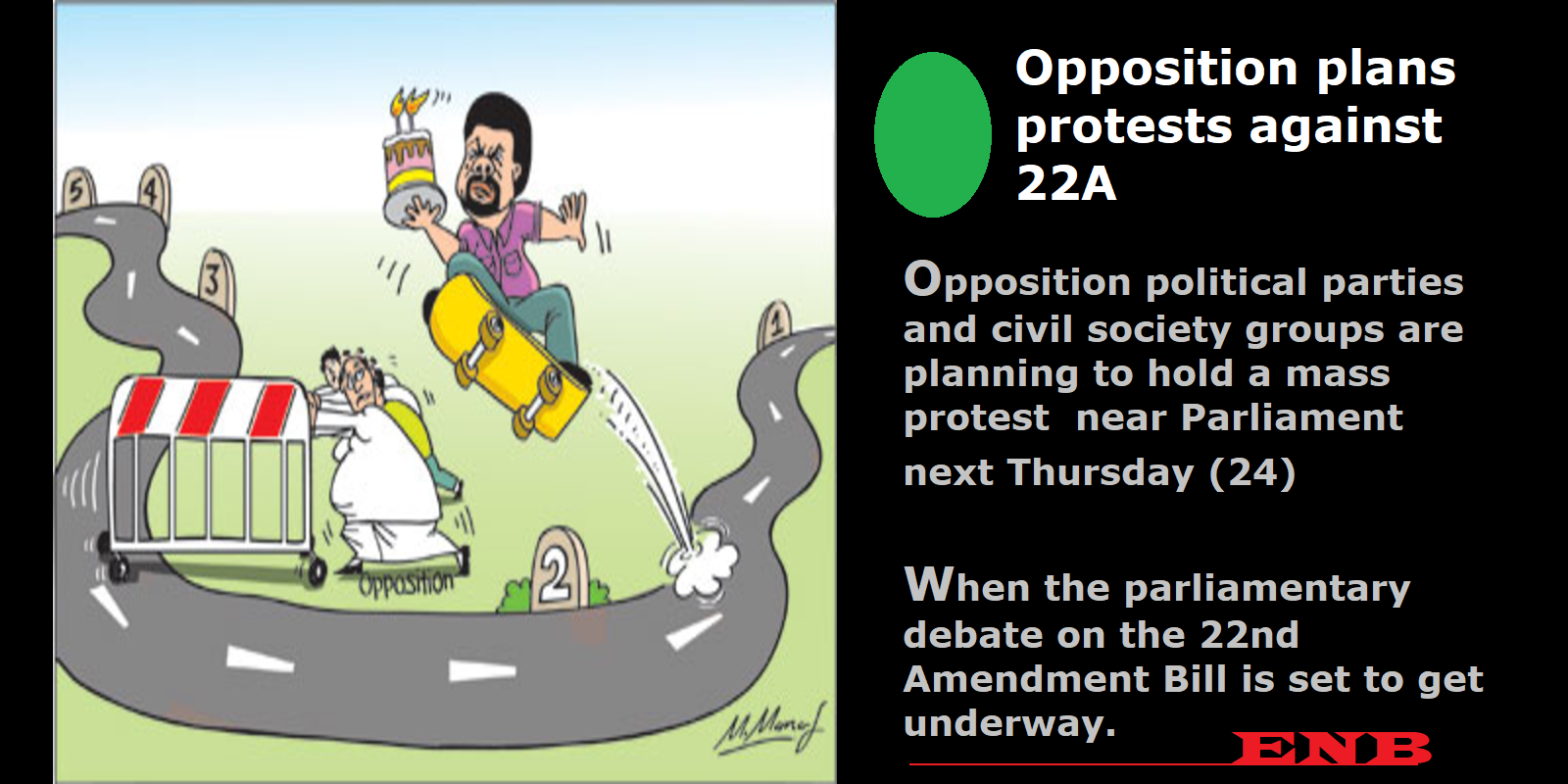
As part of their ‘Call to Action’, opposition political parties and civil society groups are planning to hold a mass protest at Polduwa Junction near Parliament next Thursday (24), when the parliamentary debate on the 22nd Amendment Bill is set to get underway.
It is not just on the streets that the opposition is planning to protest against the 22nd Amendment. SJB General Secretary Ranjith Maddumabandara says that opposition MPs planned to protest inside Parliament as well when the debate gets underway.
As a party, it was the SJB which took the lead in bringing people to protest whenever any anti-democratic actions were being taken, Mr Maddumabandara claimed. “It was we who first began holding meetings at the village level to talk about the issues affecting the people. Others have now followed our example, including the government. Even when it comes to the 22nd Amendment, we are leading the way in organising protests against it. There are others who lead meetings against such activities from the comfort of their rooms, but we prefer to take to the streets and protest with the people,” he insisted.
As he prepares for a history-making week of his presidency, President Anura Kumara Dissanayake will be in the southern province today and is expected to address two public rallies organised by the NPP in Akuressa and Weligama in the Matara district. They are part of a series of such public rallies being held by the ruling party since the start of this month. The official explanation is that they are being held to mark two years since Mr Dissanayake’s election as President. The government’s critics have questioned this narrative, however, claiming that the rallies are part of an attempt to regain the initiative after opinion polls showed that the NPP’s popularity had plunged dramatically in recent months.
The series of rallies with the President in attendance began on September 6, with two public rallies in Bulathsinhala and Beruwala in the Kalutara district. These were followed by a farmers’ rally at Deepa Uyana in Polonnaruwa on September 12 and two public rallies at Kahatagasdigiliya and Nochchiyagama in the Anuradhapura district on September 13.
The NPP had initially planned to hold these island-wide public rallies headed by President Dissanayake over two months. The events were to be held during the weekends to maximise turnout. Two such rallies were to be held in each district. That plan has now changed somewhat, with Agriculture Minister K.D. Lal Kantha telling journalists this week that the party has decided to space out the series of public rallies. All the rallies will still be held, he said, but the schedule has been revised to increase the intervals between rallies. Following is the revised schedule for the NPP public rallies to be attended by the President over the next few weeks: September 20 – Akuressa and Weligama, September 27 – Gampaha, October 11 – Kurunegala, October 12 – Badulla, October 24 – Monaragala, November 1 – Hambantota, November 15 – Galle, November 21 – Rathnapura, November 29 – Jaffna. The dates and locations of more rallies are expected to be announced in the coming days.
According to the newly revised schedule, President Dissanayake will be attending public rallies organised by his party throughout November as well. In fact, he will be addressing rallies even during the period that Parliament will be debating next year’s budget. The President is scheduled to present Appropriation Bill 2027, or Budget 2027, to Parliament on November 12 in his capacity as Minister of Finance. The bill received clearance from the Attorney General this week, enabling it to be published in the Government Gazette. According to the schedule for the Appropriation Bill 2027 announced in July, the bill will be submitted for first reading on October 7, followed by second reading (Budget speech) on November 12. The second reading debate will be held from November 13 to 20. Committee-stage amendments and debates will follow till December 14.
Exactly what prompted the NPP to increase the intervals between the President’s public rallies is unclear. The change, though, comes after the farmers’ rally held in Polonnaruwa on September 12 coincided with a public rally held by the SLPP in Anuradhapura. The SLPP’s rally largely overshadowed the media and public attention given to the one attended by President Dissanayake due to the appearance of former President Mahinda Rajapaksa at the SLPP’s event. The former president made an appearance at the rally in the absence of his son, Namal Rajapaksa, who continues to remain in remand custody after being arrested in connection with the probe into the Airbus bribery scandal. The SLPP had also rallied supporters to the event by saying it would send a message of defiance to the NPP government over the arrest of Namal Rajapaksa.
Some in the opposition have also questioned whether the NPP’s rallies are drawing the kind of public response the government had expected. SJB General Secretary Ranjith Maddumabandara claimed there was “not much of a crowd” at the NPP rally in Polonnaruwa even though the President himself was in attendance. He claimed the SJB had held meetings in about 500 villages across the country thus far and now intends to start holding such meetings in the Matale district next. “Rather than gather the people in one place like what the government is doing, we are going to where the people are.”
Questions have also been raised regarding the conspicuous absence of Agriculture Minister Lal Kantha and his Deputy Namal Karunaratne at what was heavily advertised as a ‘farmers’ rally’ in Polonnaruwa. It is no secret that both ministers have borne the brunt of criticism from farmer unions that have accused them of failing to resolve pressing issues faced by farmers. Several farmer unions even publicly protested the decision by the NPP to hold a farmers’ rally in Polonnaruwa, claiming that “real farmers” would choose to stay away from such a rally. Parties such as the SLPP claimed that Lal Kantha and Namal Karunaratne had avoided the Polonnaruwa farmers’ rally because they could not face the farmers after failing to address their many grievances.
The government, though, has been largely dismissive of the SLPP’s Anuradhapura rally. “Political parties should know that if their leaders have committed wrongdoing, they should reject them and elevate other, non-corrupt persons into positions of leadership. What we saw in Anuradhapura instead was a shameless attempt to portray this (Namal Rajapaksa’s arrest) as an act of political revenge,” said a high-level government source, speaking on condition of anonymity.
The source pointed to President Dissanayake’s recent comments during the Nochchiyagama NPP rally, where he said that the government has put in place the mechanism to punish fraudsters and thieves. As such, there really is no point in holding rallies to protect those accused of fraud and corruption, the government source stressed. Referring to the appearance of Mahinda Rajapaksa at the rally, he said the tactic of bringing out the father in the absence of the son only shows the “desperation and bankruptcy” of the SLPP.
“The age where powerful political dynasties ruled this country’s direction is over,” the source asserted. “The people ended that culture when they elected us to power, and they are certainly not ready to bring back one family to power.”
Referring to the ongoing investigation into the Airbus bribery scandal, the source pointed out that Namal Rajapaksa has now been named as a suspect in the case. “He is entitled to the presumption of innocence, but we believe that once the evidence is presented in court during a future trial, his guilt will be established. The people cannot expect anything by bringing such a man to power,” he remarked.
Rajapaksa family woes
Legal woes of the Rajapaksa family intensified this week with MP Namal Rajapaksa facing allegations of accepting a bribe of Rs. 100 million in connection with the procurement of Airbus aircraft for SriLankan Airlines, having his remand order extended till September 29. This was after he was produced before Colombo Chief Magistrate Asanga S. Bodaragama on Friday. He was first remanded over the Airbus issue from September 4 till September 18. When he was produced on Friday, his lawyers sought bail for him, but it was denied by the magistrate after the Attorney General’s Department objected to bail.
Adding to the Rajapaksa family woes is the decision by the Police Financial Crimes Investigation Division (FCID) to summon Shiranthi Rajapaksa, the wife of former President Mahinda Rajapaksa, to appear before it on September 24 to provide a statement regarding the Siriliya Saviya account. It is alleged that monies from the Siriliya Saviya Foundation, a charitable organisation once headed by the former First Lady, had been misappropriated.
According to sources close to the family, Mrs Rajapaksa was at the Bandaranaike International Airport (BIA) to travel to Singapore for medical treatment, where she had been served notice by the FCID through an airport official at the departure lounge, informing her that she is required to appear before the Division on September 24. She is expected to return in the next few days to give the required statement.
Meanwhile, the case against Yoshitha Rajapaksa connected to his recruitment to the Sri Lanka Navy as a Cadet Officer in 2006 and his selection to undergo training in the United Kingdom at state expense also gained traction this week after the Colombo High Court called for a pre-trial conference on October 13. Last week former speaker Chamal Rajapaksa was questioned by the CIABOC in connection with the Airbus case, while former president Gotabaya Rajapaksa too has been questioned by the CID over the purchase of Russian-built MiG fighter aircraft for the Sri Lanka Air Force when he served as Secretary to the Ministry of Defence. Latest reports indicate that the net could be closing in on another of the Rajapaksa siblings, Basil Rajapaksa, who faces several corruption cases. It is reported that Interpol Notice has been issued in his name in a bid to have him extradited to face charges in Sri Lanka, adding to the long line of members of the Rajapaksa family as well as those closely connected to them being targeted in CIABOC, FCID and CID investigations.
While those in the SLPP have been alleging that the cases are politically motivated, it’s not a convincing argument given that the allegations against the family were there long before the NPP took power. Investigations had begun under the Yahapalana government and were in the preliminary stages, but they were not pursued with the same level of momentum as they are being done at present.
While the focus on the Rajapaksa family will continue in the months ahead, the serious nature of the cases against Namal Rajapaksa puts the future of SLPP itself on the line. The party did manage to draw a decent crowd to its public rally at Anuradhapura on September 12 in the absence of Namal Rajapaksa, but the main reason that attracted the crowd was the presence of Mahinda Rajapaksa on the stage. Before the rally, it was publicised that the former president would make an appearance and that enthused SLPP supporters as well as others who were keen to catch a glimpse of the once much admired leader.
The SLPP was launched in November 2016, two years after the ‘Yahapalanaya’ government led by Maithripala Sirisena took power. Mahinda Rajapaksa was nominated to lead it with Basil Rajapaksa as its National Organiser, and while the party’s rise was meteoric, its fall too has been spectacular. Namal Rajapaksa replaced his uncle Basil Rajapaksa as National Organiser in 2024, but now that he’s behind bars, the party looks rudderless. Former president Mahinda Rajapaksa, who turns 81 in November, is a shadow of his former self, and despite being the only person who can change the fortunes of the SLPP to some extent at least, he will not be able to do much given his health condition.
Prior to Namal Rajapaksa’s arrest, the SLPP had begun carrying out various programmes at the grassroots level to win back voters, and this culminated with the Anuradhapura rally. However, there is no indication when a district-level rally will be next held, given that there is no one to lead the party. “For now we will continue with the village-to-village campaign. We are planning district-level meetings, but no date has been decided. The grassroots campaign will be titled ‘Village to Village for Namal’, SLPP General Secretary Sagara Kariawasam said.
While Namal Rajapaksa had begun to draw some crowds to the SLPP, it’s unlikely that the momentum can be sustained in his absence and in the face of the number of cases piling on the Rajapaksa family as a whole. Also, many who once were in the forefront of the SLPP, including some who served as cabinet ministers under Ranil Wickremesinghe’s presidency, seem to have distanced themselves from the Namal Rajapaksa-centred SLPP, probably understanding that individual-centric political parties have a limited shelf life and will disintegrate once the central, often charismatic figure around whom such a party sustains itself, is no longer in the equation.
UNP-SJB reunion
While the SLPP faces its own problems, the flirtations between the SJB and the UNP remain just that, with talk of coming together as one party hanging in the balance.
This week UNP leader Ranil Wickremesinghe and SJB leader Sajith Premadasa shared the same platform to commemorate the country’s first executive president and onetime leader of the UNP, J.R. Jayewardene, whose 120th birth anniversary fell on Thursday.
The two men attended the discussion titled ‘J.R., Governance and the Middle Path’, held at the National Library and Documentation Services Board auditorium in Colombo. The event focused on the economic and social reforms pioneered by Mr Jayewardene, who introduced open market policies to Sri Lanka in 1977.
Here, the SJB leader announced the UNP and the SJB would come together to establish a policy-based political alternative to the government.
UNP leader Ranil Wickremesinghe too had spoken of a UNP-SJB union recently when he addressed the UNP Working Committee, where he had explained that the discussions between the two parties are moving from the grassroots level to the national level.
The problem with this so-called union of the UNP and the SJB is that it’s been spoken of for more than a year now, but all that it has been confined to are words. As always, committees have been appointed, but the two sides have not moved closer to reaching any kind of working arrangement. SJB insiders remain sceptical of any working arrangement with the UNP, given that it is the main opposition party and commands the support of the second largest segment of the voter base after the NPP. The UNP has made little headway in rebuilding the party at any level, while there is no indication there will be any leadership change any time soon. So for now, the leaders of the two sides sharing the same stage seem the closest they will come.
Verdict of the Colombo High Court Trial-at-Bar
Away from the political platforms, the main focus next week will be on the verdict of the Colombo High Court Trial-at-Bar in the case against 25 accused in the April 21, 2019, Easter Sunday terrorist attacks.
The three-member bench comprising High Court judges Navaratne Marasinghe, Ramanadan Kannan and Sujeewa Nissanka will deliver their judgment on Tuesday which will not only be closely watched by Sri Lanka but also internationally, given that nationals of several other countries were killed in the bombings.
The indictments were filed against the accused under the Prevention of Terrorism Act, comprising 23,270 charges, including charges of conspiracy, preparation, aiding and abetting, collection of explosives and weapons, murder and attempted murder.
Among the accused are three men who were charged with terrorism offences by the United States Department of Justice in 2021. The men have been identified as part of a group of ISIS supporters that called itself “ISIS in Sri Lanka” and have been charged with terrorism offences, including conspiring to provide material support to a designated foreign terrorist organisation (ISIS).
For both President Dissanayake and his government, this will be a decisive week. While 22A will most likely get Parliament approval on Friday, the challenges on the economic front are more formidable. Private fuel operators have already indicated to the government that it is becoming increasingly difficult to continue operations under the prevailing conditions as the conflict in West Asia drags on, disrupting fuel supplies and raising global fuel prices. As such, a revision in fuel prices is likely at the end of this month, though by how much is unclear. How the government responds to increasing global fuel prices and its impact locally will be crucial.

ஒத்தவை:
சென்ற வாரம் இலங்கை-சண்டே ரைம்ஸ்