US Pacific Command deputy chief in Lanka
By our ST Political Desk 04-10-2026
On October 30, it will be exactly one year since President Anura Kumara Dissanayake’s National People’s Power (NPP) Government launched its ‘Ratama Ekata’ (A Nation United) National Operation to eradicate narcotics.
The ambitious programme, implemented islandwide, was proposed by President Dissanayake himself and approved by the Cabinet. It has been one of the president’s signature programmes during the past year and one whose success he desperately yearns for. The NPP’s ‘A Thriving Nation, A Beautiful Life’ election manifesto released when Mr Dissanayake campaigned for the presidency in 2024, acknowledged that narcotics use had “become a social problem” and insisted that an NPP administration would prioritise drug prevention. As such, when the Dissanayake government launched the ‘Ratama Ekata’ programme almost a year ago, it was emphasised that this was a case of a government following through on an election promise.
The government had been engaged in a wider crackdown on illegal drugs even before the official launch of the Ratama Ekata programme last October. Indeed, over the past two years, it has achieved some notable successes in the fight against drug trafficking and organised criminal groups who are behind the menace. These include seizures of large quantities of narcotics, both on land and at sea. Public Security Minister Ananda Wijepala told Parliament in June this year that narcotics worth a staggering Rs 226.4 billion had been seized in Sri Lanka between January 1, 2025, and April 30, 2026. Authorities have also been successful in arresting a number of alleged key drug traffickers, including several who were taken into custody overseas following assistance from Interpol and other foreign law enforcement agencies and brought back to Sri Lanka. Some of the alleged major drug traffickers arrested overseas and brought back to Sri Lanka so far this year include Shiran Basik, Danushka Kaushalya, alias ‘Ratmalane Saima’, and Lalith Kannangara, alias ‘Bus Lalith’.
‘Ice’ container controversy
Even as the government prepares to mark the first year anniversary of the Ratama Ekata programme, a serious controversy is unfolding over the recent detention of a massive haul of narcotics at the Colombo Port. It is a scandal that goes to the very heart of the government’s anti-narcotics programme and threatens to overshadow the victories that have so far been achieved.
The controversy began seemingly as yet another successful major drug bust. On August 31, the Police Narcotics Bureau (PNB), the Central Crime Investigation Bureau (CCIB) and Sri Lanka Customs opened two containers located at the CICT Terminal of the Colombo Port after obtaining a court order to inspect the contents. Authorities soon discovered 471 kg of crystal methamphetamine (‘ice’) concealed inside. The street value of the seized drugs came to nearly Rs 8 billion. The subsequent investigation also led to the arrest of seven suspects, and the probe is ongoing. According to police, the tip-off that the two containers concealed illicit drugs had first been received by Senior Deputy Inspector General (SDIG) Ranmal Kodithuwakku, who was in charge of Crimes and Traffic.
Just days after the massive drug bust, however, police confirmed that Inspector General of Police (IGP) Priyantha Weerasooriya had ordered the Police Special Investigation Unit (SIU) to conduct an internal investigation into “certain shortcomings and omissions” identified in connection with the initial investigation. This led to speculation on social media as to what had transpired behind the scenes for the IGP to order such an internal inquiry. Some opposition MPs also weighed in, claiming that the probe was being used to target senior officers involved in the seizure of the drugs since they may have belonged to someone with connections to the government.
Controversy surrounds one of the country's biggest drug busts as police probe senior officers involved in the operation
In response to the allegations over the internal probe ordered by the IGP, the Police Media Unit issued a ‘clarification’ on Wednesday over what it claimed was “false information circulated on social media” on the discovery of the drugs on August 31 at the Colombo Port. According to the sequence of events given in the statement, on August 14, Senior DIG Ranmal Kodituwakku received information that two containers containing a consignment of illicit drugs had been imported into Sri Lanka and were located at the CICT Terminal at the Colombo Port. He passed on the information to the Police Narcotics Bureau (PNB) on the same day. The statement added that upon observing that the necessary action had not been taken in response to the information received, the IGP had ordered and instructed the Police SIU to conduct an internal investigation into the matter.
“Accordingly, the Special Investigation Unit commenced an investigation, which has not yet been concluded. Based on the investigations conducted thus far, the Unit has submitted an interim report. The interim report has revealed that the relevant officers had failed to properly discharge their duties and had acted negligently in responding to the information received by Senior DIG Ranmal Kodituwakku. The report has further indicated that, upon consideration of the facts and circumstances identified during the investigation, it would be appropriate to conduct a criminal investigation in addition to the internal investigation being conducted by the Special Investigation Unit,” the statement added.
The Police Media Unit’s statement went on to state that during the course of the SIU’s probe, it was revealed that Sub Inspector Ekanayake of the Central Crime Investigation Bureau (CCIB) had also received information regarding the said consignment of drugs from one of his informants on August 22. Accordingly, the CCIB had received a tip-off regarding the containers eight days after SDIG Kodithuwakku had received it. After receiving the information, a team of officers from the CCIB, including its director, had proceeded to the Colombo Port on August 31. The relevant container was subsequently scanned in cooperation with Customs officers. While they were engaged in this exercise, several officers of the PNB had also arrived at the location. The investigation has revealed that the CCIB had played the primary role in detecting the consignment of drugs, the statement noted.
In view of the above circumstances, the IGP has ordered the Criminal Investigation Department (CID) to conduct a comprehensive investigation to ascertain whether the ‘omissions, failures and negligence’ identified in responding to the information received regarding the said drug consignment were attributable to the actions or inaction of the relevant police officers or officers of any other relevant institution, the statement pointed out. It added that the investigation will also determine whether any such acts or omissions were intended to create an advantage or benefit for any particular party and whether sufficient grounds exist to establish criminal liability against any of the officers concerned.
The entire incident is highly troubling owing to a number of aspects, said a senior government source who spoke on condition of anonymity. The source claimed that neither IGP Priyantha Weerasooriya nor Public Security Minister Ananda Wijepala had been made aware of the tip-off received by SDIG Kodithuwakku regarding the possibility of there being two containers filled with narcotics at the Colombo Port. The PNB, meanwhile, had reported facts to court and obtained a court order to open the containers but had thereafter waited more than 10 days until it was given the green light by Sri Lanka Customs to open it. This was not necessary when a court order was obtained. Moreover, there is already a Memorandum of Understanding (MoU) between the PNB and Sri Lanka Customs regarding the procedure to follow when there is a suspected consignment of drugs at the port. “Whenever the PNB obtains a court order, Sri Lanka Customs is duty-bound to do what is necessary to urgently implement that order,” the source insisted. The CCIB, which was unaware of the information received by the PNB, had obtained its own court order and had thereafter proceeded with Customs to open the containers.
He claimed that some PNB officers had turned up at the CICT terminal as the CCIB and Customs officers were getting ready to open the containers. They had made them aware of what they knew and suggested that the CCIB’s probe be conducted jointly with the PNB. When the Public Security Ministry was informed, however, instructions were given to hand over the drugs to the CCIB and for the CCIB to take over the probe.
The investigation into the incident will focus on why the PNB seemingly did nothing until the CCIB moved in, even though the former had obtained a court order on the containers before the CCIB.
A top Public Security Ministry official, meanwhile, said that there is suspicion that the failure to open the container and inspect the goods inside even after obtaining a court order, as well as keeping the IGP in the dark about the initial tip-off, may have been part of an effort to smuggle out the containers from the port. “We want to find out exactly what happened. We are not interested in targeting specific officers,” the official claimed when asked about allegations that the incident is being used to target senior police officers.
SDIG Kodithuwakku was questioned by the CID for several hours on Tuesday in connection with the ongoing probe into the two containers.
Even as the probe continued, the IGP this week requested the National Police Commission (NPC) to transfer SDIG Ranmal Kodithuwakku, DIG in charge of the PNB Ashoka Dharmasena and several other police officers. The NPC, which met to consider the transfer requests, ultimately decided to dismiss the transfer requests.
The senior Public Security Ministry source claimed that the transfers given to SDIG Kodithuwakku, DIG Dharmasena and others were necessitated by the recent retirement of Senior DIG Ajith Rohana and were recommended based on service requirements. Under the transfers that were recommended, SDIG Kodithuwakku was to be transferred to the Uva Province, while the DIG in charge of the PNB was to be transferred to Puttalam. The official said that the IGP will be requesting the NPC again to approve the transfers that it had revoked.
Those who support SDIG Kodithuwakku and the other officers under probe assert they were simply following established protocol and dispute allegations that they took no action until the CCIB became involved. A timeline of the incident given by Sri Lanka Customs, and seen by the Sunday Times, notes that Customs officers took measures to detain the two containers on August 18 following a letter sent by the PNB. On August 20, a notice was issued to the shipping agent of the two containers, summoning them to Sri Lanka Customs on August 24. The statement of the shipping agent was recorded on August 24, while a statement from the logistics company involved was recorded on August 25. On August 28, the shipping agent had sent a letter to Sri Lanka Customs stating that the two containers were a transhipment, according to their global system. On August 28, approval was given to open the two containers on August 31.
The picture with regard to the entire saga remains murky, but what is clear is that the discovery of the two drug-filled containers and the subsequent controversy surrounding how different agencies of the police had acted have clearly unsettled the government. After all, the NPP administration continues to be dogged by controversy surrounding the release of 323 ‘red-labelled’ containers from the Colombo Port without subjecting them to a mandatory physical inspection in January 2025.
Government sources also pointed to the incident last year where former police officer and Sri Lanka Podujana Peramuna (SLPP) Pradeshiya Sabha member Sampath Manamperi was arrested following the discovery of two containers from Middeniya containing chemicals allegedly used to manufacture crystal methamphetamine. Those two containers too had been released from the Colombo Port. That investigation remains ongoing.
Meanwhile, opposition parties have seized on the find, questioning how the government can assure the public that narcotics were not similarly hidden among the 323 red-labelled containers that were released last year from the Colombo Port without subjecting them to a mandatory physical inspection. Since November last year, a Parliamentary Select Committee (PSC) headed by Justice and National Integration Minister Harshana Nanayakkara has been probing the release of those containers. The Sunday Times learns the probe is now complete, and PSC members are waiting for Chairman Nanayakkara to draft the report.
SJB parliamentarian Dayasiri Jayasekara said the PSC report had been delayed because Minister Nanayakkara had been busy with the 22nd Amendment Bill and the Judicature (Amendment) Bill, which were recently passed in Parliament. “The report has been delayed close to three months. We intend to question the chairman over this delay in Parliament in the coming days,” he said.
Mr Jayasekera said he and other opposition members of the PSC needed to see the report and go through it to see whether they can agree with the findings, observations and recommendations contained within it. He added that it was no secret that opposition members in the PSC were unhappy with the way some of the proceedings of the Committee went. Members had asked for commercial invoices related to the released containers from Sri Lanka Customs.
“The documents would have enabled us to see who had authorised their release from the port. They were not provided. Opposition MPs in the PSC also proposed that several high-profile witnesses, including then Customs Director General Sarath Nonis, then Ports Minister Bimal Rathnayake and his Deputy Janitha Ruwan Kodithuwakku and President Anura Kumara Dissanayake in his capacity as Minister of Finance and Economic Development, be summoned before the PSC to give evidence. The government, however, used its majority within the PSC to reject this proposal,” Mr Jayasekara claimed.
Foreign policy front
Meanwhile, on the foreign policy front, President Anura Kumara Dissanayake decided to forego the opportunity to address the United Nations General Assembly (UNGA) in New York, instead choosing to immerse himself in domestic politics. UNGA, considered the largest annual gathering of world leaders, however, found a new rising star in the international arena in the newly elected Nepali Prime Minister, Balendra Shah, who stood out amidst the world’s heavyweights by shining the light on the impact of climate on South Asian nations, including Sri Lanka.
The 36-year-old Nepalese PM who was elected in March this year used his first opportunity to address world leaders by warning of the increasing vulnerability of countries in South Asia to the impact of climate change, drawing specific reference to the recent catastrophic floods in his country that killed over 1,400 people. “And this is not Nepal’s private misfortune. Ask Bangladesh. Ask Bhutan. Ask India. Ask the Maldives. Ask Pakistan. Ask Sri Lanka. Ask any other country in our region and you will hear the same account: hit by the climate we did not warm and hit again by the wars we did not start,” he said.
When the Nepalese PM was making a case in New York, not only for his own country but also for others in the region, President Dissanayake was immersed in domestic politics, preparing to address a public rally in Gampaha. No reason was given for the President’s decision to skip the UNGA sessions this year, but in the wake of Cyclone Ditwah that devastated the country last December, there was a golden opportunity for Sri Lanka to add its voice to the urgent but often neglected issue of climate change, which will wreak havoc in the years to come and impact small island nations like Sri Lanka heavily.
In his place, Foreign Affairs Minister Vijitha Herath led the Sri Lanka delegation to the 81st Session of the UNGA and delivered a statement on behalf of the country on the theme, ‘Restoring Trust, Managing Transformation: A United Nations That Delivers for All.’ Sri Lanka was listed to speak on the last day of the sessions, as the speaking order is determined by the level of representation (head of state, head of government, or minister). Sri Lanka’s turn fell on September 28, the day the annual sessions ended. This year’s sessions were significant, as current Secretary General António Guterres’s term ends on December 31 and the process of electing a new SG is underway.
In his address, Minister Herath did touch on the issue of climate change, referring to both the Himalaya tragedy and Cyclone Ditwah, stating these events demonstrate the enormous human and economic costs of climate change and the harshest consequences continue to be borne by countries that have contributed least to global emissions. “The call for action on climate impact is not merely immediate. It is overdue. Climate justice must become an urgent reality,” he said.
He also made veiled reference to Sri Lanka’s decision to provide humanitarian assistance to sailors of two Iranian ships in March this year, including providing assistance to sailors who were injured when a US submarine torpedoed and sank the ship roughly 40 kilometres off Sri Lanka’s coast. Sri Lanka also gave refuge to more than 100 Iranian sailors from another ship which experienced technical issues close to Sri Lanka’s coastline. They were later successfully repatriated.
The Foreign Minister underscored the country’s unwavering commitment to international law, including international humanitarian law (IHL), stating that Sri Lanka is “a small island nation with a big heart”, a country which “believes that even in times of conflict and profound division, there remains space for humanity”.
On the sidelines of the UNGA sessions, Minister Herath also held a few meetings, including one with the outgoing UN General Secretary. He also met with the United Nations Under-Secretary-General for Peace Operations Jean-Pierre Lacroix and Under-Secretary-General for Operational Support Atul Khare. During the meeting, the two sides discussed issues of mutual interest, including peacekeeping, where the minister reaffirmed Sri Lanka’s commitment and constructive support for UN and other peacekeeping operations. However, hopes of him meeting the Foreign Minister of Saudi Arabia in New York to discuss clemency for Sri Lankan national Sivaraman Anojan, who is on death row in the country, did not materialise. Instead, he held talks with the United Arab Emirates’ Deputy Prime Minister and Foreign Minister Sheikh Abdullah bin Zayed Al Nahyan, Iran’s Foreign Minister Abbas Araghchi, and Nepal’s Foreign Minister Shisir Kjanal.
Speaking to the Sunday Times following his return to the country, Foreign Minister Herath pointed out that a Head of State does not always attend the UN General Assembly. Even on this occasion, India’s Prime Minister Narendra Modi, Chinese President Xi Jinping and Maldivian President Mohamed Muizzu were among those who chose to skip this year’s UN General Assembly. Of the 193 nations represented at the UN, the Heads of State of only 93 nations attended the general assembly this year, which means that 100 other countries did not have a Head of State in attendance. “As such, there was nothing unusual about the President not going to the UN this year. It is a perfectly normal occurrence.”
Mr Herath pointed out that he did meet with outgoing UN Secretary General Antonio Guterres. He also pointed to his meetings with UN Under-Secretary-General for Peace Operations Jean-Pierre Lacroix and Under-Secretary-General for Operational Support Atul Khare. He claimed that Sri Lanka’s continued contribution to UN peacekeeping missions was a major victory achieved by the country. Sri Lanka already has 350 of its peacekeepers serving with the UN Mission in Haiti and is due to send 950 more. Sri Lankan personnel are also serving as peacekeepers in UN peacekeeping missions in Lebanon, West Africa and South Sudan. “We have made an arrangement so that our peacekeeping missions are rotated out on a yearly basis, enabling us to send a fresh contingent every year. We are also in discussions about taking part in future UN peacekeeping missions,” Minister Herath said.
Being away in New York, Minister Herath, who represents the Gampaha District in Parliament, could not be there when the President attended a public rally last Sunday, but despite his absence, he won high praise from the President for his diplomatic and foreign policy achievements. “Even our own people thought we would not be able to successfully manage foreign relations, but look at how it is now,” he said.
US sanctions warning
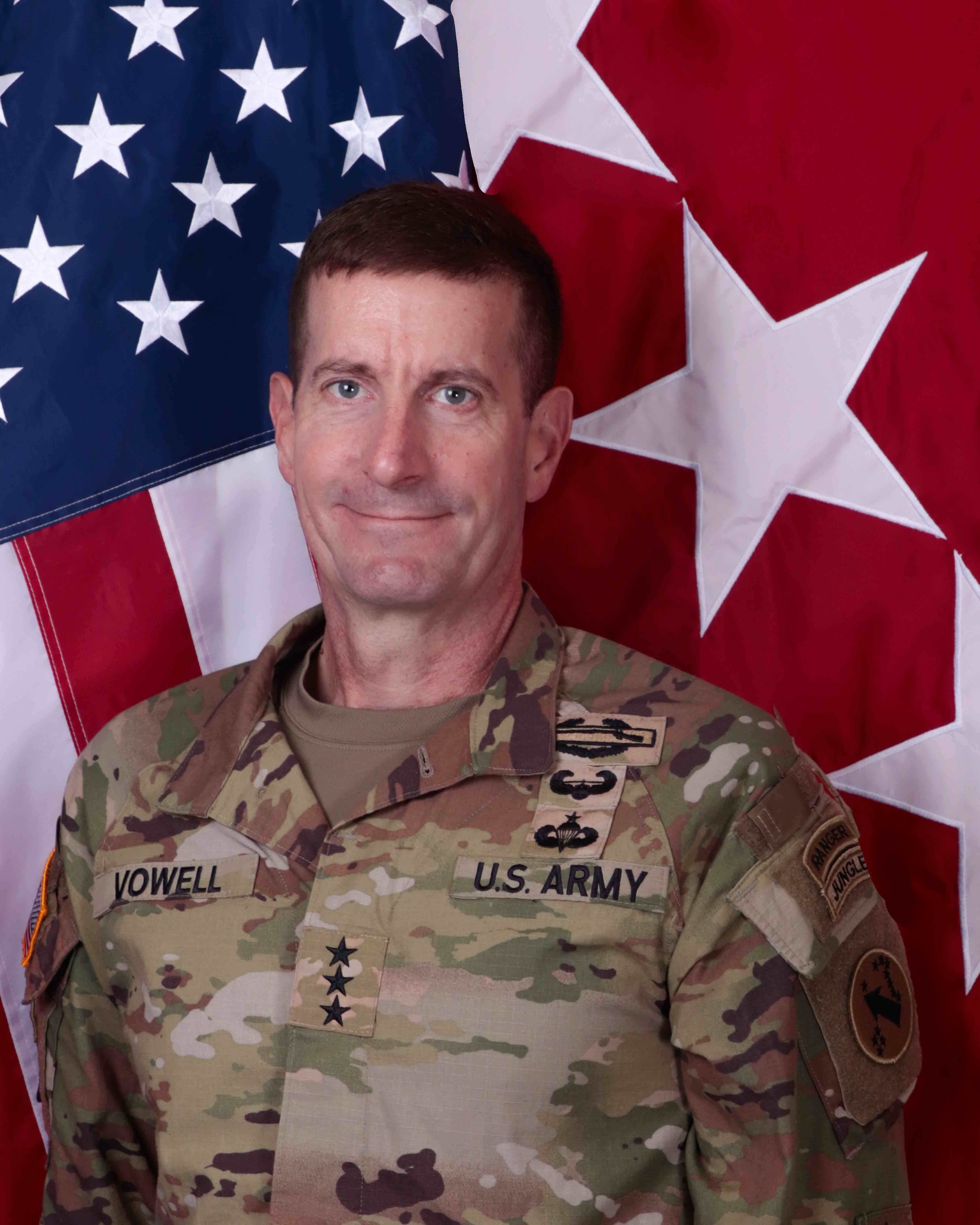
Lieutenant General Joel “JB” Vowell, Deputy Commanding General of the US Army Pacific (USARPAC)
While the President may think highly of the country’s foreign policy achievements, Sri Lanka seems to be getting drawn into a situation it would rather not be in, that of being drawn into the ever-widening war in West Asia.
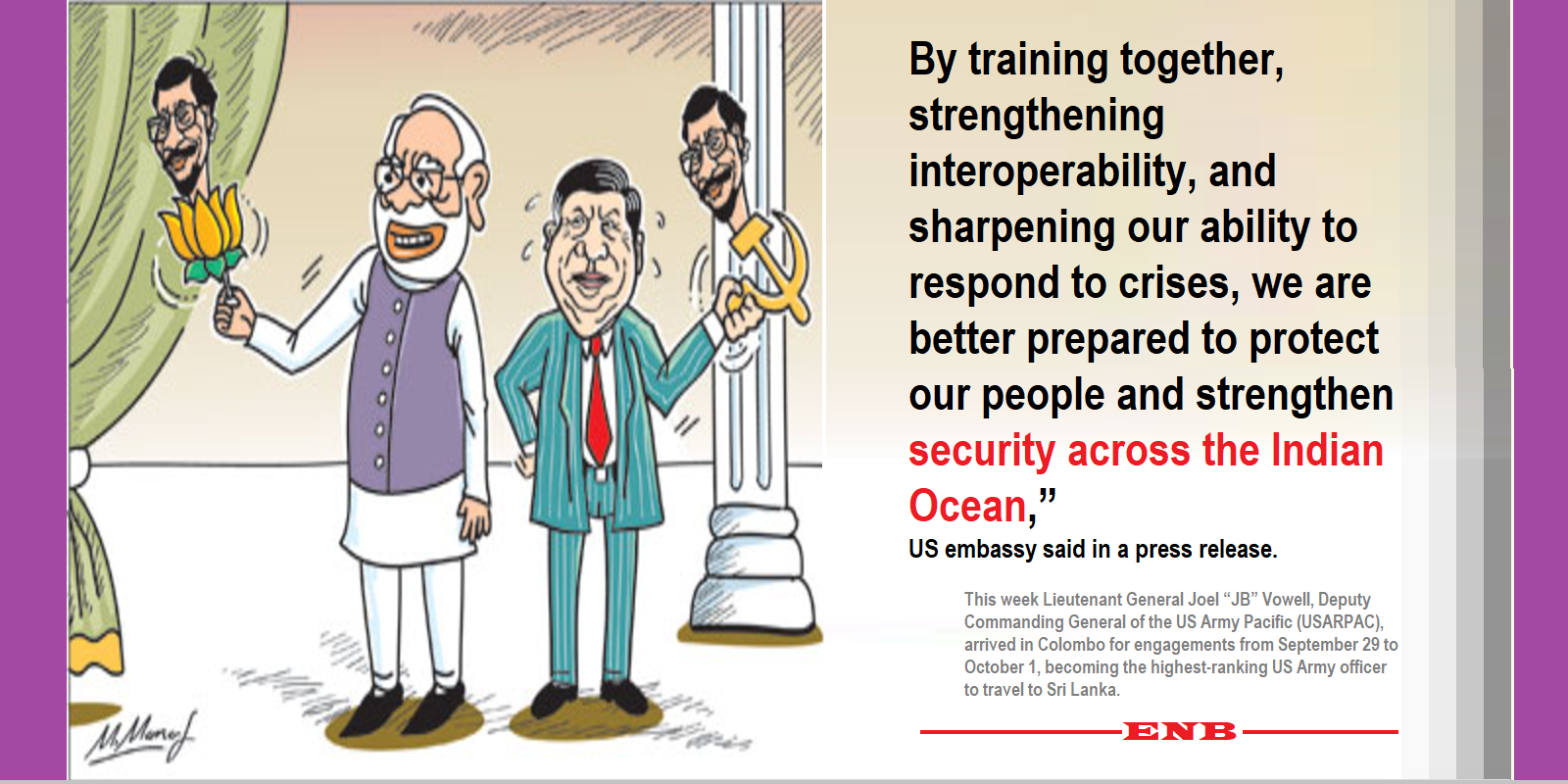
This week Lieutenant General Joel “JB” Vowell, Deputy Commanding General of the US Army Pacific (USARPAC), arrived in Colombo for engagements from September 29 to October 1, becoming the highest-ranking US Army officer to travel to Sri Lanka. According to the United States Embassy in Colombo, Lieutenant General Vowell’s historic visit “reflects the growing strength of our security partnership with Sri Lanka and a shared commitment to delivering results. By training together, strengthening interoperability, and sharpening our ability to respond to crises, we are better prepared to protect our people and strengthen security across the Indian Ocean,” the embassy said in a press release.
He met with Deputy Defence Minister Major General (Retd) Aruna Jayasekara and senior military officials to discuss opportunities to strengthen interoperability, readiness, and defence cooperation. He also visited the Defence Services Command and Staff College at Batalanda, where he addressed the next generation of military leaders and the important role professional military forces play in supporting regional security and stability.
His discussions also included upcoming joint military exercises, capacity-building initiatives, and cooperation on humanitarian assistance and disaster response (HADR).
While it was all smiles in front of the camera, the presence of around 20 stranded Iranian-linked oil tankers inside Sri Lanka’s Exclusive Economic Zone is giving a new headache to the country. According to foreign media reports, the US has cautioned against providing fuel and essentials to the crew of these oil tankers, warning of secondary sanctions against countries that do so.
Reacting to media reports that Washington has issued warnings of secondary sanctions on Sri Lanka, the Foreign Affairs Ministry said the sanctions are a common U.S. policy perspective which is applying globally and does not target only Sri Lanka or any specific country. The MFA said the secondary sanctions warning, announced by the US on August 24, says that if any individual or entity provides services to US-sanctioned vessels, they risk losing access to the US financial system, adding that the secondary US sanctions ‘commonly apply across the world.’
Tilvin in India
While the diplomatic challenges pile up on one side, the Janatha Vimukthi Peramuna (JVP) as a party is on its own trying to balance the India-China dynamics. JVP General Secretary Tilvin Silva led a five-member party delegation to New Delhi at the invitation of India’s ruling Bharatiya Janata Party (BJP), under its ‘Know BJP’ programme, which comprises a series of outreach engagements through which the ruling party seeks to familiarise foreign political leaders and diplomats with its organisational structure, ideology and governance model.
The Sri Lanka delegation met with Indian External Affairs Minister S. Jaishankar, BJP National General Secretary (Organisation) B.L. Santhosh and other senior party figures to learn more about the BJP’s organisational structure, grassroots membership network and development programmes in India. They also met New Delhi Chief Minister Rekha Gupta and other representatives of the BJB.
This is the JVP General Secretary’s second visit to India this year, having visited in February under the Indian Council for Cultural Relations’ (ICCR) Distinguished Visitors Programme.
In June, Mr Silva led a delegation to China aimed at deepening and consolidating the traditional friendship with the Communist Party of China (CPC). How the JVP hopes to balance the BJP ideology that was showcased during his recent visit to India and that of the CPC will be interesting to watch. It looks like a case of wanting to have the cake and eat it too for the JVP, but what better way than that to balance two powerful nations, both long-standing friends of the country, and in India, a newly found friend for the JVP?

ஒத்தவை:
சென்ற வாரம் இலங்கை-சண்டே ரைம்ஸ்