Row over robe: Dispute unlikely to die down as easily as govt hopes
- Gnanasara Thera supporters press for his release; protests simmer after peaking at presidential office gate
- Govt. sees monks as actors being directed by a hidden hand; vows not to yield to pressure
- As legal woes of the Rajapaksas continue, court releases former first lady on bail
- Interpol Blue Notice for Basil, but extradition from US poses challenges
By our ST Political Desk 18-10-2026
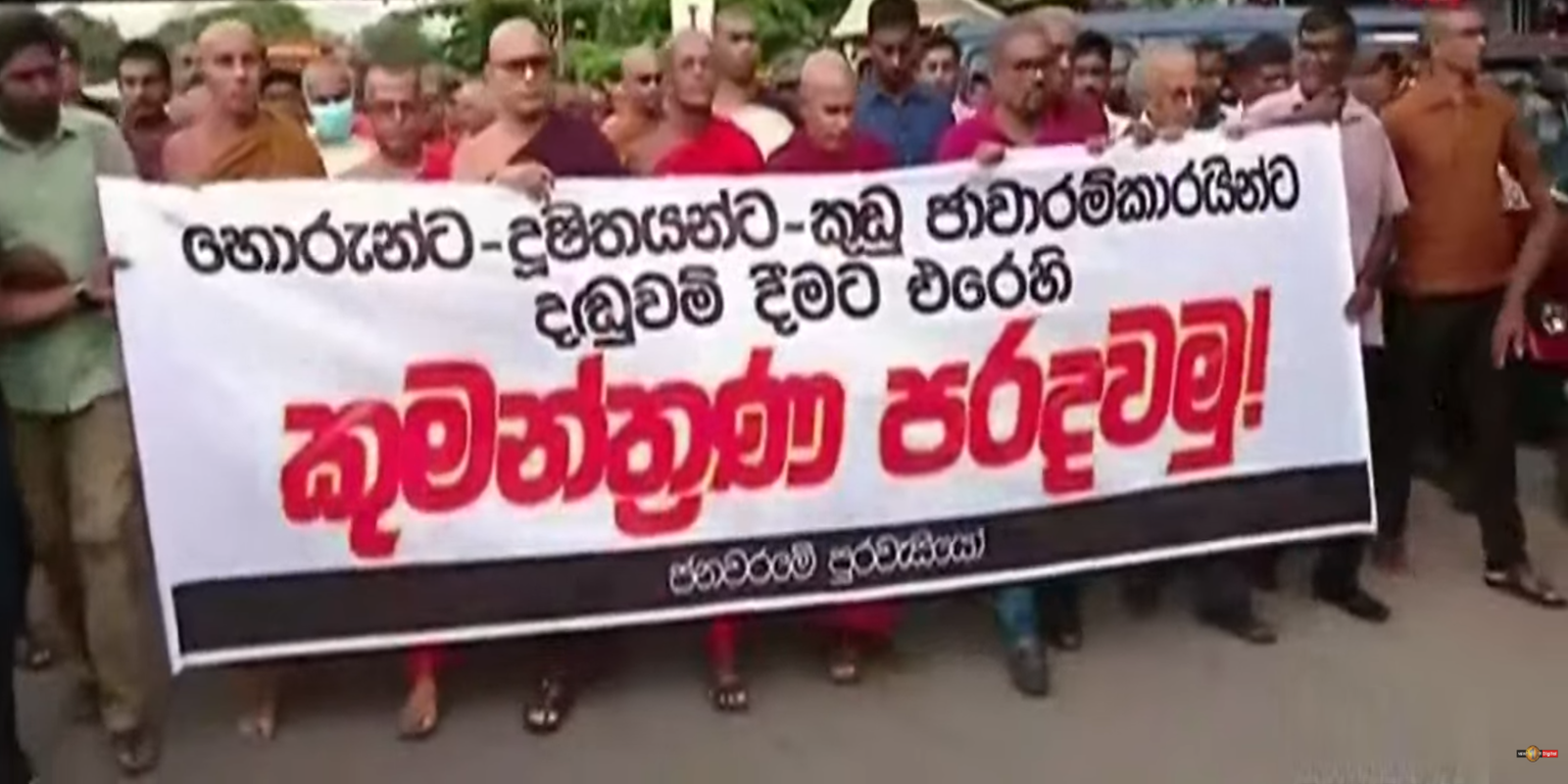
The rains beat down heavily as the “Nidahase Paada Yaathrawa” (March for Freedom), demanding an unconditional presidential pardon for convicted Bodu Bala Sena (BBS) General Secretary Ven. Galagoda Aththe Gnanasara Thera, wound its way to Colombo on Thursday (15) afternoon. The march had begun last Saturday (10) with an Adishtana Pooja at the Mahamaluwa of the Dalada Maligawa. The marchers then made their way on foot throughout the next six days, stopping at Kadugannawa, Kegalle, Warakapola, Nittambuwa and Kadawatha, before making their way to Colombo. They entered the city on Thursday with a Buddha statue at their head and Buddhist songs blaring from loudspeakers.
The rains may have kept some away, but it was still a sizable crowd that eventually made its way to the Presidential Secretariat opposite Galle Face. At its peak, police estimated the number of marchers to be around 1500, consisting of both Buddhist monks and laypersons. Many laypersons who were marching carried the National and Buddhist flags.
The march had originated as part of the “Siwurata Yukthiya” (Justice for the Robe) campaign launched in protest against the move by prison authorities to strip Ven. Gnanasara Thera of his monk’s robes and produce him in court in lay attire. In the midst of the widespread uproar created by that action, supporters of the BBS General Secretary transformed their protest into a campaign demanding his immediate release through a presidential pardon. The campaign placed President Anura Kumara Dissanayake in a difficult position, given that it was only last month that the Supreme Court nullified the 2019 presidential pardon granted to Ven. Gnanasara Thera by then-President Maithripala Sirisena. The monk was arrested at a temple in Kalutara and placed back in prison to serve the remainder of his six-year prison sentence for contempt of court.
Those who had organised the march kept the public guessing as to their final destination in Colombo until they entered the city, but the Presidential Secretariat was always on the top of the list of places they were coming to, given that it is the nerve centre of executive governance in the country.
As the marchers made their way to the Presidential Secretariat, they were met by metal barricades and a formidable police presence in front of its entrance. President Dissanayake had already left for the National People’s Power (NPP) head office in Pelawatte by the time the march reached the Presidential Secretariat. Some of the marchers mocked his absence, saying the President had fled (penala gihin) when he learned they were coming to his office. Police were forced to close the entire stretch of road in front of the Presidential Secretariat and divert vehicles along alternate routes, leading to heavy traffic that inconvenienced many motorists and commuters as they headed home in bad weather that evening.
With President Dissanayake absent, the sense of frustration and anger among the protesters soon became evident, as they demanded that the Secretary to the President come and meet them and convey the President’s stance regarding their demand. President’s Secretary N.S. Kumanayake did eventually come out to meet them but only stated that he would convey their request to the President.
Afterwards, a coordinating secretary to the President informed the protesting monks that a month’s time was needed to convey a decision on their request for a pardon for Gnanasara Thera. This only fuelled the agitation, and the monks insisted they would not move from the location until the President’s Secretary gave them a definitive answer in ten minutes, one way or the other.
The President’s Chief of Staff, Prabath Chandrakeerthi, then came out to meet them and stated that the President can only act according to the Constitution. Pointing out that the issue had arisen because the earlier presidential pardon had not been issued according to the proper procedure. He revealed that the President had agreed to act according to the law and the legal process with regard to the matter. When the monks pressed him to give them a timeframe on when that process would be completed, Mr Chandrakeerthi said he could not provide a definite answer.
A senior Presidential Secretariat official who was present during Thursday’s events told this column that they were “unprepared” for the confrontational attitude the protesters adopted. He said the thinking was that the monks, if they did make their way to the President’s office, would simply hand over a letter requesting a presidential pardon for Gnanasara Thera, make some speeches, and disperse.
Bail for Shiranthi Rajapaksa
“Since they publicly stated they were bringing a new robe for Gnanasara Thera to wear, we believed their final destination would have been the Welikada Prison after holding a protest outside the Fort Railway Station or the Presidential Secretariat,” said the official, hinting that there may also have been a failure on the part of intelligence agencies to give adequate warning about the intentions of the marchers.
He dismissed claims that President Dissanayake had left the Secretariat early on Thursday for the NPP head office because he expected trouble. The President had some pre-scheduled work and was always supposed to leave early that day. By the time the monks came to the location, many officials at the Presidential Secretariat had also left for the day. Mr Kumanayake and Mr Chandrakeerthi, however, worked late and as such, were at the President’s office as things became tense. They were able to correspond with President Dissanayake regarding the monks’ demand and convey his stance to them.
Given that the discussions they had with President Dissanayake’s senior staff ended without agreement, the monks decided to launch a ‘Sathyagraha’ outside the Presidential Secretariat. There were scuffles as police moved in to prevent the monks from erecting a temporary structure in front of the President’s office. The monks claimed the tent was for the Buddha statue they had brought with them, but the police insisted they could not erect any structure that blocked the main road. Three laypersons were subsequently arrested. Eventually, the monks moved to the pavement on the opposite side of the road and began their Sathyagraha there, but much of the crowd had dispersed by then.
Those who were still there on Friday morning were served with a court order police had obtained from the Colombo Fort Magistrate’s Court. The order by Magistrate Pasan Amarasena prohibited 53 individuals as well as their supporters from remaining in front of the Presidential Secretariat, citing its designation as a high-security zone. The order specifically named 30 monks, 11 politicians and 12 civil society activists. The monks decided to adhere to the court order and remove themselves from the vicinity. They later went to the Buddhasasana Ministry, but the talks with the Secretary to the Ministry also ended without agreement, leading some of them to set up camp at the Viharamahadevi Park across the road.
They were still there yesterday as well, but their numbers had thinned considerably. What became clear from the events on Thursday and Friday was that there were disagreements among the monks themselves as to how they should continue their struggle after the demand for Gnanasara Thera to be granted an immediate presidential pardon failed to elicit a positive response. There were angry outbursts and arguments between monks that played out in full view of television cameras as they debated what course of action they should take. Some monks angrily accused others of politicising the campaign calling for Gnanasara Thera’s release. In the end, only a handful of the core group of monks who helped organise the march and some of their supporters were left to continue the sit-in at the Viharamahadevi Park.
Opposition involvement
Many opposition political parties had thrown their weight behind the campaign to obtain a presidential pardon for Gnanasara Thera. They included the main Samagi Jana Balawegaya (SJB), the United National Party (UNP), the Sri Lanka Podujana Peramuna (SLPP) and Sarvajana Balaya. Opposition Leader Sajith Premadasa on Thursday evening even issued a statement titled “Sivurata Atha Nothabanu” (Do Not Lay a Hand on the Robe) in which he condemned the police’s actions to remove the tent the monks had set up in front of the President’s office. He also accused the police of harassing the monks and arresting several individuals. “We strongly condemn the President’s failure to intervene promptly and personally to provide solutions to the requests of the Venerable Maha Sangha and acting in such an undemocratic manner,” Mr Premadasa said. He added that what the President should do is to engage in discussions with the monks to offer them solutions. When the marchers reached Colombo on Thursday, a number of opposition politicians and their supporters also joined them.
The politicians who were named in the court order issued by the Fort Magistrate’s Court on Friday also pointed to how political parties had inserted themselves into the campaign. Those named in the court order included former ministers Wimal Weerawansa (Leader of the National Freedom Front), Udaya Gammanpila (Leader of the Pivithuru Hela Urumaya) and Sarath Weerasekara (SLPP), as well as former MPs Channa Jayasumana (Sarvajana Balaya), Saman Rathnapriya (UNP), Sanjeewa Edirimanna (SLPP) and Prasanna Ranaweera (SLPP). Also named were former Eastern Province Governor Anuradha Yahampath, who is now a Deputy Chairperson of the Sarvajana Balaya, as well as Attorney-at-Law Manoj Gamage – Media Spokesman for former President Mahinda Rajapaksa.
While some of those who had originally set out from Kandy on October 10 may have bristled at the way opposition political parties had tried to hijack their protest march for political ends, the fact is this is what political parties do everywhere in the world when they see an opportunity to advance their own agenda. This has been evident during recent protests in other countries. For example, India’s main opposition, the Congress Party, and its leaders have joined the ongoing street protests spearheaded by the influential Gen-Z-led “Cockroach Janta Party” movement demanding the resignation of the country’s Chief Elections Commissioner. In France, school students have been protesting for weeks over deteriorating conditions in public schools. Parties representing the Far-Left have been accused of hijacking these protests to sow chaos in an attempt to obtain an electoral advantage ahead of next year’s election.
The SLPP has publicly associated itself with the campaign to secure Gnanasara Thera’s release. Party General Secretary Sagara Kariyawasam said the party fully supports efforts to secure the monk’s release and will do everything in its power to make it happen.
As far as the government is concerned, there was no question that the march demanding a pardon for the BBS General Secretary had a political angle to it. “They (monks) were actors in a drama. The directors stood to one side and watched the whole thing,” said the senior Presidential Secretariat official, referring to opposition politicians who were at the rally and others who supported the campaign. He also said the monks who organised the march had not done themselves any favours by the way they behaved outside the President’s office. “Who are they to give ultimatums to the country’s President, impose deadlines on him and demand officials give them a response within 10 minutes?” asked the source. He contrasted the behaviour of the monks with those of the President’s Secretary and his Chief of Staff. “They tried to explain the situation as politely as they could, but the protesters were unwilling to listen.”
The official also said they did not believe those who took part in the protest outside the Presidential Secretariat represented the majority view of the monks in the country. “This was a group of politically inclined monks who had political backing. They tried to force the government to work according to a deadline. Their behaviour tarnished Buddhism,” he claimed.
It appears now that the government has taken a firm decision that there would be no pardon for Gnanasara Thera. Agriculture Minister K.D. Lalkantha made this clear on Friday when asked by journalists whether the President would pardon the monk. He said that the President cannot pardon Gnanasara Thera as the mandate given to President Dissanayake and the NPP government by the people was to ensure that the law applied equally for all. “The request made by the monks who took part in the march cannot be granted. If we did that, both the President and this government would be betraying the mandate given by the people,” he emphasised.
Another senior government source confirmed that Minister Lalkantha’s statement was the official stance of the government. He also pointed out that much of the anger among Buddhists was not so much about Gnanasara Thera being sent back to prison but over the decision to strip him of his monk’s robes and produce him in court in lay attire. This was done according to the prevailing regulations under the Prisons Ordinance, which the entire episode showed was outdated. “That matter has now been rectified,” he pointed out.
Indeed, that matter was rectified in record time, unlike when it came to most government appointed committees. It was only last week that a five-member committee was appointed with a two-week deadline to prepare a report recommending amendments to the existing laws to strengthen efficiency, good governance, security, cultural values and the rule of law within the prison. The committee’s interim report was handed over this week. In a statement, Justice and National Integration Minister Harshana Nanayakkara explained that in line with recommendations of the report, it has been proposed to amend Standing Order 356 of the Prison Regulations by introducing a new section, 356(A), alongside an interim directive to amend Departmental Order 550.
Under these amendments, when a Buddhist monk is imprisoned, the Commissioner of Prisons is given 10 days to notify the Department of Buddhist Affairs regarding the removal of the robes worn by the monk up to that point, and to act according to their instructions. Furthermore, should a member of the clergy from another religion become a prisoner, these provisions will be adapted accordingly to apply to them.
Additionally, an amendment will be introduced by adding a new section to Standing Order 550. This clarifies the situation when a Buddhist monk leaves the prison premises; specifically, if a monk is escorted out of the prison for any reason, full permission is granted for them to wear their robes. They retain this right unless a notification requesting otherwise is received from the relevant authorities or their respective Order (Nikaya).
When Gnanasara Thera was first brought to prison, the announcement that his monk’s robes would be removed and that he would be produced in court in lay attire was made by the Media Spokesman of the Department of Prisons, Commissioner of Prisons Senaka Palletenna. In many ways, Mr. Palletenna became the public face associated with the removal of Ven. Gnanasara Thera’s robes and copped a fair share of public criticism. It must have been decidedly uncomfortable for Mr Palletenna then when his own Department forced him to eat humble pie by sending him to Kandy at the head of a delegation of prison officers tasked with explaining the impending new regulations to the Mahanayake Theras of the Malwatta and Asgiriya Chapters. His interaction with the Mahanayake of the Asgiriya Chapter, Most Venerable Warakagoda Sri Gnanarathana Thera, was especially cringeworthy when the Mahanayake Thera insisted that Gnanasara Thera should be “set free” given that people had become agitated. Mr Palletenna later told journalists that the Commissioner General of Prisons did not have any authority to release Gnanasara Thera. Meanwhile, the Mahanayake Thera of the Malwatta Chapter, Most Venerable Thibbatuwawe Sri Siddhartha Sumangala Thera asked Mr Palletenna to look into the possibility of keeping monks who were imprisoned separately from other inmates.
While the government may be thinking that the march demanding Gnanasara Thera’s release was ultimately a failure, it would be unwise to believe the issue has died down. There are protests being organised on a daily basis in various parts of the island; most of which are led by monks. While the number of monks who ultimately joined the march in Colombo may have been smaller than anticipated, there are still large numbers of monks and laypersons who are holding protests elsewhere. The government might be gambling that these protests would eventually subside when the new prison regulations are implemented and Gnanasara Thera is presented to court once again in monk’s robes. However, now that the Chief Prelate of the Asgiriya Chapter has also called for Gnanasara Thera’s release, the matter may not die down as easily as the government hoped.
Sivarasa’s case: Good news for Govt
While the government was engaged in deciding how best to deal with the case of Gnanasara Thera, there was some good news for the government when it was announced that the death sentence imposed on Anojan Sivarasa, the 24-year-old Sri Lankan migrant worker has been set aside by the Supreme Court of Saudi Arabia. Foreign Affairs Minister Vijitha Herath said the Ministry of Foreign Affairs (MFA) and Sri Lanka Embassy in Riyadh worked tirelessly to appeal against the death sentence while engaging at different levels to save Anojan’s life. He said the appeal had to be filed within two days in the Supreme Court of the Kingdom of Saudi Arabia (KSA) as they had wanted to expedite the hearing of the case and the outcome has been a result of a lot of hard work. “It’s not easy to have a death sentence overturned but we have managed to file a convincing appeal on behalf of Anojan,” he said.
According to the Court documents released by Saudi Arabia, Anojan was charged with ‘insulting and verbally assaulting Prophet Muhammad… which is criminalised under Sharia; and producing and publishing that which would prejudice religious values and public morals via the information network, by publishing a comment on one of the social media programmes containing a verbal assault……in words contrary to religious values and public morals; which is criminalised by the Anti-Cyber Crime Law in KSA.’
Anojan was initially sentenced to a prison term of five years, and a fine of three million riyals (around Rs 260 million) in July after considering that the evidence placed before the court by counsel for the defendant who told the court that a single comment issued by him was connected to a verbal altercation and that the phrase was issued in a moment of anger and that he had deleted the comment after a short time, and that following the incident he hastened to publish a video clip in which he expressed his apology, regret, and remorse for what he had done.
Following the initial sentencing, the Public Prosecutor had submitted his objection for the ‘failure to sentence him (Anojan) to a severe discretionary penalty that dissuades him and deters others. Meanwhile the attorney of Anojan too had submitted his objection to the five year jail term and fine stating that Anojana had asked for forgiveness, and affirmed his respect for the Islamic religion and he was not a habitual offender guilty of such acts. However, the appellate court granted the prosecution’s request and upgraded the sentence to a death penalty.
The case was then referred to the Supreme Court while intense diplomatic efforts were also put in place to get the death sentence overturned. On Tuesday (October 13) the judgment imposing the death penalty on Anojan was overturned pursuant to the decision of the SC of the KSA.
President Anura Kumara Dissanayake was among many who welcomed the decision by the Supreme Court of Saudi Arabia to set aside the death sentence stating that the judgment brings immense relief to Anojan, his family, and all Sri Lankans who have followed his case with deep concern. “It reflects the value of patient diplomacy, respect for the legal processes of a friendly nation, and the tireless work of those who stood by a Sri Lankan citizen abroad,” the President said on his X social media account. He also expressed his appreciation to the Government of Saudi Arabia for this outcome and thanked the many Saudi Arabian and Sri Lankan diplomats, civil servants and legal teams for their dedicated efforts.
“My Government will continue to extend all necessary support to Anojan and his family as the remaining legal processes concludes. No Sri Lankan who leaves our shores in search of a livelihood should ever feel that they stand alone,” the President said.
While the biggest challenge has been overcome for now, Government sources said they are working to have Anojan brought back to the country. One option under consideration is for Anjoan to serve his jail term back home with the agreement of the Saudi authorities but Sri Lanka and Saudi Arabia do not have an International Prisoner Transfer Treaty (PTT) with each other and hence this may not be possible. But for now, for the government and the people, the overturning of the death sentence is big sigh of relief.
Shiranthi’s case: Some relief for Rajapaksa
Meanwhile there was little relief for the former first family of Sri Lanka with the legal woes of the once powerful Rajapaksa family continuing to grow. This week there was new focus on basil Rajapaksa who is facing allegations of misappropriation of state funds and money laundering charges. In this connection the Criminal Investigation Department (CID) this week requested INTERPOL for the issuance of Blue Notice for the arrest of the former Minister. INTERPOL Notices are international requests for cooperation or alerts allowing police in member countries to share critical crime-related information. In this case the Blue Notice is required to collect additional information about a person’s identity, location or activities in relation to a criminal investigation.
The CID investigation into Basil Rajapaksa has centred on the purchase of a property at Browns Hill, Matara, and the alleged misuse of Rs 7.8 million in funds belonging to the Sri Lanka Tourism Promotion Bureau to distribute 12,000 T-shirts during the Uva Provincial Council election campaign. The Uva PC polls were held in September, 2014 and was won by the then ruling United People’s Freedom Alliance (UPFA).
Basil Rajapaksa is a US-Sri Lankan dual citizen and law enforcement officials familiar with the case said that the modalities of having him extradited is more complex than if he were only a Sri Lankan national. “If he renounces his Sri Lankan citizenship and retains only his US citizenship, then having him brought back to Sri Lanka to face trial becomes complicated,” the official said, on condition of anonymity.
Sri Lankan and the United Sates have an extradition treaty which covers offences punishable in both countries by more than one year of imprisonment, including attempts and conspiracies. However, extradition on grounds of political offences is barred and this is an area which Basil Rajapaksa will be looking to exploit. Sri Lanka Podujana Peranmauna (SLPP) General Secretary Sagara Kariawasam said that all the charges being framed against members of the Rajapaksa family are politically motivated including Basil’s case and they would continue to voice opposition to this witchhunt.
He alleged that the government is using members of the Rajapaksa family to distract from the pressing issues of the public and expressed concerns about the trend.
Back home there was a breather for former First Lady Shiranthi Rajapaksa, who was granted bail on Friday after being in remand custody from October 7 over allegations of misappropriating funds from the ‘Siriliya Saviya’ account. She was released on a cash bail of Rs 100,000 and two personal bail bonds of Rs 10 million each. The court imposed an overseas travel ban on her with December 11 fixed for a progress report on the investigations.
Ms Rajapaksas’s health has been a matter of focus since she was taken into custody from her home by officers of the Commission to Investigate Allegations of Bribery or Corruption (CIABOC). A medical report submitted by the National Hospital of Sri Lanka to court on Friday disclosed that she needs to undergo a coronary artery bypass grafting (heart bypass).
Along with the legal woes, Mrs Rajapaksa is not the only family member facing health issues as well. Former president Mahinda Rajapaksa was hospitalised earlier this week, though details of his condition are not clear. SLPP sources said he had gone for his routine medical treatments.
Former President Gotabaya Rajapaksa also filed a motion before the Colombo Fort Magistrate’s Court seeking the removal of the overseas travel ban imposed on him to enable him to travel to Singapore for follow-up medical treatment required after undergoing heart surgery. A foreign travel ban on him has been in place since June in connection with ongoing investigations into the 2019 Easter Sunday bombings.
Both, Namal Rajapaksa and his brother Yoshitha Rajapaksa also appeared in Court this week. Yohitha’s money laundering case was taken up before the Colombo High Court on Thursday and further hearing was postponed till October 30, 2026.
While Yoshitha is on bail pending conclusion of hearings, MP Namal Rajapaksa remains behind bars. When he was produced in court on Friday, he was further remanded until October 23 by the Colombo Chief Magistrate’s Court, in connection with an alleged bribery case involving the Krrish group.
His ongoing incarceration has disrupted his party’s planned anti-government campaign and brought it to a virtual standstill.

ஒத்தவை:
சென்ற வாரம் இலங்கை-சண்டே ரைம்ஸ்