Day after presenting budget,
President outlines new accountability-based social contract
- When in government, people come before party, President says at JVP commemoration;
- vows to create a society free from fear and submission
- Budget offers cost-of-living and tax relief; but opposition dismisses it as a “fairytale”
- News of Anojan’s release in Saudi Arabia brings joy to Govt and family; but monks’ protest over
- India-funded sacred city plan adds to its woes
By our ST Political Desk 15-11-2026
In a marathon effort lasting five hours, President Anura Kumara Dissanayake on Thursday (12) presented Budget 2027 to Parliament in his capacity as Minister of Finance, Planning and Economic Development. It was the third full budget of his National People’s Power (NPP) government (it had also presented a Vote on Account to cover expenses for the first four months of 2025). Thursday’s budget speech was even longer than the one President Dissanayake delivered when presenting Budget 2026 last year, where he spoke for four hours and 20 minutes.
Thursday’s budget speech followed a now familiar pattern for President Dissanayake. He mostly stuck to the script, reading from the Sinhala text of the speech that went over 70 pages. He paused at certain points to elaborate further, sometimes even offering clarifications to queries shouted from the opposition benches. There were also his customary light-hearted barbs directed at those on the other side of the aisle.
There is no denying that the past year has been a challenging one for the government, as its plans for the economy were severely affected by unexpected events that were beyond its control. One situation, namely the war in West Asia, is becoming more prolonged than ever before, creating great uncertainty in the world, he observed. The closure of the Strait of Hormuz has affected nearly 20 per cent of global petroleum shipments. Accordingly, the increase in fuel prices, premiums and shipping and insurance charges had an adverse impact on the country’s energy market. “We have still not been able to free ourselves from the pressure this created on our economy and on people’s lives. As a result, more than Rs 147 billion was spent to minimise the impact on the people and on economic stability.”
Meanwhile, the government also has to prepare for the ongoing El Niño weather pattern, which is expected to peak in February 2027. Budget 2027 proposes to allocate Rs 5 billion as advance preparedness to meet the requirements that may arise from El Niño.
Further, according to the Post-Disaster Needs Assessment (PDNA) report, the damage caused by Cyclone Ditwah to housing, industries, railway systems, agriculture, education and the health system has been estimated at USD 2 billion, which, together with economic losses of USD 1.4 billion, amounts to a total of about USD 3.4 billion (Rs. 1.022 trillion).
After having built economic stability while facing all these adverse circumstances, the main objective of Budget 2027 is to move from “economic stability towards transformation,” the President emphasised.
The Sunday Times last week pointed to how crucial Budget 2027 is to the NPP government given that it is the last budget before Sri Lanka’s 48-month Extended Fund Facility (EFF) programme with the International Monetary Fund (IMF) ends in March next year. This will bring an end to the IMF bailout package totalling about USD 3 billion to Sri Lanka by the end of the arrangement.
Some economic experts had urged the government to make a clear statement when delivering the budget as to its next course of action once the IMF programme concludes. The response typified the approach the Dissanayake government had taken to most major issues that have emerged during the past two years: the appointment of yet another ‘committee’ to study the matter. The President pointed out that this ‘committee’, headed by the Deputy Minister of Finance and Planning, will “examine and submit a report on the suitability of entering into another programme after the successful completion of the current IMF programme and on what type of programme it should be.” There was no timeline on when the committee’s work would be completed and its report would be submitted, but experts had warned about the danger of waiting until the last moment to start negotiations with the IMF on a possible successor programme, pointing out that this would put Sri Lanka at a disadvantage.
A detailed breakdown of the main budget proposals appears elsewhere, but given that Sri Lanka is still under the EFF of the IMF, the government was still bound by the terms of the agreement when drafting the 2027 budget.
Nevertheless, President Dissanayake had publicly pledged last month that there would be further tax cuts in the upcoming budget. These would be affected without jeopardising the government’s revenue target, he had assured. When the budget was unveiled on Thursday, there was indeed some tax relief. Most notable among them was the proposal to increase the tax-free threshold from Rs 150,000 to Rs 162,500. This would increase the annual personal income tax-free threshold from Rs 1.8 million to Rs 1.95 million. This is still well below the annual tax-free threshold of Rs 2.4 million that the NPP had promised in its manifesto, ‘A Thriving Nation, A Beautiful Life’, when the party campaigned for election in 2024, but that was before the reality that they had to work with the IMF had set in.
The NPP had also pledged in its manifesto to exempt Value Added Tax (VAT) from schoolbooks, stationeries and equipment. This, however, was not done in the past two budgets, garnering criticism from the public. As such, it must come as a relief to parents and students everywhere that Budget 2027 has fully exempted exercise books, textbooks, dictionaries, encyclopaedias, children’s drawing and colouring books, educational publications and other printed books from VAT. It was reported yesterday that sellers are planning to reduce the prices of exercise books by 18 per cent from next month in response to the decision to exempt exercise books from VAT.
Meanwhile, to ease the cost-of-living pressure on consumers, the government substantially reduced the Special Commodity Levy (SCL) rates on several essential imported food items with effect from Friday. Accordingly, the SCL on sprats was reduced from Rs 100 to Rs 10 per kg, while the SCL on Maldive fish was reduced from Rs 302 to Rs 10. The SCL on both powdered and unpowdered dried chillies was reduced by Rs 50 per kg.
“We have a very clear, progressive and proud dream for our motherland. Our hope is to make this country not merely an island but one of the most advanced countries, not only in Asia but in the whole world, rich in knowledge, skills and modern technology,” the President told the House near the conclusion of his speech.
Opposition hits out
While government MPs praised Budget 2027 as excellent and forward-looking, most opposition MPs were less than impressed. Some commented that those who listened to the President for five hours should be given some relief for having been forced to sit through his ‘fairytales’.
One of the main problems with the budget is that it offers no solutions to the issue of the rising cost of living, said Samagi Jana Balawegaya (SJB) General Secretary Ranjith Maddumabandara. “They (NPP) initially claimed they would allocate 6 per cent of GDP for education, but this budget barely manages 2 per cent. The pay hike for public servants is in three stages, but it has not taken into account how rapidly the rupee has depreciated within a short time, resulting in the cost of living skyrocketing. The pay hike for public servants, therefore, should be more,” he asserted.
The government claims it has more than enough money, the SJB MP added. If that is indeed the case, the first thing they should do is to use those funds to lower the cost of living and provide relief to the people.
He also claimed a lot of funds earmarked in Budget 2027 are from unutilised funds from Budget 2026, because the government “has not done much of what it promised to do.”
The budgets of 2025 and 2026 did not do much at all for the people of the country, said Sri Lanka Podujana Peramuna (SLPP) General Secretary Sagara Kariyawasam. “Budget 2027 promises a lot, but we don’t believe much will come out of it. We see this budget as similar to all others presented by this government. They are presented simply because according to the law, the government needs parliamentary approval to allocate public funds. Beyond that, they haven’t done a single development project of note over the past two years,” he charged.
Mr Kariyawasam claimed that the budget mostly provides tax relief for the rich but does virtually nothing for the people who largely helped bring President Dissanayake and the NPP to power.
Meanwhile, an economic expert who spoke to this column on grounds of anonymity questioned the claim made by the government that sections of the Rambukkana–Galagedara, Kurunegala–Galewela and Ruwanpura motorway will be built with ‘tax money’ rather than foreign loans. “This framing effectively shifts the political discourse away from the underlying fiscal reality,” said the expert. After the 2022 default, caution about foreign debt is sensible, and giving work to local contractors has clear benefits. From a public finance point of view, however, it is useful to understand what ‘tax-funded’ means in practice. The label describes how a project is presented in the budget. On its own, it does not tell us how the project affects borrowing, foreign currency needs, or other spending.
The amounts are significant, he pointed out. In May, the Cabinet approved the Rambukkana–Galagedara section at an estimated cost of Rs 112 billion. The 2026 Budget set aside Rs.20 billion for it, and the 2027 Budget adds a further Rs 23 billion, with completion targeted for July 2029. The 2027 Budget also provides Rs 30 billion to begin the Kurunegala–Galewela section and Rs 27 billion for the Ruwanpura Expressway. These projects will draw on the budget for several years.
In Sri Lanka, tax revenue goes into the Consolidated Fund and pays for all government spending. Unless money is set aside by law for a particular purpose, specific taxes cannot be linked to a specific road.
When revenue is not enough to cover expenditure, there is a gap, or a deficit, in the budget. That gap must, by definition, be filled by borrowing, either at home or abroad. Sri Lanka’s budget is still in deficit. The 2027 Budget itself aims to keep the deficit below 5 per cent of GDP. A project described as ‘tax-funded’, therefore, sits inside a budget that still depends on borrowing through Treasury bills and Treasury bonds, financing from the World Bank and the Asian Development Bank, and bilateral lenders such as Japan, and, as market access returns, international sovereign bonds, he explained.
“Therefore, a rupee of tax is the same as any other rupee in the budget, whatever it is called. Using ‘tax money’ for the expressways does not create new money. It means that the same rupee is not available for another purpose.”
This is the opportunity cost. A rupee spent on the expressways could otherwise have gone to essential schools, hospitals, support for the poor, or repairs to existing roads that directly impact economic productivity and human development. It could also have paid interest on past borrowings, which the government currently meets partly through new borrowing. So when ‘tax money’ is used for the roads, other needs are met through borrowing, or some of them may be cut or reduced. The borrowing does not disappear. It simply moves to another part of the budget: instead of borrowing for the road, the government borrows for something else. This is not an argument against the projects. It is simply how a budget works, he explained.
Public understanding would be helped by information on the full cost of each project, how the budget will carry it over the coming years, and how it fits with overall government borrowing, even as government revenue rises, he remarked. Such information is all the more useful given recent news reports of public projects that have stopped halfway for lack of money.
Anuradhapura brawl
As President Dissanayake was presenting Budget 2027 to Parliament, a tense situation arose near the Ruwanweliseya in Anuradhapura, where a group of Buddhist monks and their lay supporters led by the controversial Ven. Balangoda Kassapa Thera clashed with another controversial monk and his supporters. The group led by Ven. Kassapa Thera had been engaged in a Satyagraha near the Ruwanweliseya for several days, demanding that the government scrap the Anuradhapura Sacred Area Development Plan, which is set to be implemented with funding from the Indian government. The monks had been carrying on their protest in defiance of a court order telling them to vacate the area. It was Ven. Kassapa Thera who also recently led a Satyagraha at the Viharamahadevi Park in Colombo demanding the release of Ven. Galagoda Aththe Gnanasara Thera, who is serving a prison sentence for contempt of court.
Kassapa Thera and six others arrested following the clash near the Ruwanweliseya were remanded until November 26 after being produced before the Anuradhapura Magistrate’s Court.
President Dissanayake also spoke of plans to develop the Anuradhapura sacred area when he delivered his budget speech. He said Anuradhapura “represents the historical heritage of Buddhist civilisation.” Therefore, the government expects to implement a number of development activities, including improving the facilities required by devotees, road rehabilitation and waste management, while safeguarding its archaeological and religious values for future generations, the President stressed. An advisory council, co-chaired by the Acting Chief Prelate of the Atamasthana, has already been established to monitor and guide this programme, he further pointed out.
The Anuradhapura Sacred Area Development Plan has the consent of the Mahanayaka Theras and the Atamasthanadipathi. All of them went over the plan in detail before giving their consent. Foreign Affairs Minister Vijitha Herath has told the Sunday Times. “We have no plan to establish a Hindu Kovil (among Buddhist heritage sites) as part of the project,” he insisted, dismissing claims made by those opposed to the project that the government was trying to alter the Buddhist environment in Anuradhapura.
Some of the plans the government has for the Anuradhapura sacred area date back to the 2024 coalition government between the United People’s Freedom Alliance and the Janatha Vimukthi Peramuna, says Minister Herath, who was Minister of Cultural Affairs and National Heritage under that government. This included implementing a shuttle bus service for pilgrims to move about between the various sacred sites. He alleged these plans had been scuttled by interested parties, but the new development plan also includes such a shuttle service, he revealed.
He also noted that the new development plan will take time to implement. This is because there are sites that come under the Anuradhapura sacred area where people have illegally constructed houses and other structures. Some properties even have stone pillars and other ruins on their grounds, while some buildings are sitting on top of areas that have been earmarked for excavation. Accordingly, people who are now living in these areas must be given alternate lands and removed from the area, said the minister.
“We have to conserve this area but also develop it because it is part of our national heritage. Those who are opposed to this are trying to stir up needless fears. We have been extremely transparent with everyone with regard to this plan,” the minister insisted.
Freedom for Anojan
Meanwhile, Minister Herath received the news on Tuesday (10) that the Public Prosecution Office of Saudi Arabia had decided not to pursue the legal proceedings against Sri Lankan national Anojan Sivarasa (24) any further, effectively freeing him of all blasphemy charges. It was by way of a verbal communication from the Sri Lanka Embassy in Riyadh. The minister chose to delay going public with the good news till he received a written communication, which he got the following day. By then a vehicle had been arranged to get Anojan’s parents and brothers to his ministry from Kalmunai, and the minister personally relayed the happy news to them and handed over the copy of the official communication regarding their son’s case. There were emotional scenes as the overjoyed family members were in tears, having got to know that their loved one would be reunited with them soon.
Foreign Affairs Minister Vijitha Herath breaks the news of Anojan's release to his mother and family members
Anojan’s family members also met with President Dissanayake at the Presidential Secretariat on Thursday morning, where they thanked him profusely for his intervention in the case and for sparing no effort to have their son returned home. “You are a god to us. We will never forget what you have done for us,” Anojan’s tearful mother told the President as she kissed his hand. From the inception the President had been clear that the government would take all steps possible to assist a Sri Lankan national in need. He told Anojan’s family members that it was his responsibility to stand up for Sri Lankan citizens at all times, wherever they may be in the world and emphasised that special appreciation should be extended to the Government of the Kingdom of Saudi Arabia for ensuring that Anojan was freed of all charges as well as to everyone who intervened on his behalf, irrespective of differences in ethnicity, religion or political affiliation.
The President was to present the budget to parliament that afternoon, and amidst the usual gloomy news, including those brought on by nature and the tense situation around the Ruwanveli Maha Saya, there was reason for the President and his government to feel upbeat over the outcome in Anojan’s case.
For Foreign Affairs Minister Herath, it felt like a personal victory given that his ministry played a major role, first in getting the death sentence against Anojan set aside and then seeing him released from the five-year jail sentence and the fine of 3 million Saudi Riyals (around Rs. 260 million). Sri Lanka’s Ambassador to the Kingdom of Saudi Arabia, O.L. Ameer Ajwad, played a crucial role in engaging with the Saudi authorities at a diplomatic level, which resulted in a happy outcome in the case.
“It was a collective effort which resulted in this outcome. As Sri Lankans we must all be happy about it,” Minister Herath says. The Sri Lanka government hired one of the best law firms in Saudi Arabia to represent Anojan and paid the legal fees on his behalf as well as arranged travel and accommodation for a legal team from here to go there. The team included a representative of the Attorney General’s Department as well as President’s Counsel Faizer Musthapha and Upul Kumarapperuma and Attorney-at-Law Hafeel Farisz.
Minister Herath said Anojan’s release was made possible through the guidance of President Dissanayake, his diplomatic intervention and the efforts of other diplomatic officials. He also acknowledged the role played by the government and the judiciary of Saudi Arabia, the diplomatic institutions and officials of both Saudi Arabia and Sri Lanka, and the team of lawyers who travelled to Saudi Arabia to assist with the matter.
Anojan faced a blasphemy charge in Saudi Arabia for a post he had written on his Facebook account. According to the court documents released by Saudi Arabia, Anojan was charged with ‘insulting and verbally assaulting Prophet Muhammad… which is criminalised under Shariah law and producing and publishing that which would prejudice religious values and public morals via the information network, by publishing a comment on one of the social media programmes containing a verbal assault… in words contrary to religious values and public morals; which is criminalised by the Anti-Cyber Crime Law in KSA.
Anojan remains in prison in Saudi Arabia till all the legal formalities for his release are completed, and he is expected to be repatriated within the next two to three weeks.
Commemorating JVP heroes
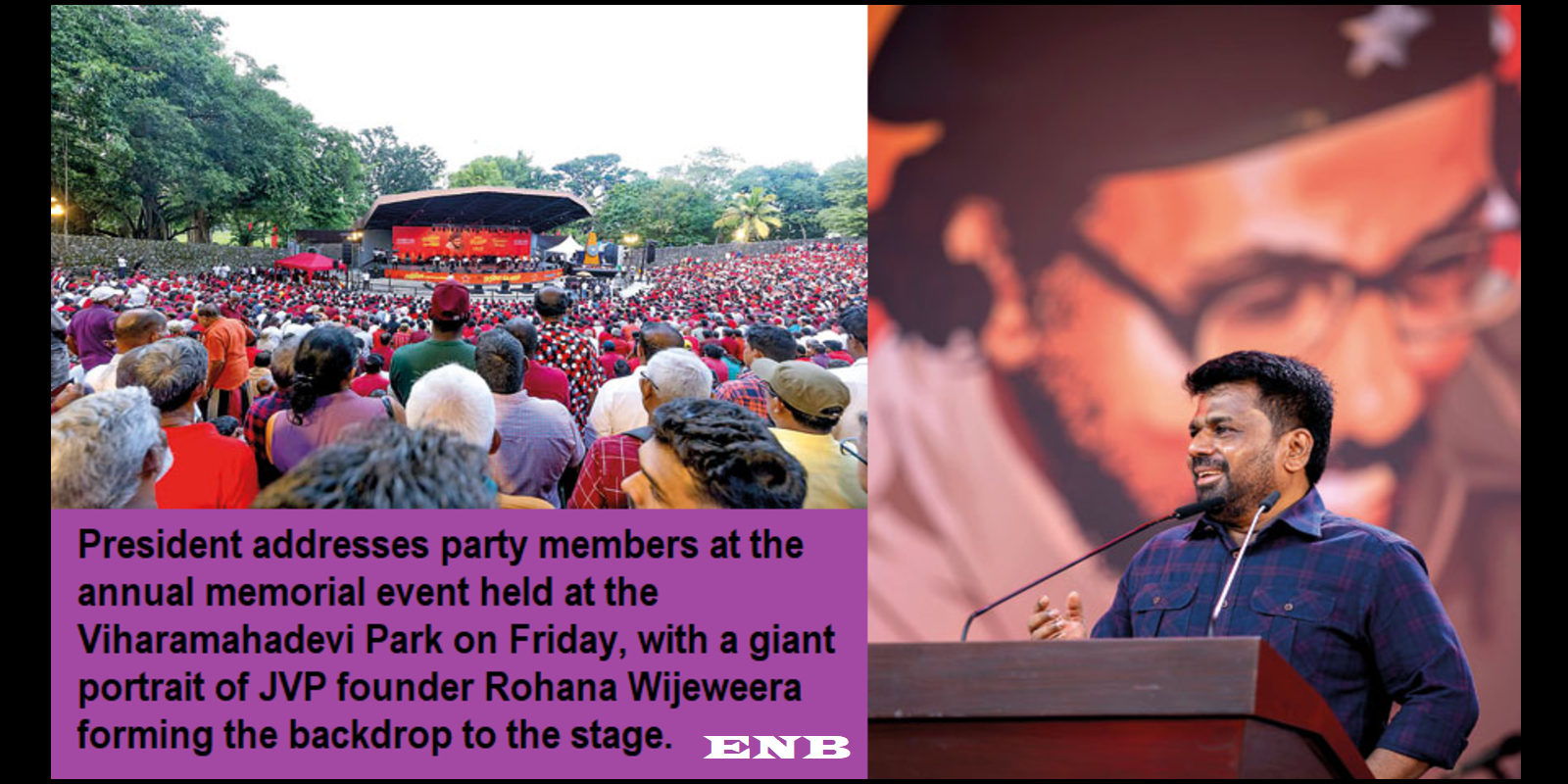
Meanwhile, the annual Il Maha Viru Samaruma, or the Commemoration of November Heroes, which the Janatha Vimukthi Peramuna (JVP) has been holding since 1994, has gained more significance since 2024, when the JVP-led National People’s Power (NPP) was elected to office. On Friday, President Dissanayake, who is also the leader of the JVP, joined Party General Secretary Tilvin Silva and political bureau member Bimal Rathnayaka for the commemoration held at Colombo’s Viharamahadevi Park, where the party faithful gathered to remember their fallen comrades. It was in November 1989 that JVP founder Rohana Wijeweera and the top hierarchy of the party were killed during the government crackdown on the movement.
Anura Kumara Dissanayake, who was appointed JVP leader in 2014, has led the party to electoral victory, which was unimaginable during the time that Wijeweera led it. Within ten years of Mr Dissanayake being elected party leader, the JVP has gone from being an ‘also-ran’ party to holding state power. Now that a JVP-led party is in power, there seems to be change in the line of thinking on where it should go from here, with the President telling his party members that there was a need to change course from the traditional path the JVP had hitherto followed.
“For 59 of the 60 years of our history, our challenges and responsibilities were largely centred on securing political power. Now that we have secured that power, we must direct it towards achieving our objectives. Therefore, we must develop a new way of thinking, transform ourselves in new ways and adopt a mindset and approach capable of overcoming the new challenges before us,” the President told his party faithfuls.
He told them that it was time to shift the primary focus from the party towards the people. “When governing the country, our full responsibility and commitments are towards the people. We cannot hide behind explanations that something belongs to the past, that it was inherited from previous administrations, or that those who came before us failed to do it. We must be accountable to the people living in this country at this moment. The people have given us a mandate. They have established a government under our leadership. Therefore, it is we who must be accountable to them now,” he said.
He called on the JVP members to transform themselves into a movement that is committed and accountable to the people. “We need a new transformation in our economy. We also need a new transformation in our politics. We have already begun the journey required to bring about these changes. We are not prepared to frighten or subjugate anyone. Our aspiration is to build a society in which the people question and criticise those who govern them,” the President said.
At a time when the government is under fire for attacks on freedom of expression and concerns over laws like the Prevention of Organised Crime Bill, the President’s effort to allay those fears is reassuring, especially when he stated that the people have the right to criticise the government—and that it is up to those in power to create a political culture that recognises that right.
‘When we are accountable to the people, they have every right to criticise us. They have the right to reprimand us and to protest against us. Why? Because we are duty-bound to work for them. We must create a political culture that recognises this right,” the President said, adding that the reign of past leaders when they ruled by imposing fear on the people must be left behind for good.
“Those living in an area feared their local councillor. People in a province feared the minister, and the people of the country feared the leader. That was the nature of the relationship between the rulers and the people. Fear and submission defined that relationship. This was the relationship that existed between the people and those in power in our country for a long time. We must break away from it. What should the new relationship be? The people must have the right to question those in power. They must have the right to criticise them and to protest against them. We must establish a new relationship between the people and those who govern them,” he added.
SLFP crisis
In a separate political corner, the infighting within the Sri Lanka Freedom Party (SLFP) led to miscommunication last week with reports that the party had been delisted by the National Election Commission (NEC). The situation had come about due to party members making contradictory comments.
However, the NEC this week clarified that the situation is not that dire for the SLFP, and there is no threat of the SLFP being dropped from the list of recognised political parties in Sri Lanka.
In a statement the NEC sought to clarify the situation, stating that the SLFP remains a recognised political party but has been classified as a party for which the post of General Secretary has remained in dispute since 2025 due to rival factions claiming the position.
The NEC said that following requests to resolve the matter, representatives of the parties involved were summoned for discussions on November 6. During the meeting, both parties had agreed that it would be appropriate to make a decision on the disputed general secretary position after a ruling is delivered in the case currently being heard before the Western Province Civil Appellate High Court. The Election Commission said a final decision on the matter would be considered following the court’s determination.
MP Dayasiri Jayasekara and former MP Duminda Dissanayake are making rival claims for the post, which has led to the long-drawn-out legal woes of the party. All is therefore not entirely lost for a party that has been in power and place in this country for some time ever since 1956, when its founder, S.W.R.D. Bandaranaike, was swept to office in a landslide electoral victory.

ஒத்தவை:
சென்ற வாரம் இலங்கை-சண்டே ரைம்ஸ்