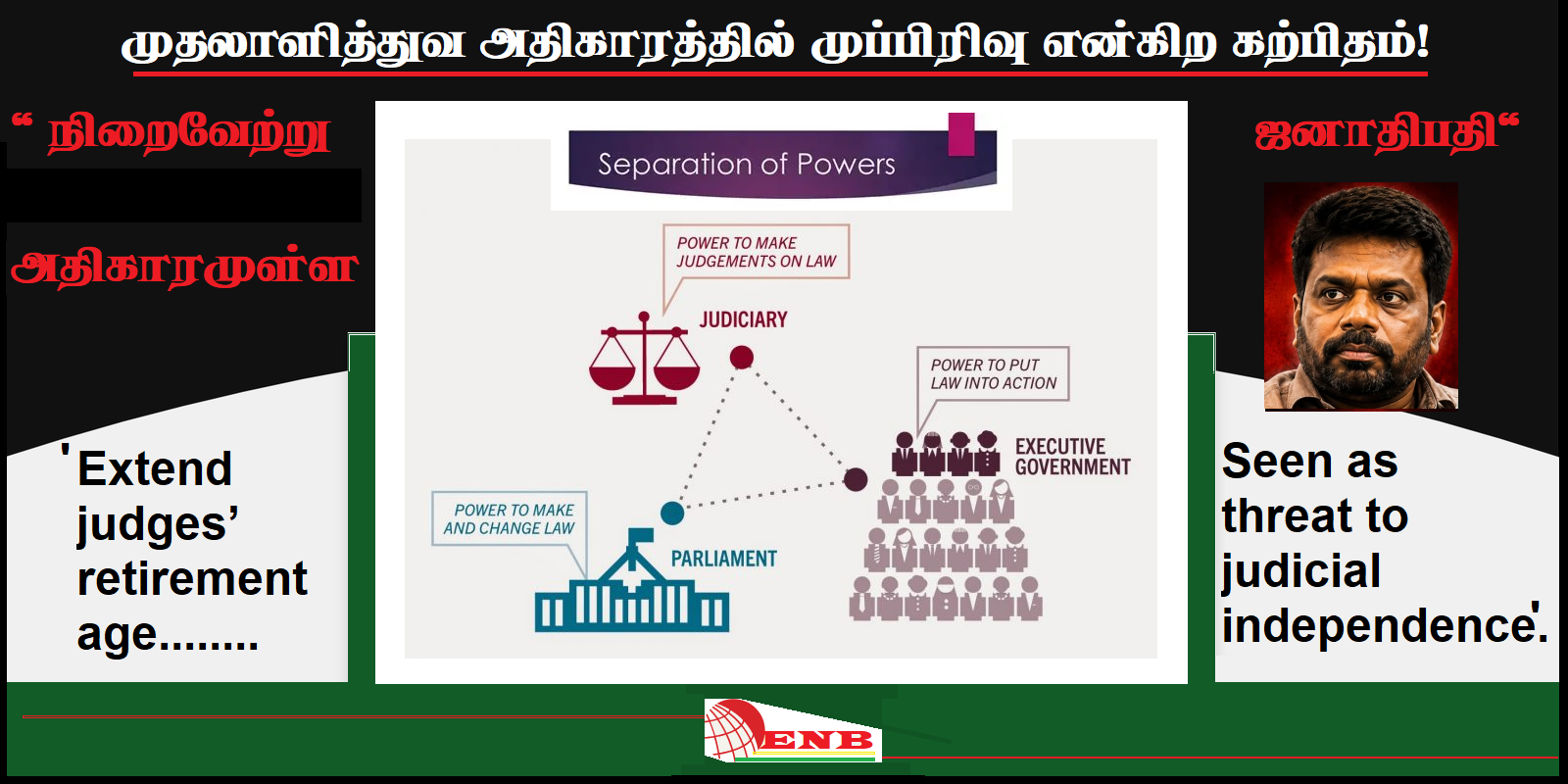
Alleged bid to extend judges’ retirement age seen as threat to judicial independence by lawyers’ bodies, opposition
- BASL describes the attempt as unnecessary and undesirable
- Wijeyadasa says separation of powers principle undermined
- Eight superior court posts remain unfilled, raising concerns
- Critics say delay in filling vacancies suggests government seeks to appoint preferred candidates
- Senior government source rejects allegations, says no such proposal discussed in Cabinet
By our ST Political Desk 07-06-2026
It was only a month ago that President Anura Kumara Dissanayake set off a firestorm of criticism when he called on supporters during a May Day speech to be prepared to celebrate a judicial verdict due later that month. The ill-advised comments, which some interpreted as a direct interference in the judiciary, drew widespread condemnation from opposition parties and sections of civil society. Just weeks later, the Dissanayake government is facing fresh allegations that it is trying to interfere with judicial matters – this time through a proposed constitutional amendment to increase the retirement age of the judges of the Court of Appeal (CA) and the Supreme Court (SC).
Under the Constitution, the current retirement age of an SC judge is 65, while the retirement age of a CA judge is 63.
Talk of an impending draft constitutional amendment to increase the retirement age of superior court judges is not new. Even before the President made his comments during his May Day speech in Maharagama, some in the opposition had rung alarm bells that the National People’s Power (NPP) government was planning to increase the retirement age of the judges on the two highest courts of the country. Former Justice Ministers G.L. Peiris and Wijeyadasa Rajapakshe first raised concerns over the matter in April during a joint media briefing. The matter has gained more attention since then amid reports that such an amendment may now be in the final stages of being drafted. A number of organisations representing lawyers, including the Bar Association of Sri Lanka (BASL), have now come out strongly against any move.
The BASL has written directly to President Dissanayake, raising grave concern over the alleged move to raise the retirement age of the judges. In its letter, signed by its president, Rajeev Amarasuriya, and secretary, Nalin de Silva, the BASL has emphasised that it is its considered view that the CA and SC judges’ retirement age, which has stood at 63 and 65, respectively, from the promulgation of the 1978 Constitution, “should not be changed arbitrarily and that such a change is neither necessary nor desirable.”
The letter points out that the cadre of the judges of the Court of Appeal was increased from 12 to 20 (including the President of the Court of Appeal) and that of the Supreme Court from 11 to 17 judges (including the chief justice) by the 20th Amendment to the Constitution. With such enhancement, workwise, there cannot be a real requirement to extend the retirement ages of these judges, the BASL argues. Noting that altering the retirement age of the judges of the apex courts would require a constitutional amendment, the Association has remarked that for many years Sri Lanka’s Constitution has been subject to ad hoc amendments, sometimes to cater to the political needs of the government in power and often contrary to the interests of the rule of law, the independence of the judiciary and the judiciary.
“Extending the retirement age of the sitting judges of these courts at this point of time is likely to be viewed by the public as a blatant attempt to interfere with the judiciary. We believe that to go ahead with such an ad hoc move will also be an affront to the Honourable Judges of those courts. If the government goes ahead with such a move, it will set a dangerous precedent for future governments too to introduce ad hoc amendments to the Constitution in respect of the functions of the judiciary,” the BASL warned. It has thus requested the President not to proceed with any constitutional amendment seeking to increase the retirement age of judges.
The alleged moves to increase the retirement age of the judges come amid a situation where vacancies in the two apex courts are mounting. There are at present four vacancies each on the Court of Appeal and the Supreme Court. In other words, eight positions on the country’s two highest courts are now vacant. There are concerns that so many vacancies are also hampering the work of the two courts, with more retirements due in the coming months.
Meanwhile, concerns have also been raised regarding the sudden transfer of judges by the Judicial Service Commission (JSC) headed by Chief Justice Preethi Padman Surasena. The Bar Association of Jaffna this week wrote to President Dissanayake raising concerns over the transfer of Judge A.G. Alexraja from the High Court of Jaffna to the Civil Appellate High Court of Badulla. The association notes that the transfer, coming just over a month after Judge Alexraja’s appointment to the Jaffna High Court on April 22, has led to speculation as to the presence of extraneous reasons for his transfer.
The association claims that it has “reliably heard” from its membership that the transfer may have been occasioned by certain interim orders that the judge had made against the Northern Province governor, who was named as a respondent in certain writ petitions. The letter alleges that the governor had brought the matter to the notice of members of the government, inviting their interference. While acknowledging the JSC’s prerogative to transfer judicial officers, the association contends that the “unexplained and sudden transfers of judicial officers and interference by members of the executive branch of government in such transfers lead to loss of public confidence in the judiciary.”
Opposition politicians have also weighed in on alleged government attempts to interfere with the judiciary.
The Constitution has clearly designated separation of powers, former Justice Minister Wijeyadasa Rajapakshe told the Sunday Times. He noted that the executive and the legislature will handle the functions of government as per their majority, but the judiciary is independent. The country’s Supreme Court is 225 years old. There has never been a period during its history where a head of state has allowed for vacancies on the country’s two apex courts to last for a prolonged period such as this, the former minister claimed.
“Whenever a vacancy arises in the Court of Appeal or the Supreme Court, the usual practice is for someone to be sworn into that vacancy the very next day. However, at present, there are four vacancies in the Supreme Court and four in the Court of Appeal, meaning that eight positions on the two topmost courts in the country are vacant. Percentagewise, this amounts to 25% of these courts,” Mr Rajapakshe said.
The NPP came to power assuring that justice will be done for the people and promising that an administration it heads will safeguard the rule of law, he recalled. “But the NPP government is now deliberately refraining from appointing judges to fill vacancies in the top courts. Where is the justice in that?”
The high number of such vacancies has created a huge problem for the country’s judiciary, Mr Rajapakshe said. He alleged that the government has deliberately kept the vacancies open while awaiting the retirement of some judges it does not like so that it could appoint its preferred candidates to these positions.
Judges who are down the line on the promotion list are frustrated due to this situation, he said. Much of the judicial mechanism functions through the lower courts, where there are more than 350 judicial officers. Some of these judges had served for close to 30 years and rendered an exemplary service and have never faced allegations of wrongdoing, but they were sent on retirement with the Supreme Court within reach, the former minister claimed.
There is opportunity for public servants who have been unfairly deprived of their promotions to turn to the Supreme Court via fundamental rights petitions to seek legal redress for the injustices suffered by them, Mr Rajapakshe pointed out. “But when judges’ promotions are unfairly denied to them and their own fundamental rights are violated, who do they turn to for justice?”
If the government extends the CA and SC judges’ term by two years, it will lead to a major issue for the country, the former minister warned. Others such as university professors and specialist doctors could ask for their retirement ages to be increased as well. Such a knock-on effect could result in those from younger generations being unfairly deprived of their promotions.
Referring to recent controversies over the sudden transfer of certain judicial officers, Mr Rajapakshe stressed that unless there are compelling reasons, a judge should be allowed to serve at his or her post for at least three years. The manner in which some judges have been given sudden transfers from their positions could raise suspicions among the public as to what prompted those transfers, he added.
The NPP came to power promising to amend the Constitution and abolish the executive presidency. There was no mention anywhere in the NPP’s manifesto pledging to increase the retirement age of judges, said Sri Lanka Podujana Peramuna (SLPP) General Secretary Sagara Kariyawasam. He claimed the NPP has now fully abandoned its election pledges and is trying to push a constitutional amendment to raise the retirement age of judges of the superior courts with an ulterior motive in mind. “There has been no call from society to raise this retirement age. The legal fraternity, including the vast majority of lawyers and judges themselves, overwhelmingly opposes such a measure. So, why is the government trying to bring this through?”
The only inference one can draw from the situation is that the government is trying to manipulate the system and abuse the process of law, Mr Kariyawasam claimed.
He said that the eight current vacancies in the apex courts have also created an enormous problem for the legal system. “There is a suspicion in society that these vacancies are being dangled as a sort of reward for judges awaiting promotions, provided they give certain rulings that are advantages to the government.”
The Free Lawyers Association, too, has firmly opposed raising the retirement age of judges of the superior courts. Association member President’s Counsel Maithri Gunaratne opined that current Chief Justice Preethi Padman Surasena has done “a lot of good work” since his appointment, including implementing measures aimed at minimising law’s delays. The association, however, believes the government is now trying to mask some of its own failures by misusing the work done by the CJ. He noted that the present chief justice is due to retire in December. As such, moves to extend the retirement age of superior court judges at such a juncture will inevitably create unwanted suspicions regarding judicial impartiality, he added.
A top government source who is aware of the controversy surrounding alleged interference in the judiciary dismissed the allegations against the government. He noted that many people are unaware that the transfer of judicial officers is the JSC’s prerogative. As such, whenever there is a controversy regarding the transfer of a judge, the government gets blamed, he said. While the President appoints the chief justice, the Court of Appeal president and every other judge of the Court of Appeal and the Supreme Court, the appointments are subject to the approval of the Constitutional Council (CC), he pointed out. Meanwhile, the CJ also recommends the names of judges to be forwarded to the CC by the President to be considered for the two apex courts. “However, we are not bound to follow such recommendations. We will ensure that the person best qualified will be appointed to the post,” the source added.
Previously, many judicial appointments were based on closeness to the ruling regime. That is not the case now, he claimed.
Regarding the controversy over alleged plans to raise the retirement age of CA and SC judges, he said the retirement age of judges of apex courts differs from country to country. In the US, there are no age restrictions to be appointed a Supreme Court justice, and they are lifetime appointments. The source pointed out that even Sri Lanka’s Supreme Court justices who have retired by age 65 have gone on to take on other jobs. “Both sides of this argument have good points to raise,” he remarked.
He stressed that a proposed constitutional amendment to raise the retirement age of judges has not been discussed at the Cabinet as yet. He would not be drawn into speaking on whether this means such an amendment is not being actively considered. Any decision on such a constitutional amendment will have to be taken in consultation with the JSC and other stakeholders, the source added.
He dismissed allegations that the government was eying such an amendment in order to give a two-year extension to the current CJ, who is set to retire in December. “If the government was going to provide a service extension to only one person, the argument regarding favouritism might be valid, but no such thing is happening. Even if retirement ages of all judges are going to be raised, such a decision will be taken based on scientific reasons. This also applies when choosing the next CJ. No matter what anyone says, the President will only send his recommendation to the CC once he obtains all the necessary details and makes a full appraisal.”
He claimed there was currently a “cold war” regarding the appointment of judges but insisted the government would take the correct decisions at the right time. Unlike in the past, judges who have committed acts of wrongdoing are now also being held accountable for their actions by the JSC, the source said. He also hit out at the BASL and other lawyers’ associations, who he claimed were stepping outside their limits. “The JSC’s prerogative regarding judicial matters cannot be questioned by the government, BASL or any others,” he insisted.
Nevertheless, it is very much a fact that current concerns regarding government interference in the judiciary have gained more traction mainly due to the fault of the NPP government itself. The NPP’s manifesto, ‘A Thriving Nation, A Beautiful Life’, stresses that the ‘independence of the judiciary will be fully guaranteed’. Yet certain statements the party’s leaders have made since coming to power are compelling people to question the sincerity of that assurance.
While the President telling supporters to be prepared to celebrate an upcoming judicial verdict is bad enough, there have been many other instances where NPP ministers and MPs have made remarks concerning judicial matters that could be considered problematic. While addressing another May Day rally in Nuwara Eliya, President Dissanayake himself claimed that 2026 will go down in history as the year where the corrupt, fraudsters and criminals were sent to prison. While he may again have been playing to the gallery, such public announcements only add more pressure on the judiciary and could be interpreted as a public announcement of how the executive intends that they should rule.
Rebuilding Sri Lanka Fund
Meanwhile, questions continue to be raised regarding the “Rebuilding Sri Lanka” Fund, which was established to assist those impacted by Cyclone Ditwah, with the National Audit Office informing the Committee on Public Finance this week that no funds received by the Fund have been utilised and that monies donated by various donors and organisations remain in a special account of the Deputy Secretary to the Treasury account (DST account).
The NAO officials informed the committee that no statutory fund currently exists under the name “Rebuilding Sri Lanka” and the programme operates through an account maintained under the Deputy Secretary to the Treasury.
This came to light at a CoPF meeting chaired by SJB MP Harsha de Silva, who questioned officials about the fund called ‘Rebuilding Sri Lanka’.
Cabinet approval to set up the fund was given last December with the ‘Rebuilding Sri Lanka Fund’ operating as a statutory fund operating under the Presidential Secretariat.
The NAO officials told the committee that while a Cabinet decision has been taken to establish the ‘Rebuilding Sri Lanka’ Fund as a statutory fund, it has not been done so far and that monies donated to the fund are credited to a special DST account.
“According to the new Public Finance Management Act, non-statutory funds cannot be established. Only statutory funds can be established. A cabinet decision has been taken to establish the ‘Rebuilding Sri Lanka’ Fund as a statutory fund. It has not been done as yet,” the official said.
The CoPF chairman questioned whether the particular DST account could be audited, for which the NAO officials said the account could be audited as it comes under the scope of the Finance Ministry.
According to Deputy Finance Minister Anil Jayantha Fernando, the ‘Rebuilding Sri Lanka’ Fund had received Rs 9,583 million as at April 24, 2026. The fund operates under the Presidential Secretariat, with a management committee chaired by Finance and Planning Deputy Minister Anil Jayantha Fernando. Additionally, a Presidential Task Force chaired by Prime Minister Harini Amarasuriya was appointed to oversee, coordinate, and ensure funds are distributed transparently to the affected population, but the monies remain dormant in the Fund while thousands affected by the cyclone remain without due relief.
The missing USD 2.5 million
Meanwhile, there is continuing controversy regarding the diversion of USD 2.5 million, which was meant to be paid to an Australian company but was siphoned off by hackers who broke into the email system at the Finance Ministry.
The Finance Ministry sent its report on the missing USD 2.5 million to CoPF this week.
The report was first sent to the private residence of the CoPF Chairman Harsha de Silva, but he had refused to accept it. “I firmly rejected a report on the alleged $2.5 million fraudulent transfer from the Ministry of Finance that was sent to me privately. As Chairman of the #CoPF, I will not accept backdoor attempts to bypass @ParliamentLK. This report was requested by the Committee, not for my personal perusal,” De Silva said on his X account.
He had directed that the MoF submit the report officially to Parliament, which was done. The committee chairman said steps were taken to distribute the report to all its members, and it will be reviewed, and the matter will be discussed with the Finance Ministry secretary next week.
High profile cases
Meanwhile, the noose seems to be tightening on several members of the Rajapaksa family with some key developments in the course this week and a high-profile trial expected to begin in July.
There was a high-profile development in the Easter attacks investigation this week when the Colombo Fort Magistrate Pasan Amarasena imposed a foreign travel ban on former President Gotabaya Rajapaksa and two military officers over an ongoing investigation into the Easter Sunday terrorist attacks.
Officers from the Criminal Investigation Department made a request before court seeking travel restrictions on the individuals concerned. Upon considering the request, the magistrate imposed travel bans on former President Gotabaya Rajapaksa, former Army Colonel Mohomad Ansar and former intelligence officer Premananda Udalagama.
The detention of the former head of the State Intelligence Services (SIS), Suresh Sallay, continues to draw attention over his medical condition and allegations of inhumane treatment in custody as alleged by his family members.
When the case was taken up this week, the Colombo Fort Magistrate announced that it will deliver its order on June 10 regarding a request made by the Attorney General to direct the Director General of Health Services to refer former Head of the State Intelligence Service, Major General (Retired) Suresh Sallay, who is currently being detained under the Prevention of Terrorism Act (PTA), to a specialist medical board and obtain a report on his condition.
The case was taken up this week following a motion filed on behalf of Suresh Sallay.
After considering submissions made by Additional Solicitor General Dileepa Peiris, the court decided to issue its ruling on the matter on June 10.
Meanwhile, the Colombo High Court has postponed until July 9 the case filed against Yoshitha Rajapaksa, the son of former President Mahinda Rajapaksa, under the Prevention of Money Laundering Act.
During the proceedings, Deputy Solicitor General Janaka Bandara informed the court that a revision petition filed by the accused was taken up before the Court of Appeal on June 3 and that it had been scheduled for hearing on June 16, 2026. Hence, the High Court judge ordered that the case be postponed until July 9, pending the decision of the Court of Appeal, and instructed witnesses to appear on that date.
Yoshitha Rajapaksa is facing charges of acquiring five plots of land valued at over Rs. 73 million under the Prevention of Money Laundering Act.
In July, the Colombo High Court will begin the trial against MP Namal Rajapaksa in the “Krrish” case in which he stands accused of receiving Rs 70 million from India-based Krish Company under the pretext of supporting rugby development and subsequently misusing those funds.
The charges against Rajapaksa were formally filed by the Attorney General on February 5, 2025, before the Colombo High Court, alleging criminal breach of trust linked to a financial deal purportedly conducted for the promotion of rugby in Sri Lanka. The hearings will begin on July 7.
While the court cases take centre stage, there is also pushback from the Rajapaksa supporters, who have labelled investigations targeting the family as politically motivated.

ஒத்தவை:

சென்ற வாரம் இலங்கை-சண்டே ரைம்ஸ்