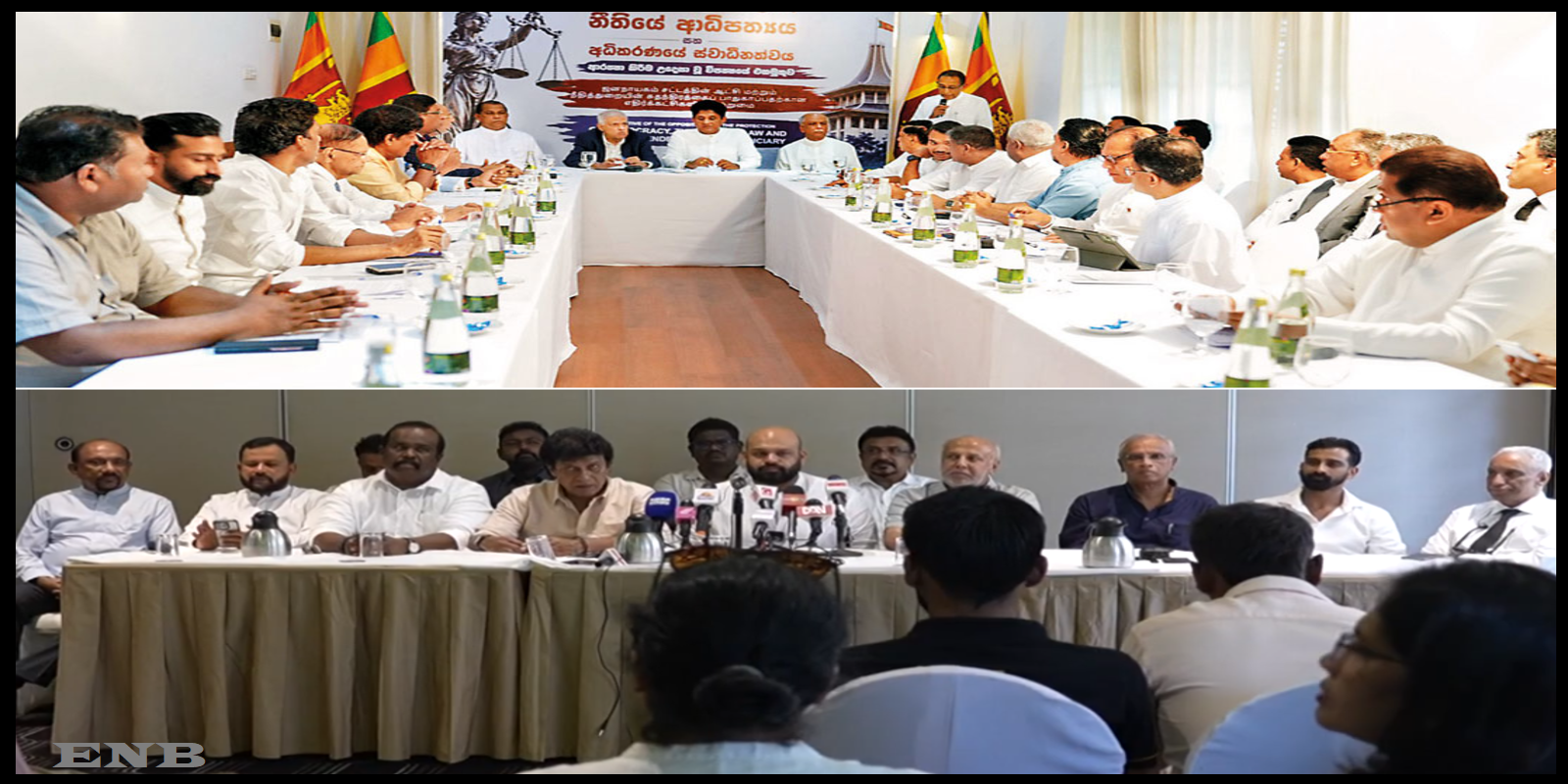
Opposition party leaders gather in the Opposition Leader's Office to discuss strategy to defeat government moves to extend the retirement age of judges
Divided opposition in rare show of unity to defeat Govt’s bid to extend judges’ retirement age
- Sajith convenes meeting bringing anti-Govt parties under one roof; Ranil outlines
- judicial dilemma, proposes referendum
- Ruling party dismisses opposition show of force, comfortably defeats NCM against Justice Minister, defends amendment to extend judges’ retirement age as necessary for delivery of justice
By our ST Political Desk 26-07-26
As leaders and other senior officials of various opposition political parties started arriving at the Office of the Opposition Leader on Sir Marcus Fernando Mawatha, Colombo 7, on Thursday afternoon, a throng of media personnel was already waiting.
This gathering of parties representing the opposition, convened by Opposition Leader Sajith Premadasa, was billed by many as a key development in the fight against the National People’s Power (NPP) government’s plans to introduce a constitutional amendment to raise the retirement age of judges of the superior courts. While there have been meetings and talks among a number of major parties during recent months as part of their efforts to form a ‘joint opposition’ against the government, this was the first time that so many parties of different political ideologies had met under one roof since the arrest of former President and United National Party (UNP) Leader Ranil Wickremesinghe last August.
Mr Wickremesinghe was also one of the attendees at the meeting, as was his one-time prime minister and Royal College classmate Dinesh Gunawardena. Among the many other notable current and former MPs in attendance were Sri Lanka Freedom Party Chairman Nimal Siripala de Silva, Sri Lanka Podujana Peramuna (SLPP) National Organiser Namal Rajapaksa, Convener of the Joint Opposition, Sri Lanka Muslim Congress Leader Rauff Hakeem, Samagi Jana Balawegaya (SJB) General Secretary Ranjith Madduma Bandara, Sarvajana Balaya Leader Dilith Jayaweera, National Freedom Front Leader Wimal Weerawansa, Pivithuru Hela Urumaya Leader Udaya Gammanpila, United Republic Front Leader Patali Champika Ranawaka, former Minister Tiran Alles, Democratic People’s Front Leader Mano Ganesan, Ceylon Workers’ Congress General Secretary Jeevan Thondaman and National Union of Workers Leader Palani Digambaram.
Some of those who arrived at the opposition leader’s office sarcastically told the media waiting outside the gates that they wanted to thank President Anura Kumara Dissanayake for helping to convene the meeting, given that it was his government’s moves to increase the retirement age of judges that brought them all together. Nevertheless, the fact that so many parties whose political, economic and world views were directly in conflict with each other came together for the meeting highlighted just how serious they believed the threat from the government’s proposed amendment was. Indeed, the consensus was that the proposed constitutional amendment seeking to increase the retirement age of superior court judges amounts to blatant interference with the judiciary and a threat to judicial independence. Some of the opposition party representatives who spoke to the media painted the proposed amendment as similar to the highly controversial 18th and 20th Amendments to the Constitution.
Addressing the meeting, Opposition Leader Sajith Premadasa stated that there are ample examples throughout history where every attempt made to blunt the independence of the judiciary had ultimately ended in the fall of governments. He noted that President Anura Kumara Dissanayake’s “authoritarian, dictatorial government” has laid hands on the judiciary. “However, as progressive citizens, we have the power to defeat this attempt aimed at interfering with the judiciary in a manner that ensures that those hands end up being burnt,” he remarked. The opposition leader proposed that regardless of individual party views, everyone should dedicate themselves to protecting popular sovereignty, casting aside party, colour, or other divisions for the common goal of safeguarding democracy.
Speaking during the meeting, former President Ranil Wickremesinghe raised a question that would inevitably arise if and when the government does introduce a constitutional amendment to extend the judges’ retirement age – who will be hearing the challenges to the proposed amendment when fundamental rights applications are filed before the Supreme Court? He noted that there have been many rulings handed down internationally stressing that judges cannot hear a case if they stand to benefit from the matter under consideration. With regard to the amendment to raise the retirement age of superior court judges, it would mean that they stand to gain salaries, pensions and vehicles, among other benefits. Given that the Supreme Court justices stand to benefit from the amendment, it would be an obvious conflict of interest if they are asked to sit in judgement on petitions filed challenging it, the former president noted.
Mr Wickremesinghe rejected the argument that since the Supreme Court is the highest court of the land, it would have to decide on the constitutionality of such an amendment. The Constitution has provided for another court to decide on such an amendment, which is a public referendum, he argued. “We will be the judges in this situation,” said Mr Wickremesinghe, pointing out that the country’s 17 million voters will decide on the amendment then. The former president proposed that the opposition should carry out an island-wide campaign to educate the public on the matter and pressure the government into placing the proposed amendment before the public at a referendum so that the country can decide on whether to raise the judges’ retirement age.
Mr Wickremesinghe said he agrees “100 per cent” with the statement made by Justice Minister Harshana Nanayakkara that solutions must be found to the issue of the law’s delays in the country and that cases pending for years in courts must be resolved quickly. To aid the government in this regard, the former president requested the opposition leader to submit a proposal to the government to appoint a Parliamentary Select Committee (PSC) to look into how to expedite some 1.1 million cases that are currently pending in courts.
Opposition parties are of the view that the government’s proposed constitutional amendment is aimed specifically at ensuring that judges the government would prefer to hear cases are kept longer on the bench. They also point to how the government has continued to keep eight positions in the superior courts (four each on the Court of Appeal and the Supreme Court) vacant over several months. There has been no sign that the vacancies are going to be filled anytime soon. The prolonged delay has prompted opposition allegations that the positions are being deliberately kept vacant as an incentive to judges to give rulings that suit the government. The government has firmly rejected these charges, insisting that it is working on filling the vacancies in the lower courts first since those vacancies contribute more towards the law’s delays. Efforts were made to recruit 50 new magistrates recently, though only 33 ultimately met the required qualifications to be appointed. The government has emphasised that it will fill the vacancies in the superior courts but pointed out that the prevailing vacancies have not held up proceedings in either the Court of Appeal or the Supreme Court.
SLPP National Organiser Namal Rajapaksa, who had first proposed to Opposition Leader Premadasa that a gathering of opposition parties be held to discuss the government’s attempts to extend the retirement age of judges, told the media outside the opposition leader’s office that constitutional amendments centred on individuals have been rejected by the people. “We too brought such amendments, but in the end, we lost as the people rejected those amendments,” Mr Rajapaksa acknowledged. He added that extending the tenure of judges does not shorten the time taken to hear court cases, remarking that it is wrong for the government to exploit impractical issues for political gain.
While some among the opposition parties may have been upbeat about the meeting serving as a springboard aimed at forming a grand coalition to challenge the NPP government during elections, others made it quite clear that they were only coming together to face what they see as a serious threat to the independence of the judiciary and democracy itself. They were quite clear that this does not signal that their parties were willing to come together under one banner. Nevertheless, their resolve to fight the government tooth and nail over the constitutional amendment is not in doubt.
The government is not being honest when extending the retirement age of judges, SLPP General Secretary Sagara Kariyawasam says. He claimed that for the government, the proposed amendment is a strategy to keep one person on the bench. “There is currently no dialogue in society that the judges’ retirement age should be extended. The NPP’s manifesto promises to introduce a new constitution, and this was what the party campaigned on during the elections, but it never pledged to introduce a constitutional amendment to extend the retirement age of judges.”
Mr Kariyawasam claimed that the proposed amendment is opposed by judges, lawyers and local and international civil society organisations. That alone should serve to convince the country that the amendment is nothing more than a plan to keep one person on the bench, said the SLPP General Secretary. “If the government is really genuine about its intentions, it should bring this amendment next year rather than try to rush it through this year,” he remarked.
The government side’s response
A senior government source was dismissive of the meeting convened at the Opposition Leader’s Office, terming it as part of a concerted attempt by the opposition and other interested parties to attack the judiciary, in particular Chief Justice Preethi Padman Surasena.
The present CJ has done much to enhance the quality and efficiency of the judicial service. His actions, however, are facing opposition from opposition parties as well as certain lawyers and even some judges, the source alleged.
He noted that the CJ has instructed that steps be taken to expedite cases that are languishing in courts. “There are some who do not like this. They don’t like it that cases have to be heard on weekdays till 5.00pm. They don’t like it that disciplinary action has been taken against some 30 judges over allegations of misconduct.”
There are also some errant magistrates who have enjoyed acting as a law unto themselves without fear of having to face consequences for their actions, said the source. Such persons obviously oppose what the CJ is doing and have been behind the recent campaigns targeting him, the source also said.
What the government is trying to do is to ensure justice for the people and to not let “crooks” from the opposition exercise influence over the judiciary, the government source said. The earlier pattern was that when one party is in the opposition, it uses various tactics to postpone court cases against their members until they come to power. This is no longer possible due to steps taken by the CJ to expedite cases. The pressure being brought against the CJ are part of efforts to prevent these cases from being resolved quickly, he asserted.
The source was insistent that the government would have its way on raising the retirement age of superior court judges. “We will bring a new constitutional amendment before Parliament as soon as possible because this is in line with the pledge we gave to the people to ensure that cases are expedited and the law’s delays are minimised,” he said, arguing that the proposed amendment would be a key element in ensuring people receive speedy justice from the judiciary.
Law and order question
While the government is clearly prepping for a fight on the extension of the retirement age of superior court judges, it is also facing other challenges on the law and order front. Shooting incidents, which had markedly reduced over recent months, have suddenly started spiking up again. There have been a number of such shootings that have left several people dead and injured over the past two weeks. These included two separate shootings within a span of three hours on Thursday in Dematagoda and Wattala, leaving one dead and another injured. In the fatal shooting that took place at Palliyawatta in Wattala on Thursday night, an assailant posing as a guest opened fire during a child’s birthday party, killing one person before fleeing the scene. Police believe the shooter was targeting a suspected drug trafficker who had been at the party, but he had shot another individual after mistaking him for the intended target. The motive for the shooting is believed to be a long-running feud between two organised criminal groups.
A senior government source, who spoke on grounds of anonymity, noted that the spike in underworld-related shootings has been reported from Colombo and suburbs as well as in the Southern Province in recent days. “This is an unusual spike,” said the source, claiming that the rapid number of such incidents has led authorities to look into whether some unseen political hand was also involved. “We are wondering if these incidents are being carried out with the aim of diverting the attention of authorities elsewhere while certain court cases are being expedited,” he claimed.
He also noted that the government is taking prison reform extremely seriously in the aftermath of the deadly Negombo Prison riot. President Dissanayake has become involved in the matter personally, as witnessed by his recent visit to the Government Analyst’s Department’s premises and his convening of a meeting of senior officials of the department at the presidential secretariat, said the source. During the meeting, the president had noted that over 15,000 reports by the Government Analyst’s Department relating to suspects in remand custody are still pending. About 10,000 of these reports relate to suspects who had been arrested for drug possession.
Among those who had been arrested, the majority had been arrested for possessing less than 5g of drugs, said the source. The period whereby they are eligible for release from prison on bail has also come and gone. The president instructed the Government Analyst to expedite finishing these reports in a bid to reduce delays and asked how long they needed. Officials had replied that they would be able to clear the backlog within two months. They agreed to clear 9,000 reports by the end of the month, the source revealed.
To expedite finishing the reports, the Government Analyst’s Department will remain open till 10 pm on weekdays. The staff who are working during the extra shifts will receive overtime pay as well as transport facilities.
“When the backlog is cleared and the reports are sent to court, there will obviously be a rush of cases coming before courts. This will stretch the resources of the courts, requiring more judges. If we cannot recruit enough, we will obviously have to try to keep those we have,” the source said, advocating for the government’s proposal to increase the retirement age of all judges, including those in the superior courts.
With many questions remaining unanswered relating to the Negombo prison unrest which left more than 30 people dead, including 10 prison officials, the opposition in Parliament moved a no-confidence motion against Justice Minister Harshana Nanayakkara. The motion was defeated, as it was bound to be given the NPP’s overwhelming majority in the House, but the debate held on Friday gave the opportunity for the opposition to raise questions on the serious lapses in the prison systems which led to the tragic situation.
The NCM tabled in Parliament, signed jointly by MPs of the SJB, the SLPP, the SLFP and the Sarvajana Balaya, raised several issues with regard to Minister Nanayakkara’s responsibility in relation to the incident as the Prison Department functions under his subject ministry.
The motion stated that the Negombo prison incident raises serious concerns regarding the supervision and security management of the Prisons Department, which functions under the Ministry of Justice and National Integration.
It added that failure to secure the weaponry and security equipment of the Negombo Prison, alongside the failure to implement necessary precautionary measures to prevent clashes among inmates, demonstrates a severe inefficiency in prison administration, and “due to the failure of the minister in charge of the subject of justice to take prompt, adequate, and timely measures to resolve the clash when it commenced on the 5th of July 2026, the violence intensified on the 6th of July.”
The motion added that deploying prison officers, who are state officials, to the site of the clash without a prior strategic plan placed the lives of the said officers in grave jeopardy, and the ultimate responsibility for ensuring the safety of the lives of inmates and officers within the state prison system rests with the minister in charge of the subject of justice, and this august assembly believes that he has failed to fulfil the said responsibility.
The motion stated that the minister in charge of the subject of justice has failed to responsibly execute the duties assigned to him under Gazette Extraordinary No. 2412/08 of 25th November 2024, of the Democratic Socialist Republic of Sri Lanka, which includes the formulation and implementation of policies, plans and programmes in relation to prison reforms, prison administration and reforms, and developing infrastructure and minimising overcrowding of prisons.
It added that the minister has acted contrary to the public mandate by failing to implement the measures concerning prisons as outlined in the policy statement of “A Thriving Nation – A Beautiful Life”, and in light of this, the minister has failed to discharge the duties vested in him with a sense of responsibility, and it is prima facie evident that the minister acted without any accountability regarding his functions, and hence the Parliament resolves that it has no confidence in the competence of Harshana Nanayakkara, Attorney at Law, Minister of Justice and National Integration, to properly discharge the duties of Minister of Justice and National Integration any longer. (See details of the debate in the Lobby Column on Page 6.)
The government, however, stood by Minister Nanayakkara and had no difficulty in comfortably defeating the No-Confidence Motion when it came to a vote on Friday evening. The final result was 36 votes for and 152 against. For the opposition, the NCM was largely symbolic, as it allowed them the space to lay out the government’s alleged failures regarding its promises to reform the prison system. It also forced the government into defending Minister Nanayakkara, who took responsibility for the tragedy but chose not to resign his ministerial portfolio.
Several MPs from the opposition pointed out that it was not too long ago that the government used its two-thirds parliamentary majority to also defeat an NCM against then Energy Minister Kumara Jayakody, though he ultimately had to resign days after surviving the NCM amid intense public criticism and the appointment of a presidential commission to investigate coal procurements.
Common platform of parties representing Tamil-speaking people
Meanwhile, following last week’s meeting where six Tamil political parties agreed to work on a platform, they met on Friday (July 24) in Parliament and decided to seek a meeting with the president on matters of common concern, including conducting much-delayed provincial council elections.
Leaders and representatives of the six Tamil-speaking political parties – All Ceylon Makkal Congress (ACMC), Ceylon Workers’ Congress (CWC), Democratic Tamil National Alliance (DTNA), Ilankai Tamil Arasu Katchchi (ITAK), Sri Lanka Muslim Congress (SLMC), and Tamil Progressive Alliance (TPA) – reaffirmed their commitment to engage collectively on issues of common concern affecting the Tamil-speaking communities.
While reaffirming that each party will continue to function independently and retain its own political positions, policies, and identity, the parties agreed to work together on matters where common ground exists to advance the interests of the Tamil-speaking communities through constructive engagement.
It was also decided that ITAK’s parliamentary group leader, Shanakiyan Rasamanickam will take up the role as convenor of the group on behalf of the six parties.
Pursuant to this decision, the representatives have formally written to President Anura Kumara Dissanayake requesting a meeting to discuss several matters of national importance affecting the Tamil-speaking communities.
Following the meeting with the president, the representatives also intend to meet with the opposition leader and members of the diplomatic community to exchange views on these matters as well.

ஒத்தவை:

சென்ற வாரம் இலங்கை-சண்டே ரைம்ஸ்