
El Nino: a call for climate resilient agriculture
21 Aug 2026 Daily Mirror
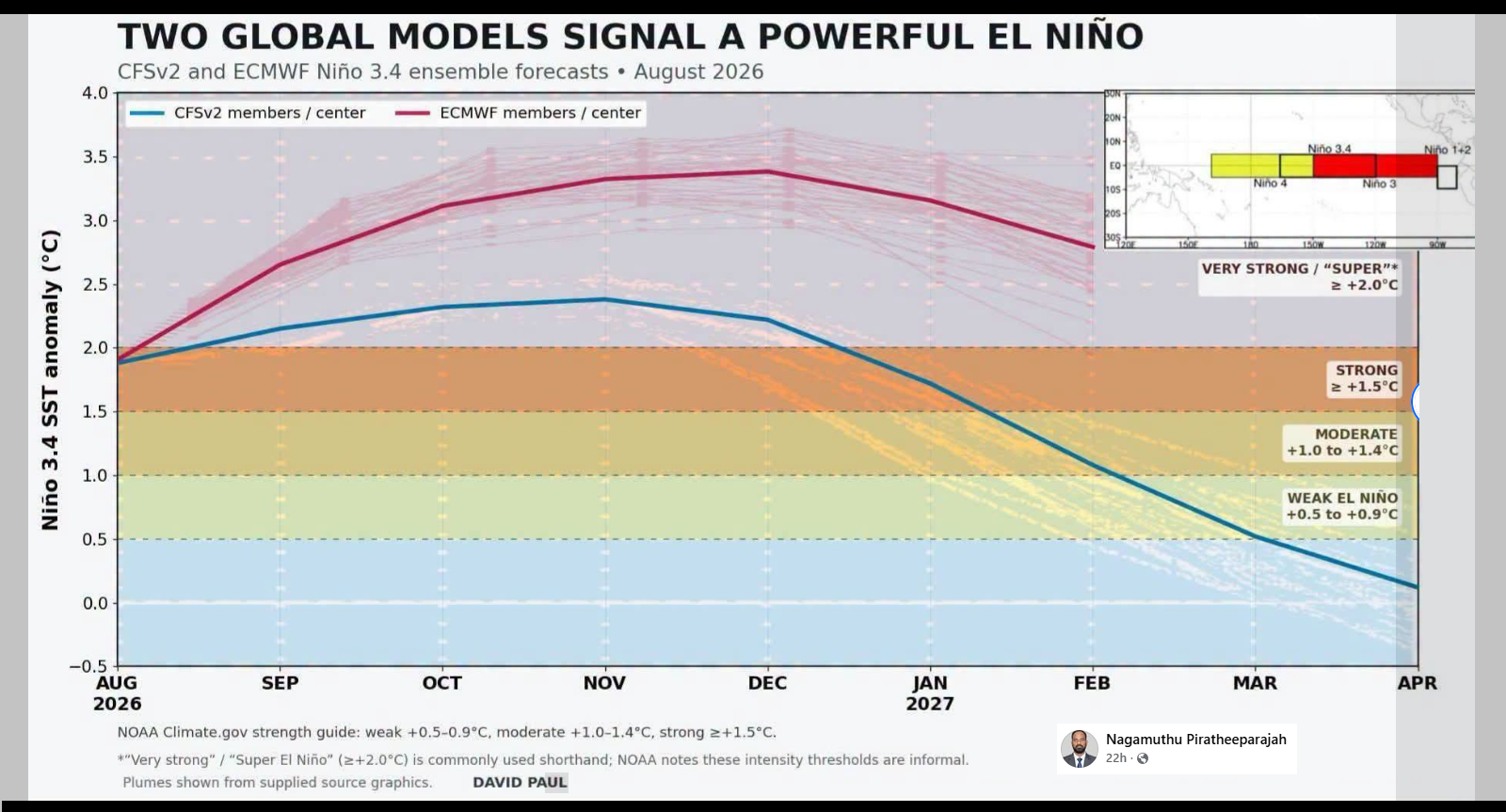
As global weather patterns grow increasingly chaotic under the influence of shifting oceanic temperatures and intensifying El Niño phenomena, Sri Lanka, like many other countries, is at a perilous agricultural crossroad. Recent reportage in the Daily Mirror paints a troubling picture of the impending weather duality expected to impact the island’s upcoming farming cycles: a Maha cultivation season fraught with intense, highly localised heavy rainfall, followed immediately by a severely dry, prolonged ‘Yala’ season marked by heat waves and acute drought.
Compounding this domestic uncertainty, recent global economic reports, including comprehensive assessments from the World Bank, warn that climate disruptions, coupled with ongoing supply chain bottlenecks, threaten to drive regional food import prices up significantly.
For a country whose smallholder farmers produce the bulk of domestic food supply, these looming climate shocks are not mere abstract meteorological forecasts—they are existential threats to national food security, macro-economic stability, and rural livelihoods. Climate adaptation is no longer a peripheral policy or a post-disaster afterthought. Sri Lanka must urgently accelerate its transition toward climate-resilient agriculture, converting seasonal emergency responses into a permanent, modernised framework.
The impending El Niño threat vividly exposes the structural vulnerabilities of traditional farming systems in South Asia. Excessive, unstructured rainfall during the Maha season risks drowning standing crops, leaching soil nutrients, and causing severe topsoil erosion across major agricultural basins. Conversely, an unmitigated dry spell during the Yala season threatens to empty major reservoirs, leaving key farming districts across the Dry Zone parched. The Department of Agriculture’s current advisories—such as advancing the Maha cultivation calendar, harvesting surface runoff into localised farm ponds, drought-tolerant crop varieties—are commendable tactical adjustments. However, temporary seasonal advisories alone cannot shield the rural economy from the compounding impacts of long-term climate destabilisation.
This is where institutional alignment and strategic investment become paramount. Frameworks highlighted in World Bank agricultural assessments point to a clear roadmap for developing countries facing extreme weather vulnerability. Building an agri-food sector capable of withstanding severe climate volatility demands rapid, scaled investment across three foundational pillars: adaptive water infrastructure, precision technology, and targeted economic safety nets for smallholders.
First, water resource infrastructure must be modernised to function as dynamic, two-way buffers. Sri Lanka’s ancient cascade tank systems provided historical resilience, but contemporary climate extremes require upgraded irrigation technology. Storage systems must be capable of absorbing sudden, heavy volumes of water during torrential deluges while minimising evaporation and wastage during months of extreme heat.
Second, the state and the private sector must accelerate the adoption of digitalised, precision agriculture. While promoting climate-resilient seed varieties—such as flood-tolerant paddy and high-yield, short-maturity pulses—is essential, it must be paired with localised, tech-enabled extension services. Equipping smallholders with real-time micro-weather data, soil moisture sensors, and automated pest prediction models empowers them to make informed decisions.
Third, economic resilience must complement physical adaptation. As World Bank findings consistently emphasise, physical interventions fail if farmers lack the financial stability to withstand a single bad harvest. Expanding parametric crop insurance, improving credit access for climate-smart technologies, and strengthening market infrastructure are critical steps. When extreme weather strikes, uninsured smallholders without access to formal finance are frequently forced into severe debt cycles or compelled to sell productive assets. Linking smallholder collectives directly to organised supply chains, cold-storage networks, and processing centres reduces post-harvest losses and protects consumers from extreme price spikes.
Addressing the threat posed by El Niño also demands strong political will and institutional cohesion. While high-level task forces and ministry advisories demonstrate growing policy awareness, bureaucratic inertia often slows implementation at the field level. Agrarian services, irrigation authorities, local government bodies, and farmer organisations must operate under a unified, streamlined mandate.
Sri Lanka cannot afford to wait for reservoir levels to plummet or crop fields to wither before committing to structural change. Relying heavily on global food markets during periods of climate instability is a high-risk strategy. The imminent threat of El Niño must serve as an unyielding catalyst for structural reform. By combining local agronomic heritage with modern technology, strategic infrastructure investments, and robust policy execution, Sri Lanka can shield its agricultural sector from climate shocks—transforming acute vulnerability into enduring national resilience.

ஒத்தவை:


சென்ற வாரம் இலங்கை-சண்டே ரைம்ஸ்