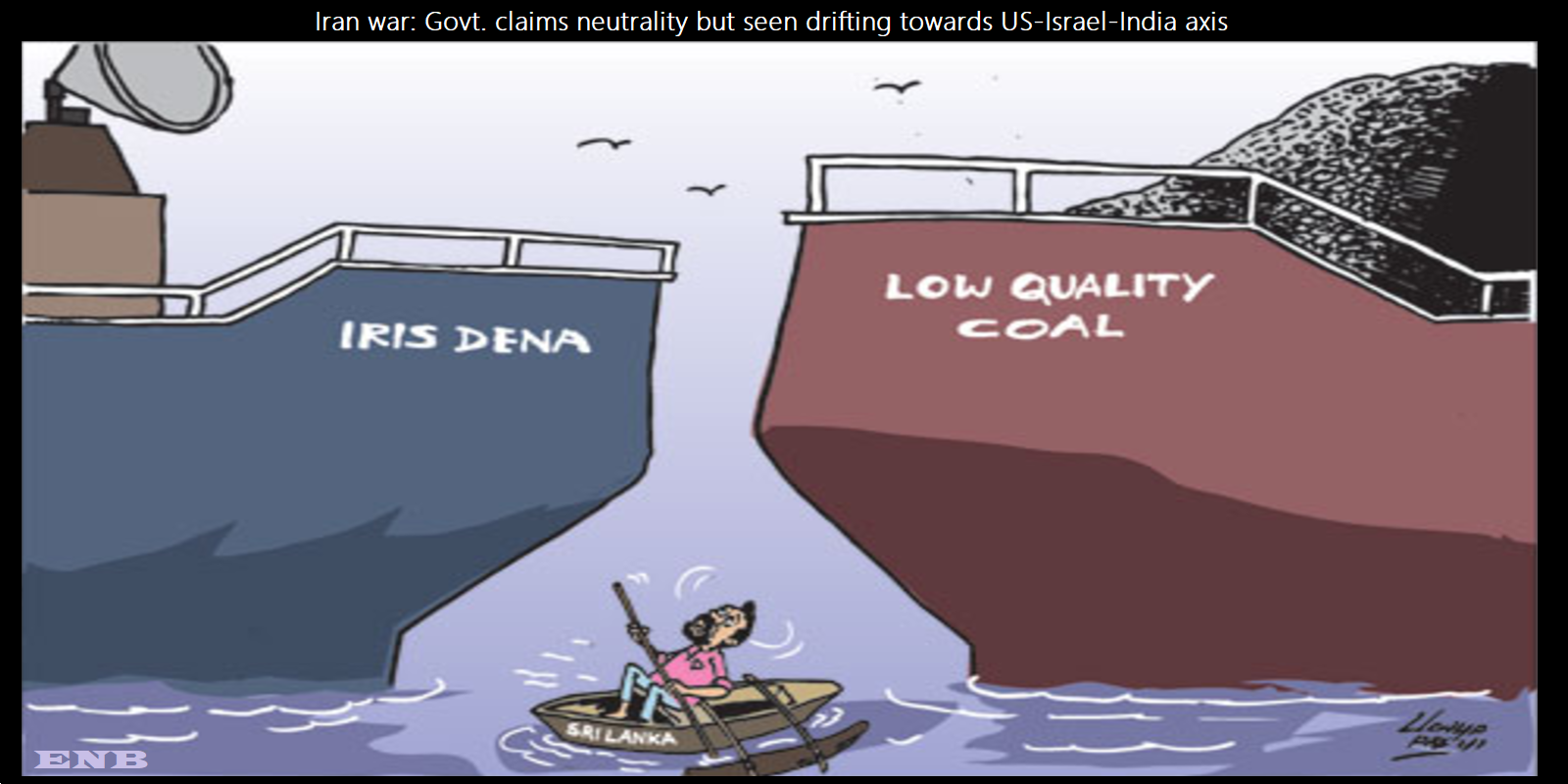
Iran war: Govt. claims neutrality but seen drifting towards US-Israel-India axis
Sunday Times 08-03-2026
- IRIS Dena’s goodwill request for a port call in Colombo was pending when hit and sunk
- More headaches for Govt., as US urges Lanka not to repatriate rescued Iranian sailors; vessel, meant for Trinco, now anchored near Colombo, raising security concerns
- Power crisis looms next month as low-grade coal reduces generation at Norochcholai plant; SJB to table no-confidence motion against energy minister
By our-ST- Political Desk
President Anura Kumara Dissanayake had the unenviable task of walking the diplomatic tightrope this week when Sri Lanka was unexpectedly thrust into the middle of the ongoing conflict engulfing West Asia, commonly referred to even here as ‘the Middle East’, and the Gulf States. Initially, it seemed that Sri Lanka had pulled off a diplomatic coup by playing peacemaker in the middle of warring parties by giving refuge to Iranian sailors from two ships, but unfolding events in the past 48 hours have given rise to questions if the country has been unwittingly drawn into a quagmire.
The news that a US submarine had sunk an Iranian warship off the southern coast of Sri Lanka became public on Wednesday, followed soon after by reports that the Sri Lankan Navy was engaged in rescuing the survivors of the Iranian warship IRIS Dena, 19 nautical miles off the country’s southern coast. The Sri Lanka Navy spokesman at first denied that the Iranian ship had been sunk by a US submarine and also refused to identify those aboard the vessel even though by then 32 sailors had been rescued from the vessel and brought to shore. However, at the same time or thereabouts, US Defence Secretary Pete Hegseth confirmed that a torpedo fired from a US submarine had sunk the IRIS Dena, which he described, with his usual exaggeration, as a “prize ship”.

Iranian navy ship IRIS Bushehr escorted to safety in Sri Lanka’s territorial waters
The Iranian warship had participated in the International Fleet Review and the multilateral naval exercise MILAN 2026, organised by the Indian Navy in the port of Visakhapatnam from Feb. 15 to Feb. 25; had left India’s territorial waters before war broke out and entered into international waters but was within Sri Lanka’s Exclusive Economic Zone (EEZ) when tragedy struck.
It was after reports emerged of another Iranian ship being anchored in close proximity to Sri Lanka and seeking assistance that President Dissanayake decided to publicly address the unfolding events on Friday night.
Here’s the timeline of events given by the President on Friday, March 6: On February 26, Iran requested permission from the Ministry of Foreign Affairs for three naval vessels to enter the Colombo port on the 9th to 13th of March, within a four-day period on a “goodwill visit”.
The Sri Lankan authorities were processing the Iranian request when, on February 27, the Iranian personnel reached out to Lankan authorities requesting medical assistance for an injured sailor to be brought ashore along with an accompanying officer on humanitarian grounds. The Sri Lanka Navy and Air Force facilitated the removal of the sailor and the accompanying officer for medical treatment the same day.
On March 4, between 5:08 a.m. and 5:30 a.m., it was reported that a vessel had come under attack outside but close to Sri Lanka’s maritime zone, approximately 19 nautical miles from the Port of Galle, and that distress signals were picked up by the Sri Lanka Navy, which, along with the Air Force, carried out a rescue operation saving 32 sailors. Around 90 bodies were later recovered from where the ship had gone down. By the time the Sri Lankan sailors and airmen reached the site of the distress call, the ship had already sunk, and only the sailors who managed to stay afloat were saved.
The same day, March 4, there was a message from another Iranian vessel, IRIS Bushehr, relayed to the Ministry of Foreign Affairs requesting permission to enter the Colombo port on the same day or the following day, March 5. After exhausting discussions and in keeping with Sri Lanka’s obligations under international law, it was decided to bring the sailors on board the IRIS Bushehr to Colombo and dock the ship at Trincomalee. Subsequently, the sailors were moved to the Welisara Navy Camp, where they remain for now.

When the President addressed a select crowd of media personnel at the Presidential Secretariat on Thursday night, he was upbeat about Sri Lanka’s ability to remain neutral in the middle of an ongoing conflict and said the government had acted in a ‘manner that safeguards the reputation and dignity of our country, protects human lives and demonstrates our commitment to international conventions.”
On the face of it, it seemed ‘all’s well that ends well’ where the government is concerned, but unfolding developments in the 48 hours after the President spoke have shown that the government could be in a less than ideal situation and a pawn in a bigger power game in the Indian Ocean region.
Hours after President Dissanayake’s press briefing, the Indian Navy disclosed that India had allowed another Iranian vessel, IRIS Lavan, an amphibious warfare vessel, which was also in the region, to participate in an International Fleet Review, and it was docked at Kochi since March 4, the same day that the frigate IRIS Dena was sunk. According to Indian media reports, India was approached by Iran to take in IRIS Lavan on February 28. According to the timeline given by President Dissanayake, on February 26, Iran requested permission from the Sri Lankan Ministry of Foreign Affairs for three naval vessels to enter our port from March 9 to 13, within a four-day period. It’s likely – though not confirmed – that while Sri Lanka was deliberating the Iranian request, a similar request had gone out to India for one of the three ships, IRIS Lavan, to dock there, and subsequently permission was granted.
It is not yet clear if Iran had requested the Indian government to allow all three ships to dock there as they had done with Sri Lanka. The IRIS Dena was sunk while Sri Lanka was deliberating the Iranian request, and hence questions have been raised: if the government had acted more swiftly, could more lives have been saved? This is a question that opposition legislators raised in Parliament this week as well.
Technical issues in Iran ship
The government is also facing a problem in moving IRIS Bushehr to Tricomalele as was the initial plan due to technical issues that have arisen in the vessel. As of last afternoon, the IRIS Bushehr remained anchored in the waters outside the Colombo Port. This is despite the President stating on Friday that although the vessel was near the Port of Colombo, retaining such a vessel within the main commercial port carried the risk of adversely affecting the maritime shipping industry. For now, the plan to move the warship to Trincomalee remains stalled, adding to the government’s headaches.
On top of that is the exclusive report by the Reuters news agency published yesterday. Quoting from an internal US State Department cable, the report said the United States is pressing Sri Lanka’s government not to repatriate the survivors from the Iranian warship it sank this week, as well as the crew of a second Iranian ship that is in Sri Lankan custody.
According to an internal State Department cable dated March 6 seen by the news agency, Jayne Howell, the charge d’affaires at the US embassy in Colombo, had emphasised to Sri Lanka’s government that neither the Bushehr crew nor the 32 Dena survivors should be repatriated to Iran.
Foreign Affairs Minister Vijitha Herath, who was in India attending the Raisina Dialogue, India’s flagship conference on geopolitics and geo-economics, when asked if Sri Lanka would repatriate the Iranian sailors, answered that it would be done in keeping with the international laws that govern such situations, without elaborating.
The Sri Lankan government’s claim of neutrality is a claim that needs closer examination. Since taking office, the National People’s Power (NPP) has been swinging strongly towards the US and India. Last November, Sri Lanka’s Defence ministry signed a Memorandum of Understanding (MOU) with the US, formalising a defence partnership between the two countries. Other than sketchy details released after the MOU was signed, its contents remain under wraps.
The first inkling that Sri Lanka may be falling deeper into the US sphere of dominance became evident when Admiral Steve Koehler, Commander of the US Pacific Fleet, visited Sri Lanka in October 2024, shortly after President Dissanayake was elected to office. He met with the President and other officials during the visit widely seen as an attempt to consolidate US military ties with Sri Lanka.
His second visit to Sri Lanka was days before the US-Israeli strikes on Iran. Admiral Koehle, who heads the largest naval fleet command in the world, was in Colombo from February 19 to 21, 2026, during which he engaged with Sri Lankan government officials and military counterparts, where advancing cooperation in maritime security and regional stability and enhancing collaboration and interoperability were on the agenda for discussion. The US Embassy in Colombo said after the visit that it was to highlight the ‘strategic importance’ the United States places on Sri Lanka’s role at the crossroads of global maritime routes and ‘underscores a shared long-term commitment to a free, open, and prosperous Indo-Pacific’. There has been speculation that the US Admiral was in Colombo to give a heads-up to the government on imminent Iran strikes, but Defence Ministry officials have denied any such prior knowledge.
Meanwhile, the first series of joint activities under the MOU between the US and Sri Lanka are planned for mid-2026, with a focus on disaster response, maritime domain awareness, and professional military education, but the ongoing conflict may lead to its delay.
Other than strong military ties with the US, the Dissanayake government also entered into a defence cooperation pact with India last year. It was signed during Indian Prime Minister Narendra Modi’s visit to Sri Lanka last April. On Friday, Sri Lanka and India agreed to jointly address the evolving situation around the Indian Ocean. This was when Minister Herath met Indian External Affairs Minister S. Jaishankar on the sidelines of the Raisina Dialogue. The two agreed to strengthen bilateral cooperation and address the evolving security landscape in the Indian Ocean.
“Our position and neutrality dictate that we shall not, under any circumstances, permit our land territory, maritime zones, or airspace to be utilised in a biased manner by any nation engaged in a conflict, nor in any manner that inflicts harm upon another nation,” the President said on Friday. But talk of neutrality in a highly polarised world seems far-fetched and Utopian.
The optimistic expectation that a new Global South would rise like an albatross from the ashes of the Non-Aligned Movement, led by a new configuration of global leadership, is proving to be an illusion. The founding members of the movement—Gamal Abdul Nasser’s Egypt has submitted to the US dollar to bridge their budget; Tito’s Yugoslavia has been carved out into several independent states—all now behind the European Union; Soekarno’s Indonesia, Nkrumah’s Ghana and even Mrs Bandaranaike’s Sri Lanka are ‘sitting on the fence’. The eye-opener for South Asia is that Nehru’s once nonaligned India is now entirely with the US-Israel axis, with Prime Minister Modi visiting Israel and hugging his counterpart Benjamin Netanyahu, an alleged war criminal, hours before Israel waged war on Palestine. India’s capitulation – as in the US-India trade deal, for example, the limits of which were announced to all by the US representative at the ongoing Raisina Dialogue in Delhi – are proof of India’s current foreign policy. BRICS, the new Brazil-Russia-India-China-South Africa alliance, is to be chaired by India shortly but is yet to get its act together to challenge the overpowering might of the US, leaving the field wide open for unabated unilateral action by the trigger-happy ‘cowboys’ in Washington. India is the current chair of IORA (Indian Ocean Rim Association), and Iran is a member of IORA and got no help from the chair.
While Sri Lanka may be miles away from the theatre of war, its repercussions are being felt closer to home already. This week saw a snapshot of what would be a common sight in the weeks and months ahead. There was panic at fuel stations in parts of Sri Lanka as motorists, fearful that a long-drawn-out war could result in a shortage of fuel, rushed to fill up their tanks. The panic soon spread to all corners of the country. Long queues, some running well over 1km, had formed by the following morning, in scenes reminiscent of the dark days of the economic crisis.
Both the government and the Ceylon Petroleum Corporation (CPC) put out statements insisting there was no fuel shortage and the country had enough stocks to last over a month. CPC Chairman Janaka Rajakaruna fronted the media on multiple occasions to stress the point, as did various government ministers. The CPC was even forced to distribute fuel to stations on Sunday – usually a day where such deliveries are not undertaken. The CPC chairman had earlier poured scorn on those waiting in long queues outside fuel stations, saying the CPC could not help it if people wanted to stand outside in the heat of the day in long queues for fuel when there was no fuel shortage. Citizens rarely take the government’s words and assurances kindly. As the queues continued, however, there was a rare Poya Day media briefing at the Department of Government Information on Monday (2), with both Mr Rajakaruna and Cabinet Spokesman Nalinda Jayatissa in attendance, underlining the fact that appeals made during the previous two days had little effect. When questioned by journalists, Minister Jayatissa said there was no immediate need to introduce a QR code system to ration fuel as seen during the economic crisis, though he did not rule out introducing the system at a future date should the need arise.
The fuel queues had eased by Tuesday, and the situation, despite the escalation of the conflict over the course of this week, has now returned to normal. President Dissanayake did not blame the public for the panic buying of fuel when he addressed Parliament on Tuesday to brief the House on what his government was doing to mitigate the impact of the widening conflict. “I understand that it is not unreasonable for our people to feel a degree of anxiety. There is no point in blaming any citizen. Our people endured a very bitter past, which still lingers in their minds. Only two or three years ago, they experienced the tragedy of fuel and gas shortages, spending weeks in queues and even losing lives while waiting in line. Therefore, our society becomes alarmed even by minor disturbances. This is understandable,” he said.
Other government sources blamed opposition parties and certain private television stations for instigating panic among the public of a fuel shortage due to the conflict in West Asia. They also pointed out that during his address to Parliament on Tuesday, President Dissanayake had outlined a host of projects his government has already undertaken to increase the country’s fuel storage capacity since coming to power. These measures include a new 86,000 metric tonne storage complex in Kolonnawa consisting of eight new tanks, a new 40,000 metric tonne storage complex at Muthurajawela and a new oil pipeline from Muthurajawela to Katunayake. The government is also renovating the Trincomalee Oil Tank Farm to further increase storage capacity, they pointed out. The President blamed past governments since Independence for doing nothing about maintaining buffer stocks, but Opposition MPs said all plans to do so were torpedoed by JVP agitation in the past.
Nevertheless, neither the President nor any member of his government has addressed the fact that the trust deficit that had been created between the public and previous governments who were in power during the economic crisis seems to have transferred to the NPP government as well. While organised disinformation campaigns often spread via social media may have played a part, there is no denying that the party most culpable for this trust deficit is the NPP government itself. Statements made by NPP politicians, both before and after coming to power, have contributed to this state of affairs. Whether they are claims boasting about being able to bring back stolen public funds hidden in Uganda or calling on those of other parties to come with desks and benches to take lessons on national security – the NPP is finding out the hard way that previous public comments can come back to bite them. So, when ministers say there is no threat to national security when suspects are gunned down inside courtrooms or lawyers are shot in close proximity to the nerve centre of the country’s defence establishment, or when they say cooking gas is readily available when it is not, is there any wonder that people look upon other statements made by government figures with scepticism?
Coal crisis: No-faith motion looms
While in instances such as tackling corruption, there are indications that the public, by and large, is supportive of the government’s efforts, there is no doubt that it is more than 18 months since Mr Dissanayake was elected president and more than a year since the NPP obtained a two-thirds parliamentary majority. The honeymoon period is well and truly over. The NPP saw signs of this during last May’s local council election, where it lost an alarming 2.3 million votes from the parliamentary polls held just seven months before. With an 11-member Parliamentary Select Committee (PSC) appointed last month to examine the electoral system under which the provincial council elections should be conducted, there is little likelihood of the government putting its popularity, or lack thereof, to the test before the ballot box anytime soon by holding the long-delayed PC polls.
The government’s waning popularity may suffer even further if it fails to address the bungled coal tender that may have long-term negative effects on the country’s power sector. Operational information released by the Lakvijaya power plant has already revealed that a majority of South African coal shipments that have arrived—after being purchased under the latest tender via India’s Trident Chemphar Ltd—do not meet the minimum criteria for use in the plant. The government, however, has its hands somewhat tied given that both load port and discharge port reports from two separate accredited foreign laboratories still indicate that every coal consignment—except for the first one, for which a hefty penalty was charged—meets the minimum specifications of the tender.
Energy Ministry officials have admitted that there is a drop in performance at the Lakvijaya plant when using the South African coal, compared to the previous stock of Russian coal. A total of 25 South African coal shipments purchased under the tender from Trident Chemphar Ltd are due by the end of April, though it is now doubtful whether the company will be able to meet this deadline. About 11 shipments have arrived by this week. The Lanka Coal Company (Pvt) Ltd (LCC) has now enlisted another independent, accredited foreign laboratory called Bureau Veritas (BV) to test the coal at the load port, the Richards Bay Coal Terminal in South Africa. BV has been hired to test the 13th and 14th vessels bringing coal for Lakvijaya. It will also supervise loading and sample preparation, analyse the buyer’s sample, certify the cargo covering specific parameters, and issue two sets of documents. One official from LCC and one from the Ceylon Electricity Board (CEB) have flown to South Africa to inspect the coal stocks being loaded for Sri Lanka and to be on hand when BV tests the coal sample stocks.
LCC requires Gross Calorific Values (GCV)—which represents the heat released upon combustion—between 5,900 (reject value) and 6,150. Under the terms of the purchase agreement, the agreement can be cancelled only in the event of two shipments registering GCVs of reject value. Only the first shipment has failed both quality tests so far after registering a GCV value below 5,900.
The government has also consulted the Attorney General regarding what legal options it has at its disposal. The AG has advised officials to follow the agreement with Trident Chemphar. Energy Ministry sources said the AG had also advised the government to study the report compiled by a seven-member committee appointed to evaluate the current coal supply mechanism for the Lakvijaya coal power plant and to take legal action against the company based on its findings. The formation of this committee was announced only last week, and it is unclear when it will submit its report.
The developments come as a report by the Public Utilities Commission of Sri Lanka (PUCSL) warned of a “potential capacity shortage risk” in April, June and July. Titled “Generator Performance and Financial Impact due to use of Coal supplied by Trident Chemphar Limited at Lakvijaya Power Station”, the report, which was tabled in Parliament this week, pointed out that there was a real risk of such a shortage given that Units 1 and 2 of the Lakvijaya Power Station (LVPS), as well as two other power plants, are scheduled to undergo maintenance at different points from April till July.
Under the normal conditions, there is a potential capacity shortage risk in April, June and July if the demand reaches 3030MW, 3070MW and 3000MW, respectively, the report notes (the recorded maximum night peak demand in 2026 is 2949MW on 25th February). “Further, if one coal unit or one major power plant becomes unavailable out of the available units/plants, there is a high risk of a generation capacity shortage for catering to the night peak demand, especially in April, June and July.”
Moreover, if the generation capacity of LVPS needs to be further reduced to maintain a stable and safe operation level, the risk of generation capacity shortage is further increased, the report further stresses.
The report clearly indicates a potential power crisis by next month if the situation is not addressed. Only time will tell at this point if the government will be able to act decisively to prevent such an outcome.
The PUCSL’s report also calculates the estimated financial loss from the nine coal shipments received at the point the report was compiled at nearly Rs 8.5 billion. An Energy Ministry official however, said the ministry will wait until the report compiled by the expert committee it appointed is handed in to determine the extent of the financial loss.
The flood of bad news comes as embattled Energy Minister Kumara Jayakody, who is facing calls for his resignation, was indicted by the Commission to Investigate Allegations of Bribery or Corruption (CIABOC) this week in the Colombo High Court over misappropriation of funds while he was serving at the Fertiliser Corporation in 2015.
The main opposition Samagi Jana Balawegaya (SJB) is now preparing a No-Confidence Motion (NCM) against Minister Jayakody. SJB MP Ajith P. Perera says that the NCM against Minister Jayakody will be submitted on two counts – that he has been indicted by the CIABOC on corruption charges, making him ineligible to hold a ministerial portfolio, and that he mismanaged the 2025-26 coal tender, causing a loss of over Rs. 8 billion to the state. The SJB hopes to hand over the NCM against the Energy Minister to Speaker Jagath Wickramaratne next week. “We hope other opposition parties will also sign onto the NCM,” Mr Perera said.

ஒத்தவை:
சென்ற வாரம் இலங்கை-சண்டே ரைம்ஸ்