Oil patch appears after IRIS Dena sinking in Sri Lanka;
origins still unverified
Kamanthi Wickramasinghe 13 Mar 2026 Asia https://news.mongabay.com/
- Following the March 4 sinking of an Iranian warship in the Indian Ocean, fishers and coastal communities have spotted an oil patch along the Hikkaduwa coast in southern Sri Lanka, raising concerns about its origin.
- Authorities are conducting investigations to determine the origin of the oil patch and debris washed ashore.
Studies show the sea around Sri Lanka as highly vulnerable to oil spills, as more than 25% of oil transported globally passes through Sri Lanka’s exclusive economic zone.
Legal experts say in the event of confirmed environmental impact due to the ship sinking, the “polluter pays principle” should be applied.
HIKKADUWA, Sri Lanka — On Saturday, March 7, three days after the Iranian warship IRIS Dena was torpedoed by a U.S Navy submarine close to the southern coast off Galle in Sri Lanka, fishers and coastal communities noticed a thick oil patch along the coast of Hikkaduwa.
Hikkaduwa is one of the most pristine coastal belts in the south of Sri Lanka, frequented by tourists throughout the year with a peak tourism season from December to March.
Even as authorities say the oil spill has been brought under control to some extent, environmentalists express concerns about the possible environmental implications of the oil spill on marine ecosystems in Hikkaduwa and its environs.
The frigate was torpedoed by USS Charlotte, a U. S. Navy submarine. The Iranian-flagged IRIS Dena was returning from the International Fleet Review 2026, a multinational naval exercise held in Visakapatnam, India. The incident occurred in international waters, around 40 nautical miles (74 kilometers or 46 miles) off the island’s southern coast.
“As soon as we were informed by the Coast Conservation and Coastal Resource Management Department (CCD) about the appearance of several oil patches along Hikkaduwa coast on March 7 morning, we deployed teams to check on the situation,” Samantha Gunasekara, chair of Sri Lanka’s Marine Environmental Protection Authority (MEPA), told Mongabay.
He said that ever since March 4, the day the warship was attacked, local teams have been alerted via a WhatsApp group to watch for evidence of any environmental impacts. “We obtained photographs from coastal areas of Hikkaduwa, Dodanduwa, Habaraduwa, Seenigama, Galle and Hiniduma, where oil patches were seen. On March 7, some local people also observed several oil barrels and debris that had washed ashore. The third and fourth barrels were damaged. It is highly likely these are lubricant oil that had leaked from the barrels. We have obtained samples and sent to the MEPA laboratory in Galle,” he told Mongabay.

Teams from MEPA, the Sri Lanka Navy and Coast Guard clearing the oil spill. Image courtesy of the Marine Environmental Protection Agency (MEPA).
Satellite data show early appearance
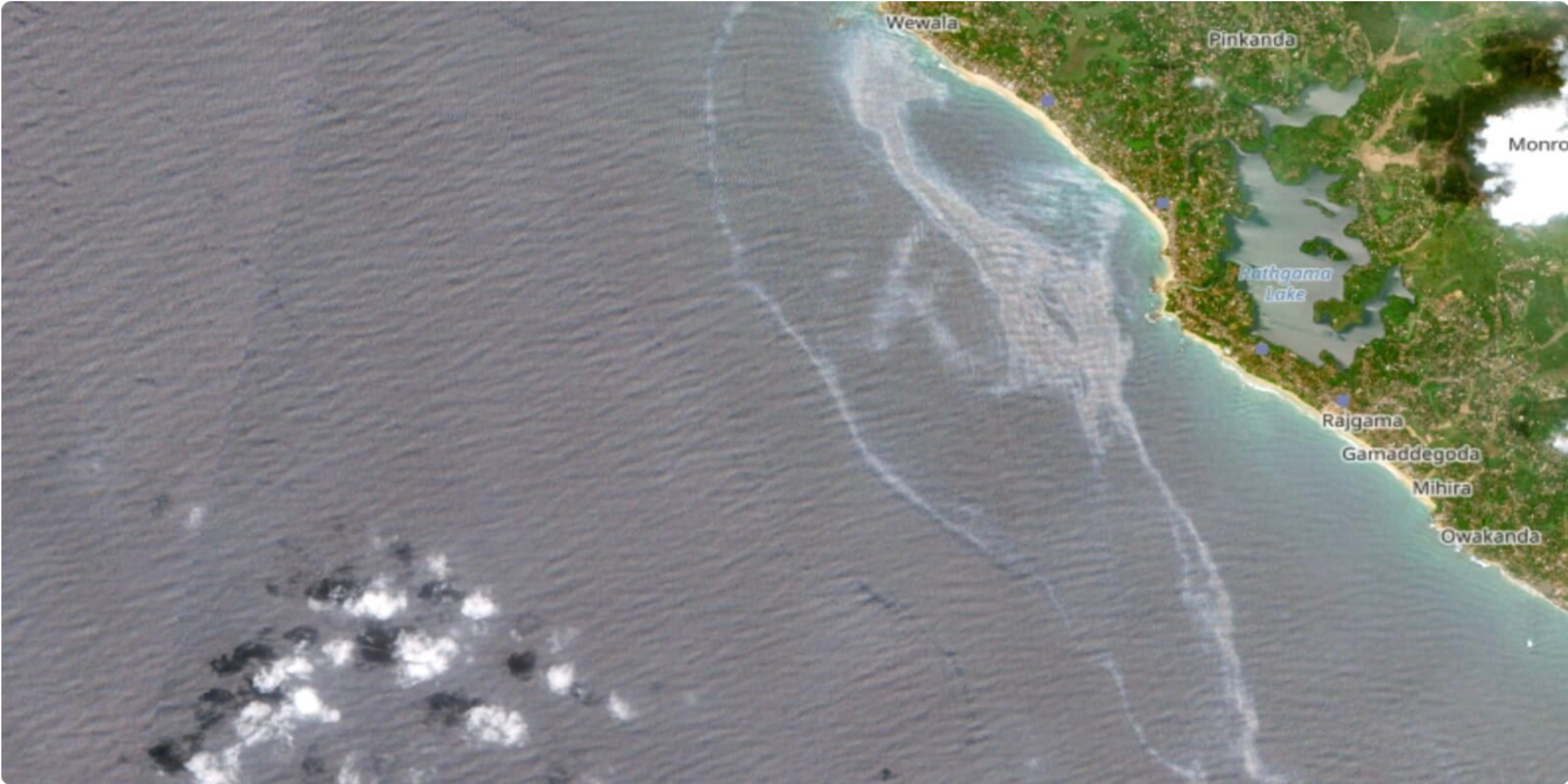
Juan Peña Ibáñez, chief executive officer of Orbital, a Spanish company that specializes in monitoring oil spills using satellite data, said the spill was initially observed on the morning of March 5.
“An – 18 kilometer (11- mile) portion of the spill has moved towards the coast, affecting the shoreline south of Hikkaduwa, especially Wewala, Thiranagama and Kumarakanda. It appears that the oil is continuing to leak from the IRIS Dena shipwreck,” he told Mongabay.
Meanwhile, Dulip Rangajeewa, coordinator of the National Fisheries Solidarity Movement in the Galle district, said fishers observed oil patches closer to the deep sea on Monday, March 9, saying that if the oil spill is not cleared soon, it would impact the livelihoods of fishers in the area as well as the environment.
“When there’s a disturbance in the surface, there’s less fish coming to the surface. On the other hand, when oil encounters fish nets, it’s difficult to engage in fishing activities. One reason is that it’s difficult to wash away the oil and naturally, it keeps fish away,” Rangajeewa told Mongabay.

An oil patch appeared near the popular Hikkaduwa coast three days after the Iranian flag-carrying IRIS Dena sank close to the island’s southern coast. Image courtesy of the Marine Environmental Protection Agency (MEPA).
Speaking to Mongabay, Muditha Katuwawala, conservationist and founder of The Pearl Protecters, a youth-led marine protection organization, recalled instances when large oil spills caused marine pollution along Sri Lanka’s coastline. “A similar event occurred in Uswetakeiyawa in 2018 when a pipeline leak from the Muthurajawela oil refinery complex released over 25 tons of furnace oil. Then, following MV X-Press Pearl and MT New Diamond incidents, bunker oil started washing up along the shores,” he said.
Katuwawala said there were many ichthyoplankton — fish eggs and larvae — from March to April, and an oil spill, highly toxic, could impact fish larvae. “It would also affect shallow water corals and marine life around it. According to the National Aquatic Resources Research and Development Agency, around 50% of shallow-water fish have been depleted. This also calls for a need to protect the habitats of ichthyoplankton,” he said.
This is also the sea turtle nesting season along the southern and western coasts and Hikkaduwa, which is popular for sea turtles coming near the shore. “Turtles emerge above the waters to feed and breathe, and this means they would be critically impacted due to the oil spill. Sea turtle hatchlings would consider the reefs as their habitats. Since their mortality rate is high, it would also have an impact on sea turtle populations along the southern coast because of the uniqueness of the reef and the larger habitat that is there,” he added.
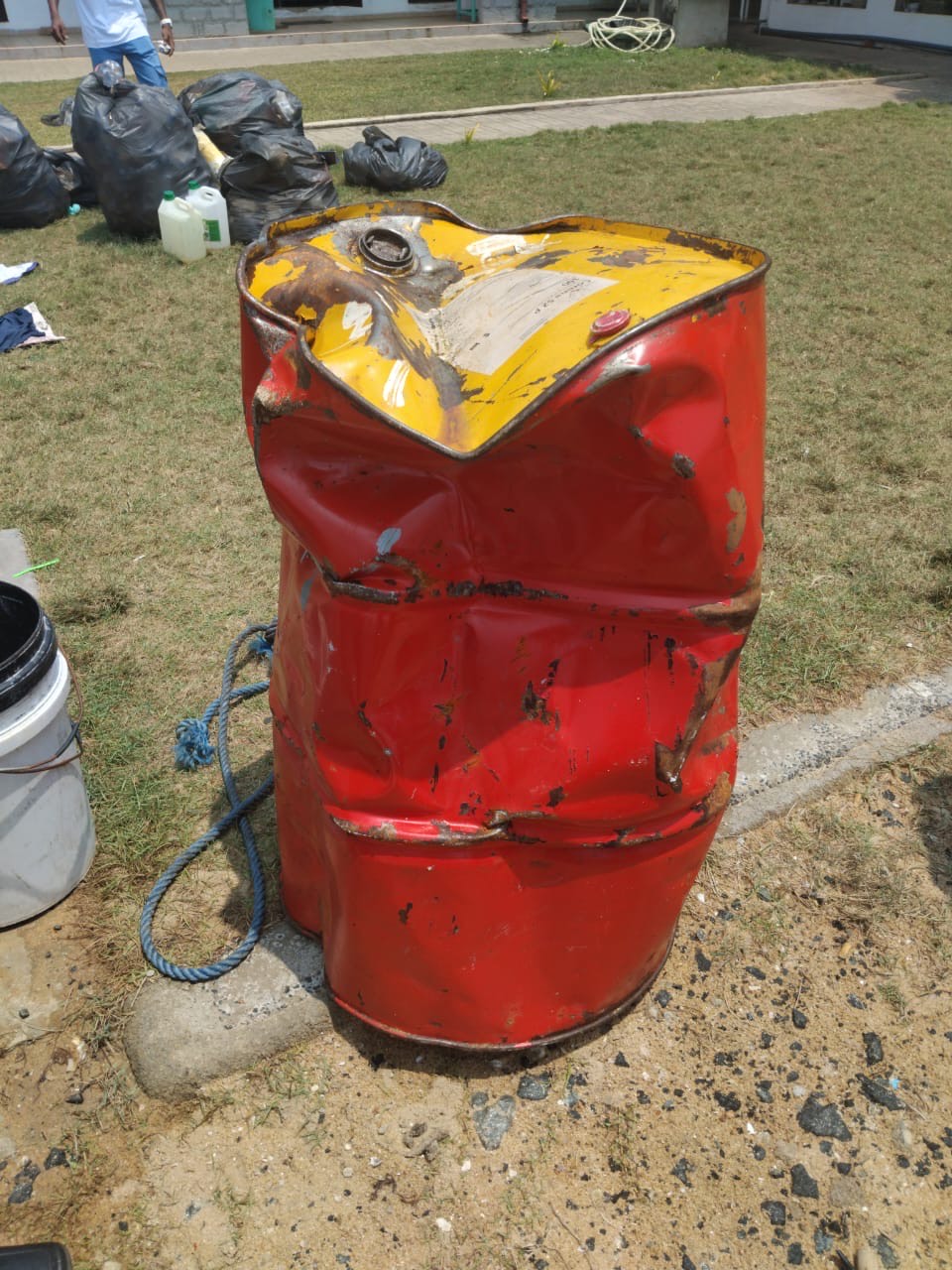
One of the barrels that washed ashore on March 7. Image courtesy of the Marine Environmental Protection Agency (MEPA).
Clearing oil patches
Meanwhile, MEPA’s Gunasekara said that around 90% of the oil patch was cleared on Saturday through a collaborative effort by MEPA, CCD, the Sri Lanka Navy, police, provincial councils and other local authorities.
However, the MEPA chief refuted a link between the recent oil patches and the sunken Iranian vessel and reiterated that the origin of either the debris or the oil patch is still to be determined. “Without obtaining and comparing oil samples from the Iranian vessel, it is difficult to prove whether this oil patch originated from the vessel. There are around 400 ships that travel through this maritime route daily and some of these ships release oil to the sea deliberately. But we are closely monitoring the situation. We sent the samples to the Ceylon Petroleum Corporation on March 9 and awaiting the final report,” he told Mongabay.
No origin yet
Commander Buddhika Sampath, Sri Lanka Navy spokesperson, said the reason for the oil patches is not yet identified. “But the Navy, Coast Guard and MEPA have taken proactive measures to handle the situation” he said.
A 2021 study on the natural resource damage assessment for oil spills in Sri Lanka done by Dinishiya Athukorala stated that 39 oil spills occurred in Sri Lanka between 1999 and 2021, including the MV X-Press Pearl. A previous study published in 2017 on oil spill events in marine waters in Sri Lanka showed the sea around Sri Lanka being highly vulnerable to oil spills, as approximately 25% of the world’s oil transportation passes through Sri Lanka’s exclusive economic zone.
In August 2025, the Sri Lankan Supreme Court ordered owners of the MV X-Press Pearl to pay $1 billion in compensation for the 2021 sinking that caused the country’s worst maritime pollution disaster. Applying the “polluter pays principle,” the ruling mandates payments for extensive plastic pellet contamination and ecological damage.
Ravindranath Dabare, attorney-at-law and co-founder of the Centre for Environmental Justice, said if the origin of the current oil spill is determined and is linked to the sunken Iranian warship, those who carried out the attack should be responsible for any environmental damage. “This should be then handled at a diplomatic level. There may be certain ambiguities under the United Nations Law of the Sea Convention. There were no weapons aboard the warship, and they were returning from a demonstration,” he told Mongabay.
Banner Image: A satellite image of the oil patch off the Hikkaduwa coast, containing modified Copernicus Sentinel-2 data. Image courtesy of Orbital EOS.
Citations: D Athukorala, S. M. (2021). Natural resource damage assessment for oil spills in Sri Lanka: the application of Habitat Equivalency Analysisthe application of Habitat Equivalency Analysis (Unpublished master’s thesis). World Maritime University, Sri Lanka.
Credits-S L Prakash, T. G., Cooray, I. G., & Jayawardhane, P. (2017, October). An overview of Oil Spill Events in Marine Waters of Sri Lanka. Paper presented at Third National Marine Symposium 2017, Colombo, Sri Lanka.

ஒத்தவை:

சென்ற வாரம் இலங்கை-சண்டே ரைம்ஸ்