Govt hopes to secure a favourable deal with IMF
Power crisis looms: Govt. blames West Asian conflict, opposition flags corruption in coal deal
- National programme launched to conserve power amid growing public criticism over low-grade coal imports
- Desperate Govt. explores buying oil from Russia and the US, but the move is beset by multiple challenges
- Water cuts in several areas add to Govt’s woes, as it hopes to secure a favourable deal with IMF
- Hunt for Easter Sunday mastermind becomes hot political pursuit; opposition leader’s presence at Gammanpila’s book launch draws flak
By our ST Political Desk 05-04-2026
As Sri Lankans prepare to celebrate the upcoming National New Year, the National People’s Power (NPP) government is facing multi-pronged challenges that threaten to unleash disastrous consequences for the country in the coming weeks.
One of the most pressing is a potential electricity crisis that may result in scheduled power cuts having to be imposed for a prolonged period. Last Sunday, the government officially launched its ‘Surakimu Lanka’ national programme to promote energy conservation. Implemented under the ‘Clean Sri Lanka’ initiative, the Surakimu Lanka programme has been initiated under the theme “Let’s Unite – Let’s Shine Bright“.
A key goal of the programme is to encourage the public to limit electricity consumption during the peak hours from 6 pm to 10 pm or to carry out high-energy-consuming activities during the daytime as much as possible. The government estimates that if consumption can be cut by about 25% during the peak demand period, it will be possible to provide a continuous power supply without resorting to scheduled power cuts. The programme is set to continue for five months.
The President’s Media Division (PMD) issued a statement announcing the project’s launch, claiming the government is implementing the programme “considering potential disruptions to the country’s energy and fuel supply due to the prevailing war situation in the Middle East”. It also considers forecasts of possible El Niño weather conditions in the future.” There was no mention in the statement about how the usage of low-grade coal at the Lakvijaya coal power plant in Norochcholai has also significantly contributed to the energy crisis the country now finds itself in. The bungled coal tender has been the source of enormous controversy for months, though many in the NPP government, much like the proverbial ostrich, have chosen to bury their heads in the sand and attempt to pretend it does not exist.
This strategy (if it could be called that) is no longer working. With each passing day, criticism against the coal fiasco only continues to grow louder, not just from the opposition but from the general public as well.
Such criticism is certain to intensify in the days ahead now that the Public Utilities Commission of Sri Lanka (PUCSL), the country’s power sector regulator, has approved an increase in electricity tariffs from April 1. According to the tariff revision approved by the PUCSL, general consumers will see their electricity tariffs increase by 8% on average. The industrial sector will see a tariff increase of 8.7% while the Commission approved a tariff increase of 9.9% for the hotel sector. Approval was also given to increase the electricity tariff for government institutions by 14.4%.
The regulator said it decided not to increase electricity tariffs for religious and charitable places with monthly consumption of less than 180 units. Approval has been given to increase tariffs by 9.6% only for such places with monthly consumption of more than 180 units.
The electricity tariff increase immediately had a knock-on effect on the cost of living. The All Ceylon Restaurant Owners’ Association announced that the price of a packet of rice would be increased by Rs. 30. Prices of other restaurant food have also gone up in different amounts. Even a cup of milk tea went up by Rs 10, while plain tea was increased by Rs 5.
The tariff increase immediately came in for criticism from opposition politicians, who claim the increase came about due to the enormous loss suffered through the controversial coal deal. They have repeatedly alleged that the tender which led to the supply of low-grade South African coal by India’s Trident Chemphar was mired in corruption. They also accused the government of attempting to transfer the financial loss from the coal fiasco onto the electricity consumers through the new tariff increases.
Meanwhile, more questions are being thrown up regarding the coal deal. The Sunday Times pointed out last week that the contract contains a clear basis for termination, including in the event any two different shipments of coal quality parameters are reported outside the minimum/maximum tolerance limit after testing of coal samples at the load port and jetty of the plant. Three coal shipments out of 12 that have been unloaded at Norochcholai so far have failed quality testing by the independent accredited laboratory Cotecna. The contract, however, is yet to be terminated. Officials have now calculated that Trident will also not be able to deliver all 25 coal shipments it had been contracted for before the monsoon sets in and that there would be a shortage of three to four shipments. This has forced the government to buy five additional shipments of better-quality coal through an emergency tender at considerable expense to the state.
Addressing a news conference organised by parties representing the joint opposition on Wednesday, United Republic Front leader and onetime power and energy minister Patali Champika Ranawaka claimed that the situation with the low-grade coal was so serious that there was a real danger of scheduled power cuts having to be imposed in the coming weeks. He accused the government of carrying on a campaign to hoodwink the public into believing that it is the drought situation that would ultimately compel the government to impose power cuts when, in reality, it will be because of the “fraud” involving the procurement of low-grade coal. The drought situation was far worse in 2022 and 2023, though no power cuts were imposed then, he added.
Mr Ranawaka is not alone in claiming that the procurement of the low-grade coal had been a corrupt deal. These accusations have become widespread, with Energy Minister Kumara Jayakody facing allegations of involvement in the matter. Minister Jayakody was also recently indicted in the Colombo High Court by the Commission to Investigate Allegations of Bribery or Corruption (CIABOC) on corruption charges. The CIABOC accuses him of committing financial irregularity whilst he was serving as the procurement manager of the Lanka Fertiliser Company in 2016. He has been charged with causing a loss of more than Rs 8.8 million to the state through his alleged actions of allowing a contracted private company to make undue financial profits.
The embattled minister will face a No-Confidence Motion (NCM) in Parliament next Friday (10). The NCM is expected to receive the support of most opposition parties. The NPP government has rejected allegations against the energy minister as baseless and is poised to back him when the NCM comes up for a vote. All NPP MPs have been instructed to be present in Colombo on Friday in preparation for a vote on the NCM later that evening.
Given that the government is intent on backing Minister Jayakody, opposition parties are also accusing President Anura Kumara Dissanayake himself of complicity in the coal fiasco, questioning why he has not acted to remove Minister Jayakody from his portfolio in the face of serious allegations against him. The government’s stance now seems to be that while Trident Chemphar has indeed supplied low-grade coal, the tender procurement process that awarded the contract to supply coal for Lakvijaya was not tainted by corruption.
Public Security and Parliamentary Affairs Minister Ananda Wijepala echoed these sentiments when he said that there was no issue regarding the tender to procure coal for Lakvijaya. “The opposition is trying to put this (electricity issue) all down to the coal tender. There is no issue regarding the tender for coal supplies. The supplier provided low-grade coal, for which we have imposed penalties amounting to about USD 12 million so far,” said the minister.
He pointed out that many Asian nations are undergoing fuel shortages and power supply difficulties owing to the war in West Asia. Sri Lanka has actually managed the situation far better than most in the region, Minister Wijepala claimed. “We are continuing to provide a continuous supply of fuel and electricity. The plan is to continue providing them without any interruption, though we cannot control the rise in global oil prices, which will also affect domestic pricing.”
He also dismissed accusations by the opposition regarding electricity tariffs, pointing out that low-income consumers who consume less than 30 units per month will see their electricity bills increase by only Rs 15. The government, Mr Wijepala argued, “deserves praise” for managing the fuel, gas and electricity supplies so efficiently when many other countries are struggling.
“The opposition is always trying to use various situations beyond our control to attack the government. They did it during Cyclone Ditwah, and they are doing it now with the war, trying to instigate anti-government sentiment. They are now trying to use a foreign war to topple the government. This shows that the opposition does not have a clear aim other than to try and attack the government using whatever situation that arises from time to time. Such attempts, however, continue to end in failure,” he said.
Whatever the minister may say about the power situation, it is a fact that the usage of low-grade coal at the Lakvijaya power plant has resulted in it generating well-below the required power output. This has created immense pressure on the national grid, forcing the Ceylon Electricity Board (CEB) to rely on costly thermal power plants. With both diesel and furnace oil needed to run such plants hard to come by due to the war in West Asia, the situation has become rather desperate.
That desperation has been plain to see in how the government has been trying hard to obtain fuel. There has been a lot of movement on this front in recent days with regard to Russia. The possibility of Sri Lanka being able to purchase Russian oil came about after the Trump administration issued a temporary 30-day waiver allowing countries to buy sanctioned Russian oil and petroleum products stranded at sea. There were high hopes of success when a Russian delegation led by Deputy Energy Minister Roman Marshavin visited the country last week for talks on energy cooperation between the two countries. Mr Marshavin held a meeting with President Dissanayake and also took part in formal talks with Sri Lankan officials, including Energy Minister Kumara Jayakody; Deputy Finance Minister Anil Jayantha Fernando; Central Bank Governor Nandalal Weerasinghe; Treasury Secretary Harshana Suriyapperuma; and Ceylon Petroleum Corporation (CPC) Chairman Janaka Rajakaruna.
Back in Moscow, Mr Marshavin this week met with Transport, Highways and Urban Development Minister Bimal Rathnayake, who was undertaking an official visit to Russia. A media statement issued by the Transport Ministry stated that Mr Marshavin “assured consistent support to meet Sri Lanka’s current fuel requirements and to bridge potential future energy shortages”. The ministry also said that the Russian deputy minister had further confirmed that Russia is capable of supplying the fuel necessary for April and May.
While Minister Rathnayake held discussions with Deputy Minister Marshavin in Moscow, in Colombo, the government welcomed Russian Deputy Foreign Minister Andrey Rudenko. During his stay, Mr Rudenko held discussions with Foreign Affairs, Foreign Employment and Tourism Minister Vijitha Herath, where there was a renewed focus on the possibility of procuring Russian oil. A statement issued by Minister Herath’s office after the meeting said that Mr Rudenko “promised to take swift action to supply necessary Russian oil during this difficult period facing Sri Lanka.”
Despite the hopeful official statements, behind the scenes, government sources remain cautious regarding the possibility of acquiring Russian oil, pointing out that the temporary waiver given by the US to procure Russian oil expires on April 12. Many other nations desperate for oil are also lobbying Russia for oil for their own countries, and Russia will be bound to provide oil to those countries that have already signed agreements first, they add. In contrast, Sri Lanka is yet to sign any official agreement to procure Russian oil. If the US does not extend the waiver period, they concede that it would be near impossible to obtain the Russian oil before April 12, even if an agreement is reached.
The government had requested US Special Envoy for South and Central Asia, Sergio Gor, during his visit to the country last month, to consider the possibility of extending the 30-day waiver to buy Russian oil to three months. It is understood that Bangladesh has also sought a similar waiver from the US to import fuel from Russia. Following the Russian deputy foreign minister’s visit, Jayne Howell, the chargé d’affaires at the US Embassy in Colombo, met with Foreign Minister Herath to follow up on the talks held with US Special Envoy Gor, especially the possibility of Sri Lanka procuring oil from the US.
For crude oil, the CPC has already taken steps to order West Texas Intermediate (WTI) crude from the US, as it has been unable to secure Murban crude, which is produced only in the war-ravaged West Asian region. Murban crude supplies have been disrupted as the Strait of Hormuz still remains blocked to most tankers. Addressing a media briefing on March 28, CPC Chairman Janaka Rajakaruna disclosed that they had run tests at the Sapugaskanda oil refinery using samples of WTI and that the tests were successful. Two tenders were even called, but the shipments could not come because the freight was too high, he noted. “We have now floated tenders for Sahara Blend from Algeria, and we are also trying to buy Siberian crude from Russia. We are expecting a WTI shipment in May, so we don’t need to wait for Murban crude,” said the CPC chairman.
The 50,000 barrel-per-day Sapugaskanda oil refinery was originally commissioned in 1969 to process Iranian light crude oil. Due to the failure to sufficiently modify the refinery over the years, the number of crude oil varieties that the refinery can process is limited, the CPC chief explained, adding that this is why plans are now being drawn up to modify the refinery and enhance its refining capacity.
US officials had been pushing the NPP government since last year to purchase US oil to narrow the trade gap between the two countries as part of its conditions to reduce reciprocal tariffs imposed by the Trump administration. A government source noted there was no possibility to quickly purchase oil under a government-to-government deal from the US since no state entity in that country is involved in fuel trading. “We spoke to US authorities about the matter during tariff negotiations, and they suggested the names of several private US oil firms. The process, however, will take time.”
It would be no exaggeration to say that Sri Lankans have been undergoing a torrid time in recent months as they faced hit after hit due to situations that were beyond their control. It does not seem there is any respite even as the country prepares for the upcoming National New Year.
Water cuts
This week saw the National Water Supply & Drainage Board (NWSDB) announce that it would impose a 24-hour water cut for several areas in the Colombo district with effect from April 2 due to the reduction in water levels at the Labugama and Kalatuwawa Reservoirs. Accordingly, 24-hour rotating water cuts were imposed in the Padukka, Pelanwatta, Homagama and Pannipitiya areas. These cuts were reduced to 18 hours on Friday. The NWSDB said yesterday that talks on further reducing the duration of the water cuts for these areas to 12 hours were ongoing. The cuts underscore difficulties posed by the prevailing dry weather conditions for the supply of drinking water, with the NWSDB continuing to appeal to consumers to use water sparingly. The Irrigation Department has conveyed the same message to the public, pointing to the reduction of water levels of several rivers and highlighting the need to conserve water for the upcoming cultivation season.
Negotiations with the International Monetary Fund (IMF)
Amid the scramble to secure oil, to avert a power crisis, and to face a drought situation, the government is also continuing negotiations with the International Monetary Fund (IMF). An IMF delegation led by its Mission Chief Evan Papageorgiou arrived in the country on March 26 and will remain till April 9, holding discussions with Sri Lankan authorities on the combined fifth and sixth reviews of Sri Lanka’s reform programme supported by the IMF’s Extended Fund Facility (EFF). The team met President Dissanayake at the Presidential Secretariat on Thursday. A PMD statement issued after the meeting quoted President Dissanayake as telling the IMF delegation that Sri Lanka has met all targets set under the EFF programme and has reached a position of relative stability. He had also highlighted the need to take all necessary measures to minimise the impact on the public. The IMF team is scheduled to give its assessment during an address to the media at the end of its visit.
Mastermind of the Easter Attacks
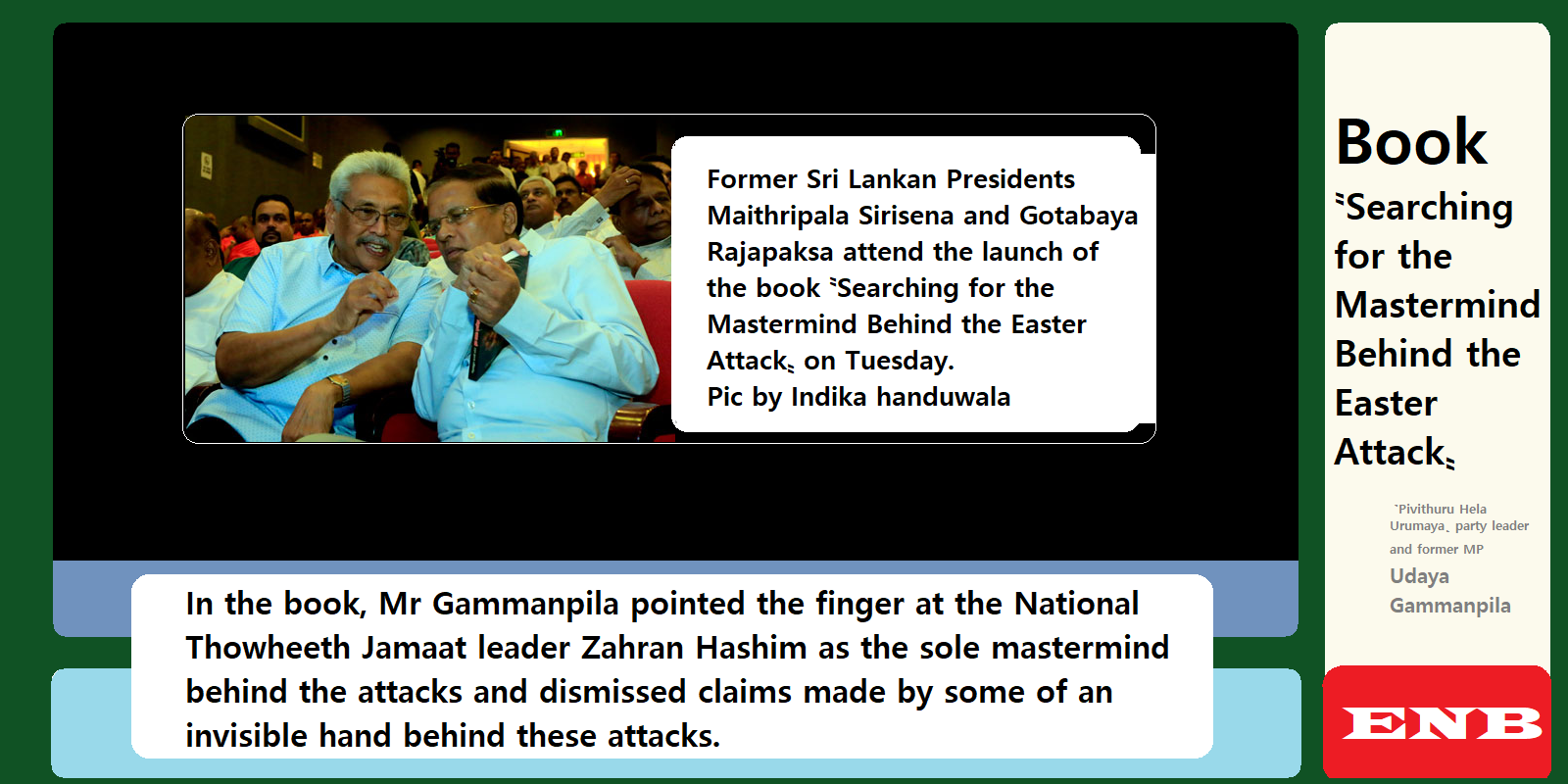
Meanwhile, with the seventh anniversary of the Easter Sunday terrorist attacks drawing closer, once again the search for the mastermind (maha molakaru) behind the attacks has intensified, with ‘Pivithuru Hela Urumaya’ party leader and former MP Udaya Gammanpila taking the lead as he has been doing for some years now. In the past year and a half, he has made public two reports pertaining to the deadly attacks that took place on East Sunday on April 21, 2019. On Tuesday, he took the matter further when he held a high-profile launch for his book titled ‘Pasku Praharaye Mahamolakaru Soyayema (In Search of the Mastermind of the Easter Attacks)’. The launch, held in Colombo, was well attended, with three former presidents, namely Mahinda Rajapaksa, Gotabaya Rajapaksa and Maithripala Sirisena, in attendance along with Samagi Jana Balawegaya (SJB) Leader Sajith Premadasa.
In the book, Mr Gammanpila pointed the finger at the National Thowheeth Jamaat leader Zahran Hashim as the sole mastermind behind the attacks and dismissed claims made by some of an invisible hand behind these attacks. Zaharan was one of the suicide bombers who carried out the multiple attacks and has been identified by investigators also as being the man who radicalised the other men who carried out the suicide bombings, resulting in the death of over 260 persons and injuring many others.
The US Justice Department, which filed indictments against three men in connection with the attacks, in which five American citizens were killed, has identified the bombers as part of a group of ISIS supporters which called itself “ISIS in Sri Lanka”. However, these findings have not put the conspiracy theories to rest in Sri Lanka, with Colombo’s Archbishop Malcolm Cardinal Ranjith also claiming that the mastermind is someone else. They support their claim based on a documentary aired in 2023 by the UK’s Channel 4, which in 2011 also aired a documentary titled “Sri Lanka’s Killing Fields” alleging serious human rights violations by the Sri Lankan military during the war.
Mr Gammanpila’s book launch came a few weeks after the arrest of the former State Intelligence Services (SIS) Chief Major General (Retired) Suresh Sallay, who is being investigated as being part of the conspiracy to carry out the attacks. He has been detained under the Prevention of Terrorism Act (PTA) since February 25. Last week he was admitted to the Colombo National Hospital following a sudden illness and remains there. Mr Gammanpila, in his speech at the book launch, sharply criticised the Criminal Investigation Department Director, Shani Abeysekera, for paving the way for the Easter Sunday attacks. SSP Abeysekera served as the director of the CID during the time the attacks took place and was removed from the position after Gotabaya Rajapaksa was elected president in 2019. “Shani Abeysekera was given the information relating to the preparations by Zaharan to manufacture bombs as well as warnings that he was planning to carry out suicide bomb attacks. But Shani Abeysekera ignored these warnings and paved the way for the attacks to take place,” Mr Gammanpila alleged. Instead, he said the CID director is trying to put the blame on Suresh Sallay and other war veterans.
The allegations that the CID Director has a personal vendetta against former SIS chief Suresh Sallay were also raised in court last week, with lawyers representing Mr Sallay requesting the Colombo Fort Magistrate’s Court to remove Mr Abeysekera from the ongoing investigations into their client. However, Magistrate Isuru Netthikumara turned down the request while noting that the present CID director had been closely involved in investigations related to the 2019 Easter Sunday attacks in Sri Lanka since the outset and therefore could not be removed from the investigative process.
A senior government official commenting on Mr Gammanpila’s book launch said there is a clear attempt by him to mislead the investigations by making various allegations, and there is the possibility that the former MP could himself be investigated soon.
“There is one ongoing case before court with regard to the Easter Sunday attacks, while there is another ongoing investigation around the former SIS chief and others who may be linked to the case. Any attempt to divert attention from this has to be viewed seriously,” the official who wished to remain anonymous said.
Meanwhile, SJB Leader Sajith Premadasa has come in for criticism for attending the book launch and for sitting alongside the Rajapaksa brothers, whom Mr Premadasa has been strongly critical of in the past, including alleging they had a role in the Easter Sunday terrorist attacks.
Former MP Navin Dissanayake was among those who took to social media to voice his views. “There was a function, yes, to unveil the mastermind of the Easter attacks. Surprise, surprise, the mastermind was mentioned as Zahran Hashim, who was anyway mentioned in the presidential commission report. This should have been held today, April fool’s day. It was basically an attempt to whitewash the Rajapaksas. Glad i didn’t go. Sorry that @sajithpremadasa @SagalaRatnayaka (Sagala Ratnayaka)@wajiraabey (Wajira Abeywardena) and Thalatha (Athukorala) attended,” he wrote on his X handle. Several others too took to social media to criticise Mr Premadasa’s decision to attend the event given his platform rhetoric.
SJB General Secretary Ranjith Maddumabandara, however, dismissed the criticism, saying that when someone sends an invitation for a book launch, they attend the event. “We don’t know ahead of time the contents of the book prior to launch,” he said.

ஒத்தவை:
சென்ற வாரம் இலங்கை-சண்டே ரைம்ஸ்