Dent in Govt.’s anti-corruption credentials; will Jayakody’s resignation and coal probes save its image?
- Move to probe past tenders draws criticism over witch hunt of officials; CID visit to Lanka Coal Company (Pvt) Ltd disrupts work
- As West Asian tension prolongs amid shaky ceasefire, Govt under pressure from fuel importers to raise prices
- Lanka welcomes US-Iran ceasefire; helps repatriate Iranian sailors rescued from distressed vessels in Indian Ocean
By our ST Political Desk 19-04-2026
The final act of MPs from the ruling National People’s Power (NPP) before going on their New Year vacation last week was to use their votes to defeat a No-Confidence Motion (NCM) against one of their own ministers, who was only recently indicted in the Colombo High Court on corruption charges and is currently out on bail.
Energy Minister Kumara Jayakody was indicted before the High Court by the Commission to Investigate Allegations of Bribery or Corruption (CIABOC) last month on corruption charges for causing a loss of more than Rs 8.8 million to the state through his alleged actions of allowing a contracted private company to make undue financial profits whilst he was serving as the procurement manager of the Lanka Fertiliser Company in 2016. The indictment was one of the charges listed in the NCM against Mr Jayakody, with opposition parties insisting that it made him unfit to serve as a cabinet minister.
The other main charge against Mr Jayakody in the NCM was that he had mishandled the highly problematic tender to purchase coal for the Lakvijaya Coal Power Plant in Norochcholai and that “such gross negligence in overseeing a critical national energy asset constitutes a fundamental breach of ministerial responsibility”.
The coal tender is now under increased scrutiny following the release of a special audit report by the National Audit Office (NAO) last week. The report, released on the same day that President Anura Kumara Dissanayake voiced his confidence in Minister Jayakody in Parliament, has thrown up serious concerns regarding the tender awarded to coal supplier Trident Chemphar. The low-grade South African coal delivered by Trident Chemphar is now threatening to plunge the country into a prolonged electricity crisis.
On Friday (17), both Energy Minister Jayakody and Ministry Secretary Udayanga Hemapala tendered their resignations to President Dissanayake. Both stated they were stepping down from their positions to facilitate the investigation of the Presidential Commission of Inquiry appointed to examine whether any irregularities or unlawful acts have occurred in the importation of coal to Sri Lanka. The news of the resignation came after the Presidential Media Division’s announcement that President Dissanayake had appointed a commission headed by Supreme Court Justice Gihan Kulatunga to probe the coal tender. The commission also includes as members Court of Appeal Justice Adithya Patabendige and High Court Judge Sanjeewa Somaratne.
The resignation of Mr Jayakody came exactly a week after the entire NPP government came together in Parliament to defeat the NCM tabled against him by the opposition.
Calls had been growing for Mr Jayakody’s resignation in the days leading up to debate on the NCM in Parliament on April 10. There was even speculation on the eve of the debate that the Energy Minister would dramatically announce his resignation, but this was not to be. The NPP, for better or worse, decided to stick with its beleagured man. Opposition sources claimed some NPP MPs, conscious of the fact that they campaigned aggressively on a platform of showing ‘zero tolerance’ for corruption, were uneasy about Mr Jayakody continuing to remain in his post but ultimately chose to toe the party line and vote against the NCM.
There were those who saw uncomfortable parallels in the way the NPP chose to behave during the NCM against its minister and how the previous government dealt with the NCM against then Health Minister Keheliya Rambukwella. In some aspects, the NPP’s behaviour comes off as even worse. Unlike Mr Rambukwella at the time, Mr Jayakody was already indicted on corruption charges in the High Court mere days before his NCM was tabled in Parliament.
NPP’s anti-corruption slogan
It should also be pointed out that a key factor in the NPP’s appeal among the masses during recent election victories was its anti-corruption credentials. President Dissanayake’s election manifesto, ‘A Thriving Nation, A Beautiful Life’, also stressed that winning the battle against corruption would be a key factor in ushering in the “social transformation” that the NPP envisaged for the country. “An NPP government will be dedicated to eradicating the deeply entrenched corruption that has plagued our political culture over the past 76 years and will work towards establishing a more favourable and ethical political environment. Under our rule, reclaiming the wealth looted by corrupt elite ruling groups will begin, ultimately returning this wealth to the people. To achieve this, we will guide the Anti-Corruption Commission, the Police, and the Attorney General’s Department by enacting necessary laws and ensuring they operate with full independence and authority,” states the NPP’s election manifesto.
Needless to say, such rhetoric deeply resonated with an electorate fed up with the corrupt political culture that had taken root in the country over many decades – where power was alternatively wielded by the two main political parties, alliances led by them, or their offshoots. In this context, there was widespread belief that here at last was a political movement that would finally ‘walk the talk’ when it came to fighting fraud and corruption once it was elected to power. For a time at least, it certainly looked that way.
A number of incidents since the NPP swept to power less than 18 months ago have dented the public’s confidence in the ruling party since then. The first of these was the release of more than 300 ‘red-labelled’ containers from the Colombo Port without subjecting them to a mandatory physical inspection. Exactly what these containers really contained is a matter of continued debate. A Parliamentary Select Committee (PSC) chaired by Justice Minister Harshana Nanayakkara is probing this matter at present. It has been over a year since the incident first came to light. The Lakvijaya coal tender, which is increasingly facing allegations of being mired in corruption, is another such controversy. In between, there have been other problematic incidents – including the alleged lack of preparedness to face Cyclone Ditwah (another PSC chaired by Health Minister Nalinda Jayatissa is investigating this incident).
The main matter of concern, though, remains corruption, and the NPP’s actions in the face of the NCM against Minister Jayakody have opened the entire government up to severe criticism. The government has taken different approaches to the issue. Some have pointed to the Bribery Commission’s indictment of Mr Jayakody as proof of how the NPP has already ushered in a ‘system change’ in the country. They point to the indictment as a testament to how independent commissions have been allowed to function without any political interference. They ask: What more evidence is there of a government allowing justice to take its course than paving the way for the indictment of one of their own?’ While acknowledging this fact, they also stress that Mr Jayakody, as with every suspect, is entitled to the presumption of innocence. The government’s stance has been that while the coal supplied by Trident Chemphar has definitely been of low grade, the procurement process whereby the supplier was awarded the contract was completely legitimate. The NAO’s special audit report, however, raises serious questions about the accuracy of this statement.
Meanwhile, the NPP’s move to close ranks around Mr Jayakody in the face of the NCM has also shone a spotlight on how the ruling party – for all its moral grandstanding about enforcing discipline within its ranks – has done the exact opposite now that it has the reins of government. The Energy Minister’s case is not an isolated incident. One need only look back at former Speaker Asoka Ranwala, who had to resign in disgrace just 22 days into his term over questions regarding his educational qualifications. More than 16 months since the resignation, the NPP is yet to take any disciplinary action on the former Speaker, despite even government higher-ups admitting Mr Ranwala did not possess the educational qualifications he claimed to have.
The government’s reaction to all the accusations surrounding the coal procurement tender was to announce that a presidential commission comprising sitting Supreme Court judges will be appointed to investigate all coal procurements from 2009 to date. This would mean that more than 465 coal consignments imported to the country since 2009 will now have to be investigated. The Criminal Investigation Department (CID), meanwhile, has begun its own probe into coal imports since 2009 following a complaint made by Presidential Secretary Nandika Sanath Kumanayake. Opposition parties have heaped scorn on the moves to investigate past coal procurements going back more than 15 years in the face of scrutiny over the current one. Addressing a press conference in Galle, United National Party (UNP) Chairman Wajira Abeywardana suggested that the government’s decision to investigate past coal transactions is an admission of its own failures. “Investigating the past is like saying, “We are wrong, but so are they’. The people didn’t vote for this government to hear something like that. They voted (for the NPP) because they believed the new lot would do the job properly.”
The CID’s probe into coal procurements from 2009 onwards had initially resulted in unintended consequences of obstructing work at the Lanka Coal Company (Pvt) Ltd, officials claim. CID sleuths had earlier taken laptops and some other items from the Lanka Coal Company premises as part of the investigation. Special police protection has also been provided to the premises of the Lanka Coal Company. These issues have since been rectified, and work at the office is now carrying on as normal, according to officials.
A senior Energy Ministry official who spoke on grounds of anonymity expressed frustration at the actions of both the government and opposition. He accused them of “playing politics” with the whole coal procurement saga. “Imagine how much work it would be to investigate coal procurements going back to 2009. This action is clearly designed as a means to save the Energy Minister and pin the blame for the procurement scandal on officials,” the source alleged. On the other hand, the opposition is going all out to try and blame the Energy Minister for the entire scandal, which is also another extreme. “The curious thing here is that amidst this blame game, there has been very little action taken against the supplier who provided the substandard coal.”
The official also said that about 10 coal shipments were due during the period from June to August, including shipments procured on an emergency basis. If politics were to interfere in this process, it could further strain the country’s ability to stave off a power crisis, he warned.
Fuel price hike likely
There are also indications that further price shocks are coming in the fuel sector, with government sources indicating that a hike is imminent. The Sunday Times revealed last week that the government is to introduce a new fuel pricing formula which could see multiple fuel price revisions within a month based on fluctuations in world oil prices rather than the monthly review system in place now.
A senior official of the state-owned Ceylon Petroleum Corporation (CPC) disclosed that the three private fuel importers – LIOC, Sinopec and R.M. Parks – had requested yet another price increase, citing high global oil prices, and indicated this is likely to be granted soon. The government is providing a Rs. 100 subsidy for every litre of diesel, while a Rs. 20 subsidy is provided for every litre of petrol. “We are doing everything we can to lessen the burden on the public, but this (subsidy scheme) is not really sustainable in the long run,” he warned.
The good news is that the government has been able to secure at least one crude oil shipment a month for the next few months, the official said. He also pointed out that the available fuel stocks had been sufficient enough for the government to be able to temporarily lift the quota system imposed on petrol vehicles during the Avurudhu season, enabling many motorists to pump fuel without the QR system as they visited friends and relatives for the holiday season.
Meanwhile, going by the remarks made by the IMF’s Asia and Pacific Director, Krishna Srinivasan, on Thursday, there is also room for some cautious optimism where the country’s economy is concerned. He said Sri Lanka has strengthened its fiscal position over the past three years, placing it in a better position to support vulnerable groups affected by global energy shocks.
Speaking at a media briefing in Washington on the International Monetary Fund’s Asia Pacific Economic Outlook for 2026, Mr Sirinivasan cautioned that the country remains vulnerable due to its reliance on energy imports such as oil and gas but that over the past three years, Sri Lanka has made significant progress under its IMF-supported programme by increasing tax revenue as a share of Gross Domestic Product (GDP) and gradually building fiscal buffers.
“Over the last three years, they have slowly built up buffers on the fiscal side. Their revenue as a share of GDP has doubled from the bottom of the crisis to where we are today. So, they are in a better position than they were before to provide targeted fiscal support,” he said in response to a question by a journalist.
He said that these improvements enable the country to provide targeted and temporary support to those impacted by rising energy costs, provided the available resources are used efficiently, and underscore the need to maintain fiscal discipline. He added that continuing economic reforms are essential to ensuring sustainable, inclusive, and balanced growth, while avoiding any setbacks that could undermine the country’s recovery.
Warning of an acute hit to growth if a prolonged war triggers supply shortages, the IMF officials said that Asia is more vulnerable to an energy shock than other regions because of its heavy reliance on West Asian fuel.
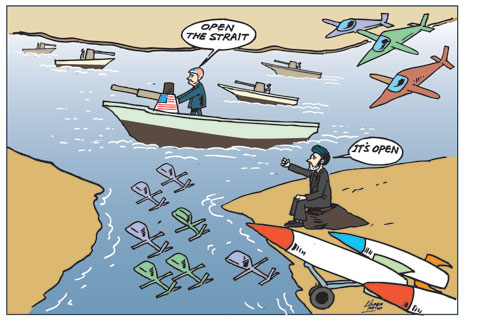
“In the severe scenario—where the energy supply shock is even larger and lasting well into 2027 before fading—the adverse growth impact would naturally be even larger, with growth in the major economies with a cumulative output loss of about 2 percentage points by 2027 relative to the reference scenario. Headline inflation would be 2.3 percentage points higher in 2027. The impact would again be larger in more energy-exposed economies in the region. In general, this would disproportionately hurt economies that rely on imported energy, have limited fiscal space, or are highly exposed to the Middle East conflict through remittances, tourism, or commodities such as fertilisers. This is especially relevant in parts of South and Southeast Asia and Pacific Island countries. Sri Lanka, for example, depends on imported oil as well as remittances and tourism transiting from the Gulf,” Mr Srinivasan said.
Govt comes in for praise
Meanwhile, the two-week ceasefire between the US and Iran paved the way for the repatriations of 238 Iranian sailors who were stranded in the country due to war in West Asia. These included the 32 sailors rescued from the Iranian frigate IRIS Dena, which sank after being fired upon by a torpedo from a US submarine on March 4, as well as 206 sailors who were on board the IRIS Bushehr, which was assisted by the Sri Lanka Navy as the ship developed a technical fault. All the sailors left on a chartered Turkish Airlines flight from Colombo, government sources said. Fifteen Iranian sailors will remain in the country with the IRIS Bushenr as the vessel remains docked in Trincomalee for now.
The conclusion of this testing saga for the government is certainly a diplomatic success for the country which has been caught up in the middle of a war in which it has had no role in. The fact that the government managed to balance Sri Lanka’s relations between Iran and the USA must be lauded given the sensitive nature of the crisis and how Sri Lanka could have easily got drawn into the middle of two warring sides and a widening conflict in the region.
Sri Lanka was among the many countries that welcomed the announcement of a temporary ceasefire in West Asia on April 8.
“While recognising this development as a significant step towards de-escalating tensions in the region and alleviating profound human suffering, we strongly encourage all stakeholders to seize this opportunity to work towards a permanent and durable solution through an inclusive peace process, which ensures long-term stability and security for all peoples in the region,” the Ministry of Foreign Affairs said in a statement.
Sri Lanka also appreciated the role of all parties whose diplomatic efforts and resolve have been instrumental in facilitating this significant development of establishing dialogue.

ஒத்தவை:
சென்ற வாரம் இலங்கை-சண்டே ரைம்ஸ்