Blow hot, blow cold: Lanka-India ties face reality test
India’s envoy presses for upgrade of FTA, saying every year of delay is a year of opportunity lost
- New Delhi pushing for progress in Land connectivity and energy hub matters
- Govt. source says Lanka will take decisions with national interest in mind
- Easter probe tainted by politics; Church faces criticism over Shani, Ravi appointments
- HRC probes degrading treatment of Sallay; govt. says refusal to share password makes him complicit
By our(ST) Political Desk-21-06-2026
When the National People’s Power (NPP) government came into office just over 18 months ago, the initial assumption was that the new administration’s foreign policy would pivot more towards China given the longstanding ties that the NPP’s main party, the Janatha Vimukthi Peramuna (JVP), had with the Chinese Communist Party (CCP). While Sri Lanka-China ties have remained strong under the NPP, it is with India that the administration of President Anura Kumara Dissanayake has built a stronger rapport.
That India was keen to build a strong relationship with the NPP leadership was evident even before the September 2024 presidential election, when, in February of that year, the Narendra Modi government took the unusual step of inviting an NPP delegation led by then presidential candidate Anura Kumara Dissanayake to India for an official visit. The visit did much to raise the international standing of both Mr Dissanayake and the JVP-led NPP.
Since President Dissanayake came to power, there has been a flurry of diplomatic activity between the two countries aimed at strengthening ties. As has been the usual practice among newly elected Sri Lankan leaders, President Dissanayake’s first overseas state visit was to India in December 2024. He met Prime Minister Modi and senior Indian officials. Premier Modi reciprocated by undertaking a state visit to Sri Lanka in April 2025. Prime Minister Harini Amarasuriya undertook an official visit to India in October 2025 – her first such overseas visit since assuming duties as PM. President Dissanayake visited India again in February this year to participate in the AI Impact Summit in New Delhi, while Indian Vice President C.P. Radhakrishnan undertook an official visit to Sri Lanka in April. In between, there have been many other official visits between various delegations of politicians and officials between the two countries.
India has also taken pains to cultivate stronger ties with the JVP itself, keenly aware of the influence senior members of the party have on the NPP government. In February this year, the Indian Council for Cultural Relations hosted a delegation led by JVP General Secretary Tilvin Silva. It was Mr Silva’s first ever visit to India. Among those the JVP delegation met were External Affairs Minister Subrahmanyam Jaishankar and Deputy National Security Advisor Pavan Kapoor.
Mr Silva is the senior-most JVP leader after President Dissanayake and was also active in the movement during its failed second insurrection in 1987-89 amid the signing of the Indo-Lanka Accord. Given the JVP’s long-held suspicions regarding India, the visit of such a senior party leader served as a major turning point in relations between India and the JVP. In an interview with the Sunday Times political column at the conclusion of his visit, Mr Silva insisted his party was “never against India” but was forced to act against the Indian government of the time under Rajiv Gandhi and the J.R. Jayewardene government in Sri Lanka and the political policies they followed. “Hence, we opposed both the governments of Rajiv Gandhi and J. R. Jayewardene. It happened in light of the Indo-Lanka Accord, which we say even today is something that shouldn’t have happened,” Mr Silva told the Sunday Times at the time. “That’s a history from 38 years ago, and now the world has changed. India has changed, and we have changed also. We don’t have to make the past an obstacle to future relations,” Mr Silva added.
Amid attempts to woo members of the senior JVP leadership, there has also been a serious uptick in various ‘capacity-building programmes’ that India has organised for different sectors. These include a programme to train 1500 Sri Lankan civil servants over a period of five years. A Memorandum of Understanding (MoU) in this regard was signed between India’s National Centre for Good Governance (NCGG) and the Sri Lanka Institute of Development Administration (SLIDA) during President Dissanayake’s state visit to India in December 2024. The 10th capacity-building programme for civil servants under this MoU was concluded earlier this month, when a batch of 39 officers successfully completed a programme under “Disaster Management” at the NCGG. This was the third such specialised disaster management programme, requested by SLIDA. Officers were provided with two weeks of intensive, interactive training. The curriculum covered topics such as disaster management planning and policy, risk assessment, preparedness and mitigation strategies, response mechanisms, early warning systems, disaster risk governance, urban and local resilience, climate change adaptation, biodiversity conservation, and the implementation of the Sendai Framework for Disaster Risk Reduction, according to the Indian High Commission. With the conclusion of this latest programme, 400 officers have so far been trained, to date, under the MoU, said the Indian High Commission.
Additionally, during his visit to Sri Lanka in April last year, Indian Premier Narendra Modi committed to offering 700 customised training slots annually for Sri Lankan professionals, enhancing India’s capacity-building endeavour to cover 1000 Sri Lankans each year. Those who have since taken part in capacity-building programmes undertaken as part of the PM’s commitment include judicial officers, officers from the National Audit Office, local government representatives, health professionals, cooperative professionals from the dairy industry, officers from the Central Bank, the Ceylon Electricity Board, professionals from the software industry and aquaculturists.
Disaster preparedness and response is also one area where the Sri Lankan government has been eying closer cooperation with India, particularly in the aftermath of Cyclone Ditwah. Indian External Affairs Minister Jaishankar, who visited Sri Lanka in December last year in the aftermath of the cyclone as Premier Modi’s special envoy, announced a USD 450 million package to assist rehabilitation and reconstruction post-Ditwah. The package is structured along five pillars: physical connectivity infrastructure; health and education; housing and water; agriculture; and disaster preparedness and response.
In line with cooperation in this area, India is set to assist Sri Lanka to set up a disaster early warning and response system covering the entire country, with the Disaster Management Centre (DMC) as the focal point. Under the proposed system, in the event of a natural disaster, emergency alerts and warnings can be sent directly to mobile phones in areas likely to be affected. The system will be designed to enable such alerts to be sent to mobile phones even when users do not have an active internet or mobile data connection.
India-Lanka FTA
As Indian influence within the NPP government has grown, however, the Modi government has grown more assertive in pushing Sri Lanka on certain matters whose slow progress has frustrated New Delhi. Main among these issues is trade and the failure to upgrade the Free Trade Agreement (FTA) between the two countries. Indian High Commissioner to Sri Lanka Santosh Jha alluded to the matter during his speech at the Global Innovation & Leadership in Colombo last month. High Commissioner Jha observed that the India-Sri Lanka FTA has been in place since 2000. “It was the first FTA for both of us. And it is widely acknowledged that the FTA has delivered on its promise of benefiting Sri Lanka more. More than 65% of Sri Lankan exports use FTA benefits, whereas only 5% of Indian exports use the same. For more than a decade, Sri Lanka has enjoyed a trade surplus with India if we calculate only the FTA-enabled trade. The trajectory of Sri Lankan exports to India is growing steadily. India is now the second largest export market for Sri Lanka, demonstrating how an FTA can enable an economy of 22 million people to effectively leverage an economy of 1.4 billion people!” he claimed.
However, there is a need to upgrade the FTA into a modern framework that delivers the full potential of the bilateral economic partnership, the High Commissioner added. “We have spent too long talking about it; sometimes renaming it; but not actually moving with purpose and required political will to forge a new framework. I say this not to assign blame but to note that every year of delay is a year of opportunity lost. Think of it: in the last 6 years, India has signed nine FTAs covering trade with 38 countries!”
He urged Sri Lanka to work on updating and expanding the FTA, “not over an extended horizon of time, but now. The economic logic is overwhelming,” he insisted.
While the High Commissioner has stressed that he is not assigning blame for delays in upgrading the FTA, the comments reflect clear frustration felt by New Delhi over the negotiations on the subject being in limbo as a Cabinet-appointed committee evaluates ongoing FTAs and explores potential new ones. The report of that committee is supposed to be handed over this month, though it is unclear if this will be delayed.
India has also advocated land connectivity between India and Sri Lanka, while insisting it was Sri Lanka that proposed it first. High Commissioner Jha, during the same speech, described the absence of any connectivity between Rameswaram and Talaimannar – the two closest points between the two countries (where the distance is about 30 km) – as “an anomaly”. A fixed link between India and Sri Lanka would transform the economic geography of this entire region, he claimed, adding that the time for wavering is over. Despite the High Commissioner’s blunt tone, there is very little likelihood of the Dissanayake government signing off on any land connectivity between the two countries, at least for now.
One area where progress has been made, though, is over the Trincomalee Energy Hub Project. A trilateral agreement between Sri Lanka, India and the United Arab Emirates (UAE), aimed at developing Trincomalee into a strategic energy hub, was signed in April 2025. Amid the fuel crisis caused by the war in West Asia, the NPP government is looking at developing the project as a permanent solution to any fuel shocks. Development of the World War II-era oil tank farm, bunkering facilities and the potential for an oil pipeline are being looked at as part of the project.
A senior government source, however, said the government has no intention to pursue any move that would compromise the country’s energy security. He was speaking in answer to a query on the potential for the construction of an oil pipeline to supply oil from India to Sri Lanka. The Trincomalee Energy Hub Project is proceeding with a mutually advantageous business model, the government source noted. As for the idea of a pipeline, the Sri Lankan government insists that a feasibility study must be conducted on any proposed pipeline. “We have already conveyed this to India. We are not obligated to accept an oil pipeline just because India wants us to have one.”
Indian officials have pointed out that such pipelines have allowed countries such as Bangladesh and Nepal to obtain fuel directly from India. The government source, though, pointed out that such pipelines have made these countries overly dependent on India for their fuel needs. He also pointed out that India too was compelled to increase fuel prices following the war in West Asia. He noted that while Sri Lanka did have to buy fuel at high prices, the government still managed to control the situation and ensure there were no fuel queues by reverting to the QR fuel distribution system. “Before lecturing us on what is best for our energy security, India should sort out its own problems,” the source insisted, adding that decisions on the Trincomlaee Energy Hub Project will be made with Sri Lanka’s national interests in mind.
Meanwhile, a second government source with knowledge of the ongoing review of FTAs said that the decisions on FTAs will be made according to the recommendations of the committee now reviewing them. This includes FTAs with countries such as India, Thailand and Singapore. “Before moving to new FTAs, we need to see what are the advantages and disadvantages of previous FTAs. Many existing FTAs are outdated and we need to upgrade them to meet the present geopolitical situations and digital advancements,” the government source stressed, clarifying that aspects of some FTAs have been rendered useless as time has gone on. Both the Ministry of Trade and the Ministry of Finance are carrying out assessments of the existing FTAs and those that have been proposed to be signed, he also revealed.
Sri Lanka is also keen on joining the Regional Comprehensive Economic Partnership (RCEP) – the world’s largest FTA. It includes the 10 ASEAN countries, Australia, China, Japan, New Zealand, and South Korea. India, though, walked away from negotiations on the RCEP, claiming it was not in its national interest. Analysts noted that the Modi government feared India could be flooded by cheap goods from China and elsewhere if it signed onto the agreement, threatening its own industries. While India might prefer countries such as Sri Lanka to also stay out of RCEP, the source said Sri Lanka would enter agreements that benefit Sri Lanka, rather than anyone else.
One such agreement that Sri Lanka is keen on is the Japan-backed trilateral corridor between Japan, India and Sri Lanka. The proposed industrial corridor is envisaged to attract Japanese investors to Sri Lanka to manufacture industrial products in Sri Lanka which will then be exported to India and eventually beyond India as well. Discussions on this framework are currently ongoing.
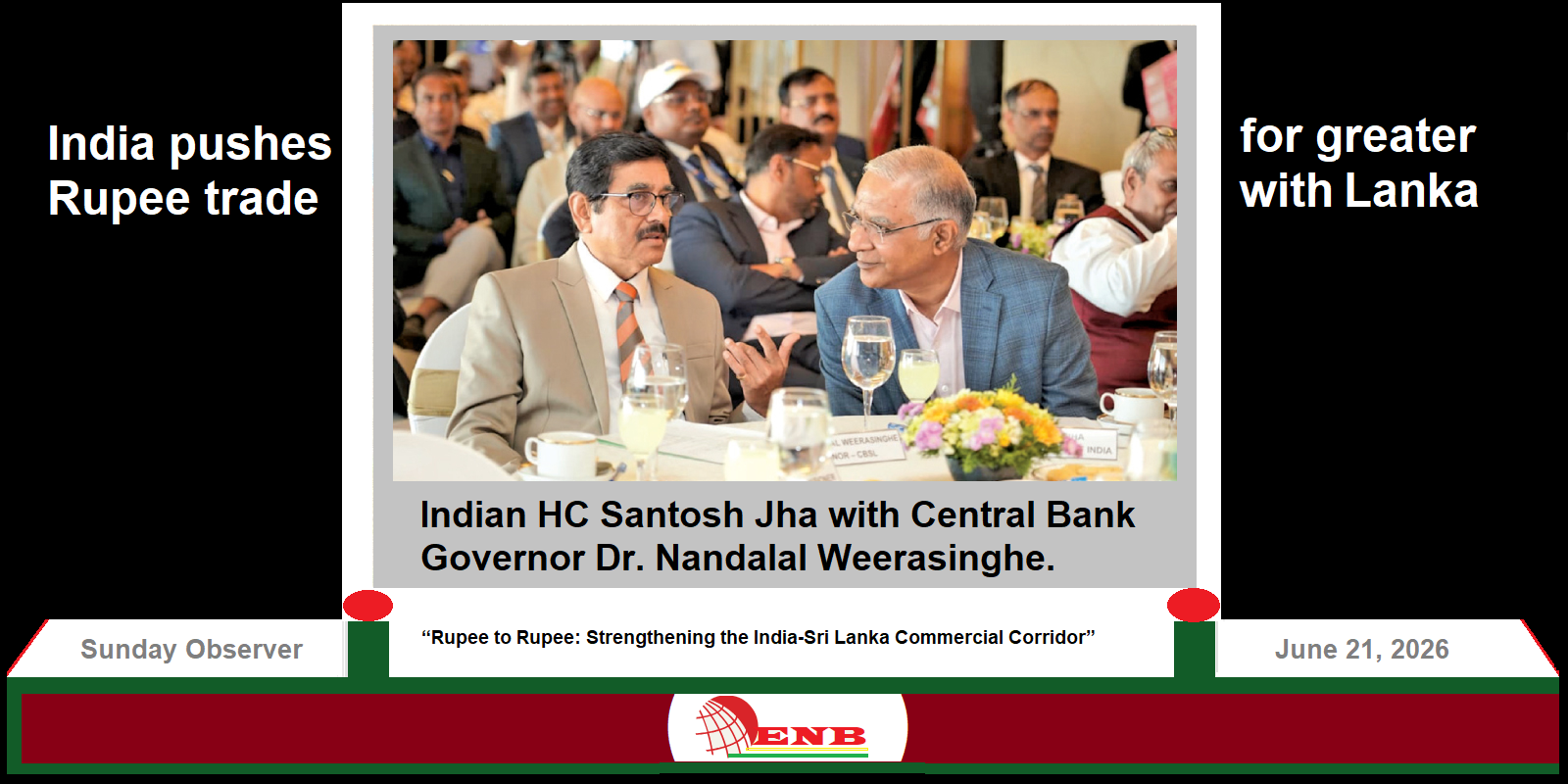
This week, the Indian High Commission also organised a roundtable discussion titled “Rupee to Rupee: Strengthening the India-Sri Lanka Commercial Corridor”, where key opening remarks were delivered by Central Bank of Sri Lanka (CBSL) Governor Nandalal Weerasinghe. India has also been pushing to strengthen INR-LKR transactions.
Easter attack politics
Meanwhile, the finger-pointing relating to the Easter Sunday terrorist attacks continued this week amidst reports of the possible arrest of former President Gotabaya Rajapaksa and heightened concerns regarding the health of the former head of the State Intelligence Service (SIS), Major General (retd) Suresh Sally. The growing public debate by all sides seems intended at winning in the court of public opinion given the high stakes attached to the case for both those on the government side as well as those who are opposed to the manner in which the Criminal Investigation Department (CID) has been handling the case since the NPP came to power. The ruling party, the CID and the Catholic Church are aligned in the belief that there was a conspiracy linked to the Rajapaksa family which led to the attacks, while those on the other side accuse these parties of being driven by a vendetta against the Rajapaksa family and others who were once closely allied to them, including Suresh Sallay. Both sides say they want the ‘truth’ to come out, but each is seeking their own ‘truth’, and what has happened in the frenzy is the loss of objectivity and a growing chasm in society which could escalate into a dangerous situation in the future.
The credentials of the Director of the CID, Senior Superintendent of Police (SSP) Shani Abeysekera, and the Secretary to the Ministry of Public Security, retired Deputy Inspector General of Police Ravi Seneviratne – both retired police officers brought into office after the NPP took office – have not helped the case. The NPP is not the only party to bring back retired police or public officials who are loyal to it, as this has been a practice under almost all previous governments, but given the high profile and sensitive nature of the Easter Sunday attacks investigation, the two men being in such crucial positions has led to questions being raised about their impartiality, particularly of the CID Director, who has personal scores to settle given the unfair treatment meted out to him under the Gotabaya Rajapaksa administration.
It is well known that one of the main proponents of the conspiracy theory relating to the terrorist attacks of 2019 was Shani Abeysekera, whose views heavily influenced Colombo’s Archbishop Malcolm Cardinal Ranjith on the matter and many others. On top of that, both Mr Abeysekera and Mr Seneviartne worked for the victory of the NPP at both the 2024 presidential and general elections and were seen on their election platforms. Their influence no doubt led presidential candidate Anura Kumara Dissanayake to make the Easter Sunday attacks investigation a mainstay of his campaign with promises to get to the ‘truth’ once elected, which he, along with his two trusted lieutenants (the CID director and the public security ministry secretary), is now hard pressed to do. Which is why the whole direction in which the investigation is now heading is heavily politicised and has in turn given voice to extreme voices on all sides which are being amplified amidst the politicisation of the investigation process.
This week, the Catholic Church had to once again publicly reject claims that it was at the request of the Church that the NPP government appointed Shani Abeysekara to the post of CID Director and Ravi Seneviratne as Secretary to the Public Security Ministry.
Addressing the media, the Catholic Church’s spokesman Rev. Fr Cyril Gamini Fernando said neither the Church nor Cardinal Ranjith had ever asked for any particular individual to be appointed to a post.
The controversy over the church’s involvement in government appointments came about as a result of a passing comment made by House Leader and Minister Bimal Rathnayake in Parliament some months ago, where he said the two appointments were made at the request of the church.
Fr Gamini Fernando said what the Church had called for was the reinstatement of the investigating team that handled the Easter Sunday attacks probe from its inception during the Yahapalanaya administration. He said after Gotabaya Rajapaksa became president, the original investigation team was removed from the CID, including Shani Abeysekara, and hence the Church called for their reinstatement.
Attention also continues to be on the former Head of the SIS, Suresh Sallay, whose family members continue to raise their voices against the alleged degrading and inhumane treatment that was meted out to him while he was being held at the CID headquarters under a detention order issued by the President. He has remained warded at the National Hospital, Colombo, for the past ten days after he began a hunger strike but continues to refuse food and hence is being nasally fed, according to family members.
This week members of the Human Rights Commission of Sri Lanka visited the CID to inspect the cell he was being held in following a complaint by Mr Sallay’s family members. The Sunday Times learns that HRCSL will hold a formal inquiry into the matter following the visit. It has also sought video footage of the interrogation of Mr Sallay as part of the inquiry.
While the Sallay saga plays out in the public domain, a senior government source said it is clear that the former SIS chief is attempting to avoid cooperating with the CID in its investigations. “If he is a law-abiding citizen, he should cooperate with the CID and give them access to his laptop and mobile phone. By refusing to do so, he is showing he is complicit in a conspiracy and wants to hide the facts. If he is innocent, he can prove it without resorting to hunger strikes,” the source said.
He added that the investigating team will pursue other leads in the investigation as well, adding that there is a clear link between Mr Sallay’s decision to refuse food and Gotabaya Rajapaksa seeking court intervention to prevent his arrest.
Adding voice to the growing debate on the matter was the United National Party (UNP), which issued a statement on Thursday requesting the government to seek assistance from the U.S. authorities into the investigation as was done immediately after the attacks took place on April 21, 2019.
In a statement, the UNP said that following the attacks, the then Prime Minister, Ranil Wickremesinghe, requested a full investigation and a report by the U.S. government into the attack, as the Sri Lankan investigative agencies did not have adequate expertise, and assured the full cooperation of the Sri Lankan authorities. Subsequently, on April 22, during a phone call between the then prime minister and U.S. President Donald Trump, a similar request was made.
“The FBI carried out a full investigation into the attacks in collaboration with the Sri Lankan authorities, including the CID, Military Intelligence and State Intelligence Services. On the basis of all the information recorded and the material collected, a report was issued by the FBI to the Sri Lankan government. This was accepted by all the relevant authorities in Sri Lanka. On Nov. 12, 2020, FBI Special Agent Merrilee R. Godwin filed a 71-page affidavit in the U.S. District Court for the Central District of California. Following a two-year investigation, a criminal case was filed on Dec. 11, 2020, in the U.S. District Court in Los Angeles. The defendants named in the complaint (Mohamed Naufar, Mohamed Anwar Mohamed Riskan and Ahamed Milhan Hayathu Moahmed), along with other suspects linked to the attacks, were already detained in Sri Lanka at the time of filing the case,” the UNP statement said.
It added that the entire material pertaining to the U.S. investigation is available with the FBI and questioned if the government has made an application to the U.S. government for this material and, if so, what has been the reply. “If not, why has the government not done so? This material must be made available to the judicial authorities in Sri Lanka,” the statement said.
Meanwhile, with reports of the imminent arrest of Gotabaya Rajapaksa for his alleged role in a conspiracy relating to the attacks, the former president filed a petition before the Court of Appeal seeking an order preventing his arrest in connection with ongoing investigations into the Easter Sunday terrorist attacks. The case was taken up on Friday before a bench comprising Court of Appeal President Judge Rohantha Abeysuriya and Judge Priyantha Fernando and was deferred for further consideration until June 24. Hence, all attention will be focused on the case in the coming week with the fate of the former president resting with the judiciary for now.
Gotabaya Rajapaksa is not the only one in the family who is facing the weight of the law. Yoshitha Rajapaksa, who has already been indicted in a financial fraud case, was arrested by the Commission to Investigate Allegations of Bribery or Corruption (CIABOC) over an investigation related to his enrolment into the Sri Lanka Navy and the British Royal Naval Academy. He was later released on bail after being produced in court.
This case has also landed former Navy Commander Admiral of the Fleet Wasantha Karannagoda in trouble. He had allegedly conspired with Yoshitha Rajapaksa to cause a loss of Rs. 62,814,216 by enabling him to attend the training programme despite not being eligible for the overseas training programme, according to the CIABOC.
Meanwhile, the CIABOC on Friday filed indictments before the Colombo High Court against former State Minister Shasheendra Rajapaksa and two other defendants over corruption charges relating to several properties unlawfully constructed on land belonging to the Mahaweli Authority of Sri Lanka in the Sevanagala-Kiriibban Wewa area.
------------------------
ENB transmit analysts' perspectives. The publication of contributed articles does not necessarily imply approval of the authors', agent's viewpoints.

ஒத்தவை:
சென்ற வாரம் இலங்கை-சண்டே ரைம்ஸ்