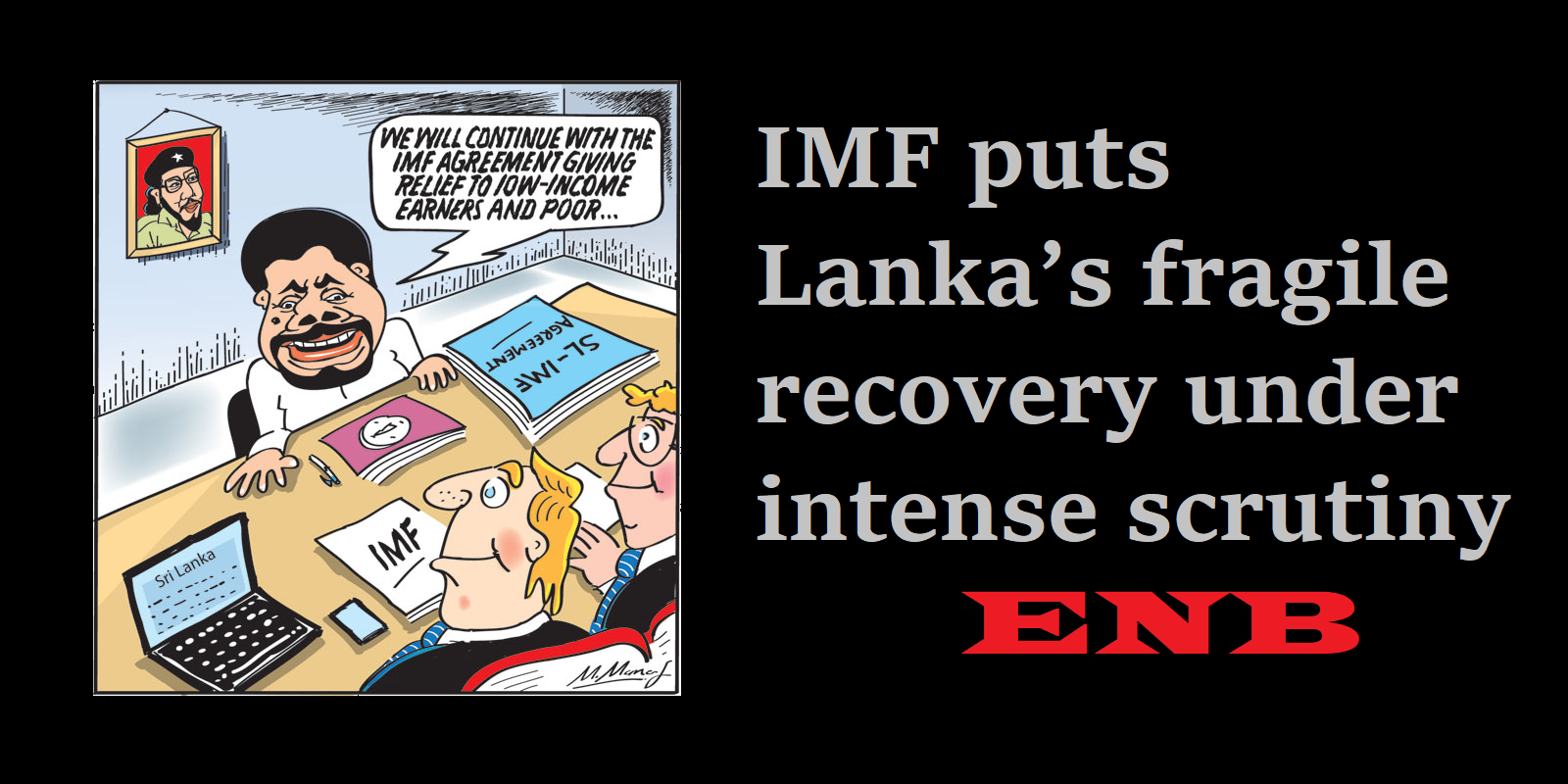
IMF puts Lanka’s fragile recovery under intense scrutiny
By Bandula Sirimanna ST 13-09-26
Sri Lanka’s economic resurrection enters a critical diagnostic phase as an International Monetary Fund (IMF) delegation, headed by Mission Chief Evan Papageorgiou, has commenced a two-week deployment in Colombo to steer the nation through the high-stakes Seventh Review of its three-billion-dollar Extended Fund Facility (EFF).
This mission unfolds against a backdrop of resilient but complex recovery, following the IMF Executive Board’s recent completion of the combined Fifth and Sixth Reviews that injected nearly $695 million into the state coffers. With total disbursements now scaling past $2.4 billion, the current status of the programme reflects deep structural engagement, but this visit serves as an uncompromising health check.
The delegation is tasked with scrutinising the fine margins of Sri Lanka’s macroeconomic trajectory, balancing a remarkable surge in state revenue and foreign-exchange reserves against recent performance deviations, IMF sources revealed.
These deviations, which include a temporary breach in external payment protocols triggered by a severe cybercrime incident and the enactment of restrictive import measures, must be reconciled alongside a domestic economy grappling with a sudden inflation spike to 5.5 per cent, a defensive one-hundred-basis-point interest rate hike, and the compounding fiscal strains of global geopolitical friction and natural disasters.
While authorities successfully executed prior actions by enforcing strict cost-recovery pricing for fuel and electricity, the broader implementation of structural milestones has faced minor delays due to institutional capacity constraints.
Nevertheless, the government has managed to preserve social stability by rolling out targetted budget reliefs to insulate vulnerable populations, all while maintaining a firm legislative commitment to achieve a primary budget surplus of 2.3 per cent of gross domestic product by 2027, an official of the Finance Ministry told the Sunday Times Business.
Looking beyond the horizon of March 2027, which marks the official conclusion of the current 48–month EFF, Sri Lanka will confront a definitive architectural shift in its relationship with global capital markets and international lenders. The post-programme next steps will necessitate the rapid institutionalisation of a monitoring framework, ensuring that the hard-won fiscal discipline, central bank autonomy, and anti-corruption governance frameworks do not erode once direct IMF oversight relax. Authorities will need to leverage the stability gained under the facility to aggressively transition from emergency stabilisation to sustained, export-led economic growth, fully operationalizing external commercial debt restructuring agreements and re-establishing sovereign creditworthiness.
The ultimate objective after March 2027 will be to successfully transition Sri Lanka into a standard Article IV surveillance cycle, proving to global investors that the nation can independently sustain a stable, market-driven economy without the crutch of emergency multilateral lending, officials said.

ஒத்தவை:

சென்ற வாரம் இலங்கை-சண்டே ரைம்ஸ்