What is this New Educational Reform all about?
By Ceylon Today -July 23, 2025 By Sandaruwan Yatikinda
The new educational reform, planned to be implemented in 2026, has already sparked widespread public attention and open debate.
Reform is nothing new to Sri Lanka. Even in the times of Mahindagamanaya, various reforms have occurred in every sector in differing degrees. The field of education, too, has witnessed a range of reforms, especially during the times of Portuguese, Dutch, and British colonial rule. It is clear, upon examination, that most of these reforms were primarily aimed at spreading religion rather than advancing the nation or its people.
The most significant reform in Sri Lankan education history was initiated by C. W. W. Kannangara, who served as Minister of Education. His reforms brought a revolutionary change to the education sector, most notably through the introduction of free education, which opened the doors of learning to thousands of children across the country.
Subsequently, various governments attempted educational reforms through different education ministers. While some of these reforms helped to uplift the education system, others had to be withdrawn due to pressure from society.
So far, most educational reforms have focused merely on curriculum changes. Neglecting or not paying adequate attention to other sectors in education has been a major reason for the failure of many such reforms.
With the new government into power, the previously separate ministries of Education, Higher Education, and Vocational Education were consolidated under one Ministry and entrusted to the current Prime Minister, Dr. Harini Amarasuriya.
Education experts have also acknowledged that the new educational reforms scheduled to be implemented in 2026, aims to produce socially responsible and economically productive students through practical strategies.
The new educational reform is a significant transformation rather than a mere curriculum update. This reform targets the overall transformation of the education system through five key pillars, ensuring that every child who leaves school receives a quality education and a clear sense of direction for the future and enabling opportunities for students to enter the world of work or pursue higher education.
Accordingly, the overall educational reforms will be based on the five key pillars of:
- Curriculum reform aligned with modern society and the job market.
- Human resource development tailored to the new curriculum and a technology-driven world.
- Infrastructure development to ensure a quality, attractive school system, along with administrative restructuring for efficiency.
- A new assessment and evaluation approach that replaces exam-centric pressure with personalised attention based on modern teaching methods.
- Awareness and dialogue campaigns for parents and stakeholders to better understand and support the reforms.
Special attention is also given to early childhood development, with the goal of laying a lifelong learning foundation under the new educational reforms.
School education will operate across four main stages and in the primary stage from Grades One to Five, the focus is on developing essential life skills necessary to support educational growth of the child. Quality education will be ensured for all children across the country, eventually phasing out the competitive scholarship examination from the school education system under the new reform.
School education is planned to implement mainly through three stages considering Grade One, Grade Two, Grade Three and Four. Plans are in place to ensure correct use of the mother tongue, practical training in English and second language, enhancement of mathematical ability, fostering understanding and practice of religious and social values, introducing the basics of modern science, aesthetic education, health and physical education, and subject-related activities within a psychologically safe and stress-free learning environment. The second stage is the Junior Secondary Section, covering Grades Six to Nine. During this stage, children are prepared for their future.
At this stage, the child will have the opportunity to learn the core curriculum, and a subject has also been included to provide students with a basic understanding of entrepreneurship and financial literacy. Opportunities are provided for students to engage in sports, social, and extracurricular activities and follow the respective subjects under the assessment process. Students are required to earn 30 credits from core subjects, 3 credits from elective subjects, and 2 credits from subjects related to career development making a total of 35 credits that each student must achieve. In Grade 9, a special skills-based assessment will be conducted and this provides an opportunity to identify students’ skill levels and to understand their potential future career paths.
Based on this assessment and the students’ interests, they are granted an opportunity to select subjects for Grades 10 and 11, where the total number of subjects studied is seven including the mandatory and elective subjects all together. Students can select subjects from at least three out of the four major streams of the followings based on the skill assessment. The subject stream is as follows:
- STEM (Science, Technology, Engineering, Mathematics)
- Humanities and Social Sciences
- Management and Entrepreneurship
- Vocational Skills
At this stage, students can select a total of seven subjects, comprising four subjects from the main academic stream and three subjects from other streams. When selecting subjects, it is mandatory for every student to select History, Aesthetics, and at least one vocational subject. A key feature of this system is the introduction of the GPA (Grade Point Average) method for assessment and evaluation, replacing the traditional competitive examination system. Another important aspect is that students will be given the opportunity to engage in field-based learning aligned with their intended future careers, allowing them to gain hands-on experience and a better understanding of their prospective career paths. All students who complete their school education will receive the NVQ Level 4 National Vocational Qualification Certificate, which provides them with the opportunity to easily enter the workforce after school. At the same time, all students will also have the opportunity to pursue a university degree. A key feature of the new educational reforms is that students will be able to continue their degree studies while being employed, if they so wish.
Providing children with the proper benefits through the new educational reforms is not only the responsibility and duty of those involved in the education sector, but of all of us. To achieve this, the Ministry of Education, as well as all sectors within the education system, must work in close coordination, while support and commitment must be effectively ensured at the provincial, zonal, and divisional levels. For the new reforms to become a reality, the active contribution of principals and teachers, who work closely with students, is of great importance. Moreover, timely reform of our education system is a national necessity. In doing so, everyone must commit to working for the future generations, setting aside divisions of ethnicity, religion, and politics. It must be emphasised once again that if the 2026 education reform is not to become just another reform, the support, blessings, and commitment of the entire nation must be extended on behalf of the children of our country.
Education, Reform, and the Battle for the Classroom.
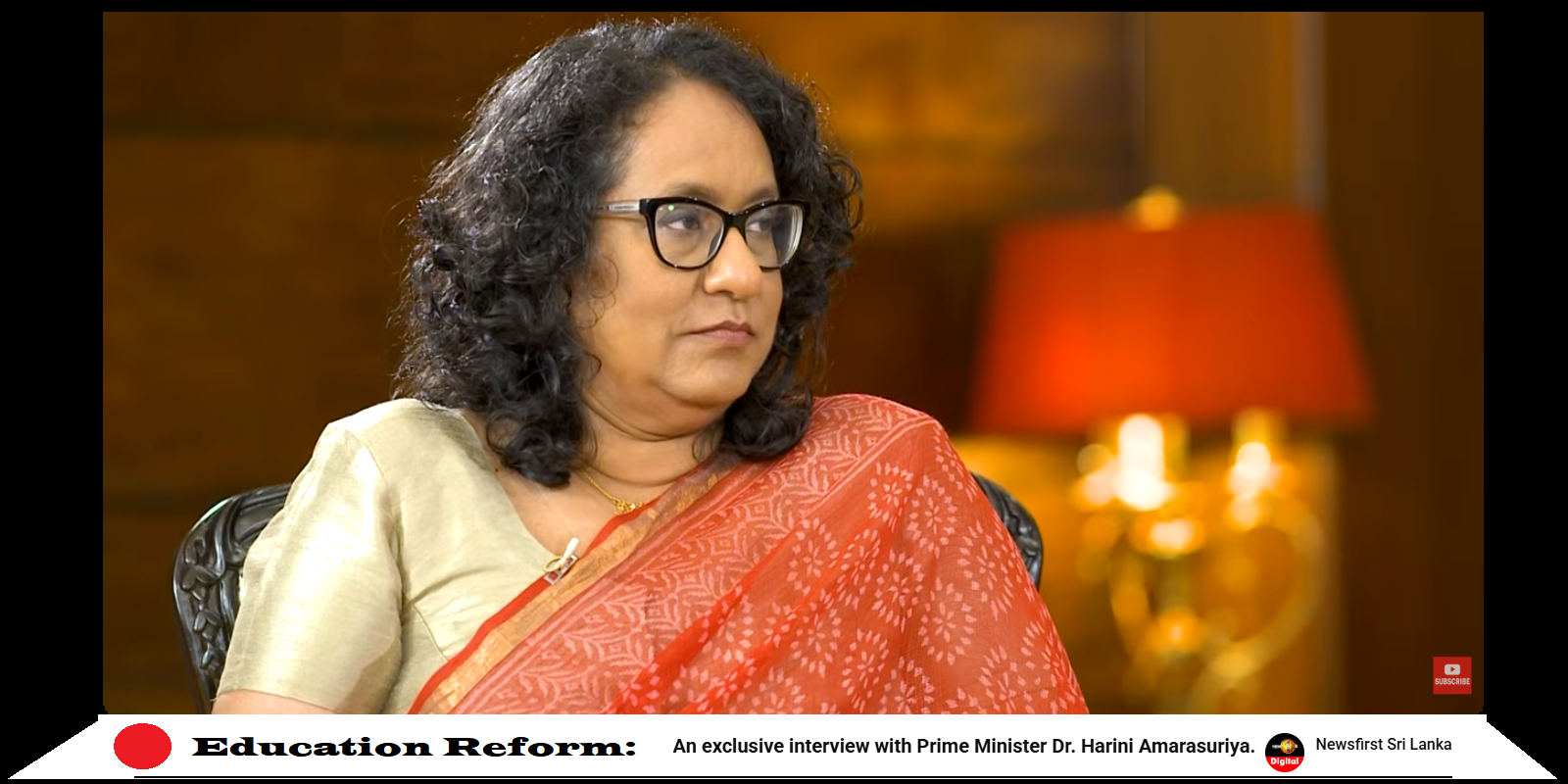
An exclusive interview with Prime Minister Dr. Harini Amarasuriya.

ஒத்தவை:

சென்ற வாரம் இலங்கை-சண்டே ரைம்ஸ்