India’s reach within NPP govt. expands amid growing diplomatic niceties
- Icing on the cake was high-level visit by JVP Gen. Sec. Tilvin Silva; top judicial officers and public servants also joined programmes in India
- As NPP leaders’ anti-Buddhist remarks spark concern, calls to protect Buddhists’ rights gain traction in political discourse, including within SJB
- Repeal of MPs’ pensions draws appeals from former MPs; for the Govt, it’s a case of ‘Promises Made, Promises Kept.’ Wijepala says broke MPs can apply for ‘Aswesuma’
By our ST Political Desk Sunday, February 15, 2026
The recent visit by a Janatha Vimukthi Peramuna (JVP) delegation led by the party’s General Secretary, Tilvin Silva, to India was described by the Indian High Commission in Colombo as “part of India’s constant engagement with political leaders across party lines in Sri Lanka”, a growing trend of increasing engagement with all sectors by India since the JVP-led National People’s Power (NPP) took office in September 2024.
That India was eager to engage or ‘capture’ the JVP leadership to its side was evident even before Anura Kumara Dissanayake was elected president when the Indian government took the unusual step of inviting the then-to-be presidential candidate to India in February 2024, giving a major boost to his and his party’s international image, indicating India’s imprimatur for a party that has for decades demonised India as Sri Lanka’s biggest nemesis.
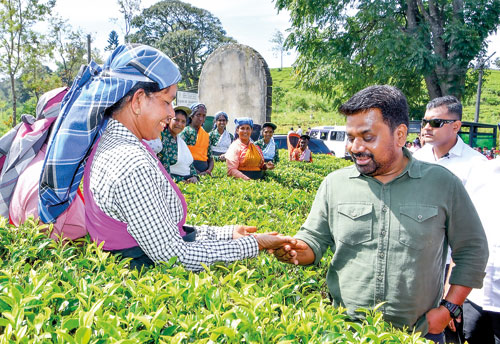
President Dissanayake engages in a lively discussion with a tea plucker during a stop at a tea estate en route to Nuwara Eliya on Wednesday
The 2024 visit by the JVP delegation included meetings with senior Indian officials, including External Affairs Minister S. Jaishankar and National Security Adviser Ajit Doval. It signalled that India had marked out Mr Dissanayake as the country’s possible future president with an NPP majority government. The hospitality paid off when he was elected president in September 2024, followed by a landslide parliamentary election victory for the JVP-led NPP in November that year. What followed shortly was the newly elected president’s state visit to India in December 2024, the first after being elected president and the usual first stop for all Lankan leaders after assuming office. There, he met with Indian Prime Minister Narendra Modi and senior Indian officials. The Indian Prime Minister did not take long to reciprocate the visit and undertook a state visit to Sri Lanka in April 2025. A photograph of Modi with his arms well around Dissanayake spoke a thousand words.
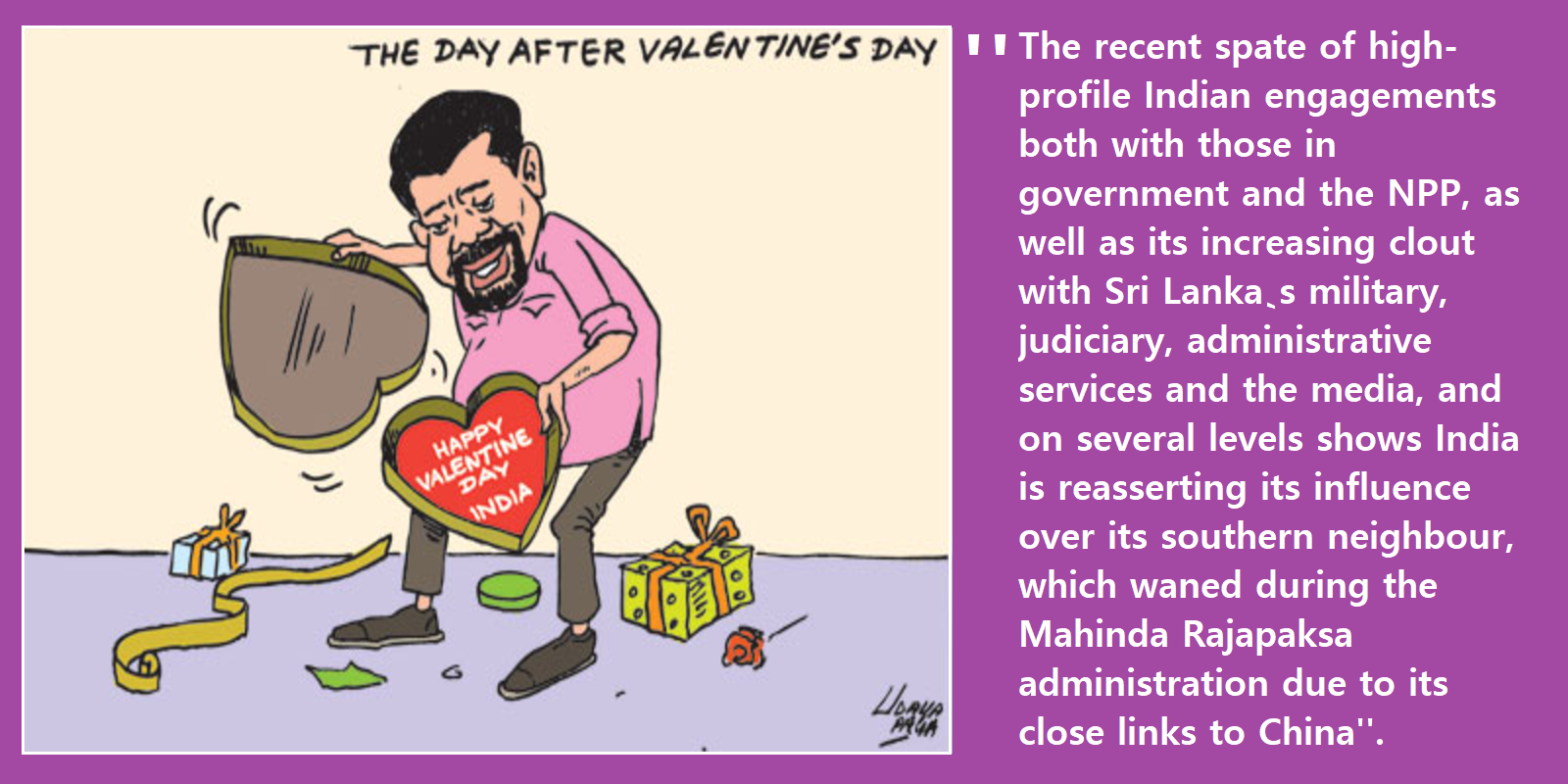
A JVP-led coalition, the NPP cosying up to India in this manner initially surprised many given its once upon a time strong anti-Indian stance, left leanings and its close ties with China, particularly the JVP’s links with the Chinese Communist Party (CCP), but the recent spate of high-profile Indian engagements both with those in government and the NPP, as well as its increasing clout with Sri Lanka’s military, judiciary, administrative services and the media, and on several levels shows India is reasserting its influence over its southern neighbour, which waned during the Mahinda Rajapaksa administration due to its close links to China.
The high-profile engagements in the past 14 months have included several delegations from the Sri Lanka judiciary visiting India. These included the 10-member Supreme Court delegation headed by Chief Justice Preethi Padman Surasena visiting India last December, followed by a delegation of 20 High Court Judges undertaking a “knowledge exchange and capacity-building programme “ in January last year, as well as a group of 30 District Court Judges visiting India also on a “capacity-building programme”. The two latter programmes were organised by the India National Judicial Academy in Bhopal, with the District Judges programme being undertaken at the request of the Supreme Court of Sri Lanka and the Sri Lanka Judges’ Institute.
There has also been high-level engagement with collaboration in personnel administration and governance under a Memorandum of Understanding (MoU) between the Sri Lanka Institute of Development Administration (SLIDA) and the National Centre for Good Governance (NCGG) of India with a view to conducting Capacity Building Programmes (CBP) for senior and mid-level civil servants of Sri Lanka. The training programme is part of a larger commitment under the MoU signed during the state visit of President Dissanayake to India in December 2024. About 1500 Sri Lankan civil servants are to receive training over a period of five years under this programme.
These have so far included a ‘capacity-building programme for 35 officials from the National Audit Office (NAO) organised at the International Centre for Information Systems and Audit (ICISA), Noida, in December 2025.
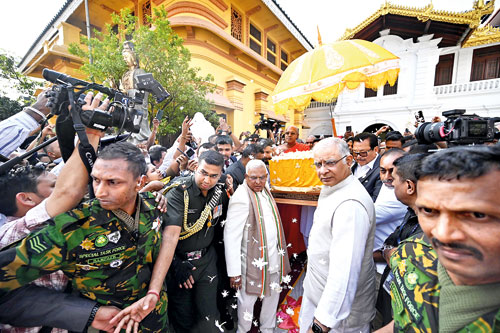
India’s High Commissioner Santosh Jha and visiting Indian dignitaries take part in the closing ceremony of the exposition of the Sacred Buddha relics brought from India
The latest engagement has been with Tilvin Silva, the JVP General Secretary, who many view as an important power behind the throne. His visit was part of the Indian Council for Cultural Relations’ (ICCR) Distinguished Visitors Programme from 5 to 12 February 2026. He was accompanied by NPP MPs Kitnan Selvaraj and Ilankumaran Karunanathan, JVP’s Central Committee Member Janaka Adhikari, JVP’s Media Unit Head Hemathilaka Gamage and the party’s International Relations Department member Kalpana Madhubhashini. During the visit, the delegation visited New Delhi, Ahmedabad and Thiruvananthapuram. It was Tilvin Silva’s first visit to India.
The visit kicked off in New Delhi with meetings with India’s External Affairs Minister Dr Jaishankar and Deputy National Security Advisor Pavan Kapoor. The delegation visited the Unique Digital Identity Authority of India, the National Disaster Management Authority, Gati Shakthi and the Indian Agricultural Research Institute. “The delegation also visited the Grand International Exposition of Sacred Piprahwa relics of Lord Buddha, reaffirming the centuries-old civilisational connection,” the Indian High Commission in Colombo said in a press release.
While Tilvin Silva was in India, the weeklong exposition of the Holy Devnimori Relics got underway at the Gangaramaaya Viharaya in Colombo. The Devnimori relics of Lord Buddha were in Sri Lanka from February 4 to February 11, significantly coinciding with Sri Lanka’s Independence celebrations. The exposition was announced by Prime Minister Narendra Modi during his state visit to Sri Lanka in April 2025 and marked the first public veneration of these relics outside of India. It drew over a million devotees and reinforced the religious and cultural ties between the two countries. It also sent a message to the government, showcasing the deep devotion of the majority towards their religion.
Herein lies the paradox in Indo-Lanka relations. There are the undeniably strong religious and cultural links, but anyone reading between the lines of the language of diplomacy, such as ‘capacity building’ and ‘constant engagement’, knows to view such niceties with a healthy dose of scepticism. They usually mean putting in place personnel and policies to further agendas and expand influence.
For the JVP, the growing engagement with India marks a break from its anti-Indian past. The ideological shift within the JVP began with the formation of the NPP in 2019 and has gained ground in the past few years. In the initial stages, in a bid to shed its anti-Indian image, the JVP leaders began to send friendly overtures to India, with more concerted efforts made after the ouster of President Gotabaya Rajapaksa in 2022, following which the JVP began to sense it had a real shot at taking power in the country. The icing on the cake, as far as JVP-India relations are concerned, is Tilvin Silva agreeing to visit India as its guest. Being in power means the JVP has had to close the door on its past anti-Indian sloganeering and welcome India with wide-open doors.
The government, though, is in the unenviable position of balancing the country’s interests along with India’s regional interests and the wider interests of China. It was India that stepped in as the first responder during the 2022 economic crisis, and more recently, after the devastation of Cyclone Ditwah, with Indian assistance providing the crucial lifeline for those impacted by the crises. Being in India’s orbit has its advantages as well as its disadvantages, and President Dissanayake and his government are no doubt aware of this.
Michael Corleone (played by Al Pacino) in the Hollywood film Godfather II delivered a line which is now almost legendary in which he says. “Keep your friends close, but your enemies closer.” Incidentally, one of President Anura Kumara Dissanayake’s favourite films happens to be ‘The Godfather’, as he disclosed in a televised interview prior to his election, and these words are wise words to go by in statecraft.
Buddhist clergy up in arms
Since President Dissanayake’s now infamous and ill-advised statement that Buddhist pilgrims bypassing the Sacred Sri Maha Bodhiya in Anuradhapura and heading north to observe sil are not doing so due to their devoutness but out of hatred, as well as remarks by some government ministers against the Buddhist clergy, there is growing disquiet among sections of the Maha Sanga that Buddhism and Buddhists in the country are under threat under this government.
Much of the tensions in the North and East have been caused by attempts to build Buddhist temples and place Buddha statues in these areas. It was one such incident which led to Venerable Balangoda Kassapa Thera and 10 other suspects being remanded in January in connection with the Trincomalee Buddha statue incident. They were granted bail this week after 29 days in custody by the Trincomalee High Court, but this incident has once again exposed the fragility of balancing inter-communal relations in these areas.
Ven. Kassapa Thera, a firebrand monk vocal on the rights of Buddhists to practise their belief in any part of the country, held a press conference after his release on bail to accuse the police of wrongdoing in the case involving him and of police brutality. “We know President Dissanayake has already signed several agreements with India to set up a Port City in Trincomalee. This is why they want us out of there. We will not allow this,” the Thera thundered at the press conference. His reference to the government as “anti-Sinhala-Buddhist treacherous” is similar to the words that several other members of the Buddhist clergy have begun to echo.
Ven. Dr Muruththettuwe Ananda Nayaka Thero, Chief Incumbent of the Abhayaramaya Temple and head of the Organisation for Protection of the Motherland, is among prominent monks who this week spoke out against the government. He said there is an attempt to undermine Buddhism, the country’s traditions and culture under this government, and there is the need for the Maha Sanga to unite against such attacks. A first step in this direction will be a gathering of the Buddhist clergy on February 20 at the All-Ceylon Buddhist Congress at Bauddhaloka Mawatha to discuss how to face the ‘ongoing attacks against the Buddhists in the country’. “We have invited the Most Venerable Maha Nayaka Theras, senior members of the Buddhist clergy, and others to join us on this day. We are not interested in toppling the government, but we want to safeguard the rights of the Buddhists,” he said at a press briefing this week.
Several other Buddhist organisations have also spoken out against what they claim is the demeaning of members of the Buddhist clergy by those in power and attempts to stifle the rights of Buddhists.
The government has been playing Dr Jekyll and Mr Hyde where the sentiments of the Buddhists are concerned since taking office. President Dissanayake initiated a Special Exposition of the Sacred Tooth Relic (Siri Dalada Vandanawa) on April 18 last year, but to add validation to his promises to end racism and extremism, the President’s words have, maybe inadvertently, sought to point the finger at the majority community as a whole for these twin evils, such as his comment that “the Buddhists are going with hatred” to the North for religious activities. There was thinking within the government that the exposition of the Devnimori relics brought from India would help with damage control caused by the President’s words. However, how much it will go toward appeasing some sections of the Buddhist clergy, apart from the populace, is to be seen.
SJB wades into nationalist cause
The signs of a revival in Sinhala Buddhist nationalist sentiments also came up for discussion when the Management Committee of the main opposition Samagi Jana Balawegaya (SJB) met on Friday. Many members who were present also wanted to know the progress of reunification talks between the SJB and the United National Party (UNP), which had been bogged down for months. SJB and Opposition Leader Sajith Premadasa personally took over the talks some months ago, but there has been no tangible progress since then, leading to frustration within party ranks. Sources within the SJB said that when members asked Mr Premadasa about the progress of the talks during Friday’s meeting, he remarked that he would “definitely get it done” but did not elaborate.
The members had also noted that a Sinhala Buddhist force was being revived in the country and that the party could not ignore it. They had questioned Mr Premadasa about how he intended to handle the matter and were again met with the assurance from their leader that he would look into it. At this point, one member had pointed out that the party was “exhausted” following two heavy election defeats and asked Mr Premadasa if the party still intends to go down the same path that resulted in those electoral losses. A majority of members had insisted that the party needed widespread changes. They emphasised that distributing goods, holding press conferences, going to protests and doing ‘media circuses’ will no longer work for the party and that it needs to adapt to a new mechanism.
A Colombo District non-Buddhist MP had claimed that he will “handle the Buddhist revival”, but some Buddhist MPs had shut him down, saying he should instead look after his own multi-religious constituency.
Court cases
While there was a high-profile conviction this week of those involved in the murder of former Polonnaruwa District Parliamentarian Amarakeerthi Athukorala and his security officer in 2022, with 12 individuals handed down the death sentences (read the story on page 10), former Secretary to the President Saman Ekanayake was further remanded until February 18 by the Colombo Fort Magistrate’s Court.
The case against Mr Ekanayake stems from a complaint filed against former President Ranil Wickremesinghe, alleging misappropriation of more than Rs. 16.2 million in public funds to allegedly finance a private visit whilst abroad to attend a convocation of his wife’s in the United Kingdom (UK) in 2023.
The police informed the court that in accordance with a court order dated January 28, 2026, steps were taken to contact the University of Wolverhampton in the UK to verify 1) if the invitation to the 1st suspect (Ranil Wickremesinghe) was official, 2) if the university has a state affiliation and 3) if the event held there was an official UK government matter.
The court was informed that the queries were sent via e-mail to the Executive Assistant to the Secretary of the University, Christine Fraser, and Chief Administrative Officer Louise Tonks. Additionally, the letter was sent to the Chancellor via AIR MAIL and another copy via EMS SPEED POST. No reply has been received yet; delivery reports and receipts were presented to the court.
Police also informed the court that on January 30, 2026, a further statement was recorded from Mr Ekanayake at the Colombo Remand Prison. In his statement, he mentioned that the former president had a transit in London while travelling from New York to Colombo; this was not a “trip”.
As Presidential Secretary, Mr Ekanayake further claimed he released funds to the Ministry of Foreign Affairs for transit expenses based on an estimate from the Sri Lanka High Commission in London.
At the time of providing funds, he only knew Mr Wickremesinghe was going to Wolverhampton but did not know what he would be doing there.
He claimed that based on his experience serving at the Sri Lankan High Commission in London, universities in the UK are “not for profit” and sustain themselves via internal income, rather than being “state-owned”. He first saw documents regarding this trip on September 7, 2023, when approving an estimate of £40,445 sent via e-mail on September 6, 2023. He was unaware of any documents marked “PRIVATE” regarding these transactions.
Matters regarding the President’s foreign trips were discussed between the then Chief of Staff Sagala Ratnayake, Ms Sandra Perera, and Ministry of Foreign Affairs officials.
The court was also informed that during the investigation, handwriting and signature samples were obtained from the suspect. These, along with documents recovered from the Presidential Secretariat, need to be compared. Therefore, it was requested that the court issue an order under Section 124 of the Code of Criminal Procedure Act No. 15 of 1979 to the Government Examiner of Questioned Documents to compare the provided samples and provide an analysis report.
Parliament set to abolish pensions of former MPs
Next Tuesday, Parliament is set to debate and pass the Parliamentary Pensions (Repeal) Bill, which seeks to abolish pensions given to MPs who have served five years in Parliament. Earlier, a three-judge bench of the Supreme Court, after conducting hearings into several fundamental rights petitions filed challenging the Bill, sent its determination to the Speaker, ruling that no provision of the Bill was inconsistent with the Constitution. Accordingly, the court ruled that it could be passed with a simple parliamentary majority. On Wednesday (11), the Bill was approved by Parliament’s Sectoral Oversight Committee on Governance, Justice and Civil Protection, chaired by NPP MP Najith Indika.
If the Bill is passed in Parliament in its current form, any MP who is entitled to receive a pension or is in receipt of a pension under the provisions preceding the date of commencement of the Act shall, on and after the date of commencement of this Act, cease to receive such pension.
Abolishing the pension offered to MPs after five years was a key campaign pledge made in the NPP’s manifesto – ‘A Thriving Nation, A Beautiful Life’. The move to abolish pensions given to former MPs follows the passage of another bill last year that stripped former presidents and their families of most of their special privileges. Back in September, the NPP government passed the Presidential Entitlements (Repeal) Act. That Act abolished any residence provided to, or monthly allowance paid to, a former president or the widow of a former president, monthly secretarial allowance, official transport and other such facilities, as well as the monthly pension paid to the widow of a former president. This was another key pledge made in the NPP manifesto.
According to the Association of Retired Parliamentarians, about 350 former MPs and over 150 widows of former MPs will lose their pensions if the bill is passed without amendments. They include a few MPs from the NPP’s main party, the JVP, as well.
Secretary of the Association of Retired Parliamentarians and former JVP MP Pemasiri Manage says that the Association has written an open letter to all party leaders and MPs in the current Parliament proposing two amendments to the bill that is set to be debated on Tuesday. One proposal is to introduce an amendment to ensure that it does not apply retrospectively, i.e., to past MPs.
The Association’s letter also notes that among those elected as MPs, a significant number were previously engaged in public service and were entitled to public sector pension rights. These members left public service to commit themselves to public service [as MPs]. Some among them had a service period of less than ten years and, consequently, are not entitled to any government pension based on that tenure. Another group received only a very low pension. They fulfilled their family needs through their parliamentary pension, notes the letter.
“Therefore, by abolishing the parliamentary pension, the lives of these families will be completely disrupted. Furthermore, most of the MPs who were in public service have now exceeded the age of 55 or 60. They are no longer in a position to seek other employment or engage in business activities,” the letter further points out.
Given this situation, the association has requested that the bill be amended before it is passed to ensure that the parliamentary pension for MPs who were engaged in public service is granted.
The NPP government, however, would see the passage of the bill as being yet another case of it fulfilling the aspirations of the people that voted to elect Anura Kumara Dissanayake president and give the NPP a sweeping two-thirds parliamentary majority. To borrow a phrase frequently used by the Trump White House, it will be yet another case of “Promises Made, Promises Kept.”
Opposition parties, while acknowledging that the bill is a key campaign pledge of the NPP that received approval of the public, are, however, warning that it will seriously limit the type of person who could become a people’s representative in the future.
“After stopping the pensions, only those who have money or are funded by political parties will be able to enter Parliament,” said Samagi Jana Balawegaya (SJB) General Secretary Ranjith Maddumabandara. He added that stripping pension rights given to former MPs means that those from poorer backgrounds will now be reluctant to enter parliamentary politics. Some MPs have found it hard to get by after leaving Parliament, Mr Maddumabandara said, adding that the SJB will use the debate on Tuesday to explain about difficulties former MPs will face when their pensions are abolished. The SJB also intends to elaborate on the shortcomings of the Bill and the harmful effects it will have on the parliamentary system, he said.
For its part, the government shows no sign it is willing to compromise on the bill. “The people voted for us to bring about a new political culture, and abolishing the pension given to MPs is part of that new political culture we pledged to introduce,” Public Security and Parliamentary Affairs Minister Ananda Wijepala says. He added that when one looks at the track record of former MPs, only a handful have been genuinely working for the people without stooping to robbing taxpayer funds and enriching themselves through illegal means.
“If there are former MPs who truly have difficulties in making ends meet without a pension, they can make an official request to us. We are prepared to consider the appeals on a case-by-case basis. However, we are not going to provide these benefits wholesale anymore to everyone,” Minister Wijepala emphasised.
He claimed there have been MPs who have asked for official residences while also having private residences in Colombo, while there are those who have taken their official vehicles home with them even after leaving Parliament. “There are also a large number of former MPs who are yet to hand over official firearms that had been issued to them. There have been many occasions where MPs have sold their vehicle permits and where they have abused their privileges to obtain liquor licences and licences to open filling stations. The abolishing of the pensions of former MPs is one step towards changing this rotten system.”
There are many schemes that the government has to assist those who are finding it hard to make ends meet, the minister went on. There is the ‘Aswesuma’ scheme for one. There are also scholarship schemes for children that can be applied for by children of former MPs. There are disability allowances and allowances for senior citizens, he pointed out. “We can consider individual requests by former MPs and direct them to the relevant benefit scheme.” The minister added that those who oppose the abolition of the former MPs’ pension can reintroduce it and ensure that it again applies to all former MPs if they come to power in the future.
President in Nuwara Eliya for ‘A Nation United’ anti-narcotics drive
President Anura Kumara Dissanayake was in Nuwara Eliya on Wednesday for the Central Province programme of his flagship “A Nation United” (Ratama Ekata) anti-narcotics campaign. Announcing the visit earlier this week, the President’s Media Unit (PMD) observed that “the illicit drug menace has been identified as a major social issue faced by the up-country community.”
Illegal narcotics have fuelled the emergence of armed criminal groups. Some of these groups then begin to enter politics, President Dissanayake said in his address during the programme. He noted that some local government chairpersons have been directly linked to criminal activity. There are also other groups that use illicit money obtained through drug trafficking to form political parties. “We have reached a dangerous point where political power risks becoming intertwined with drug-linked criminal networks. There are politicians who have provided protection and patronage to drug traffickers. If this is allowed to continue, before long, drug traffickers themselves will become politicians,” the President warned. He pointed out that several local government councillors have already been arrested over drug trafficking charges. “This situation cannot be allowed to grow any further,” he stressed. In other parts of his speech, the President also noted that many drug traffickers are currently based overseas, while some of them have already been arrested. He added that funds have been allocated in this year’s budget to establish rehabilitation centres across the country for those who have fallen prey to drugs.
Those who have followed the President’s speeches during the various events of the “A Nation United” programme would realise that they have heard many of these talking points before. The government’s official stance is that, nearly four months since its launch, the programme is bringing results. The Police Media Division sends out daily and weekly reports of drug seizures and arrests conducted as part of police operations launched in line with the anti-narcotics campaign. According to the latest report, over 522 kg of heroin, 1413 kg of methamphetamine (ice), 3024 kg of ganja and 182 kg of ‘kush’ have been among the various types of narcotics seized since the start of the campaign on October 30, 2025, to February 12, 2026. A total of 93,787 suspects had been arrested, with 116 among them being directed to the Illegal Assets Investigation Division, and detention orders were obtained against 1,883 others.
Meanwhile, shooting incidents—the vast majority of which are connected to ‘turf wars’ among various organised criminal groups linked to the narcotics trade—continue with alarming frequency. The most recent was Friday’s brazen daylight double murder of a lawyer and his wife outside a supermarket in Akuregoda, just a short distance from the heavily guarded Defence Headquarters Complex. CCTV footage shows the gunmen, who had been waiting in a car, blocking the path of the vehicle driven by the victims and opening fire even as vehicles carrying dozens of witnesses are passing by on the road in front of the supermarket. The gunmen remained at large yesterday.
The Bar Association of Sri Lanka (BASL) has condemned the shooting and is to hold an emergency general meeting of all members of the Association today to decide on their next course of action. This will be the first meeting of all the BASL’s membership in 14 years. The last time the BASL held such a meeting was during the impeachment of then Chief Justice Shirani Bandaranayake.
“To ensure that justice is delivered in the face of injustice, the supremacy of the rule of law must be upheld. This is extremely important in our journey towards rebuilding the country. Therefore, we are committed to strengthening the rule of law,” President Dissanayake said during his address in Nuwara Eliya. Friday’s brutal killings show that he and his government still have a long way to go towards achieving this goal.

ஒத்தவை:
சென்ற வாரம் இலங்கை-சண்டே ரைம்ஸ்