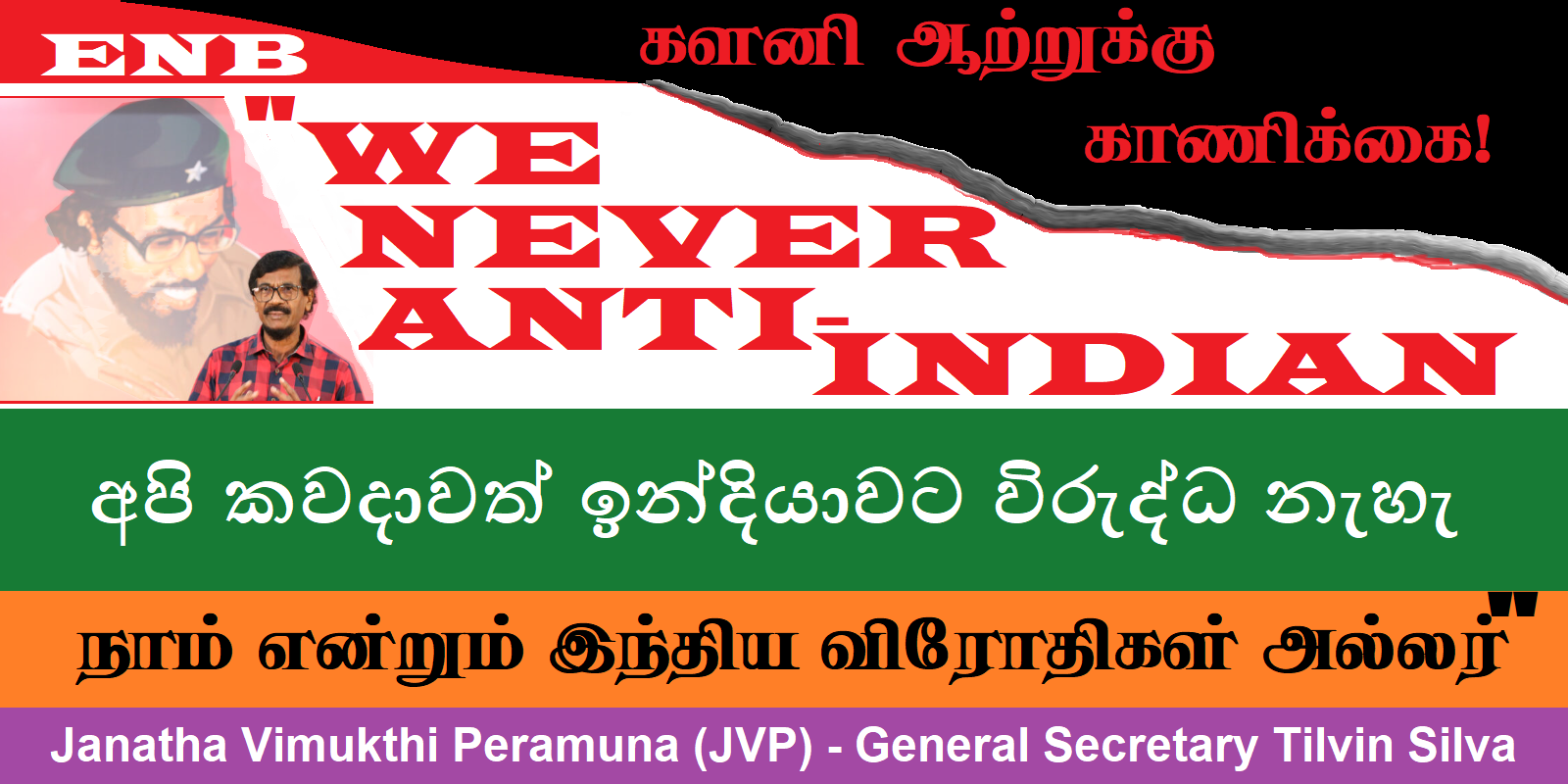
हम कभी भी भारतीय विरोधी नहीं हैं
We were never anti-India, only opposed the then Indian Govt,
says Tilvin
By our Political Desk Sunday Times LK 22-02-2026
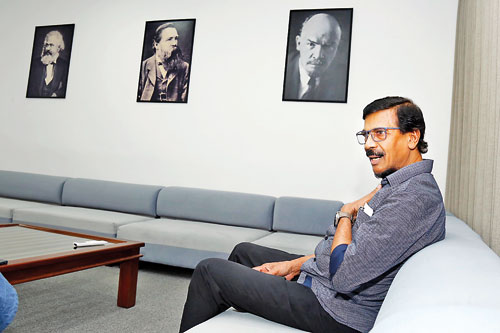
Janatha Vimukthi Peramuna (JVP) General Secretary Tilvin Silva (Pix by Indika Handuwala), who recently concluded his first visit to India, tells the Sunday Times that his party was never ‘anti-Indian’ and that it only opposed actions of the then Indian government, which forced upon the country an Indo-Sri Lanka Accord. The JVP, meanwhile, has “moved on”, having learnt from past lessons, he says. India has also changed, he adds. We believe prime minister Modi is a genuine friend.
Following are excerpts of the interview:
Q:Why did you decide to go to India?
A: I didn’t decide to go. I received an invitation through the Indian High Commissions to participate in the Indian Council for Cultural Relations (ICCR)’s Distinguished Visitors Programme (DVP). It was my first visit to India.
Q: Did they make the programme, or did you select places to visit?
A: They made the programme but asked if I had any preferences. I said I wanted to go to Kerala, as I felt it’s a lot like Sri Lanka.
Q:You visited the Amul Cooperative. Did your visit bring about any change to the NPP’s government decision to terminate the agreement signed by the previous government with Amul to run MILCO and NLDB?
A: The tour was organised to showcase India’s development, especially in the use of technology in many fields. Amul was one such place where technology has been utilised for the benefit of dairy farmers, leading to a significant improvement in their standard of living. We have been upfront with the Indian government that the dairy sector in Sri Lanka will remain under government control, but we are open to getting assistance to develop the sector, particularly the introduction of new technology to the sector.
Q:It is widely said that after being anti-Indian, your party has done an about-turn and chosen to be very close with India?
A: We were never against India. What we acted against was the Indian government of the time under Rajiv Gandhi and the J.R. Jayewardene government in Sri Lanka and the political policies they followed. Hence, we opposed both the governments of Rajiv Gandhi and J. R. Jayewardene. It happened in light of the Indo-Lanka Accord, which we say even today is something that shouldn’t have happened. That’s a history from 38 years ago, and now the world has changed. India has changed, and we have changed also. We don’t have to make the past an obstacle to future relations. If we go by this argument, then we can’t have interactions with Britain either. They colonised us; they put down the 1815 rebellion, etc., but we have moved on. History is history, and we have all learnt from it. We have to work to suit the present times. It’s wrong to live in the past.
Q:Your party’s anti-Indian stance led to mayhem, particularly in the 1988-90 period, when many thousands of lives could have been saved and the destruction of public property averted?
A: That destruction could have been averted by J. R. Jayewardene. If he had not signed the Accord without even informing his Cabinet and by keeping the public in the dark, the situation would not have arisen. Mr Gamani Jayasuriya, his cabinet minister, resigned in protest. People protested against it (the Accord) peacefully, but it was J. R. Jayewardene’s government that turned it into a violent campaign by unleashing violence on the protestors and shooting dead more than 100 persons.
Q:Do you and the party have any regrets about the manner in which your party responded to the government actions?
A: Even Isaac Newton has said that ‘for every action there is an equal and opposite reaction.’ We have not acted. We have only reacted. If our party had not been proscribed in 1983 under the false charge that we were involved in the riots, our party would not have had to go underground and engage in politics. If the proscription was not in place, we would have openly engaged in politics. We would have protested in the open like we have done in recent years, but we were denied that right. They are the ones who have to show remorse for what happened, not us. If they don’t show any remorse, why should we? We believe what happened should not have happened, but it has happened. We have said this many times: the responsibility for what happened lies with the government of the time, not us. JR’s government did not spare any of its opponents. We reacted the only way we could. If some things that should not have happened did take place, then we regret that. But no one in the United National Party (UNP) has said so far that they regret what happened at the time.
Q:Was the JVP in any way a party (part*) to what happened in 1983? The anti-Tamil pogrom?
A: If we were involved in any way, there should have been at least one court case against us. It’s clear that it was the UNP that created the riots and used it to ban the JVP along with the Communist Party of Sri Lanka and the Nava Sama Samaja Party (NSSP).
Q: How is the JVP balancing Indo-China ties?
A: Our foreign policy is clear. We don’t deceive or lie to any country and are straightforward in our dealings. India is our neighbour, and we have close ties, and in the same way, China is our friend. Pakistan and Bangladesh are also our friends. The recent success in holdling the Pakistan-India cricket match in Colombo through the good office of President (Anura Kumara Dissanayake) shows that our foreign policy is successful and we will not betray one country to the other. This is the best foreign policy suited to the current era.
Q:Have there been hurdles in balancing India and China ties?
A: There have been no hurdles because we consider both countries friends, and both have helped us at a time of need. I have visited both China and India, and there are things we can learn from both countries.
Q:JVP founder Rohana Wijeweera looked at India with suspicion and took an anti-India stance. Have you abandoned his policies?
A: India and Sri Lanka are tied to each other like an umbilical cord. Our culture and religion are all connected. Buddhism came from India. India is our only immediate neighbour. Problems have arisen when there were Indian governments that had adopted policies that were harmful to our country. We have never been against India – that is, the country and its people – but we have been against the policies of some Indian governments.
Q:Is the JVP-NPP well aligned with the policies of Indian Prime Minister Narendra Modi?
A: I think all governments after Rajiv Gandhi did not adopt a policy of coercion towards Sri Lanka. We can safeguard our sovereignty and work with the Modi government in a friendly manner. We feel that the Modi government is a genuine friend to us.
Q:Don’t you feel that there is still suspicion among the public here about India’s geopolitical agenda over Sri Lanka?
A: The suspicions were created by the actions of some Indian governments. That suspicion will go away also with the actions of the Indian government. I feel with the policies of the current Indian government toward Sri Lanka, the suspicions are receding. There are some who try to create a bogeyman of India. They are the same people who are also willing to kneel down in front of India if they are asked to. The reason we felt anger toward India in the past was because Sri Lanka’s rulers at the time also gave in to pressure from India. They did not have the fortitude to stand up to those pressures. If a government can be firm about its stance, then it can overcome undue influence from any quarter.
Q: Is there no pressure from India now?
A: No, there is no such pressure on us. When we talk to them, we are clear about our policies. Take the agreement that (former president) Ranil Wickremesinghe’s government signed with the Amul Cooperative. We told them (the Indian side) that this sector is an asset to us, and we will not barter it away and will only accept assistance to develop it, and they accepted our position. We respect India, and they respect us. When I met (Indian External Affairs Minister) S. Jaishankar, he was clear that India is a loyal friend to Sri Lanka.
Q:Were you expecting relations with India to proceed this smoothly, as you claim, before you came into power?
A: We were always sure of our foreign policy. It was those in the opposition who thought our policies would fail. But we were always sure because even before we took office, we had developed relations with India and also China.
Q:Didn’t you come under pressure from India on settling the ethnic issue, implementing the 13th Amendment, etc.?
A: No discussions were held with me on political issues such as these.
Q:There were several MOUs signed between Sri Lanka and India, but these haven’t been made public. What’s so secretive about these?
A: No secret agreements have been signed, and all the frameworks of the agreements have been tabled in parliament. If there were any secret agreements, they would have become public by now. We came to build this country, and we will not take any decisions that would be harmful to the country. We will not betray the country, but we will get whatever assistance we can from any country willing to help us.
Q:Was there any Indian displeasure with Minister Bimal Rathnayake in his Ports and Aviation portfolio which led to his removal from these positions?
A: Comrade Bimal had the Transport and Highways ministries in addition to Ports and Civil Aviation. Meanwhile, Comrade Karu (Minister Anura Karunatillake) had the Urban Development portfolio. After a year in office, we understood that the ministries of Transport, Highways and Urban Development would work better together, and the best person for the heavy work involved was Bimal. This is why the changes were made. I can assure you that we work according to what is right, not external influences.
Q:What is the transformation taking place in the JVP’s political and economic philosophy?
A: Our objectives haven’t changed. We wish to create a just society. It should be a society that is economically and socially just, where there is national unity and democracy. That was our aim then, and it continues to be our aim now. In terms of our economic philosophy, we believe there should be economic democracy. The meaning of economic democracy is that it gives the right to anyone to participate in the country’s economy. This includes both the public and private sectors, including those who are at the microeconomic level. We are also of the view that the benefits of such an economy should be distributed among our society in a fair manner. We are working towards that goal. Of course, it will take some time for this to be achieved.
Q:Has the JVP shifted from a communist to a neoliberal mindset?
A: We do not subscribe to a neoliberal mindset. Those who try to put such labels onto us cannot even explain what communism or neoliberalism means. Labels such as ‘liberal’, ‘neoliberal’, ‘social democrat’, ‘democrat’ or ‘communist’ are not important to us. What we have is a goal, which is to economically develop the country and ensure that the fruits of that development reach the people in a fair manner. This will enable us to minimise the economic disparities among the populace and help people to live happy lives. That is our goal, and if someone wants to pin a label onto us based on that, they are welcome to do so.
Q:The JVP has been accused of undermining the role of the armed forces going to the extent of refusing to refer to them as ’war heroes’?
A: We don’t live in the past. We learn from the past, but we don’t live in the past. These are problems for those who live in the past. We don’t think much of such terminologies; we work for the welfare of all the people in the country. Some refer to them as soldiers, some as war heroes. There is no organised campaign to use certain terminology.
Q:What is your party’s stance on Buddhism being the state religion, and are there any moves to change that?
A: Have we said this anywhere? Those who say this are trying to create a bogeyman like they did before the election by portraying us as being anti-Buddhist. But the opposite is true. We arranged a special exposition of the Sacred Tooth Relic. We have given state patronage to Buddhism, and recently, for the first time, the sacred Devnimori Relics of Lord Buddha were sent from India for exposition here. The President regularly visits the Dalada Maligawa and pays his respects to the Maha Nayaka Theras. Those who say we are against Buddhism are the ones who were the cat’s-paw of the Rajapaksas and, having lost their powers, are now spreading such stories. Those saying such things are doing more harm to Buddhism than good. I come from a Buddhist family. I went to Daham Pasala. From Grade Six to Grade Ten, I studied at a Pirivena. For my Advanced Level examination, I took four subjects, including Buddhist Culture. We live by the teachings of the Buddha.
Q:Are NPP MPs prevented from speaking to media without permission from the JVP headquarters at Pelawatte? Some MPs have said so privately?
A: It is not true that they cannot speak to the media without asking the party. There are times some of our MPs who go for televised debates are asked questions which they may be unprepared for. If they are unaware of the fact, for example, of what we discussed on our Indian tour, then they have to ask us before going for the discussion. Other than that, there is no other hurdle for them to speak to the media without prior permission from the party. There are times that ministers are not reachable, as they are busy with their work. There are times that even we can’t reach them for party matters.
Q:After a year in office, do you feel you are on the right path?
A: We are working according to our manifesto and the pledges made to the people during the election. I won’t say there are no obstacles. There are some natural obstacles, such as the recent cyclone, while there are obstacles due to the old habits of some, but we believe that we are on track to achieve a great deal of what we set out to do: give a better life for our people and make the country a place where everyone can be proud of it. Even now, if you look at our achievements without malice, we have already placed our country in a position we can be proud of. We have won over the international community and are not subservient to anyone. The economy is doing better, and our anti-corruption programme is yielding positive results.
Q:What about the JVP pledge to introduce a new constitution and abolish the executive presidency?
A: We have already begun the process to introduce a new constitution. We believe a new constitution should not be framed by the government alone, but it should be a collective effort involving the people. various organisations, etc. It will take some time.
Q:The common perception is that you, as General Secretary of the JVP, are the real power behind the throne?
A: Earlier, the governments were run by one individual. When one became the executive president, he/she acted alone, and others became yes men and followed the leader. We are different. We formed the National People’s Power (NPP), of which the JVP is a part. If we are taking any new decisions, we consult as the NPP and implement these changes. In addition to that, the Cabinet also takes its own decisions. When we take policy decisions, we are mindful of the fact that the NPP is the party that was elected and take collective decisions. One person doesn’t take all decisions and then seek to implement them. Actually, we don’t like the word ‘power’. We all have a responsibility, and we work to fulfil it. There is no invisible force pulling the strings from behind, as some perceive. We follow the Licchavi principles of unity and adherence. We gather frequently and discuss issues together and make decisions as and when the need arises.

ஒத்தவை:
சென்ற வாரம் இலங்கை-சண்டே ரைம்ஸ்