Sri Lanka braces for more hot weather as experts warn of El Niño risk
By Jayani Madawla Sunday Times LK Pic: SL Map ENB

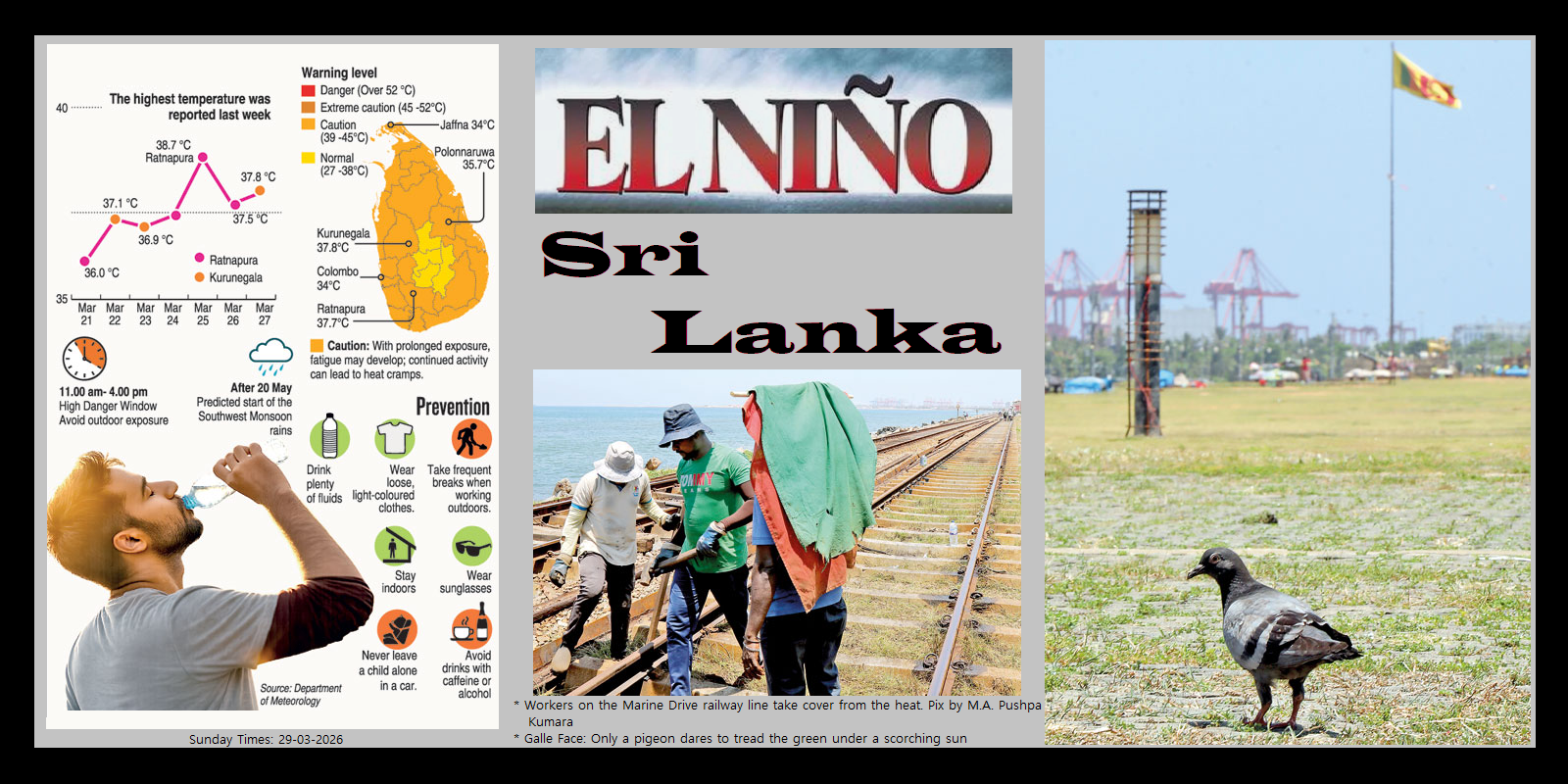
The prevailing heatwave that Sri Lanka is experiencing is expected to continue through mid-May according to the Department of Meteorology. Experts warn that the situation could be further complicated by a possible onset of both El Niño and a positive Indian Ocean Dipole (IOD) after June.
According to the the department’s Additional Director General, Ajith Wijemanne May is expected to bring typical maximum temperatures exceeding 35°C across most of the country. However, with rainfall predicted to be below average, there is an increased need to highlight and prepare for the ongoing heatwave’s impact.
He noted April remains the warmest month of the year. With the sun positioned directly over the country the combination of high humidity and less cloud cover has led to “caution level” temperatures across most provinces
Explaining further he said typically around April and May, the sun is positioned directly over Sri Lanka, maximising the amount of solar radiation that reaches the surface and leading to peak temperatures. He said particularly the first inter-monsoon is characterised by low wind speeds and reduced cloud cover allowing heat build up, contributing to warmer atmospheric conditions.
Speaking further Mr.Wijemanne said there is a 50% probability of El Niño conditions developing after June, which typically results in below average rainfall.
The situation may see some letup only after the inter monsoon period between May 20 and 25.
With the prevailing temperature recording 35°C or above, health experts are warning of a rise in heat-related illnesses such as mental disorientation, difficulty in focusing during work hours and interrupted sleep.
Health Secretary Dr. Anil Jasinghe warned of the impact of the hot weather on public health.
Outlining dangers of dehydration, heat exhaustion and heat strokes the public is strongly advised to limit outdoor activities, particularly between 10 a.m. and 3 p.m., when solar radiation is at its peak
In situations where such hours cannot be avoided for outdoor work the public is advised to wear light-coloured clothing and wear a hat. People are strongly advised to be well hydrated.
According to the advisory issued by the Natural Hazards Early Warning Centre, the temperature felt by the human body is expected to reach “caution level” in the Western, Sabaragamuwa, Southern, Eastern, North-Western, Northern, and North-Central provinces and the Monaragala District.
The National Water Commission has meanwhile advised consumers to use water sparingly and productively, warning that if the current dry weather persists, water distribution may have to be limited.
National Water Supply and Drainage Board Chairman Chandana Bandara said that water consumption had increased significantly due to the prevailing dry weather. “At Ambatale we can produce only 560,000 cubic meters a day, while Labugama has a limit of 150,000 cubic metres. We do not have the capacity to produce more than that. We are producing and distributing water to our maximum capacity. We are requesting the public to consume water very sparingly. If the prevailing weather conditions get worse the water supply may have to be restricted,” he said.
The upcoming festive season appears also to be impacted by the prevailing heat with shopping areas such as Pettah and Maharagama seeing less crowds.
Outdoor restaurants are also drawing less people during the daytime.
Meanwhile according to herpetologist Dulan Vidanapathirana, cold-blooded species like snakes are impacted by dry weather and high temperatures. In addition fewer acceptable habitats are available to them due to the hot weather.

ஒத்தவை:

சென்ற வாரம் இலங்கை-சண்டே ரைம்ஸ்